


Programming note: Slight change of editorial plans this week. My wife hasn’t given birth to our baby yet, so I had some spare time and wrote this more timely article that responds to recent news/discourse and bumped the existing Deep Dive I had teased and scheduled on partisan loyalty to next week. I’m going to keep doing this until I can’t work anymore, that way my stockpile of posts doesn’t grow stale, but I’m expecting to be out of commission any day now. I currently have about 10 weeks of articles and three podcast deep dives ready to deploy over the next 6 weeks. Thanks for your patience as I figure out how to take paternity leave with nearly 70,000 readers who get this analysis!
The political blogger Matthew Yglesias had a piece out yesterday morning arguing that Texas state Rep. and Democratic candidate for U.S. Senate James Talarico needs to “moderate” his image/brand/positions/etc to defeat Texas Attorney General Ken Paxton in the race, which he says Talarico has a moral obligation to win. Here is the money graf, which commits the Strategist’s Fallacy in prescribing a solution but is otherwise directionally right on the problem: Texas is a red state, so Talarico will have to win independents and some Republicans to carry its U.S. Senate seat.
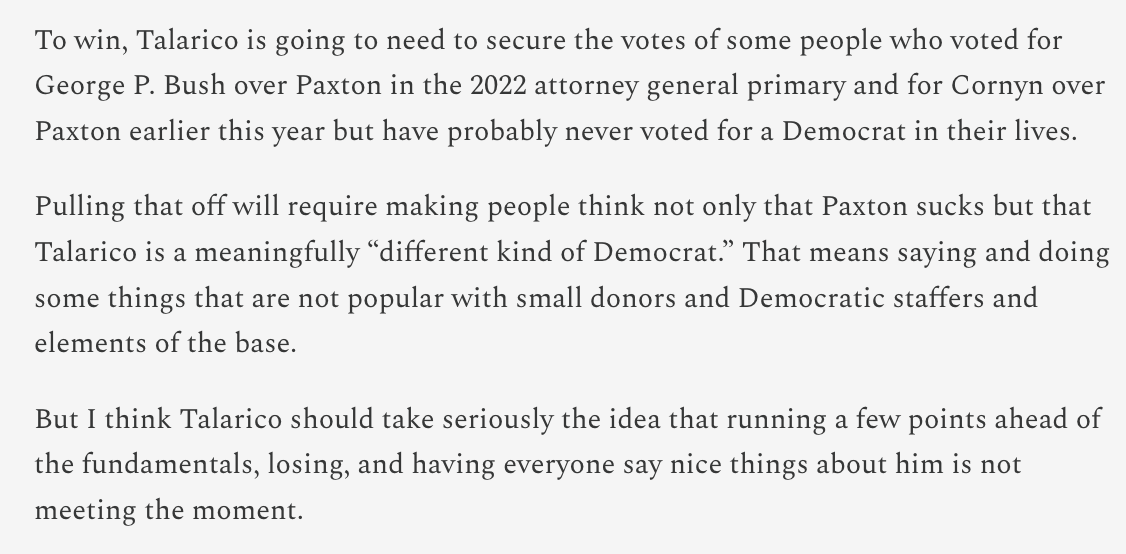
The article caused a small dust-up on X, with Greg Sargent of The New Republic pointing to his reporting that the Talarico campaign is running on what I generally call “anti-system” politics rather than just relying on one-dimensional moderation to win converts — the smarter play, in my opinion, given the data. I’m not interested in relitigating my ongoing fight with Matt to clarify what “moderate” means and bring some actual data and political science to bear on the conversation, and instead want to focus on the question in the title of this post.
See, underpinning a lot of the Discourse about Talarico’s chances is the claim that Democrats have to win “a lot” of Trump voters to take Texas. Given how red the state is at a presidential level, it’s tempting to conclude that a Democratic candidate can’t win in a state like Texas without appealing to a good chunk of Republicans too. The natural inference is that “good chunk” means 10% to 15% of them — but is that right?
This strikes me like a fitting empirical question for publication that’s all about covering politics with data, not punditry and conventional wisdom. And thanks to a lot of the other data I have crunched here at Strength In Numbers — from Census data to precinct-level election returns to voter-file matched polling data — I have all the tools to actually answer it. So come with me as I actually run the numbers on this very important question: How many Trump voters does James Talarico actually need to win in order to win the Texas U.S. Senate race?
This article is free to read, but it was not free to write. Subscribers to Strength In Numbers get exclusive data-driven analysis of politics and elections, access to premium polling data, and support independent, interactive data journalism. Consider joining as a paying member today:
If a paid subscription is not in the cards for you, the best thing you can do is share this article with a friend. Word of mouth is the #1 way new people learn about this publication! Thank you.
The partisan baseline in Texas is actually around R+5
To answer the big question today, we first need to figure out three small sets of numbers:
