

The simple statistical error Republican Supreme Court justices used to gut the VRA
The Court says vote dilution can be proven only after "controlling" racial polarization for partisan polarization. This is a nonsensical and impossible test

Strength In Numbers is a reader-funded newsletter on politics, polling and elections from a data-driven and pro-democracy perspective. Paid subscribers get my premium Tuesday Deep Dive, early access to our monthly Strength In Numbers/Verasight polls, and make it possible for me to do this work as my full-time job. Sign up for just $10/month or $90/year (a 25% discount!).
The six Republican-appointed justices on the United States Supreme Court have found a magical solution to political polarization. All you have to do is take a partisan election result and subtract out the effects of party loyalty on the result.
That, more or less, is what the Court wrote when it invalidated the Voting Rights Act last week. In Louisiana v. Callais, decided 6-3 on April 29, 2026, the conservative majority told voting-rights plaintiffs they must now “control for party affiliation” before their evidence of racial bloc voting will count under Section 2.
That sounds like a neutral statistical fix, but in reality, it’s a bad control — an error called “conditioning on a mediator variable“ that would get your paper sent back to you with lots of red ink in statistics 101. The problem is that in modern America, party isn’t a variable that operates independently of race. Rather, political party is largely downstream of one’s race. If you subtract the effects of political party from the analysis of polarization, you are subtracting away the very evidence of polarization you are trying to study!
This is important (not just a piece for nerds) because Republican legislatures are already moving ahead with new partisan and racial gerrymanders based on SCOTUS’s new theory. Tennessee passed a 9-0 GOP map this week that splits Memphis’s majority-Black and solidly Democratic 9th District into three majority-white, Republican-leaning seats. Mississippi’s governor has called a special session for May 20. Louisiana is losing at least one of its majority-Black districts. And Alabama, Georgia, and South Carolina could be next. (On this week’s podcast, David and I recap these new gerrymandering efforts that are unfolding with unprecedented haste.)
This week’s Chart of the Week is: a simple table (and one causal diagram) that shows how the Court’s new test makes racial polarization vanish on paper, while it is very much still alive in real life.
What the Court decided in Callais
To win a Section 2 vote-dilution case involving single-member districts, minority-group plaintiffs have traditionally had to clear three “preconditions” set by the Court in Thornburg v. Gingles. First, they must show that the minority community is large and compact enough to form a majority in a reasonably configured district. Second, they must show that minority voters are politically cohesive. Third, they must show that the white majority votes as a bloc often enough to defeat the minority group’s preferred candidates. Only then does the court move to the broader “totality of circumstances” inquiry.
Callais rewrites that framework in two places. On the second and third preconditions, Justice Alito says plaintiffs “must control for party affiliation” when proving minority political cohesion and white bloc voting. Failure to do so, the majority says, risks confusing partisan effects for racial ones.
Second, the Court makes it harder for plaintiffs to clear the first precondition — the illustrative-map hurdle. Plaintiffs do not merely have to show that an additional majority-minority district can be drawn in a reasonably configured way. Their proposed map must also satisfy the state’s “legitimate districting objectives,” including the state’s “specified political goals.” If the state’s goals include a target partisan distribution, a specific margin of victory for incumbents, or another constitutionally permissible goal, plaintiffs’ maps must achieve those goals “just as well.”
In other words, where the state asserts partisan advantage as one of its objectives, plaintiffs may now have to produce their own map that preserves the same partisan advantage as the map they are challenging. A state can defend a racially dilutive map as a partisan map, then require plaintiffs to draw an alternative that leaves the partisan outcome intact. As Adam Serwer wrote in The Atlantic last week, Alito and his allies have now given politicians permission to discriminate against voters, as long as they say it’s for partisan purposes. (What other major purpose would there be?)
In Callais, the Supreme Court concluded Louisiana’s second majority-Black district could not survive that test. The plaintiffs that brought the lawsuit over the state’s original racial gerrymander failed at every stage: their illustrative maps did not meet Louisiana’s nonracial goals, including political goals; their bloc-voting evidence did not control for partisan preference; and their totality-of-circumstances evidence did not show an objective likelihood of intentional discrimination.
Samuel Alito should take a stats class
In her dissent, Justice Kagan points out the nonsensical nature of this “updated” VRA. If minority citizens vote mainly for one party and majority citizens mainly for another, she writes, then under the majority’s rule “none of that difference can count” in determining whether minority voters were diluted. Plaintiffs must remove from the equation the very thing they are trying to prove: “polarized voting preferences.”
The majority’s logic assumes that race and party are two separate things that happen to be correlated — and that party can therefore be treated as a confounder. In statistics, a confounder is an outside variable that creates a relationship between two other variables. If party were truly a confounder, then controlling for it might help isolate the independent effect of race on voting behavior.
But that is not the causal story here. One’s political party is not some outside variable exerting pressure on voting in isolation of race. In modern American politics, it is often a mediator — one of the mechanisms through which race is politically consequential. Race helps shape party identification, and then party identification helps shape vote choice. So when the Court tells plaintiffs to “control for party,” it is not asking them to remove statistical noise. Instead, it is asking them to remove one of the main pathways by which racial polarization operates and is able to be measured.
That is the big error at the heart of Callais. The Court treats party as though it explains racial polarization away, when in fact party today is largely how racial polarization shows up in elections — which are, y’know, contests between parties.
This is such a basic error that the natural assumption is that the justices are engaging in bad-faith reasoning wilfully. Party identification is not merely a preference that sits next to race in a regression. And we know that party ID is largely downstream (though in some weird cases, upstream) of voters’ racial identities.
If race shapes party, and party shapes vote, then “controlling for party” is really just “ignoring the effects of race as moderated through party identity.”
The diagram below shows party as a mediating variable for vote — a variable that sits on the causal path between A and C, where A causes B and B causes C. You can see with this graph that “controlling” for political party doesn’t “isolate” the effect of race, it deletes it:
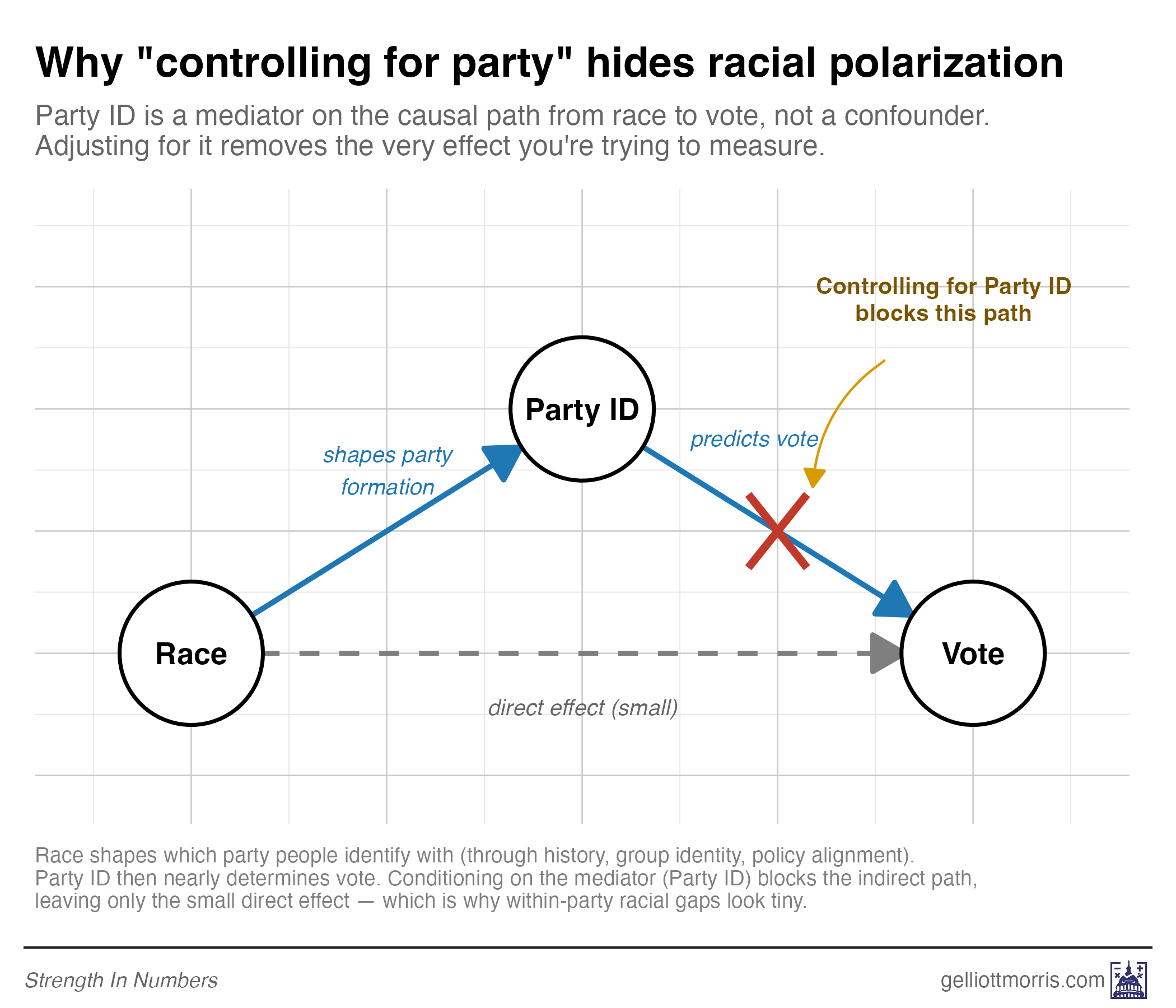
Read the diagram from left to right. In English, this chart shows that race shapes which party people identify with. Party ID then shapes their vote choice. There’s also a small direct effect of race on vote, but it’s swamped by the path that runs through party.
When the Court tells plaintiffs to “control for party affiliation,” it’s telling them to block that big middle arrow. What’s left is the small, not-party-related, direct effect of race on voting.
Strength In Numbers is made possible by paying subscribers. Become a member today.
