


Strength In Numbers is a reader-supported newsletter on polling, elections, and democracy. These Tuesday Deep Dives are for paying members. If you want more data-driven independent political journalism, join the community as a paying subscriber for $10/month or $90/year.
One programming/framing note: The numbers in this piece are depressing, and frankly, they’re likely to keep getting worse before they get better. I understand that this can be demoralizing to people, but there’s no way around the data here; putting this down on paper is the only way to be specific about what’s happening, which is required for identifying a fix for the underlying problem. So stick with me.
In 1976, the U.S. House of Representatives had 101 “structurally competitive” congressional districts. By “structurally competitive,” I mean seats that either party had a reasonable chance of winning in an electoral cycle that was perfectly tied nationally — those seats where the Democratic Party’s vote margin was within 5 points of the vote margin for the Demoratic nominee for president in the most recent election.
Last November, in contrast, the number of competitive seats was just 42. Under the new partisan gerrymanders that Republicans and Democrats (but mostly Republicans) have passed for the 2026 midterms, the number falls to a new all-time-low of 33.
That’s right: Just 33 out of 435 — less than 8% — of districts were decided by less than 5 points, in terms of partisan lean, last year.
Put another way, sixty-seven percent of the country’s structurally competitive House seats have disappeared in the last fifty years.
This first chart shows the long slide toward “safe-seat democracy.” Competitive seats were common through the 1970s, 1980s, and early 1990s. They started to vanish after the 1992 election, with another sharp decline after Barack Obama’s election in 2008 and the increasing relationship between white racial identity and voting Republican across the U.S.
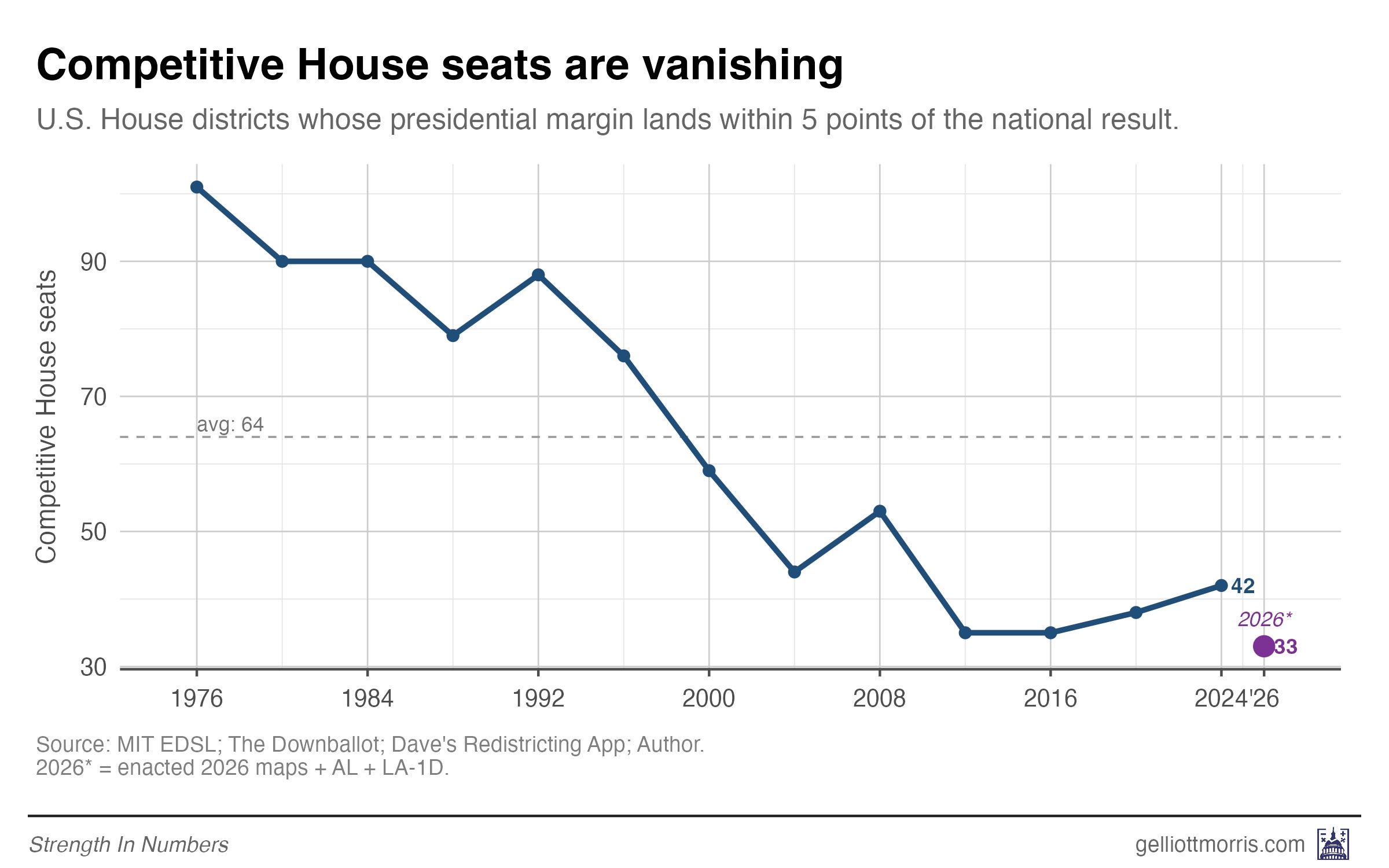
The new maps — the enacted mid-decade redraws in California, Florida, Missouri, North Carolina, Ohio, Tennessee, Texas, and Utah, plus the likely Callais-driven changes in Alabama and Louisiana — would cut the count from 42 to 33 if we hold the 2024 presidential terrain constant. Because presidential partisanship was not as intense before the 1970s, when data for this series ends, it is reasonable to assert that the House is the lest competitive it has ever been in the history of the United States.
And Republicans aren’t finished. More on that below.
The unfortunate reality of American democracy today is that legislators are less responsive to the concerns of regular citizens than they perhaps have ever been.
