


The Democratic Party has a brand problem. I mean this in two ways. First, it is unpopular: Roughly 55% of Americans say they have an unfavorable view of the party, according to the average of polls at FiftyPlusOne.news. Only about 40% view it favorably.
However the Republicans are also unpopular, with an equally bad net favorability of -15 — and Democrats currently lead in polls of U.S. House races by about 6 percentage pointson average. So this toxic national brand is not preventing it from winning national races — at least not when the president of the opposing party is himself polling closer to -20/-25.
What’s more concerning is the Democrats’ position in the states. The second problem with the party’s brand is that it is essentially the same in Brooklyn as in Omaha — LA as in Laredo. An unpopular national brand means an unpopular brand in both swing states and those that lean Republican — and elect the majority of members of the U.S. Senate. Due to key losses for incumbents the party now needs to win the national popular vote by about 6 points to win the median Senate seat. And since only a third of the Senate is up each cycle, they need to do that three cycles in a row.
The trend here is disastrous for the party’s chances of controlling the Senate:
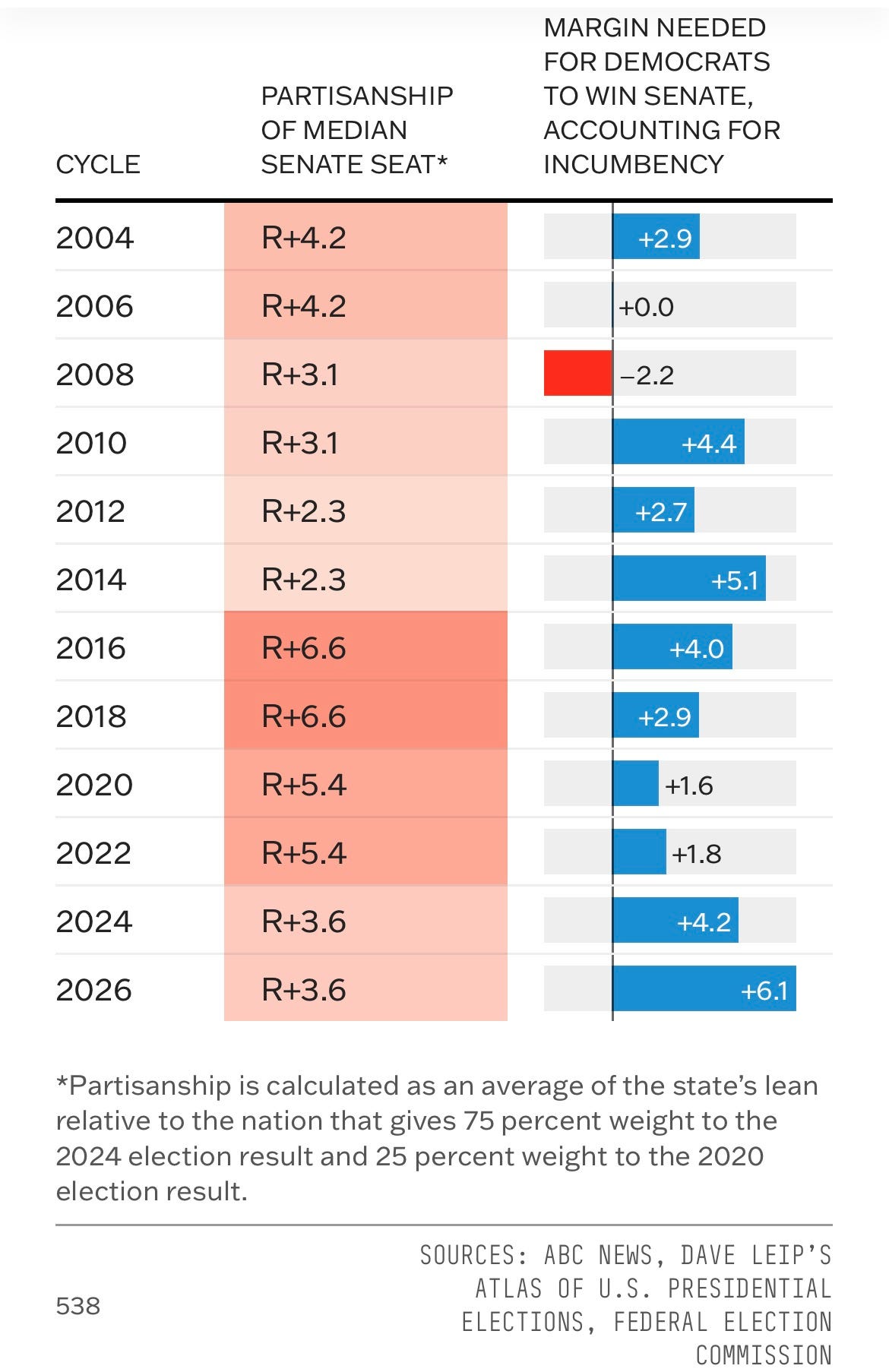
While the Democrats’ weak hand in the Senate is not all due to its national brand, the fear is that in a close race — say, 51-49 in the topping-point — a toxic reputation could cost the party power. And at the presidential level, the 2024 election was only decided by a point and a half. Would Kamala Harris have fared better with a popular party brand behind her? It seems likely she would have.
So what is the party doing about this?
For the better part of the last decade, and especially since Trump’s re-election in ‘24, Democrats have been arguing about where the party should stand ideologically. A very vocal, well-funded, powerful bloc of PACs and media elites wants it to “moderate” its issue positions and move to the middle. Others want it to turn left. That’s probably not the solution in, say, Missoula, but another potent sentiment in 2026 is the desire for lawmakers ro “fight harder” against Donald Trump and the cost of living, and that can read as ideological. An anti-Trump affordability agenda sells.
But what if this is the wrong way to think about voters entirely? What if the endless ideology talk is, as I’ve argued before, mostly noise? Instead of asserting with scant evidence that triangulating the perfect mix of issue positions will be the single fix to all the party’s problems, this post uses hard data and statistical analysis to arrive at an answer. When we actually do the work of testing how voters react to various candidates with different profiles, what do the numbers say about the path forward for Democratic candidates?
In our June Strength In Numbers/Verasight poll, we gave every respondent a description of one of four hypothetical U.S. House races and tested them against the same generic Republican. On the Democratic side, voters saw either a generic, party-line candidate with unnamed positions, a candidate with a popular policy platform, a candidate with a record of independence from party leaders to deliver for constituents, or one with deep ties to a local community.
In this week’s Deep Dive, I dig into the results. For those Democrats who want to separate their image from the national party’s toxic brand, what is the best, empirically grounded strategy?
The rest of this Deep Dive is for paying subscribers. That includes the results of the experiment, a description of the statistical model I built to test effects, and what this all means for how Democrats should run in 2026 and 2028. This is original polling and analysis you won’t find anywhere else, and your support is what makes it possible for me to publish.
