


Americans have never liked their political parties less. Pew found in May that 26% of adults now hold an unfavorable view of both parties, the highest share in more than three decades of asking the question and more than four times the comparable percentage in 1994. The averages at FiftyPlusOne.news show both parties sitting around 15 points underwater on favorability, and neither has been above water in years.
Over the last few election cycles, analysts have become obsessed with how these “double haters” vote. In 2016 and 2024, Donald Trump won voters who had unfavorable opinions of both him and his opponent by double digits, according to exit polls. He also won them in 2020, but the group was a much smaller slice of the electorate then.
How are the double haters feeling about 2026?
In our June Strength In Numbers/Verasight poll, we asked 2,000 Americans to rate both parties on a 0-to-100 “feeling thermometer” scale (where 0 represents “cold” and 100 “warm” toward a figure/party), and about one in five registered voters put both parties below 50. This is the group we’ll call the “double haters” for the midterms, though note it’s slightly different from the 2016/2020/2024 definitions that compare favorability of presidential candidates, not parties. (We can still use our 2026 polling data to establish a benchmark for 2024 — more on that below the fold.)
Our poll shows double haters favor Democrats for 2026 by 26 points, 55% to 29%, while everyone else splits about evenly: Democrats lead by 2 among voters who like at least one party. If you do the math on the generic ballot, currently around D+7 in our poll, this means that double haters are responsible for about 80% of the party’s national margin (26 * 0.21 = 5.46 / 7 = 78%).
And if we compare how the double haters feel now to their 2024 vote and partisan identity, the real story of 2026 starts to emerge. The Democratic advantage for the midterms is not built on voters who like the Democratic Party, but on those who call themselves independents and can’t stand either major party. Let’s run the numbers.
Strength In Numbers is independent and reader-funded. Paying subscribers get premium posts like this Deep Dive article, can access our community Discord server, and support the data collection and analysis work that powers articles like these. If you want political analysis that’s honest and data-driven, not beholden to publishers’ ideological agendas or donations from corporate PACs, upgrade to a paid subscription.
Independents and non-voters powering Democrats’ double haters lead
When we asked the double haters how they voted for president in 2024, they split slightly in favor of the Democrats. According to our poll, 40% of the group (of 357 adults) said they voted for Kamala Harris, 29% for Trump, 15% for “someone else,” and 16% said they didn’t vote at all. (That 15% third-party share is roughly four times everyone else’s rate of about 4%, likely reflecting the hostility the group feels toward party nominees.)
And if you look at their party identity, double haters are not an overwhelmingly partisan bunch, either: just 19% call themselves Democrats and 18% Republicans, while 64% say they are “independent” or “none.”
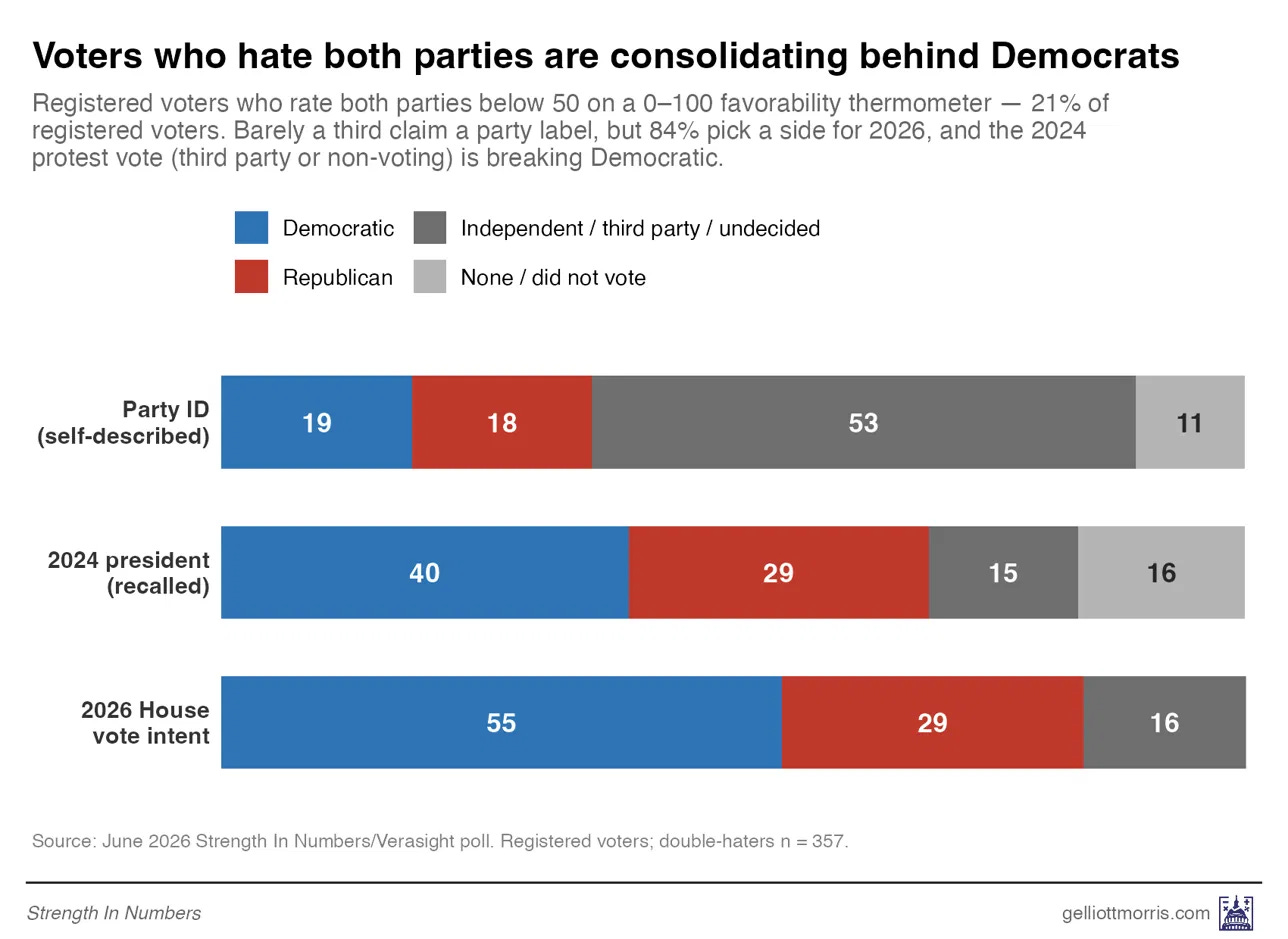
So the fact that 55% of double haters now say they’ll vote for Democrats is a big deal. This means many are changing sides.
Most double haters who say they voted for Trump in 2024 are still voting Republican (71%), but about one out of every eight has flipped to voting Democratic for the midterms. That compares to a loyalty rate of 90% among Democratic double haters (and just 4% say they’ll vote Republican).
The more important groups, however, are the “other” voters and non-voters. Just under a third of double haters — 31% — were what I will call “unaligned” in 2024, meaning they voted third party or stayed home. Today that pool is breaking for Democrats 51% to 23%. Democrats are doing well in part because they have rallied their base, in part because Trump voters are tuning out, and in part because those voters who sat out in 2024 are swinging hard to the left. That’s a meaningfully different claim than “swing voters are swinging left.”
Before moving on, I also want to note that this finding holds when I tighten the definition of “double hater.” If instead of counting everyone who rates both parties below 50/100 in the group I count only those at 40/100 or lower, the Democratic lead grows to 28 points. At 30/100, the party’s lead grows to +32.
The more voters hate both parties, in other words, the harder they currently break for Democrats.
Meet the haters
It may also help you to understand more about who these double haters are. Lucky for you, we have lots of polling data on them and can break down their demographics in several ways.
