


Last week, after Abdul El-Sayed won an upset victory against U.S. House Rep. Haley Stevens for the Democratic nomination for Senator from Michigan, I wrote about how people are largely missing the real story in the Democratic Party today. The strongest predictor of individual perception of politicians, including El-Sayed and Zohran Mamdani, is not whether someone identifies as a progressive or a moderate, but whether they think the American system needs to be torn down and rebuilt.
These are the so-called “anti-system” voters I have written about before. The general gist is that there’s a group of voters out there who have very weak ideological attachments but very strong anti-system orientation. Donald Trump used this group to win the presidential elections of 2016 and 2024.
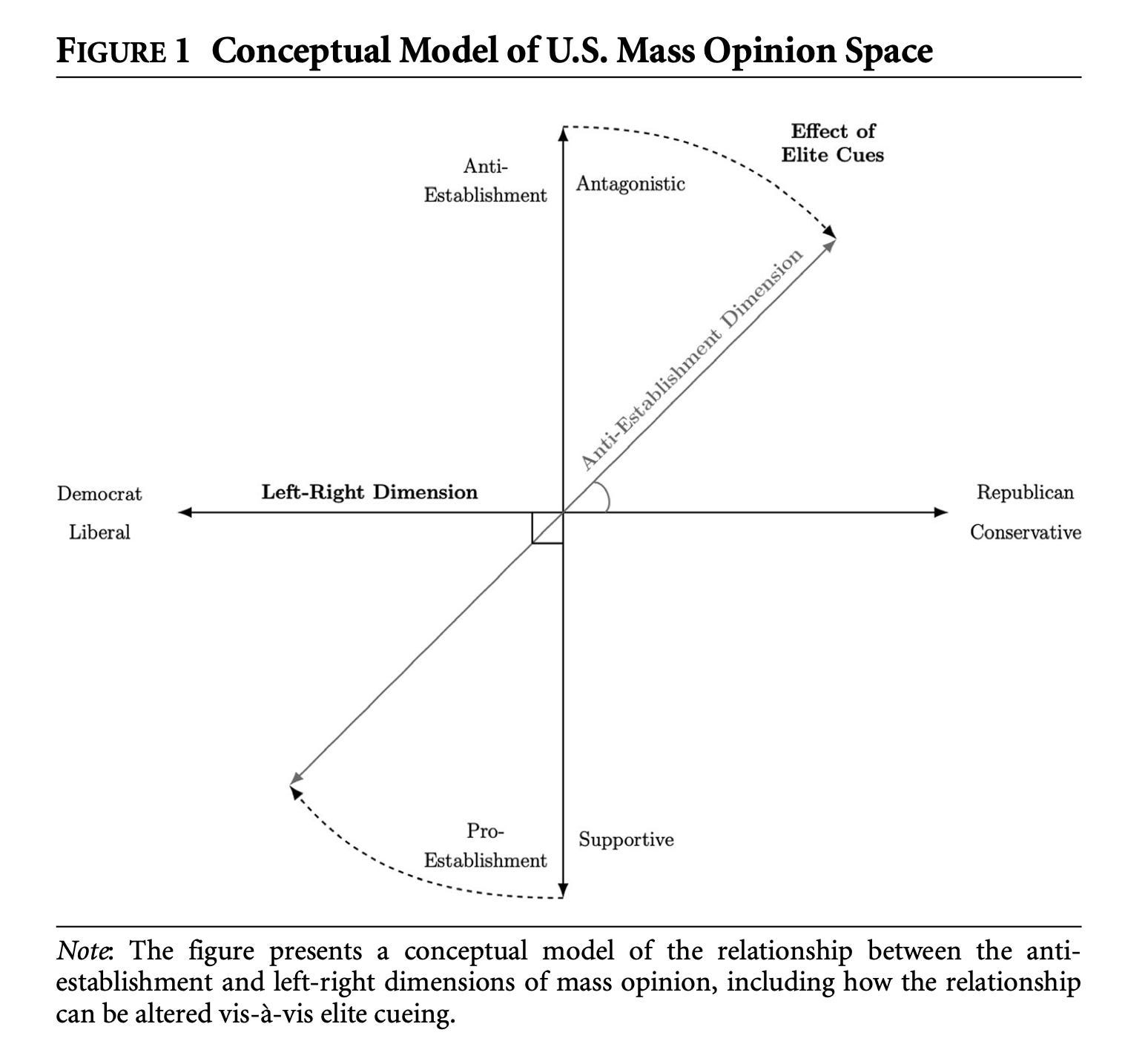
After my column last Friday, my friend Alexander, a political science PhD, texted me to say he thinks this anti-system thing “could be big and a distinct overlooked factor.” But he wondered how much of it could have just been fervent opposition to the Trump administration and to current Republican policies. That wouldn’t be a standing disposition about how American democracy works (or doesn’t) for a person, so much as their reaction to the particular person in office today.
Alexander asked me to produce two extra figures on this. First, he wanted me to look at how anti-system attitudes today predicted attitudes toward Republican politicians and political figures — do they predict support for, or opposition to, Trump? And second, to figure out if anti-system Democrats are gravitating toward lefty Democrats just because they dislike Trump — or if, as the broader theory suggests, anti-system voters are drawn to anti-system candidates regardless of their ideology or orientation to Trump.
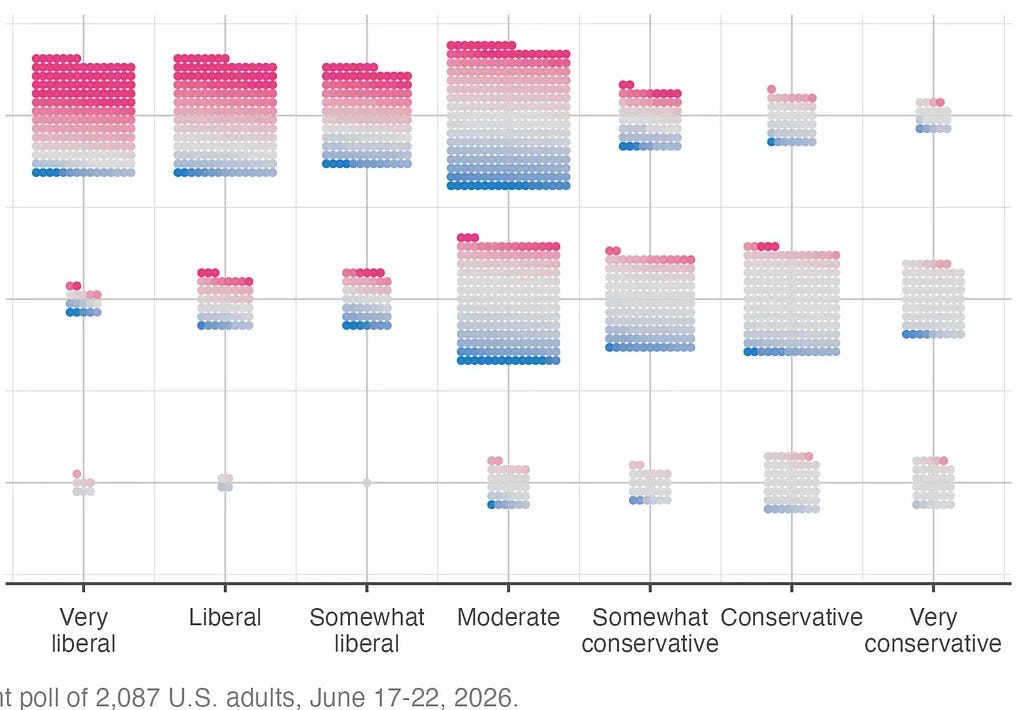
In this week’s Deep Dive, I answer both of these questions. Then, below the paywall, I introduce a new way of looking at the electorate that combines both ideology and anti-system orientation, using the following grid chart. (The chart axis and title are intentionally clipped to keep you guessing!)
But let’s take it one question at a time. Is anti-system sentiment, in fact, distinct from anti-Trump sentiment? Let’s dive in.
Strength In Numbers is a reader-funded small business supported by paying members. Subscribers get perks including premium articles like this Deep Dive, can access our private community Discord server, and support the data collection and analysis work that powers my independent, data-driven journalism.
If you want political analysis that’s honest and data-driven, not beholden to publishers’ ideological agendas or donations from corporate Super PACs, upgrade to a paid subscription.
“Anti-system” does not just mean “anti-Trump”
First, I will acknowledge that anti-system sentiment is strongly correlated with a person’s feeling toward Donald Trump (in this case, a feeling-thermometer rating from 0 to 100). Among all adults, the correlation between the 3-way “direction of country” question and Trump’s feeling thermometer is −0.68, and it holds at −0.45 among Democrats and leaners, −0.48 among Republicans and −0.52 among pure independents.
The more anti-Trump someone is, the more anti-system they tend to be — and vice versa. That holds for Democrats and Republicans.
But note, a correlation of -0.48 and -0.68 is really not that strong. There are a lot of people out there who are both anti-system and pro-Trump, or anti-Trump and pro-system (a much smaller group, to be sure). This presents an opportunity for persuasion for anti-system candidates.
Another hint that the anti-system variable is picking up a real concept, not just anti-Trump sentiment, is that anti-system voters tend to view Trump and other “in-system” figures such as JD Vance and Elon Musk much more negatively than anti-system Republicans, like Tucker Carlson.
Among Republicans and Republican-leaning independents, the ones who say the country needs “major, disruptive changes” rate Trump 37 points colder than other Republicans do, Vance 34 colder and Musk 29 colder:
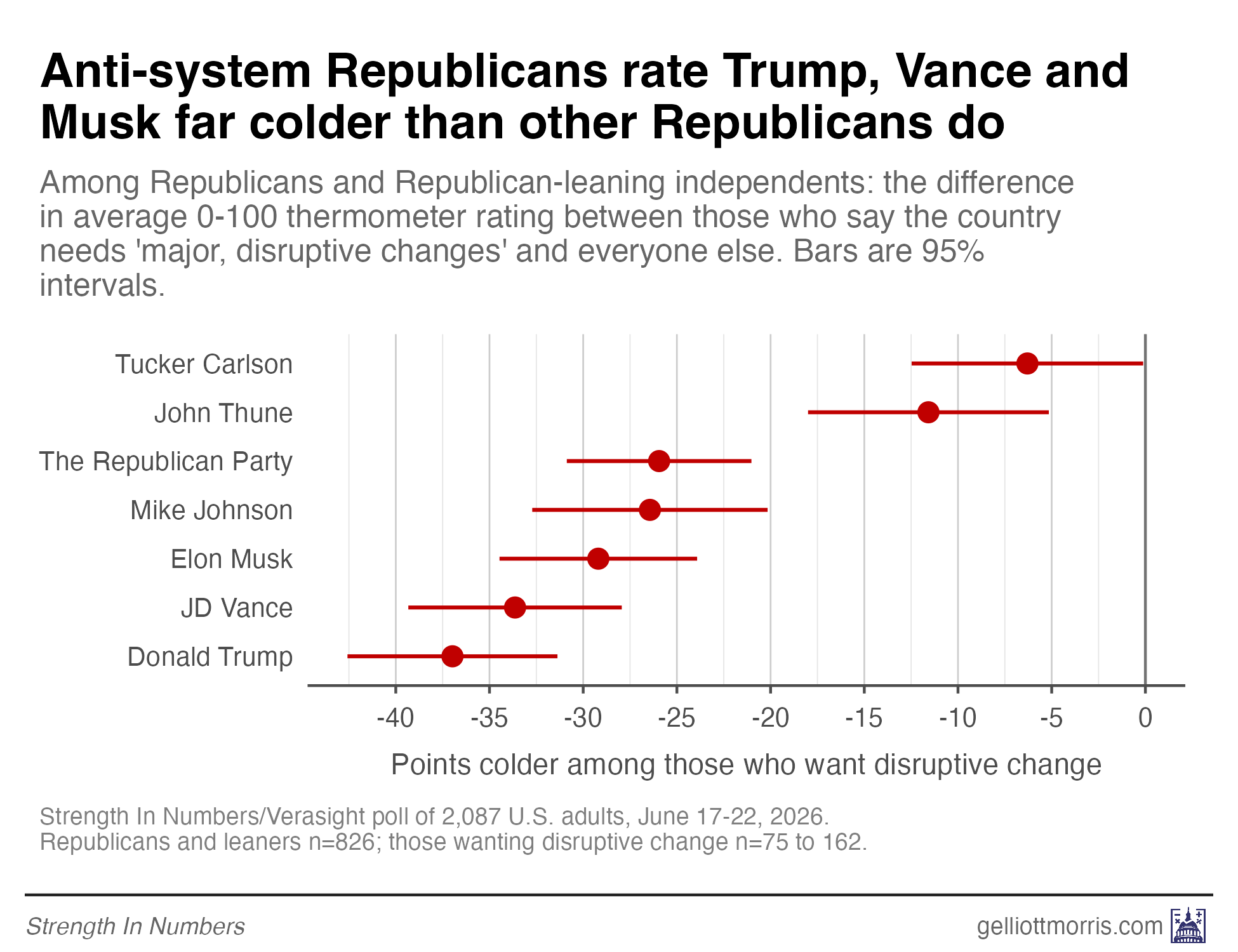
In contrast, Tucker Carlson comes in at a 6.3-point gap between pro-system and anti-system Republicans. The former Fox News host has spent the better half of 2026 criticizing the president for his war against Iran, and has distanced himself from much of the MAGA movement.
Of course, this does not give us 100% statistical confidence about which way the causal arrow between anti-Trump and anti-system is pointing, but we can at least be reasonably confident in the separateness of the anti-system axis. This is consistent with the academic literature on the subject.
“Anti-system” does not just mean “progressive”
We can tease the two constructs here — anti-Trump and anti-system — apart a bit more using a regression analysis. For each Democratic political figure in the original survey, I modeled a respondent’s 0–100 “feeling thermometer” rating as a function of their age, educational attainment, race/ethnicity, income, sex, ideology, anti-system sentiment, and Trump approval. Crucially, the last three variables are entered into the same regression, so that we can distinguish the effects of being anti-system relative to a person’s evaluation of Trump.
This graph shows the results. Points to the left indicate the variable (if blue, anti-system — red, Trump approval) is predictive of viewing the given figure/party more favorably. So, for example, controlling for all key demographic and political factors, anti-system Democrats view Zohran Mamdani about 15 points more favorably than those who say the current system is doing well or merely poor (but not bad enough to need “major, disruptive changes.”)
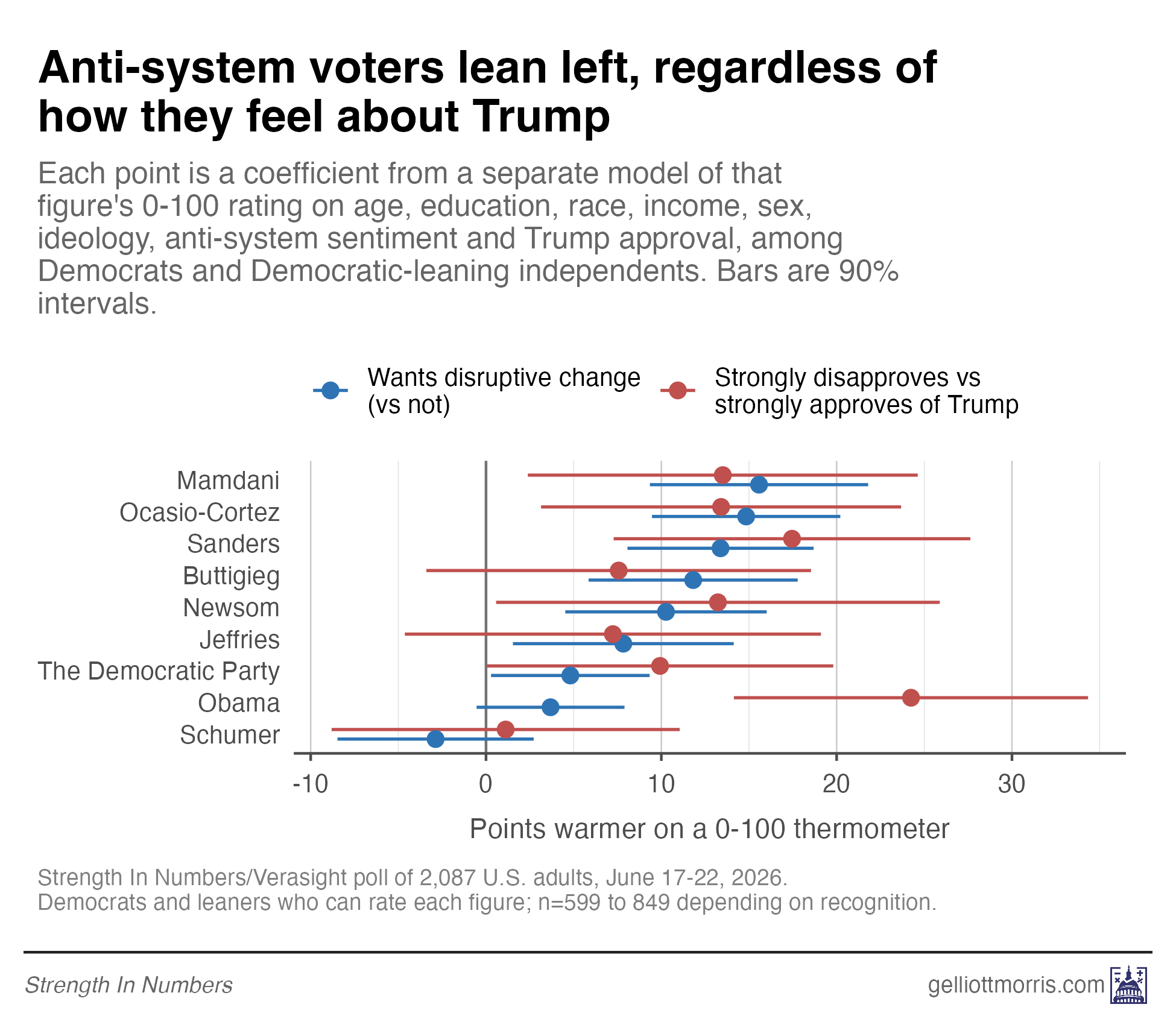
There are things worth pointing out here. First, both anti-system sentiment and anti-Trump sentiment are independently predictive of viewing lefty Democrats favorably — and, of viewing them more favorably than centrist/party figures. Senate Minority Leader Chuck Schumer is, as ever, viewed particularly negatively among Democrats, and particularly negatively by anti-system Democrats.
Second, look at Obama’s two points. Wanting the system torn up moves his rating up by just 3.7 points, which the model cannot distinguish from zero — but disapproving of Trump moves it up by 24.2 points. Obama’s is the largest Trump coefficient of anyone in the chart. This is because both pro-system and anti-system Democrats love Obama.
Compare Obama’s dots to Mamdani’s, where anti-system sentiment moves the rating 15.6 points with Trump approval and ideology both held fixed; or to Alexandria Ocasio-Cortez’s, at 14.8, or Bernie Sanders’ +13.4
Per this data, being anti-system appears to be a distinct psychological construct from ideology or partisan loyalty. And it is predictive of certain downstream traits — like voting for Democratic Socialist candidates — that are being hotly debated today.
Of course, we can’t know for now whether being anti-system would still predict voting for Zohran Mamdani in a year with a Democratic president. If you asked this during a Democratic presidency, would the same pattern appear, or is this anti-system picking up something additionally related to views about the current party in charge? What if it’s just measuring intensity of opposition to Trump, for example?
We can’t know until Democrats control the presidency again. But if the item only tracked opposition to people in charge today, it should predict support for any anti-Trump Democrat — Barack Obama very much included. But it doesn’t. It also shouldn’t separate the lefty “insurgent” Democrats from more “establishment” Democrats, since both of them oppose Trump — and yet it separates them by better than eighteen points, after controlling for potential confounders.
To understand this even more, I devote the remaining half of this post to dividing the electorate by (1) anti-system sentiment and (2) ideological self-identification.
Left-wing Democrats are winning over moderates and conservatives who oppose the system
Back in 2017, the political scientist Lee Drutman made the following graph of U.S. voters using survey data from the Voter Study Group. This chart places every person that surveyed onto a 2-dimensional grid based on the x-axis, their “economic” ideology, and, on the y-axis, their “social” ideology. Then, each person is given a color depending on how they voted:
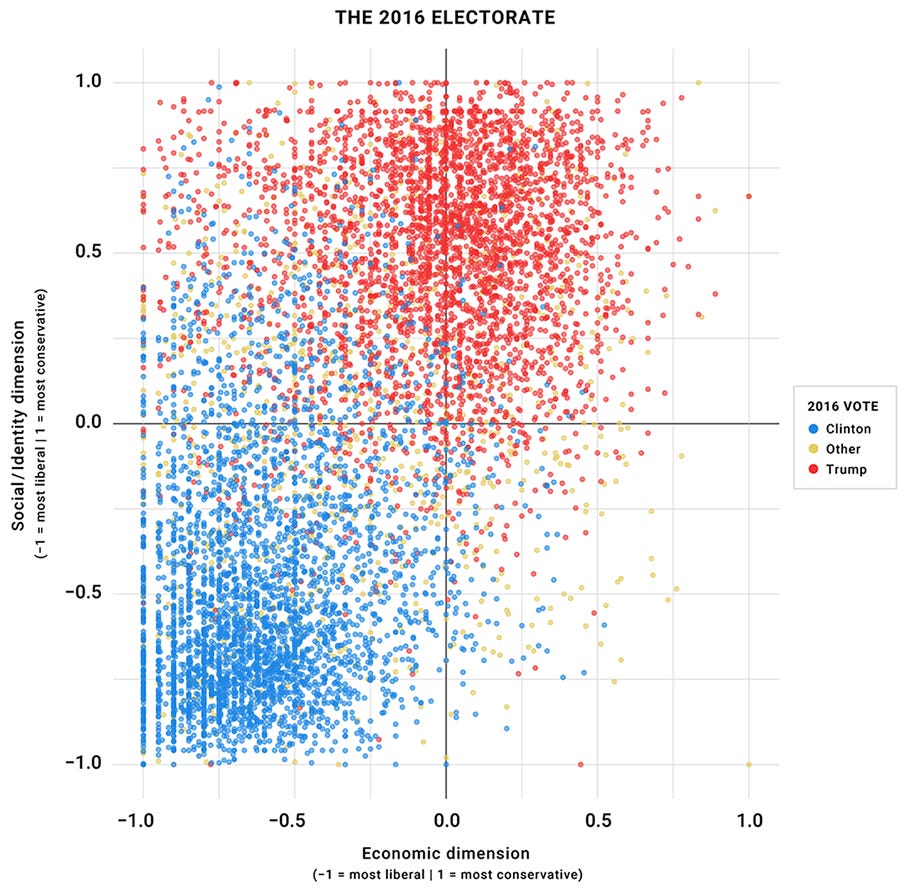
This is one of those charts you see everywhere now. In many ways, it made the idea of “multi-dimensional” political ideology go mainstream.
I wanted a similar chart, but one that sorted Americans not into Trump vs Clinton voters, but based on whether a person feels more favorably toward lefty candidates or the Democratic Party — and one where the vertical axis isn’t “social ideology,” but anti-system orientation. With such a chart, we would be able to distinguish whether/how much the appeal of figures such as Mamdani and Ocasio-Cortez is ideological vs rooted in anti-system orientation.
The chart below puts every adult on a 2-D grid with self-reported ideology across the bottom, and the anti-system “direction of country” question up the left side. Each person then gets a color from pink to blue representing how warmly they feel toward Mamdani, Ocasio-Cortez and Sanders vs Chuck Schumer, Hakeem Jeffries and the Democratic Party itself — the party’s congressional leadership and its own brand.
Here’s that chart:
The rest of this Deep Dive is for paying subscribers. I write at least one post a week reserved for the members of this community who keep Strength In Numbers running. Upgrade to continue reading and support the time and data collection it takes to do analyses like this one.
