


This article reports new results from the September 2026 Strength In Numbers/Verasight poll, fielded Sept. 16–21 among 1,528 U.S. adults (margin of error ±2.6 points). You can find the poll topline and methodology document at gelliottmorris.com/poll.
Every month, Strength In Numbers lets subscribers to this newsletter suggest questions for us to run in our recurring poll with Verasight. This month, several readers suggested we poll about the popularity of the federal government sending agents of Immigration and Customs Enforcement and other agencies to local polling places this November under the guise of “election security.”
News reports indicate that recently uncommon levels of federal “oversight” could take multiple forms. The Justice Department said in August that it is sending a record 1,000 federal monitors to polling places this November, up from 714 in 2024 and 289 in 2022. Homeland Security Secretary Markwayne Mullin has said federal agents would show up “if there’s a threat to a polling place or to serve a warrant.” This is a retreat from earlier claims by the president that ICE could “surround the polls.”
More extreme actions are possible. A draft executive order reported in February would let Trump declare a national emergency and assert federal control over voting machines nationwide. Back in February, Trump said in an interview with the New York Times that he should have ordered the National Guard to take possession of voting machines in 2020 in order to find evidence of fraud.
Among people I know in Washington, DC, and local election officials, there is a lot of anxiety about the potential outcomes above. So I decided to include this subscriber’s question in this month’s poll.
Before we get to the results, here’s a very short pitch to you to support Strength In Numbers.
Original polling like this is funded entirely by readers, who are devoted, as I am, to the causes of democracy and to using polling data to give a voice to the people in Washington. If you believe in our mission/mantra- that there is strength in numbers - become a paid subscriber to support the site.
In keeping with the usual Deep Dive rules, I have paywalled this piece about halfway down, but left the topline findings in front of the paywall because of their significance to the public.
We asked Americans whether they would support or oppose five things the federal government could do around this November’s elections — each carrying very different stakes.
Sending federal Justice Department monitors to polling places. This is already happening. It used to be a routine, bipartisan practice — but it carries more risk under a DOJ whose civil rights division has lost most of its career staff and strictly follows the orders of the president.
Having federal officials take custody of voting machines or ballots after Election Day. This isn’t legal. States control the chain of custody for ballots, not Washington. This is a democracy-ending scenario.
Sending National Guard troops to polling places to monitor the election. Historically rarer than DOJ monitors, and it carries real tail risk given how freely Trump has deployed the Guard domestically this term.
Having the military take custody of voting machines or ballots after Election Day. Another outcome that isn’t merely “bad” but a legitimate constitutional crisis.
Sending immigration enforcement (ICE) agents to polling places. Homeland Security keeps hedging its “no plans” promise, but this one could easily happen.
Here is net support overall and by political party for each of these potential actions:
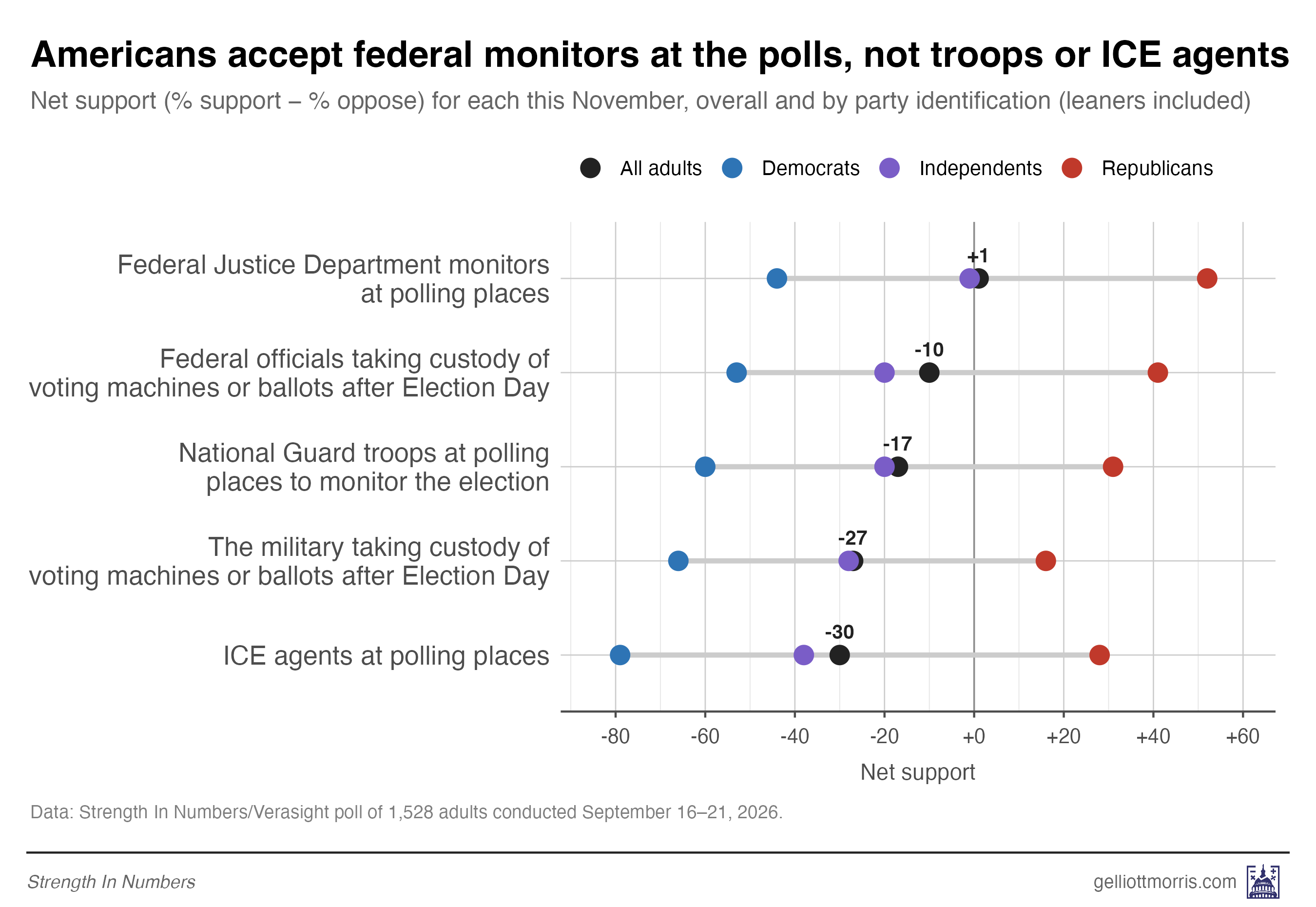
In our poll, the DOJ monitors basically split even at net +1, then things fall apart. Federal agents taking custody of voting machines is underwater by −10, National Guard troops at −17, military custody at −27, and ICE agents going to the polls at −30. Additionally, as we see with Trump’s approval rating overall, 49% strongly oppose ICE agents at polling places* and 44% strongly oppose the military taking custody of ballots.
Political independents align closely with the average American. While Republicans support most of the above measures, they are comparatively cold on the idea of the military seizing ballots.
An ICE chilling effect on turnout
We also asked respondents to tell us whether, if ICE agents were present at your polling place, that would make them more or less likely to vote.
Those results are presented in the chart below: