


Through Sunday, Oct. 18, after just four days of in-person early voting, North Carolinians had cast about 526,000 early in-person and mail ballots, according to the NC State Board of Elections. That is 37% more than at this point in 2022, with 16 days to go.
As of Monday, registered Democrats account for 45.7% of those 526,000 ballots, unaffiliated voters 34.6% and Republicans just 19.6%. Among ballots cast by members of the two major parties (ignoring non-partisan registrants), 70% of these ballots came from Democrats, who make up only 48.9% of the active Democrats and Republicans on the rolls, a 21-point gap.
North Carolina’s early vote returns show Democrats are fired up for the midterms — a pattern we have been seeing in other states, too.
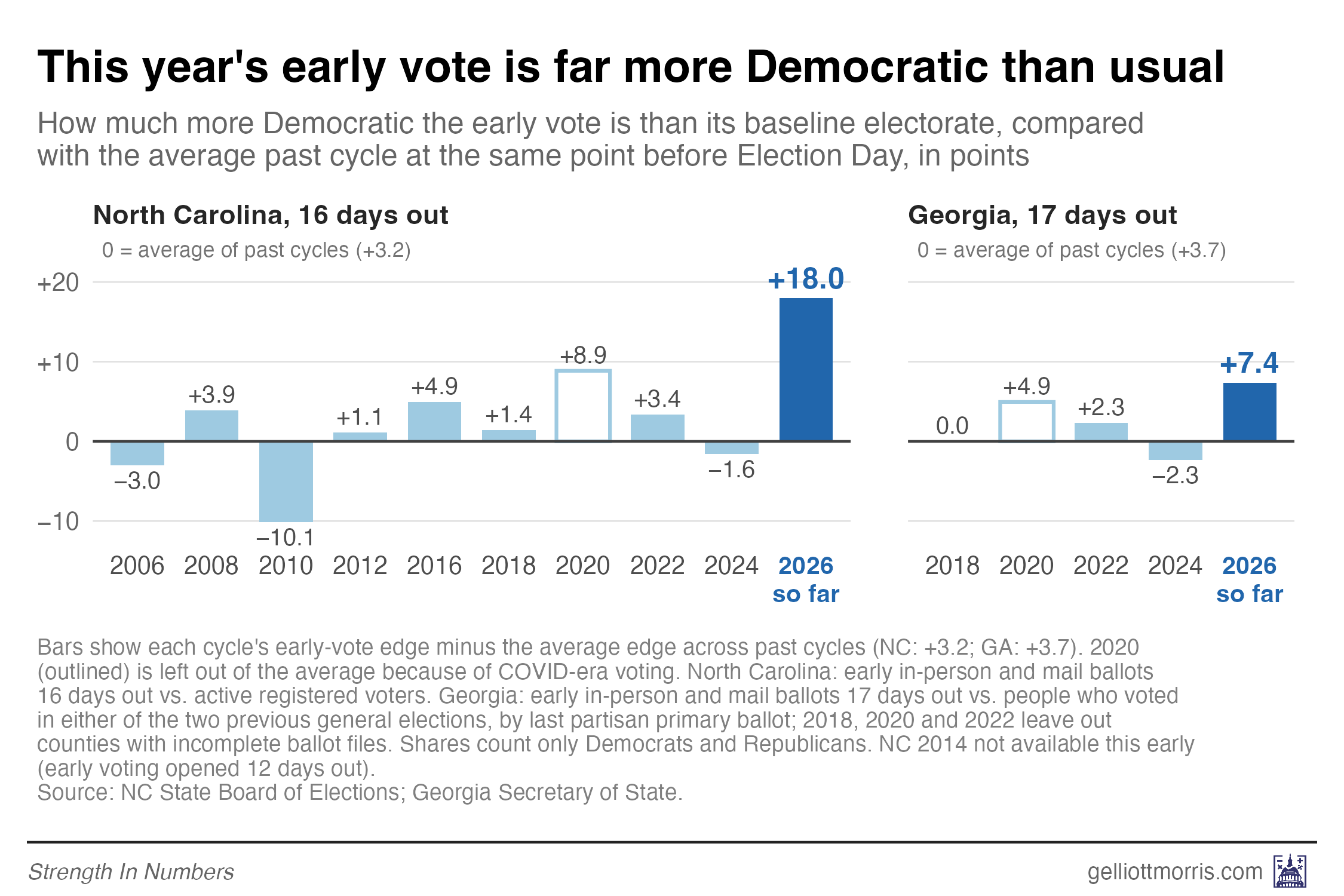
Some Democratic lean in the early vote is normal. Democrats tend to vote early at a higher rate than Republicans; in a typical year North Carolina’s early vote at this point runs about 3 points bluer than the rolls.
But this year, the Democratic composition of early vote is running about 18 points above that norm. Georgia is running hot too, at 7.4 points above its own norm compared to a previous high of 2.3.
The previous high in North Carolina since 2006 came in 2016, when the early vote ran 8.1 points bluer than the rolls — about 5 points above normal. Even 2020, when the pandemic scrambled how people voted and which I leave out of these comparisons, hit only 12.0.
Compared with this point in 2022, Democratic ballots are up 53%, from about 157,000 to 240,000, while Republican ballots are down 8%, from about 112,000 to 103,000.
But big advantages in the early vote have looked decisive before. On Nov. 4, 2016, Hillary Clinton’s campaign manager, Robby Mook, said the campaign had organized “to build a firewall in states with early voting to turn out supporters early and build up a lead that Donald Trump is incapable of overcoming,” before walking losing swing states such as North Carolina.
To give you an idea for how these edges can mislead, consider three numbers:
In 2016, the Dem. early vote lead in North Carolina 8.1 points bluer than the rolls, then the biggest edge since at least 2006.
A week before Election Day, it had already shrunk to 1.8 points.
The final electorate came in 1.5 points less Democratic than all registered voters, and Trump carried the state.
So an early advantage is not a surefire predictor of future gloom or doom. If Democrats are simply banking early voters, we should expect that this lopsided early vote advantage will dwindle as Republicans start casting their own ballots.
But if they are really staying home, Democrats could have a meaningful turnout edge on Election Day.
In this week’s Deep Dive, I analyze historical early voting returns to figure out just how much this data should be shaping our expectations for the midterms.
This piece will be added to the early vote blog, too.
What does the Democratic turnout edge mean for November?
Here are two questions we will answer using historical early vote data. When Democrats voted early historically, did that tend to predict they would do well in November? And does that signal get stronger the closer we get to Election Day?
I can answer both of these questions using the daily absentee ballot releases from the NC Board of Elections going back to 2006.
