


This is Part 2 of 2026 By The Numbers, a series that uses our bespoke polls, voter-file data, and election returns to explain how Democrats won the 2026 midterms and learn the real lessons of their victory. Read the whole series.
This series is exclusive for paying subscribers of Strength In Numbers, who support this work and enable me too make this newsletter my full-time job. The introduction is free for everyone to read, but I hope you’ll unlock the rest and support the site.
If you’ve read much post-election coverage, you’ve probably run across one of two mono-causal explanations for the Democrats’ historic victory. The first puts prices and affordability at the center of the backlash against Trump, mostly at the expense of other issues. NBC News says “Democrats won on affordability.” The Wall Street Journal worded one social post as “Voters fed up with high prices gave Democrats a landslide election victory.” Even Data for Progress, a progressive polling firm that wrote a detailed post-election analysis of voters’ demand for economic populism, titled one section “It’s All About Affordability”.
Then, there’s the U.S. war against Iran. David Shor, head of data science at the Democratic data firm Blue Rose Research, told Vox’s Eric Levitz on Nov. 5 that Trump’s approval “was really quite stable” through 2025. It “went down after a month or two,” Shor said, but then “the line didn’t move” through much of next 12 months. Then, “the Iran war happened. And there was a giant structural shift in public opinion.”
I don’t have access to Shor’s internal data, but this take contradicts pretty much every public poll published over the past 22 months. It oversells the impact of the war on Trump’s overall approval and ignores a huge drop in his popularity in 2025 and earlt 2026. In the polling average from FiftyPlusOne, Trump’s net approval rating fell from +12.0 on Jan. 21, 2025, to −18.6 on Feb. 27, 2026, the day before the first American strikes on Iran. That’s a 31-point drop before the war even started.
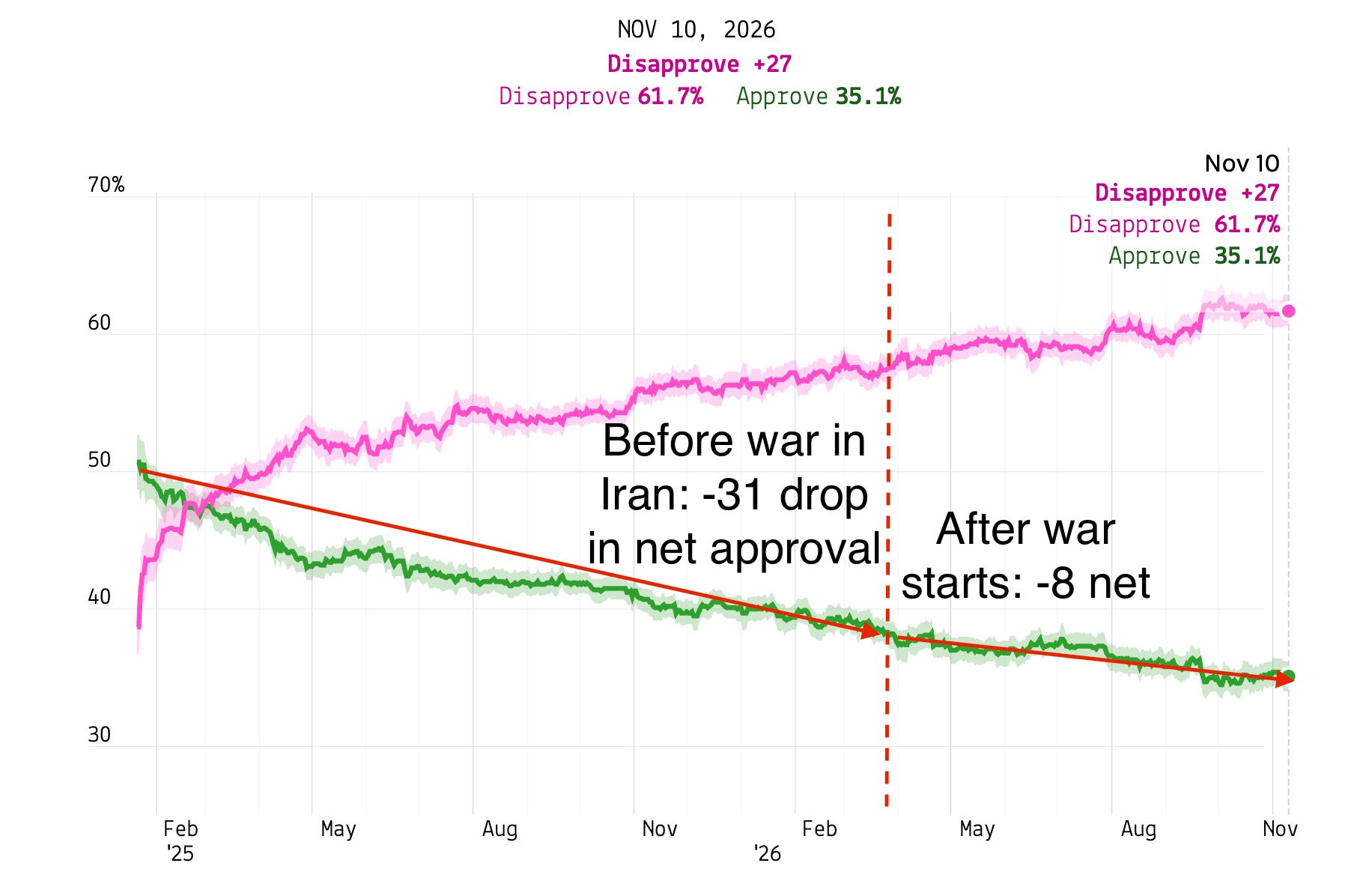
By Nov. 9, Trump’s net approval was −27, only 8 points lower than it was the day before the war began. Even if you toss out his first four months, which cover the early drop Shor acknowledges, Trump still fell 10 points in the nine and a half months before the war, or about 1.1 points a month. After the war began, he fell 8.0 points in eight and a third months, about 1.0 a month.
Our own surveys mirror the public data. In the Strength In Numbers/Verasight poll, Trump’s net approval fell 5.7 points in the nine months before the war (from −17.0 to −22.7) and 5.8 points in the eight months after (to −28.5 in October). That’s roughly the same rate of decline before and after the war!
One objection to this point is that it’s easier to lose ground when you’re near 50-50 than when you’ve already lost 31 points. Due to some funky statistics about probabilities of voter attitudes this is probably true — and it means the 8 points Trump lost after March 2026 may be “worth more” than his earlier decline. But that doesn't erase the decline Trump suffered before the war started.
To be fair to Shor, there was a lull in Trump’s decline from June through October 2025. So “it plateaued in summer 2025” is a fair reading of the data. But that’s not the same as saying “the line didn’t move.”
So what else mattered for Democrats’ huge 2026 victory?
First, immigration and deportations. In our polls, Trump lost more ground on immigration than on prices from May 2025 to February 2026, and his immigration ratings tracked his overall approval more closely than his rating on prices did. And point for point, his immigration rating mattered at least as much for the 2026 House vote intention as prices did.
After that, there’s corruption. In our polling, Trump’s own voters who were critical of him on corruption defected from the GOP about as often as the ones who were angry about prices.
Throughout 2025 and 2026, voters routinely told pollsters that prices and the economy were the Most Important Problems (“MIP,” in pollster parlance) facing the country today. But while the MIP question helps identify which issues are front of mind for most voters, that is not the same as discerning the issues that actually moved their voting decisions. Everybody cares about prices, but which issues actually flipped votes, and by how much — those are the questions to ask in an analysis of why Democrats won.
In this piece, I use our original independent polling to (a) measure how much each of 14 issues drove down both Donald Trump’s approval rating and vote share for Republicans in Congress, (b) show that immigration and corruption cost Trump significant support among his own 2024 voters, and (c) make the case for a multi-causal analysis of Democrats’ victory in 2026.
At the very least, prices are not the only thing that mattered this cycle. And at most, there’s a decent empirical case that other issues may have even mattered more.
The rest of this article is paywalled for paying subscribers of this publication. Strength In Numbers is an independent newsletter on politics, public opinion, and democracy that earns about 97% of its revenue from reader subscriptions. Paid subscribers get my premium Tuesday Deep Dive and early access to our monthly Strength In Numbers/Verasight polls, plus access to a private Discord server for like-minded readers. Sign up for just $10/month or $90/year (a 25% discount if you pay annually!).
