


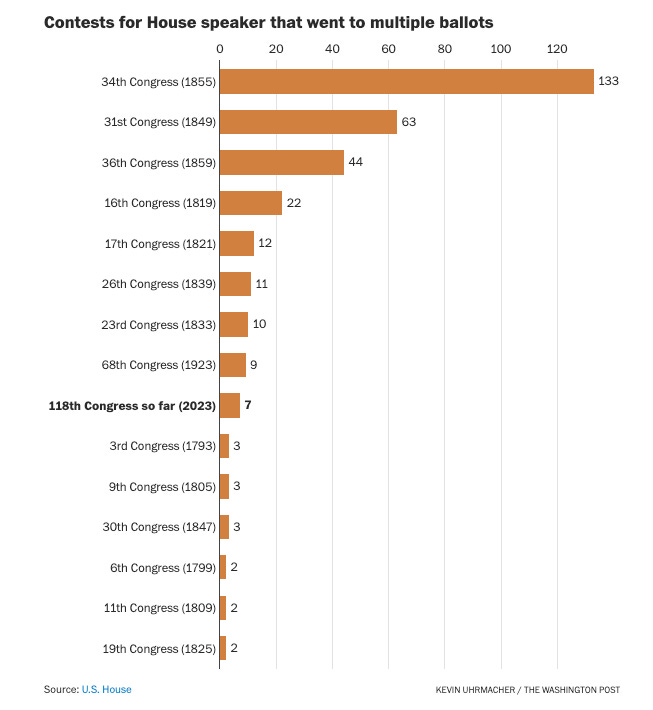
The website of the United States House of Representatives tells me there have been 14 occasions when the election for Speaker of the House has taken multiple ballots. The first was in 1793 — the third Congress ever — when it took members three ballots to cast a majority of ballots for Speaker. Others have taken many more successive votes, such as for the pre-Civil War 34th Congress (meeting for the first time in December 1855). Then, anti-Democratic members won a majority of seats but no single party controlled House due to the disintegration of the Whigs. Some of those members became Republicans, others took up with the Know-Nothings. It took two months, 133 ballots and a rules change to elect the Speaker via plurality to resolve the impasse.
Here is a chart of other multiple-ballot elections from Speaker courtesy of the Washington Post:
This year’s election for Speaker of the House will become the 15th such occasion. As I write, a majority of the chamber’s representatives have failed…
