


Democrats haven’t won a statewide race in Texas since 1994. But every cycle, we are inundated with pieces asking if this will be the year Texas turns blue. The answer, for 32 years, has been no. I wrote my own version for The Economist back in 2019, calling the state Democrats’ “white whale” for 2020. From 2020 to 2024, the state only drifted further toward Republicans, who win the state on average by 12 percentage points.
But this year, Democrats might have a real shot at winning a statewide election in the Lone Star State.
On Tuesday, March 3, Democratic primary voters picked state House Rep. James Talarico over U.S. Rep. Jasmine Crockett to become their party’s nominee for the November election to the U.S. Senate. On the Republican side, no candidate won above 50%, so incumbent John Cornyn and Ken Paxton are headed to a May 26th runoff election.
I have compiled six data-driven reasons Texas could actually go blue in 2026. They have to do with concerns over Ken Paxton’s electability, Talarico’s support among independent voters, Democratic enthusiasm, and a few other factors. Add them up, and it’s easy to see how Talarico could pull off a win (though it would not be easy to do).
Here are six data-driven reasons Texas could actually go blue in 2026.
This article is free to read, but it was not free to write. Subscribe to Strength In Numbers to get exclusive analysis of politics and elections, access to premium polling data, and support independent, interactive data journalism.
If a paid subscription is not in the cards for you, the best thing you can do is share this article with a friend. Word of mouth is the #1 way new people learn about this publication.
1. Ken Paxton’s electability problems could be decisive
The most important question remaining in this race is whether Republican primary voters pick Ken Paxton or John Cornyn as their nominee for the seat. Paxton would be a much weaker candidate than Cornyn, according to polls.
Paxton has been dogged by scandal after scandal for over a decade. He was indicted on felony securities fraud charges in 2015 for persuading investors to buy stock in a tech company without disclosing he was being paid for it. The case dragged on for nine years before prosecutors dropped the charges in 2024 in exchange for community service, ethics courses, and hundreds of thousands of dollars in restitution.
In 2023, the Texas House impeached him on 20 articles — including abuse of public trust and bribery — for allegedly using his office to benefit a campaign donor. The state Senate acquitted him, but this damaged his brand with moderates in the state.. A separate federal corruption investigation was also opened, though the DOJ ultimately declined to prosecute. And for the last year, Paxton has been going through a very public and messy divorce, with allegations of marital infidelity flying in the press.
That sets the table for his run for Senate in 2025-26. In January, an Emerson College poll found Cornyn led Talarico 47% to 44% — a pretty normal-looking 3-point lead for a Republican in Texas in a (likely) “blue wave” year. Paxton, by contrast, was tied with Talarico at 46-46.
The University of Houston’s Hobby School of Public Affairs found the same pattern across 12 hypothetical matchups last fall: Paxton’s average margin of victory was just 2.25 points, compared to 3.5 for Cornyn and 4.5 for Wesley Hunt. A more recent Hobby School poll from January found Paxton and Cornyn leading Talarico by just 1-2 points each — within the margin of error of each other, though in this survey, Paxton actually did better than Cornyn.
The strongest evidence of the drag Paxton has on the Republican ticket comes from a Ragnar Research poll conducted last November. In that survey, Talarico polled even with Paxton while losing to Cornyn by 6.
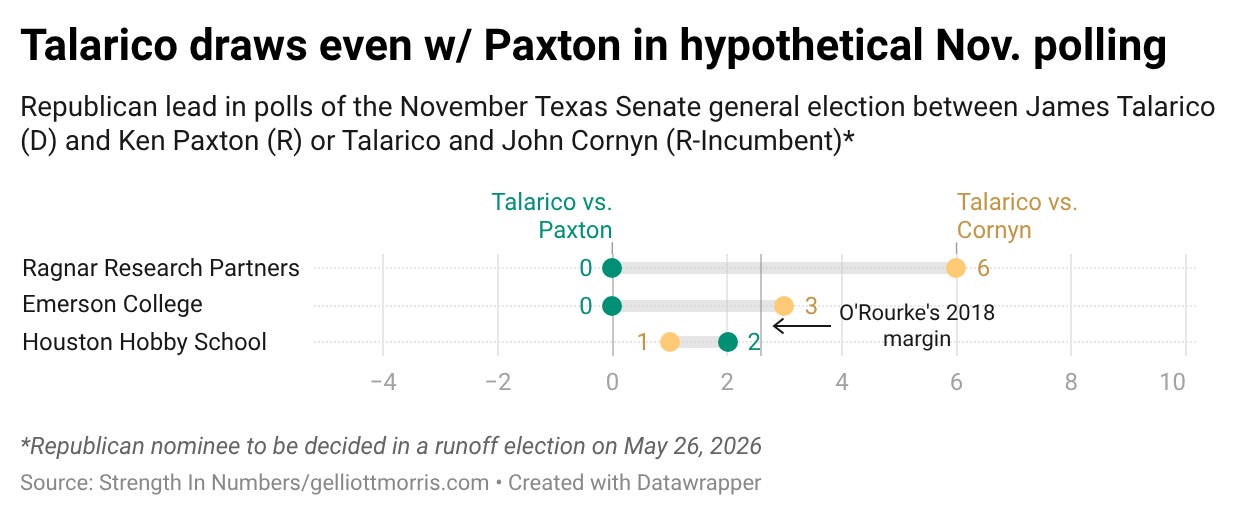
On average, polls show Talarico does 3 points better when Republicans nominate Paxton vs Cornyn. That might sound small, but it could be decisive in a close race. Consider that Democratic candidate Beto O’Rourke’s margin in the 2018 Senate race vs Ted Cruz was just 2.6 percentage points. If O’Rourke had an extra 3 points, Democrats would have an extra seat in the Senate today.
2. Democrats were probably right to pick Talarico
The second factor in Talarico’s corner is his draw with independents.
On the Democratic side, both Talarico and Crockett have polled similarly against Paxton in hypothetical surveys of the November general election. But like with the Republican primary above, differences at the margins matter.
Across polls, Talarico consistently performs 1-2 points better than Crockett in hypothetical general election matchups across most polling. In the Emerson poll, Crockett loses to Cornyn by 6, while Talarico only loses by 3, and both tie with Paxton at 46% each.
More important than the topline, however, might be the crosstabs. Normally, I would be hesitant to write about crosstabs from one single survey as evidence of “electability” effects. But as of writing, Talarico leads Crockett 53.0% to 45.7% in the vote count — incredibly close to the final Emerson poll of the primary (52-47). That provides some validation for their data, so we can take it more seriously than we can a poll, for example, showing Crockett up 18.
And on the crosstabs, Talarico’s coalition looks more like the coalition Democrats need to win a statewide election in Texas. In the latest Emerson poll, Talarico led among white voters 71-29 and Hispanic voters 60-39. He also won among both 2024 Kamala and Trump voters, with Crockett carrying non-voters. In a state where you need to run up huge margins in the suburbs while staying competitive with Latino voters, and where Donald Trump won by 14 points in 2024, Talarico’s profile is simply a better fit.
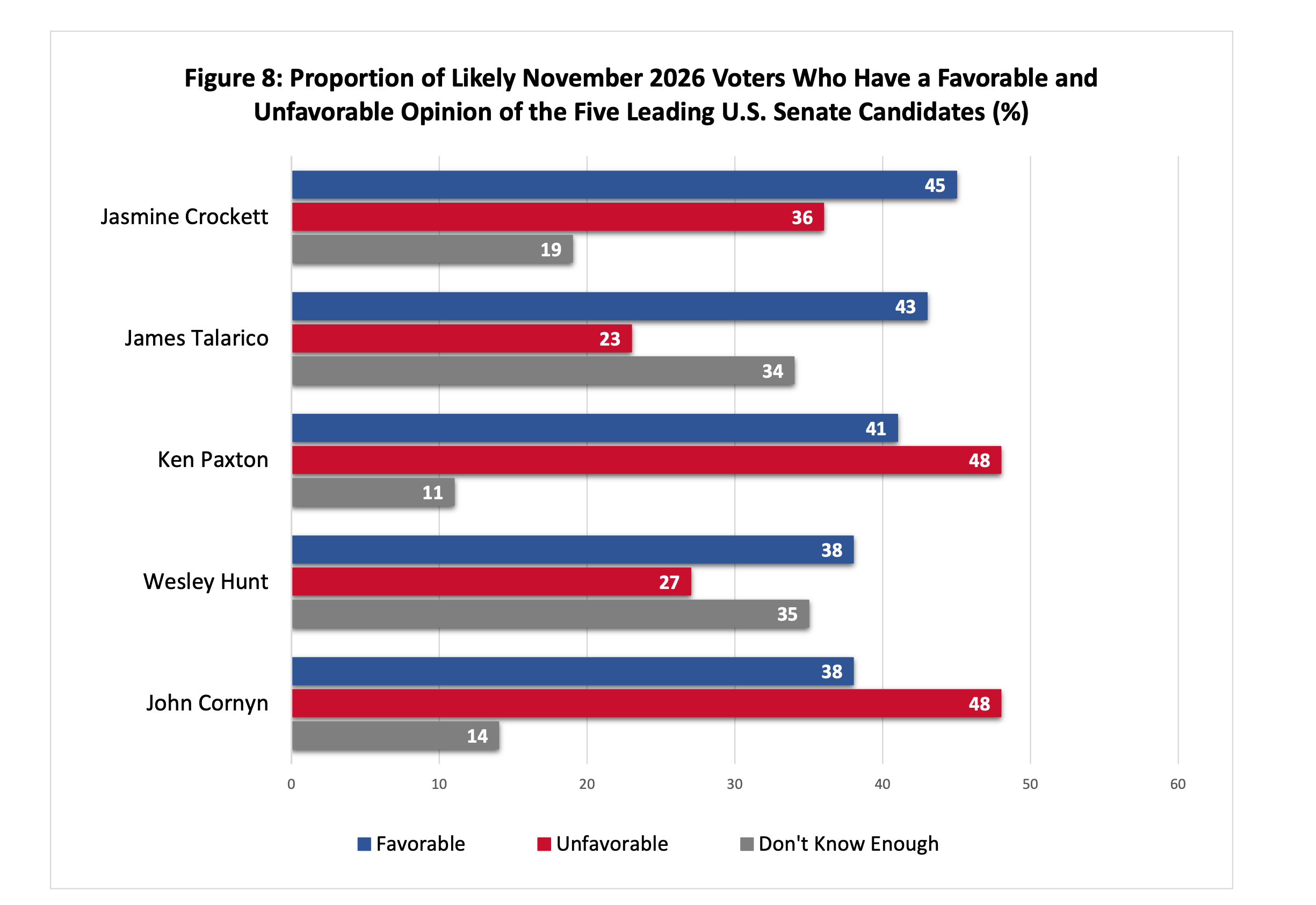
Talarico also has the highest favorability rating of any candidate on either side, once you account for the high share of Texans who said they didn’t know enough about him to say how they felt. Crockett’s favorability rating was 56% in the University of Houston poll after being adjusted for the “don’t know” share, whereas Talarico’s was 65%.
3. Democratic enthusiasm is off the charts
Third, any Democrat is bound to benefit from a massively friendly turnout environment in 2026.
Throughout Texas’s early voting period, Democrats were casting more primary ballots than Republicans: roughly 53% of all early votes went to the Democratic primary, 47% to the Republican. And compared to past years, Democratic early vote totals were up big: 274% compared to the 2022 midterm primary, vs just a 106% differential over 2022 for Republicans.
And in key counties, Democrats will need to win big for any statewide victory. Democrats also turned out in huge numbers:
In Dallas County, nearly 188,000 Democrats voted early compared to 64,000 Republicans — a 3:1 ratio. That’s the highest Democratic primary turnout since 2008, when Obama was on the ballot.
In Tarrant County, which has become the state’s key bellwether, Democrats outpaced Republicans during early voting — a county where Trump won by double digits in 2024.
In El Paso, the number of voters under 30 nearly tripled compared to 2022, and voters 30-44 more than doubled.
It turns out this wasn’t just an early vote phenomenon. As of 11:30 PM on March 3, Democrats are on track to cast 2.42 million primary ballots in Texas, while Republicans are on track to cast 2.38 million. That’s a small difference, but in 2022, Republicans cast 900,000 more ballots than Democrats.
An analysis of county data by Derek Ryan found that 28% of Democratic early voters had previously only voted in November general elections. These are people who don’t normally bother with primaries at all, but evidently decided this year was different. On the Republican side, that figure was just 13%. This data suggests Democrats are activating general-election voters at twice the rate Republicans are.
And this isn’t the only evidence of Democratic turnout. Across the country, Democrats have run ahead of the 2024 presidential results by an average of 13 points in more than 90 special elections this cycle. Republicans haven’t flipped a single seat. On Tuesday alone — the same night as the Texas primary — a Democrat flipped a Republican-held state house seat outside Little Rock in a district Trump won in 2020. Democrats also cast more ballots in the Democratic primary for U.S. Senate in North Carolina, also held on March 3.
4. Texas Democrats are becoming more demographically representative of the state
Fourth, an analysis of early vote data suggests the Democratic coalition is starting to look more like Texas itself, bringing in more suburban, rural voters into the coalition.
Election analysis website VoteHub estimates the Democratic base of all voters is roughly 40% white, 23% Black, 29% Hispanic, and 7% other. But historically, Democrats have relied much more on Black voters to pad their margins. In the 2020 Democratic U.S. Senate primary runoff between MG Hegar and Royce West, they made up 30% of the electorate despite making up just 23% of the base. This has meant the Democratic primary electorate has looked very different from the state’s overall voter pool, which is a plurality white and more than a third Hispanic.
In 2026, that gap is closing. White and Hispanic voters surged into the Democratic primary at rates well above 2020, pulling the electorate’s demographic composition closer to the state as a whole. In Dallas County, the white share of Democratic primary voters climbed from 34% to 39%, while the Black share fell from 42% to 36%. Importantly, this isn’t because fewer Black voters turned out, but because other groups showed up in numbers they hadn’t before.
A more representative primary electorate means you get candidates who are better candidates for the general election. A primary electorate that’s disproportionately concentrated in one demographic group or ideology will pick a candidate that represents a comparatively niche group. But a primary electorate that’s starting to mirror the state’s actual demographics is one that can scale.
This could signal that Democrats are improving their standing with the state’s suburban and white voters, and maybe even rural Texans, who have tended in the past to pad margins for Republicans.
5. Republicans are collapsing with Latinos
Now, consider recent elections in Texas have shown Latino voters moving away from the Republicans. A special election to the state’s Ninth Senate District on January 31st is a good example. Then, Democrat Taylor Rehmet beat Republican Leigh Wambsganss 57-43 — a 14-point margin in a district Trump carried by 17 points just 14 months earlier. That’s a 31-point swing.
In this contest, majority-Hispanic precincts swung an average of 34 points toward Rehmet compared to the 2022 baseline. VoteHub estimated Rehmet won roughly 79% of the Hispanic vote in the district, compared to the ~54% Democrats captured among Texas Hispanics in 2024. And Rehmet won 30% crossover support from voters who had previously participated in Republican primaries.
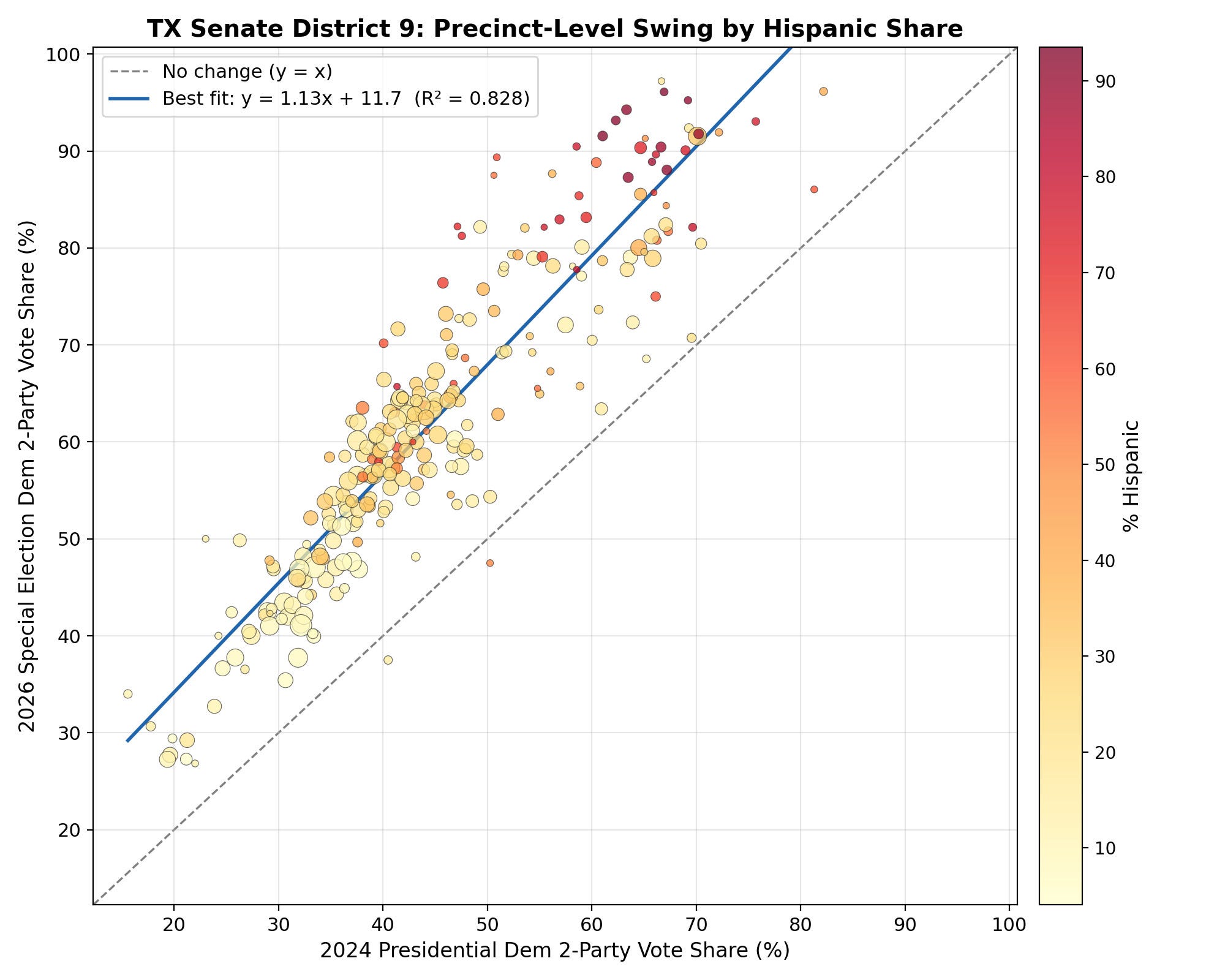
Now, special elections aren’t general elections. Turnout was about 15%. But Texas has huge state legislative districts, so SD-9 is actually larger than a congressional district, and Rehmet actually did better on Election Day (58-42) than in early voting (56-44) — the opposite of what you’d expect if this were just a low-turnout fluke. And in light of Democrats doing better with Latinos than in 2024 in contests such as the New Jersey election for governor in 2025, I don’t think we should just hand-wave the contest away.
Additionally, back to the primary, Texans in majority-Hispanic Hidalgo County cast 52,000 votes in the Democratic primary Tuesday night. Just 15,000 voted on the Republican side. Hidalgo County voted for Donald Trump in 2024 by 3 points, the first time a Republican won the county in a presidential race since 1972. So a 52k-15k vote lead is a big deal.
6. Trump is underwater in Texas
Finally, consider that Donald Trump is himself underwater in Texas, which would drag down any Republican running in November.
Trump’s job approval rating in Texas has been falling steadily in tracking surveys from the University of Texas/Texas Politics Project conducted over the last year. The president’s approval started at 52% when he took office, declined to 47% in April, to 44% by June, and has settled at 45% approve / 49% disapprove as of February 2026.
Historically, statewide presidential approval is a loose predictor of statewide midterm election results. It’s not perfect, but when the president is running at 45% approval in your state, the odds are better than not that you’ll lose the upcoming election.
In my own MRP model of Trump’s approval rating, the president sits at 44% approval among registered voters in the state, and 40% among the entire adult population (so higher turnout wouldn’t necessarily help the eventual Republican nominee).
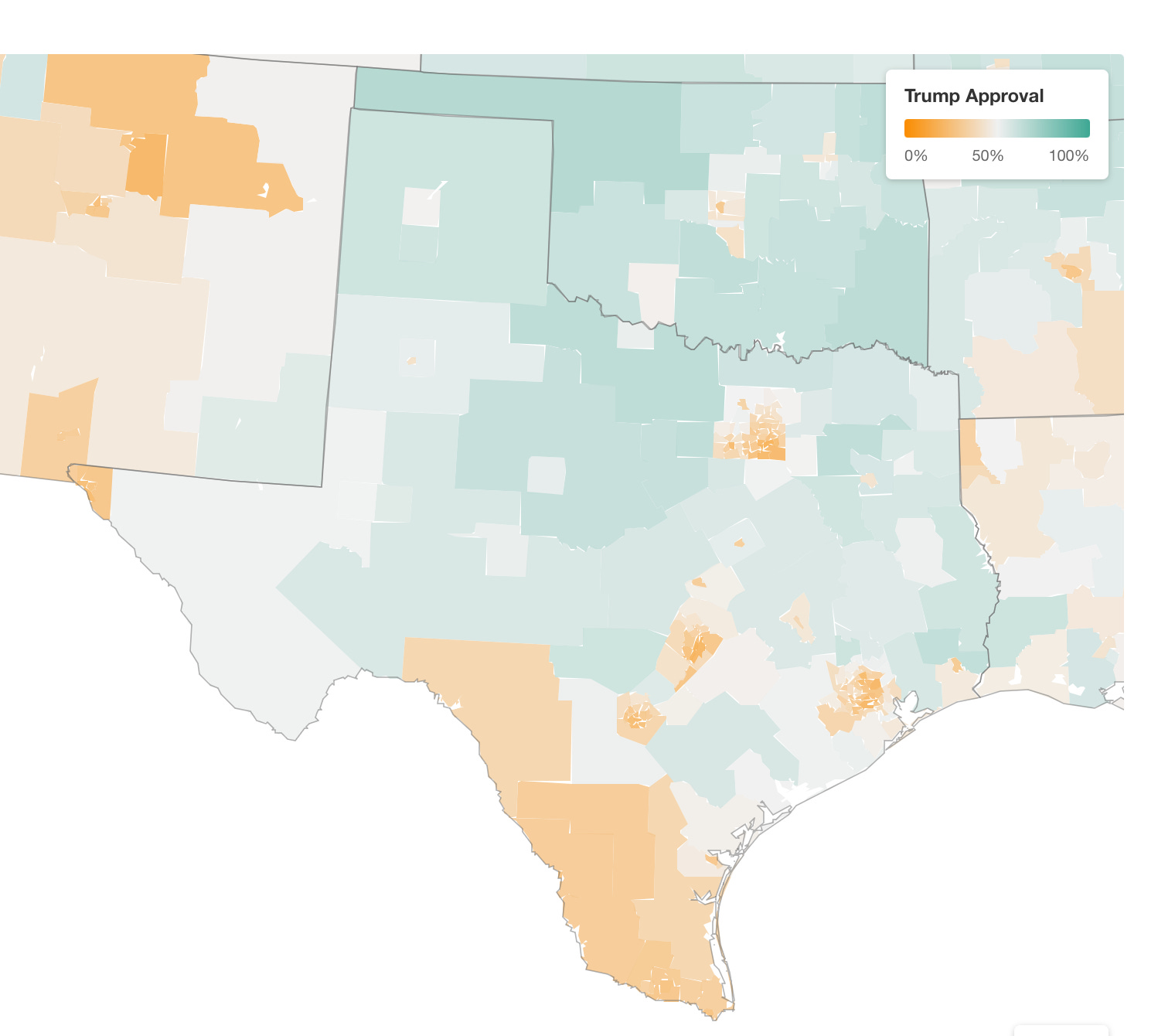
Zooming in demographically, it’s notable that Trump is much less popular with independents. According to the UT poll, just 19% approve of Trump’s job performance, while 66% disapprove. His net favorability among independents went from -22 in February 2025 to -48 a year later. Among Hispanic Texans, favorable views dropped from 47% to 39% over the same period. In the suburbs, Trump flipped from net-positive (52-44) to net-negative (44-51).
Even on his best issue, border security, Trump’s approval rating among all Texas voters is just +12. On the economy, which voters consistently name as their top issue, he’s underwater at 41-48.
So a Republican Senate nominee in Texas needs to outperform Trump to be safe. Cornyn could probably do that — he has his own brand and a long record of constituent service. But Paxton has explicitly branded himself as Trump’s candidate. That means he’s more tethered to Trump’s performance in the state. And when the president is at 45% approval in your state with independents at net -47, you have to do some major work to dig yourself out of his hole.
An initial forecast: Will Texas go blue?
At this point, 243 days out from the election, I would not go so far as to say that Texas is likely to vote for Talarico for senator in November. But the data above all point in the same direction. And if Republicans pick Paxton, that could alone be enough to close the gap for the Democrats.
To recap, Democrats have six things working in their favor: Potentially a very weak Republican nominee, a good Democratic recruit, a massive enthusiasm gap, a diversifying electorate, a Latino backlash against the GOP, and a president dragging his party underwater.
Yet on the other hand, Texas is a religious, conservative, crimson-red state where Democrats haven’t won statewide since 1994, and primary enthusiasm does not necessarily translate to November results. In 2008, Democrats cast two-thirds of primary ballots and then lost the state to McCain by 12.
But consider the 2018 baseline. Beto O’Rourke lost to Ted Cruz by just 2.6 points — the closest a Democrat had come to winning a Texas Senate seat in 40 years. He did it against a reasonably popular incumbent, in an environment where Trump’s approval in Texas was 48% — significantly better than where it sits now (45% approve, 49% disapprove). Cruz also arguably got a late boost from the SCOTUS confirmation hearings for Brett Kavanaugh that energized Republican voters right before the election.
So take the 2.6-point Republican margin, and now apply the Paxton penalty. If the political environment in 2026 is even comparable to 2018 — and the primary turnout data, special election results, and presidential approval numbers all suggest it could be as good or better for Democrats — then Paxton’s 2-3 point drag is the difference between another narrow loss and a win.
And then you can start to stack other favorable indicators on top of that baseline: Trump is losing independents by 47 points on approval; Democrats saw a 31-point swing in Tarrant County in January; Democratic primary turnout is up 274% vs 2022; and the Talarico nomination is a good match for Texas general election voters based on demographic patterns. In a Paxton-Talarico matchup, the average poll today has the candidates within a point or two. The fundamentals — the midterm penalty, presidential approval, and enthusiasm gap — all push in Talarico’s direction.
If Paxton wins the Republican primary, I’d rate the Texas Senate race a pure toss-up, with a 45-50% Democratic win probability.
The kind of original polling analysis and data journalism I’m publishing here at Strength In Numbers doesn’t exist anywhere else in the media today. Paid subscribers make it possible for me to run custom surveys, build models like the MRP estimates cited above, and spend my time on public-interest journalism full-time. Subscribe here.
Fascinating analysis. Thanks
Elliot- your data driven journalism, your political science background is reaching out to save democracy. I applaud warmly Paul.