


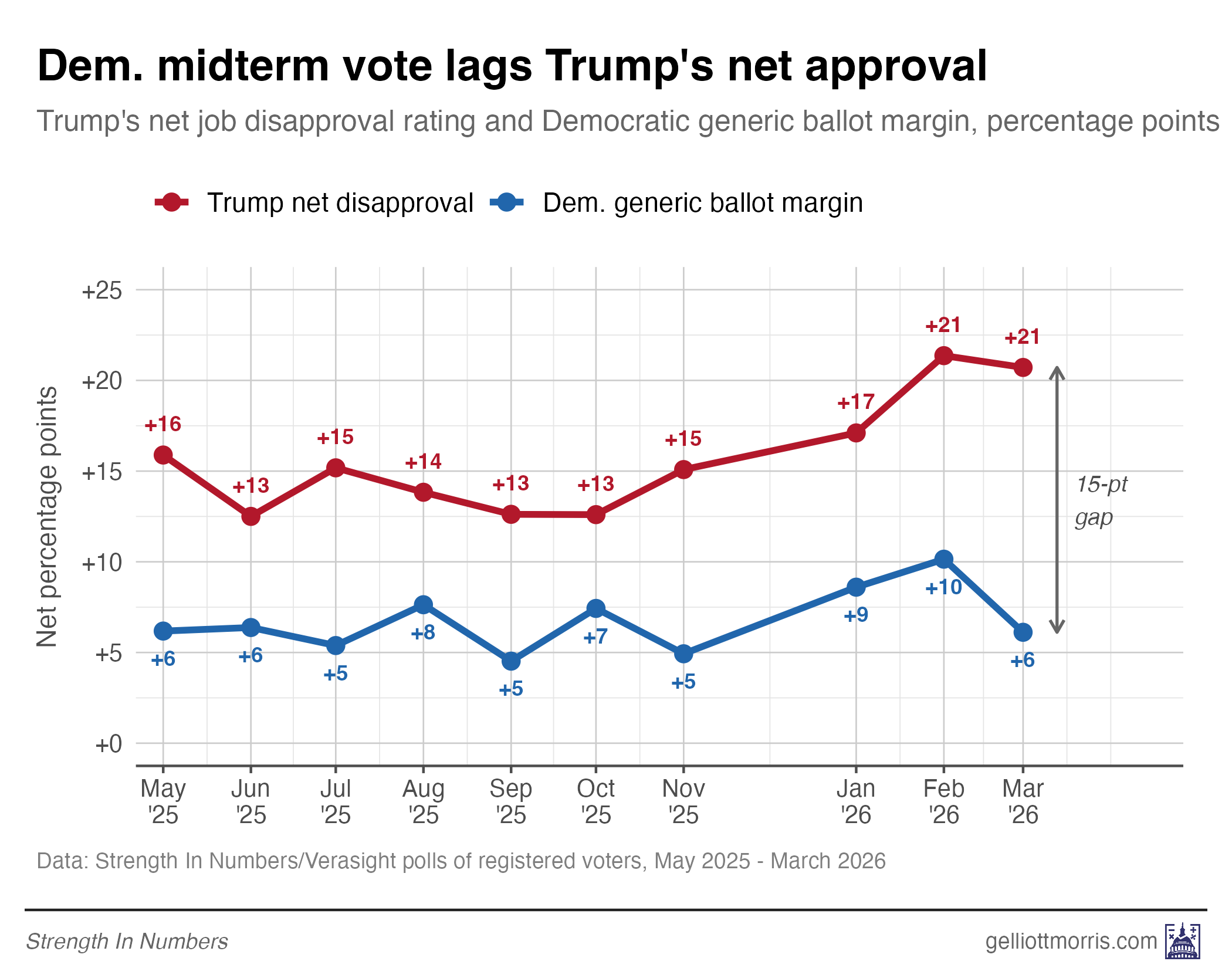
In our March Strength In Numbers/Verasight.io poll, Democrats led in the U.S. House generic ballot question by 6 points among registered voters — 49% to 43%. That’s a healthy lead, and would be large enough for the party to take back the majority of seats in the House and then some — and also would comes close to their 7-8 point victory in the 2018 “wave” election.
Yet Trump’s net approval rating (among all adults) in the same survey we published is a whopping -23 points. Just 37% of American adults approve of the job he is doing as president, while 60% disapprove.
If Trump is 23 points underwater, why are Democrats only ahead by 6?
Part of the answer is straightforward, though it accounts for a small part of the difference. The big issue here is that the two numbers measure attitudes among different populations: The generic ballot margin I report is among registered voters, and the one that eventually exists in reality will be among voters. The approval rating number we report out, however, is among all adults. Polling data suggests these groups have different political leanings.
Among registered voters specifically, Trump’s net approval is -21 — still terrible, but two points less terrible than the all-adults number. And among all adults, the Democratic generic ballot margin is D+7.5, not D+6 — about 2 points in the opposite direction. So some of the 15-point gap among RVs is just a population mismatch between the two metrics people tend to compare.
But even after you compare apples to apples, there’s still a 15-point gap between Trump’s net disapproval among registered voters (-21) and the Democratic ballot margin among registered voters (+6). Over the last 6 months, the generic ballot margin is running at roughly 40% of net disapproval.
If we take a deep dive into our polling microdata and historical exit polling, what can we learn about this gap? How big is reasonable? And what can Democrats do to bring their generic ballot number closer to Trump’s approval rating?
It’s all about the “cross-pressured” voters
Among registered voters in our March poll, 50% strongly disapprove of Trump, and another 9% somewhat disapprove. These groups say they will vote Democratic in the House generic ballot this November at much different rates.
