


Political scientist Jon Green wrote today that we should stop treating election results as purely binary. “Wins and losses are binary,” he argues, “but vote share is continuous.” His point is methodological: we can learn something when a candidate gets 25% of the vote when conventional wisdom said they’d get 5%. A close loss is not the same thing as a blowout.
Green’s post is about the IL-09 Democratic primary. Daniel Biss, the mayor of Evanston, Illinois, won last night with 29.6% of the vote in a 15-candidate field. Kat Abughazaleh, a 26-year-old journalist and social media influencer running her first campaign, came second with 25.7%. And Laura Fine, currently a member of the IL state Senate, finished third at 20.3%.
So the question I want to explore here is: did Abughazaleh perform better than we should have expected? And if so, what does that tell us?
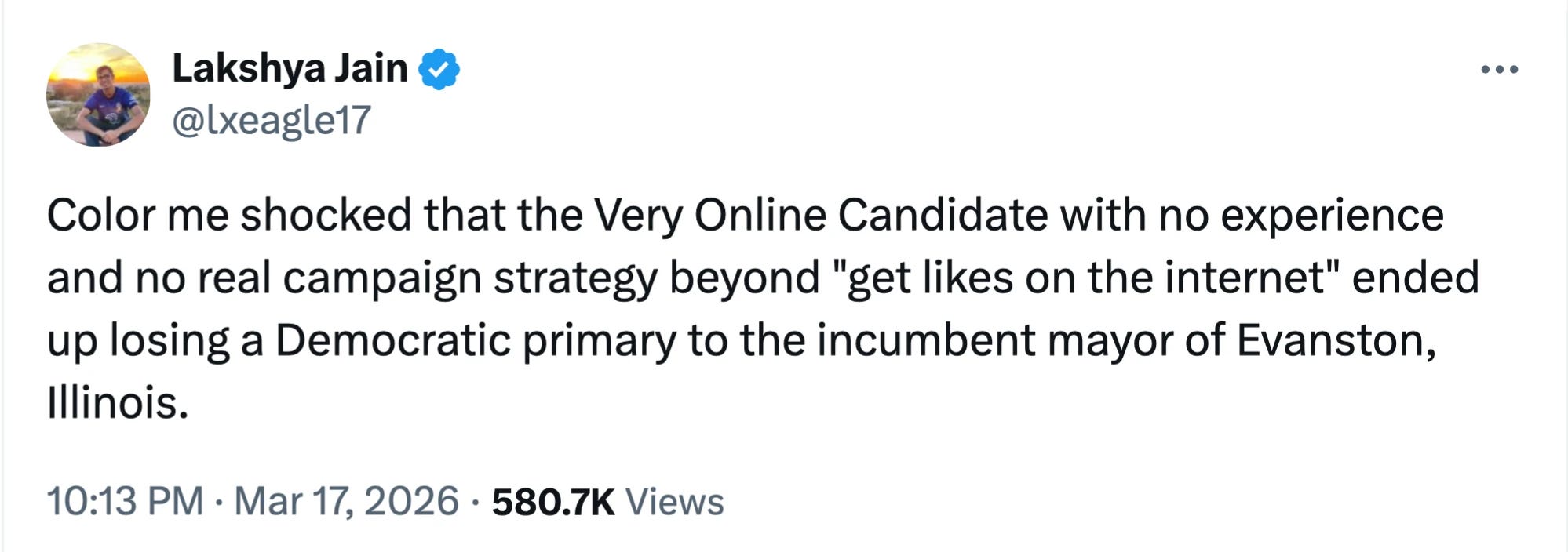
I ask this because late last night, centrist pundits on Twitter/X declared IL-09 a decisive rebuke of “Very Online” progressivism. Lakshya Jain, who runs polls for the online pro-Liberalism magazine The Argument, posted “Color me shocked that the Very Online Candidate with no experience and no real campaign strategy beyond ‘get likes on the internet’ ended up losing a Democratic primary to the incumbent mayor of Evanston, Illinois.” Nate Silver wrote that her loss showed internet progressivism “doesn’t really travel well.”
But is that the right inference to make when a candidate comes within 4 points of upsetting an establishment favorite? Abughazaleh also beat an incumbent state senator and a dozen other candidates running in the progressive, outsider track. If we treat the loss seriously as a source of information, not as a way to dunk against someone’s ideology or the fact they are “Very Online” (whatever that means, especially from critics who spend a lot of time on social media!), can we actually learn something from a candidate’s marginal defeat?
If you’re a frequent reader of Strength In Numbers, I’m confident you will get a lot of value out of a paid subscription. Paid members get access to Tuesday Deep Dives and one-off premium posts, like this one, the monthly SIN-Verasight poll, and more.
