


This article reports results from the April 2026 Strength In Numbers/Verasight poll. You can read our previous poll releases here. Subscribers to Strength In Numbers have access to additional trended charts and a full archive of crosstabs, and can suggest questions for future polls via the comments section below!
For the better part of two years, the story about the Democratic Party’s image has been simple and unflattering: voters don’t like it. The party’s favorability rating has been underwater in nearly every major poll since the middle of 2024, and the party took another hit during last fall’s shutdown fight. Our new April 2026 Strength In Numbers/Verasight poll confirms this broad pattern: Democrats are underwater at 45% favorable to 48% unfavorable, a net rating of -3.
But Republicans are doing much worse. Our survey finds the Republican Party at 39% favorable and 55% unfavorable — a net of -16, with 42% of Americans saying their view of the GOP is “very unfavorable.” That number is 12 points higher than the equivalent figure for Democrats (30%).
We originally designed this survey to unpack a puzzle of party popularity. Last summer, our analysis of favorability polling found many left-leaning Democrats were critical of their party, dragging down its overall favorability rating even though many of these critics were still planning on voting for the party. We wanted to know whether this was still the case. It is, and we asked some specific questions to voters about what the party would need to change for its rating to improve.
But our polling also shows that this puzzle — Democrats being more unpopular than Republicans because of intra-party disaffection — has now resolved itself. When we ask voters whether they think Democrats or Republicans possess certain character traits, Democrats win on nearly every one we tested. Independents dislike Republicans roughly three times as much as they dislike Democrats. Even voters who say they have an unfavorable view of the Democratic Party often plan to vote for Democrats anyway. And when Democrats’ own voters complain about their party in their own words, the complaint is not that Democrats are too liberal or “weak and woke”, it’s that they’re not fighting hard enough, particularly against Donald Trump.
Here are the headline findings:
Party favorability: 45% favorable / 48% unfavorable for Democrats (net -3); 39% / 55% for Republicans (net -16). The GOP’s “very unfavorable” number (42%) is 12 points higher than the Democrats’ (30%).
Character vs strength: Democrats lead Republicans by double digits as the party that is tolerant (D+26), respects democratic institutions (D+16), cares about people like you (D+14), is honest (D+12), and looks out for the middle class (D+11). Republicans lead on willingness to fight (R+4), clear messaging (R+8), getting things done (R+7), and strong leadership (R+11).
2026 House vote intent (among all adults): In a modified 2026 congressional vote question that tests vote intention and party disapproval at the same time, 47% of adults say they’ll vote for a Democrat, with 29% doing so happily, while 18% are unhappy with the party but voting Dem anyway.
Unhappy but still voting Democratic: Among voters with an unfavorable view of the Democratic Party, 16% say they’ll vote Democratic in 2026 anyway. Among the “somewhat unfavorable” slice, 41% still plan to.
Democrats’ biggest complaint about Democrats: In their own words, many say leadership is weak and not fighting hard enough against Donald Trump.
The toplines and crosstabs for this poll can be found on the Strength In Numbers polling portal.
Both parties are underwater with U.S. adults
Let’s start with the topline. 45% of U.S. adults have a favorable view of the Democratic Party — 15% very favorable, 30% somewhat, against 48% unfavorable, split 18% somewhat and 30% very. Six percent don’t know. The Republican Party’s numbers are worse on both sides of the ledger: 39% favorable (16% very, 23% somewhat) to 55% unfavorable (13% somewhat, 42% very). Six percent are unsure.
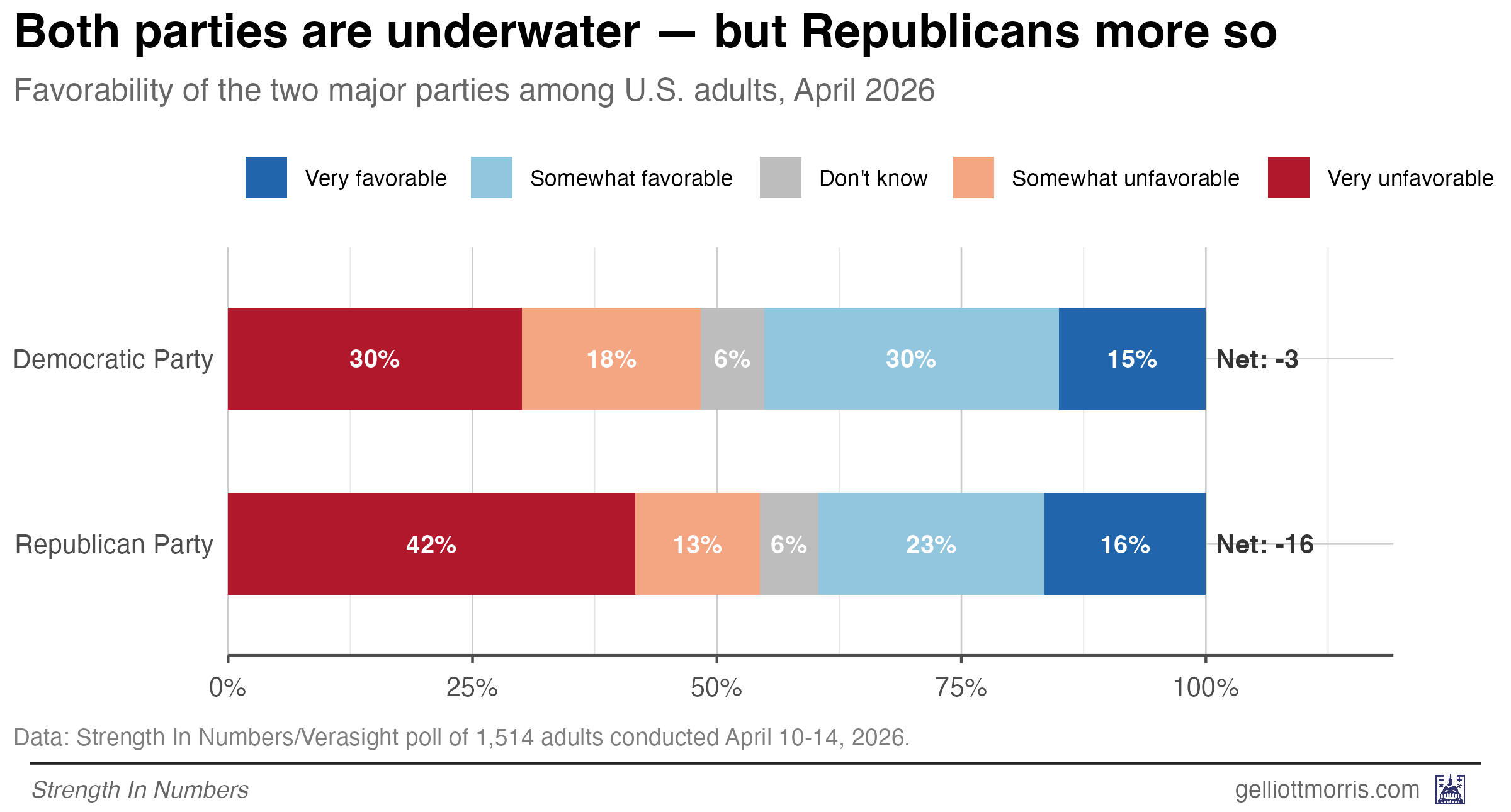
Two things stand out. The first is how close Democrats are to breaking even. A net -3 is within the poll’s margin of error and the best public-image reading we’ve measured for the party in any Strength In Numbers/Verasight wave this cycle.
The second is the asymmetry in intensity. 42% of Americans say their view of the Republican Party is very unfavorable — 12 points higher than the same number for Democrats. These are groups of voters that really detest the other side and are unlikely to be moved by campaign messaging or news coverage about the current state of politics. Democrats have an edge, in other words, with devoted voters.
Partisans like their own brand. Independents hate Republicans more.
Split the numbers by party ID and the reason Republicans are doing so poorly in the topline really becomes clear. Democrats rate their own party at net +60, while Republicans rate theirs at a net +61. This is a (predictable) reversal from 2025: there is no evidence here that Democratic voters are disenchanted with their own brand in some way that Republicans are not.
Instead, the real asymmetry is among independents.
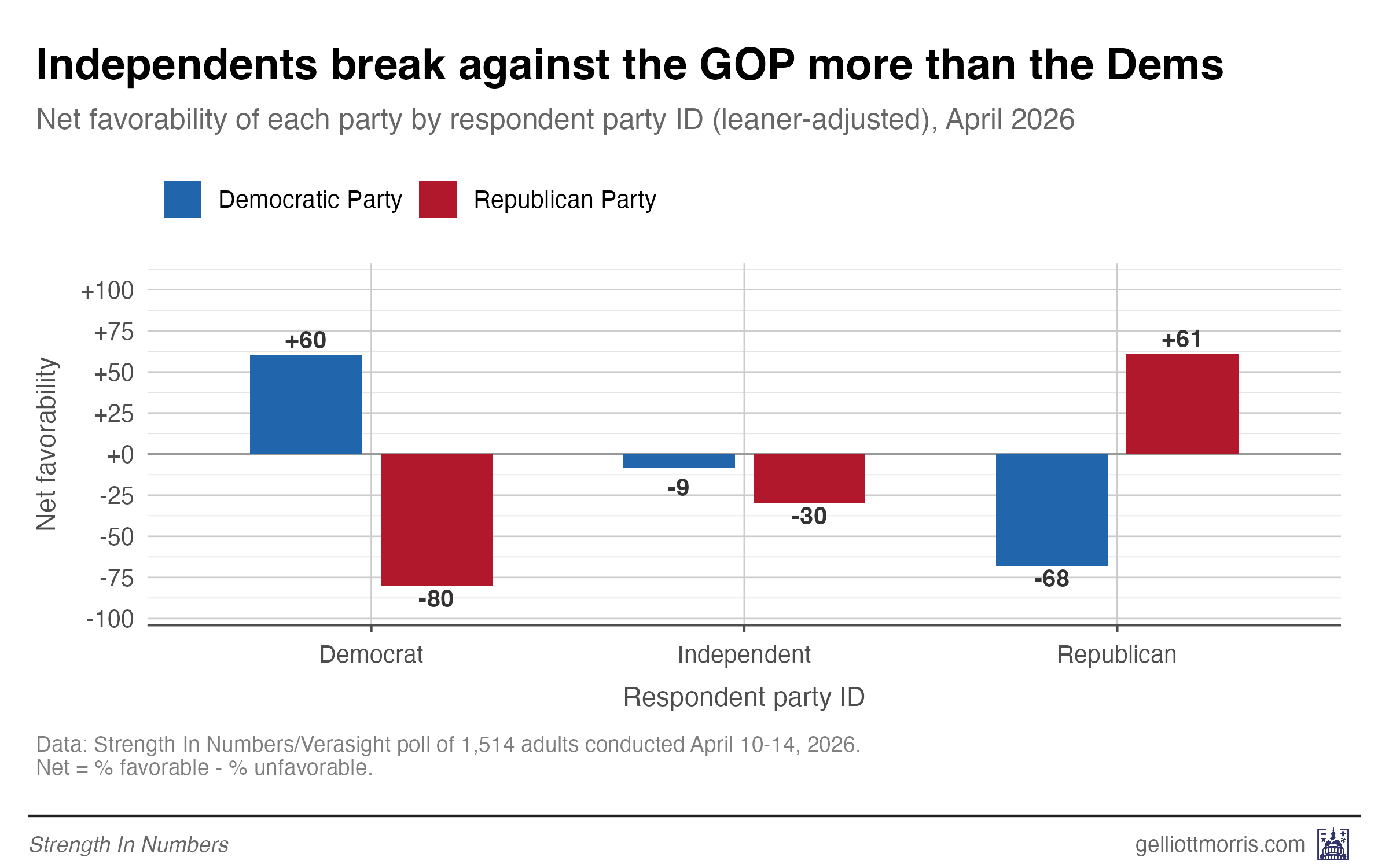
Self-identified independents (with leaners pushed toward the parties) rate Democrats at net -9. That’s meaningfully negative, but also not the worst number I’ve ever seen. By contrast, independents rate Republicans at net -30.
Many voters who dislike Democrats still plan to vote for them
If you look at the voting behavior of Americans by their view of the parties, you’ll see why I was originally so dismissive of the discourse about this polling in 2025. While the Democratic brand has mostly recovered since then (at least in our polling), there are still a lot of voters who rate the party poorly. A plurality of them, however, say they’ll vote Democratic, and that was the case in 2025, too.
We asked every respondent to pick the statement that best described their 2026 House vote intent. Seven options ranged from “I support the Democrats and will probably vote for them” to “I’m unhappy with the Democrats, but will still vote for them” to “I probably won’t vote regardless.” (I would take the exact result here as a rough measure of voting intention, since the question asks about how people feel about the party more broadly too, and is very different results-wise from this survey’s generic ballot question (D+7).
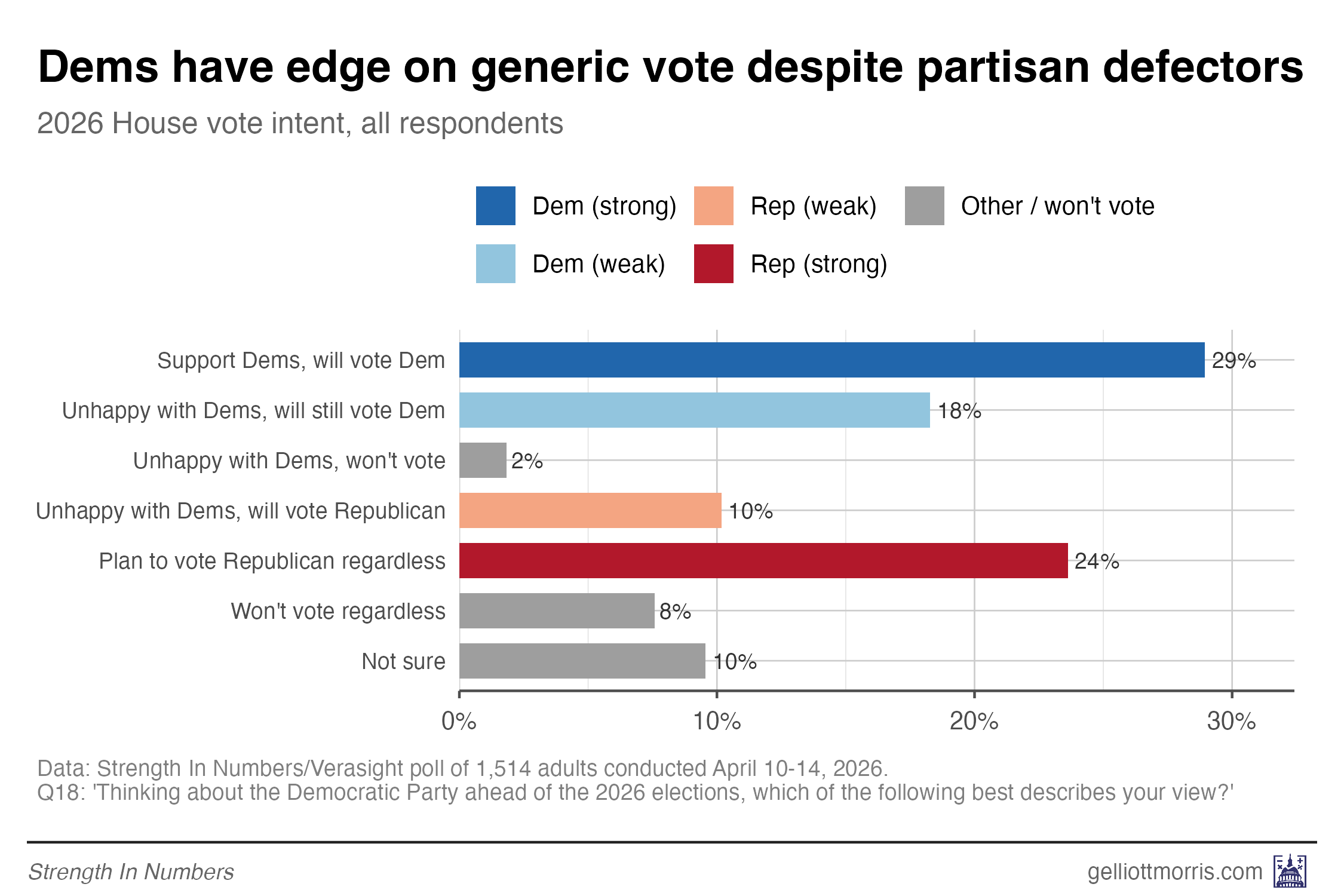
Adding the two Democratic buckets across all adults gets you to 47% who say they’ll vote for a Democrat in 2026 — 29% enthusiastically, plus another 18% unhappy but voting Democratic anyway. The two Republican buckets together come to 34%: 24% who plan to vote Republican regardless, and 10% who are unhappy with Democrats specifically and will cast a Republican ballot because of it.
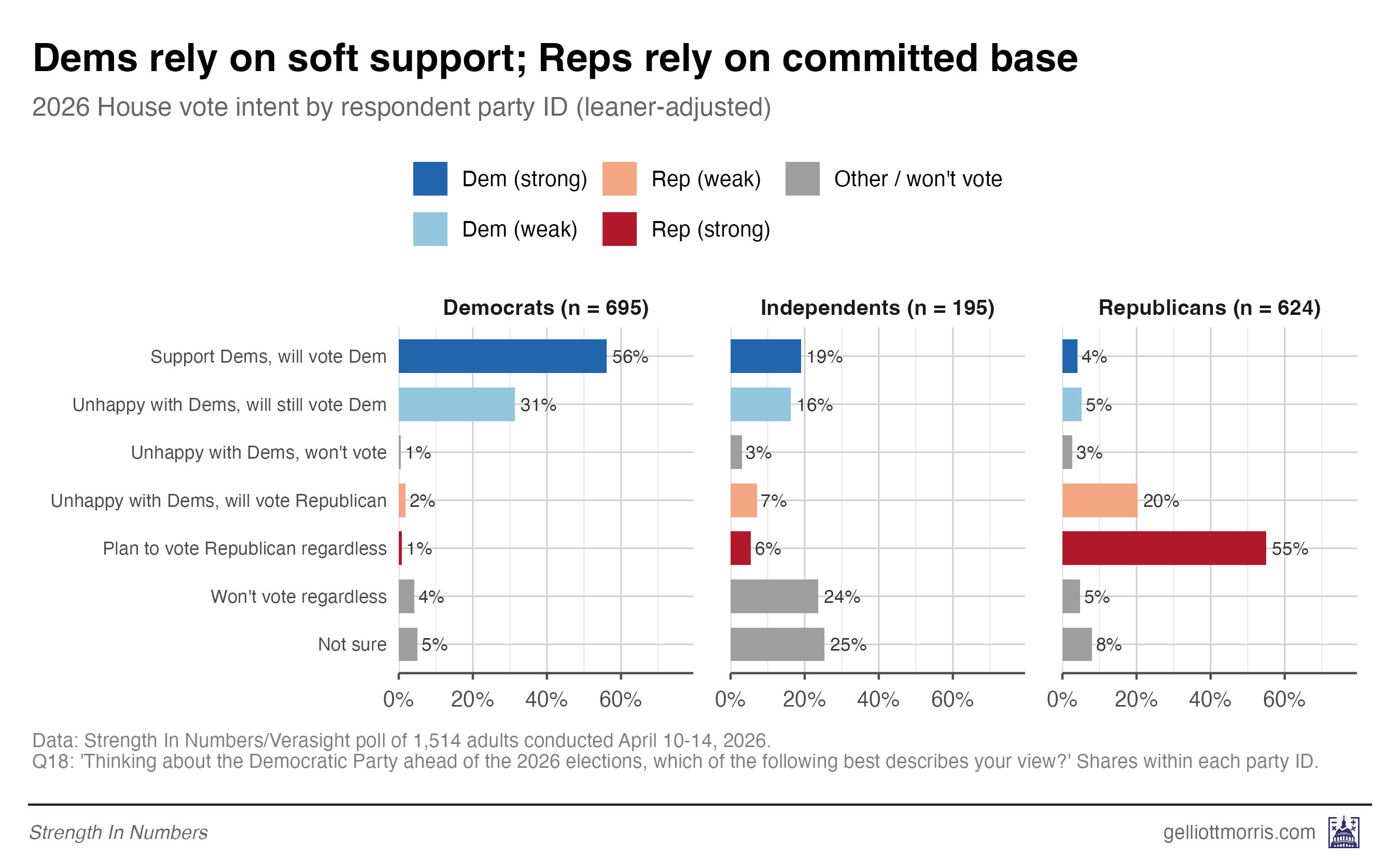
Break the question out by party, and those old stressors on the Democratic Party brand show up again. Republicans are comparatively much more consolidated in the committed lane than Democrats are.
But, as I argued last year, this has little to no bearing on election results. Few true swing voters say they would vote Republican because they’re unhappy with Democrats. Very few self-described Democrats say they would vote red because they’re unhappy with the party; instead, that’s all coming from the right:
Another way to look at this is to break down the 2026 vote question by the favorability rating of the parties:
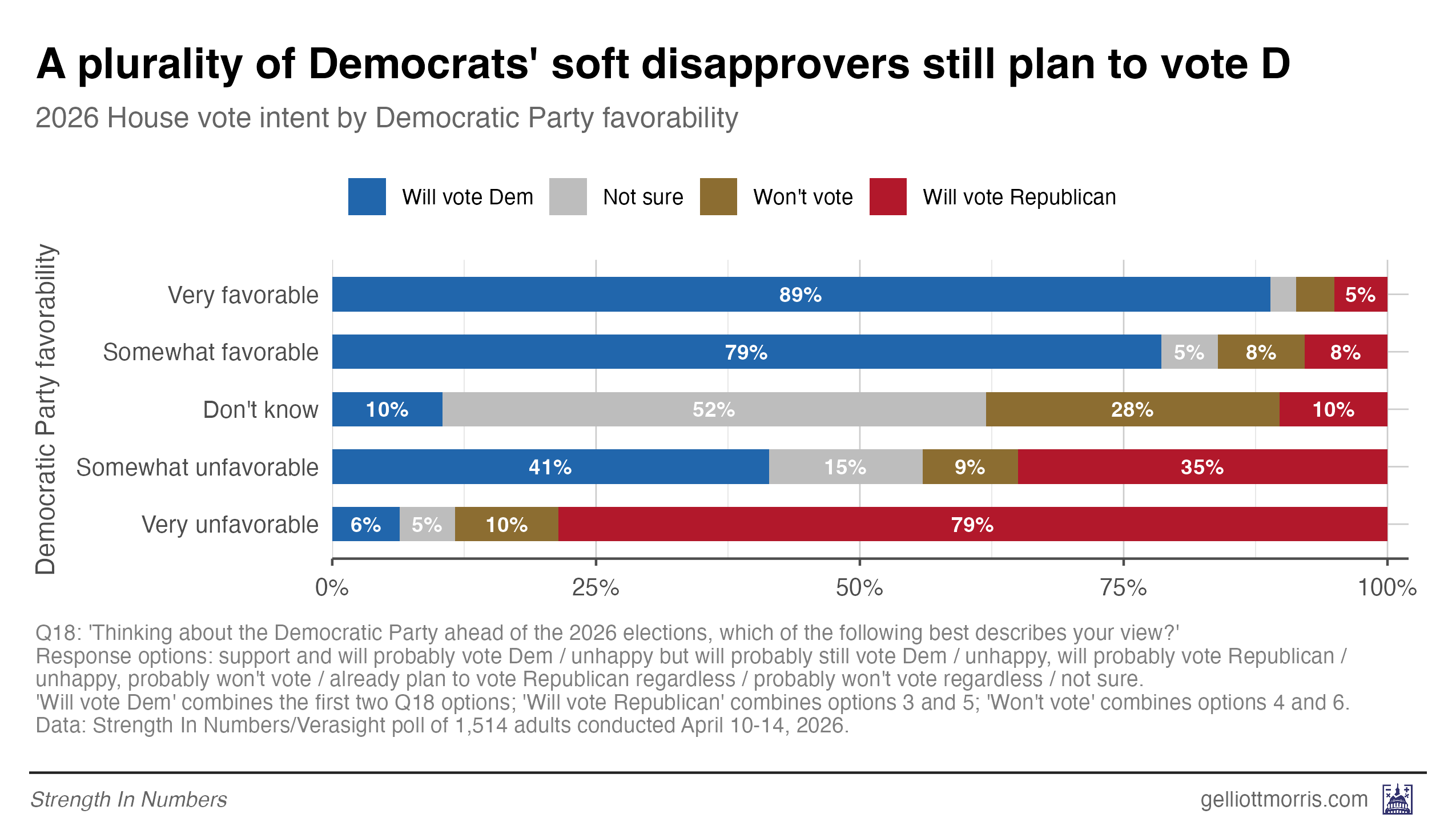
Of the 735 respondents who say they have an unfavorable view of the Democratic Party, 16% say they’ll vote for Democratic candidates next year anyway — “unhappy, but will still vote for them,” while an additional 25% are committed to Democrats and like what they’re doing. with the unhappy-but-voting-anyway group). Just 35% plan to vote Republican.
A “somewhat unfavorable” rating of the Democratic Party is not a Republican vote. For a meaningful share of American voters, the favorability rating question is a way to register complaints against a party you are committed to.
Understanding the parties’ brand weakness
Favorability rating is a common question in polling, but it suffers from being overly general. What we really want to know is what voters think defines each party's brand.
So we also asked respondents to tell us how well each of a selection of traits describe either party. As expected based on the favorability numbers, Democrats mostly win on the positive traits, while voters say Republicans possess more of the negative ones.
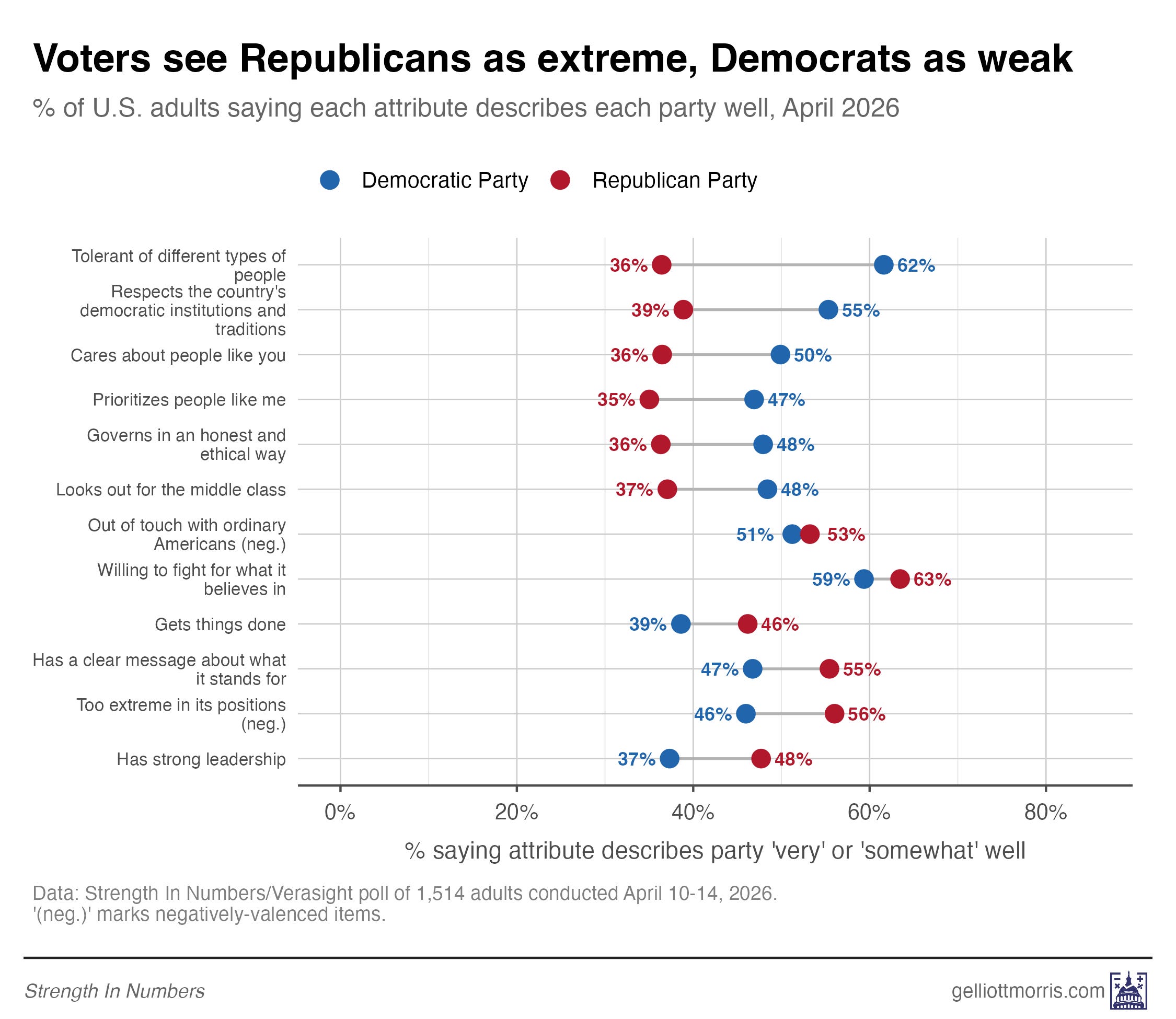
Voters say Democrats are more tolerant, democratic, and likely to care about people like them than say that of Republicans. 62% of Americans say the trait “tolerant of different types of people” describes the Democratic Party well, against 36% who say so of the GOP — a 26-point gap. Democrats also lead on respects democratic institutions (55% vs 39%, D+16), cares about people like you (50% vs 36%, D+14), prioritizes people like me (47% vs 35%, D+12), honest and ethical (48% vs 36%, D+12), and looks out for the middle class (48% vs 37%, D+11).
But Republicans win on qualities associated with strength, though by smaller margins. 55% say the GOP has a clear message, against 47% for Democrats (R+8). 48% say Republicans have strong leadership, against just 37% for Democrats (R+11) — the largest single GOP advantage on the list. Republicans also edge Democrats on “gets things done” (46% vs 39%, R+7) and “willing to fight for what it believes in” (63% vs 59%, R+4).
On the two explicitly negative items we asked about, Republicans come out worse on both. 56% say the Republican Party is “too extreme in its positions,” against 46% who say the same of Democrats. And 53% call the GOP “out of touch with ordinary Americans,” against 51% for Democrats — effectively a tie.
As I wrote back in February, the Democratic brand is not predominantly woke, but weak. Respondents to our survey associated the Democrats with traits like honesty and caring about the working class, but they are seen as weak and not particularly effective. The Republican brand, by contrast, is a strong brand that a majority of the country finds extreme.
Zooming in now on political independents — who are the actual persuasion targets in elections — the same pattern holds. If anything, on most items it’s even more pronounced.
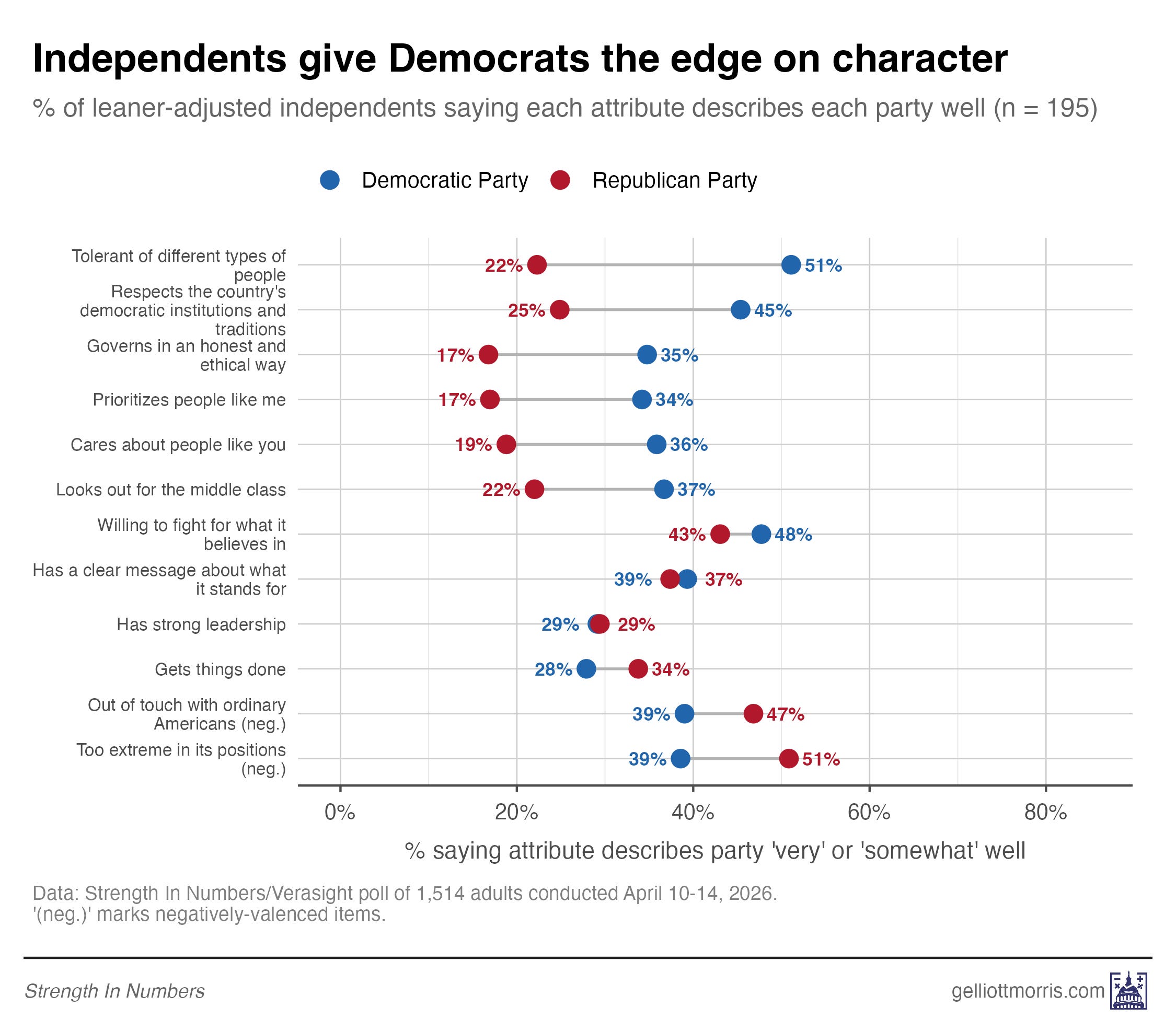
Independents give Democrats the edge on tolerance, honesty, caring about ordinary people, respecting institutions, and looking out for the middle class. Republicans hold their advantage on strong leadership, clear messaging, and getting things done — though the margins shrink compared to all adults. And independents view the Republicans as “too extreme,” just like the general public does.
That helps explain why Democrats’ -3 favorability is running 13 points ahead of the GOP’s -16. Independents don’t love Democrats; they just trust them more and feel better represented by them. And that’s despite the large gap in the leadership questions.
One more look at the “strong leadership” gap before we move on. We asked respondents to name, in their own words, a political figure whose values they share. Among Republican respondents, Donald Trump and JD Vance dominate — no one else is anywhere close.
Democrats, however, are much more split over which political figures embody their values. Among Democratic mentions, no single name gets anywhere near the share Trump commands. Left-leaning candidates such as Bernie Sanders, Alexandria Ocasio-Cortez, and Zohran Mamdani lead the pack, with more traditional voices including Barack Obama, Pete Buttigieg, Kamala Harris, and Gavin Newsom coming in close behind.
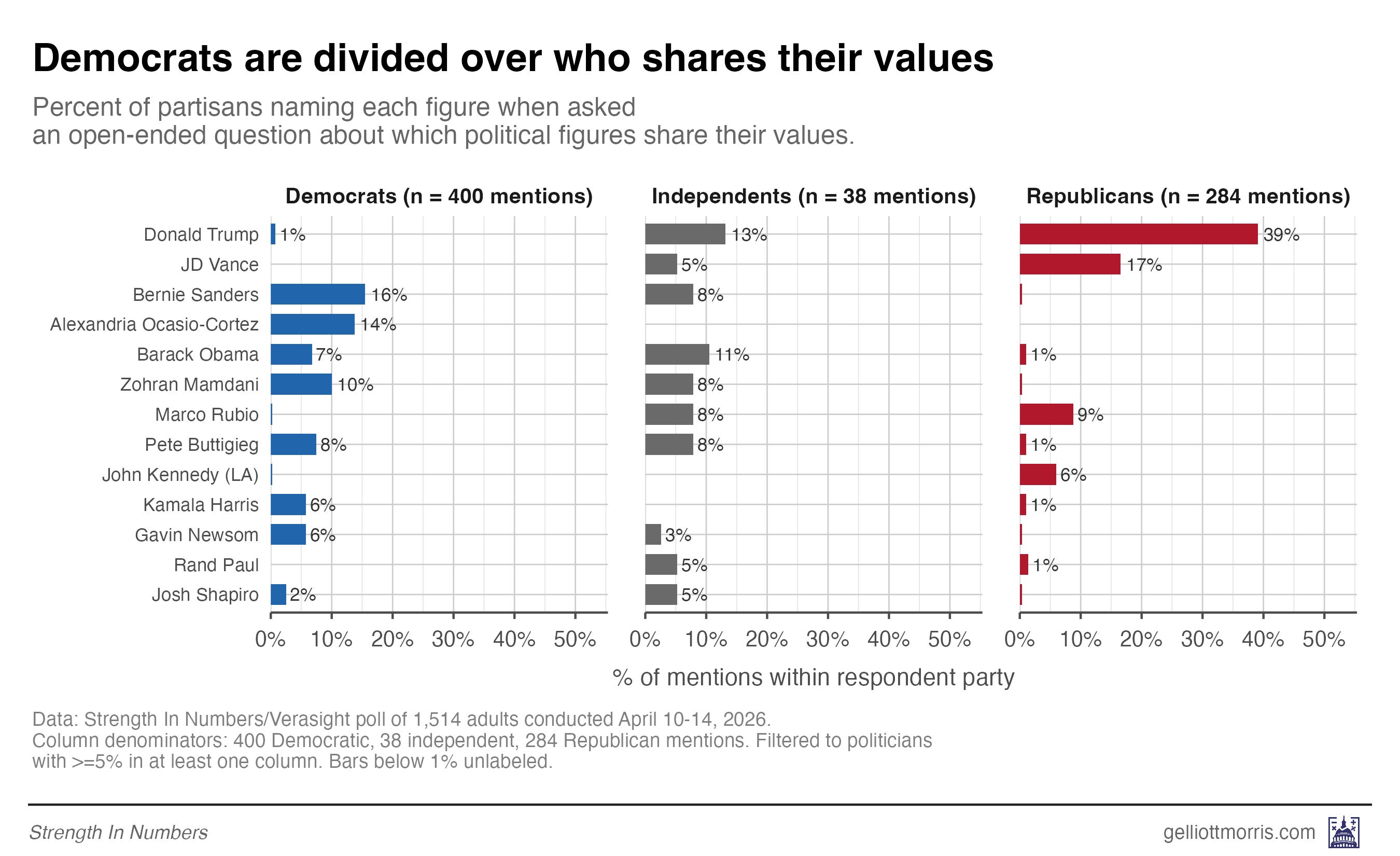
This compounds a problem for the party. It’s no wonder that so many voters think it has weak leadership when it doesn’t even have a clear leader.
What Democrats’ own voters want: for them to fight harder
So if Democrats have a “weak” problem, what can they do about it? The most revealing question in our whole poll is probably the following open-ended survey item. We asked every respondent to describe, in their own words, a recent thing the Democratic Party did that upset them. We hand-categorized the substantive answers into the buckets below.
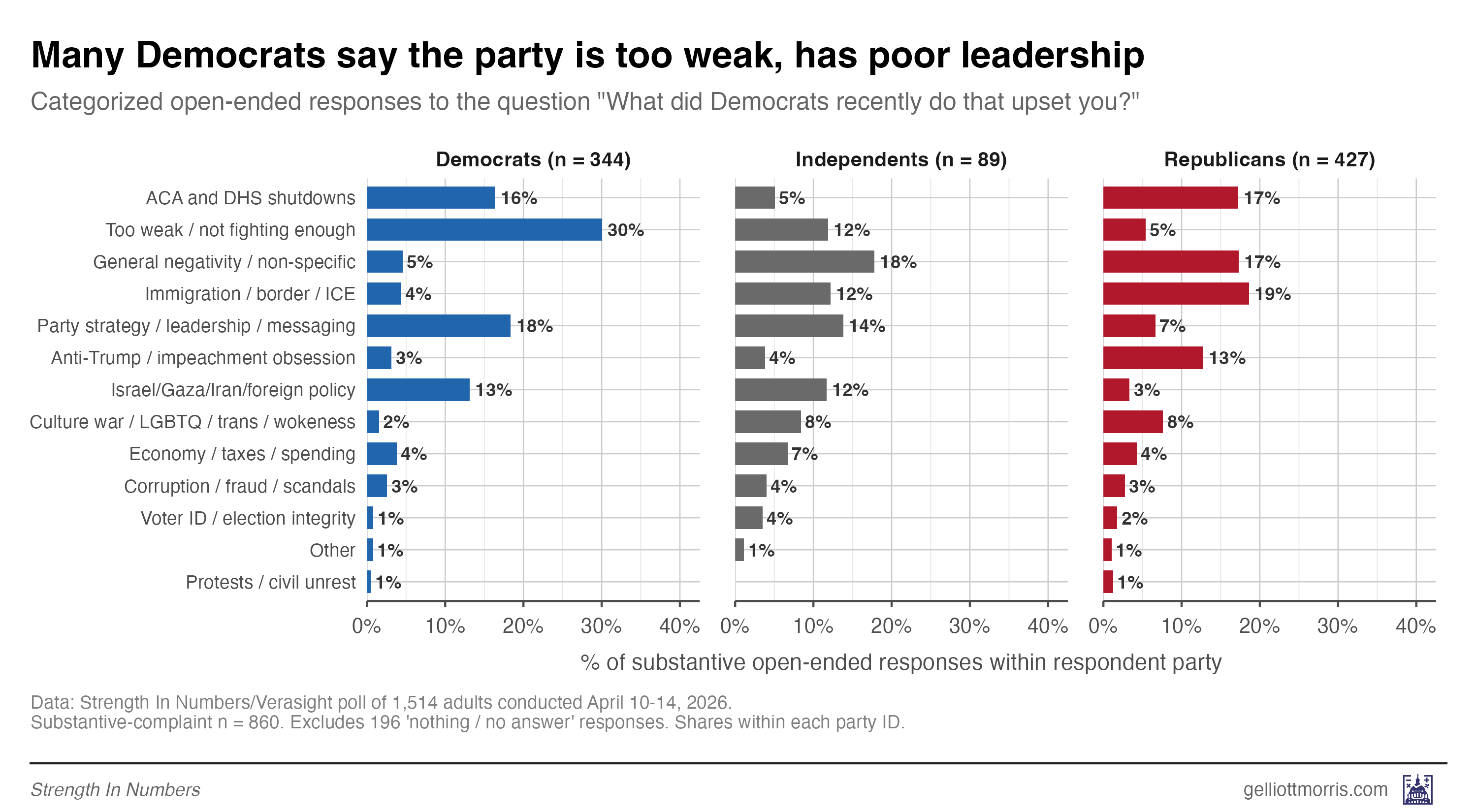
Among Democratic respondents, the single most common complaint about their own party is that it is too weak, too cautious, or not fighting hard enough — 30% of substantive answers fall into that bucket, and another 17% are still mad about the party caving in last fall’s shutdown fight without winning an extension of ACA premium subsidies (a few also cite the failure to extract concessions on ICE). That runs ahead of every substantive policy concern, including on immigration, the economy, Israel/Gaza — you name it.
And we don’t have to guess who Democrats want their party to fight. Of the 103 Democratic respondents whose answers fell into the “fight harder” bucket, more than half named Trump or his administration directly — “not standing up to Trump,” “letting Trump run amok,” “strongly worded letters are not action,” etc. A handful said they wanted the president impeached. One person said the party was “bending the knee” on the One Big Beautiful Bill. While a small single-digit percentage of Democrats said they wanted their party to moderate on cultural issues, the dominant ask is visible, sustained opposition to the president and his party.
“What upsets me the most right now about the Democrats right now is that they don’t have a clear message. I used to consider myself a strong democrat and I really don’t anymore as a result.” — Democrat
“Weak leadership. Lack of focus.” — Independent
“The party leadership consistently takes positions that are opposed to the vast majority of Democratic party voters … they try to skirt by by being ‘not as bad as Trump’.” — Independent
“They have failed to present a unified front to counter Republican insanity.” — Democrat
Independents land somewhere different. Their complaints cluster around general dissatisfaction and messaging — the sense that they don’t know what Democrats stand for or what the party is actually trying to do. Two specific themes show up that don’t appear in the Democratic column: The first is a lingering Biden grievance: independents in our open-end repeatedly cite the party “lying about Biden’s health,” keeping his campaign going “far too long,” and “anointing” Kamala Harris as the nominee without a competitive process. The second is a leadership vacuum complaint — variations on “lack of leadership” and “I don’t know what they stand for.”
Some independents do echo the Democratic “fight harder” critique, but it’s much smaller in volume (11 mentions vs 103 among Democrats). These voters chastised Democrats for not impeaching Trump, “not pushing hard enough back and folding under pressure.” Independents are not asking Democrats to move left or right. They’re asking the party to look like a coherent operation with someone in charge.
Another thing worth highlighting is that the Republican immigration column is largely just retrospective grievance. Roughly half of Republican respondents who mentioned something about immigration cited the Biden-era immigration surge — “letting millions of illegals into the country,” “open the borders with biden,” “they failed to secure the border” — rather than any recent Democratic action.
Most of the rest of Republican responses on immigration fall into one of two themes: that Democrats prioritize “illegals over Americans” (the modal phrasing on the right), and that Democrats are now actively obstructing ICE — sanctuary policies, blocking deportations, “stop funding ICE.” A smaller cluster folds the SAVE Act / voter ID into the bucket, framing Democratic opposition to it as pro-noncitizen-voting. But mostly, Republicans were just upset about “open borders” under Biden.
On the shutdown bucket, note that Democrats and Republicans are mad at Democrats for opposite reasons. Democrats are upset that the party “caved” on recent shutdowns, especially the one in fall 2025 over health care funding. Democratic voters wanted their party to keep fighting for health care, but they reopened the government without winning an extension of ACA subsidies (or, more recently, on any immediate concessions on ICE). Republicans, on the other hand, are are upset that the party caused the shutdown in the first place by refusing to fund DHS and holding up TSA paychecks.
It is notable that independents don’t really care about the shutdowns.
Democrats are not unpopular. They’re unsatisfying.
What all of this suggests is that Democrats do not have the problem many political narratives say they do. The party’s core weakness is not that voters see it as elitist or too extreme; it is that too many voters, including their own, see Democratic politicians as unmoored, passive, and ineffective. Republicans, by contrast, still project the kind of strength and clarity that voters often reward — though their extremism is a huge drag on votes.
More Americans see the GOP as extreme, out of touch, and worthy of intense dislike. That is why Democrats can be underwater on their favorability and still in a stronger electoral position overall.
The strategic implications here are straightforward. Democrats do not need to reinvent themselves ideologically nearly as much as they need to convince voters they can act with purpose and deliver on their promises. Their own supporters are not begging for moderation so much as urgency; independents, too, have fewer specific ideological qualms with the party as they do personal germane criticism. They are not demanding a lurch left or right so much as evidence of leadership, coherence, and fight.
In a political environment where neither party is broadly beloved, voters must know you stand for something — and for standing up for it, too. The Democrats have made a lot of progress on these numbers over the last year. But a perception of weakness is still its biggest one.
The April Strength In Numbers/Verasight poll surveyed 1,514 U.S. adults online between April 10 and April 14, 2026. The margin of error for the full sample is ±2.6 percentage points. Full methodology and crosstabs are available at gelliottmorris.com/poll.
If you made it this far: Strength In Numbers is subscriber-supported. If this work is useful to you, upgrade to a paid subscription to keep independent polling alive — and to get the full crosstabs and Tuesday Deep Dives.
Sometimes I just want to gouge my eyes out and bang my head against a wall.
As far as Democrats being "weak" and "not fighting hard enough", well that has a LOT to do with the fact that we are a minority in both houses of congress and don't hold the White House.
Next question: how would Democrats demonstrate "strength" and fighting "back" when we're NOT. IN. POWER?
Maybe by causing a government shutdown to highlight the loss of ACA healthcare subsidies? Maybe by legislating voter-approved gerrymander measures to fight back against the clear corruption of Trump-ordered redistricting?!?!
Republicans are "strong" and "get things done" because they have taken over the Supreme Court (who essentially have granted Trump amnesty to do anything he wants without consequences) and vote for everything Trump wants, no matter how illegal or immoral or economically damaging it is. Trump blasts through every law and Constitutional norm and Republican lawmakers lay down and roll over. But I guess that's demonstrating "strength" to some voters?
Maybe it's time for voters (and all citizens) to participate in our democracy by reading about how our government works and which party has better ideas for how to address the issues that matter most to the American people. Then they need to write/call their reps (it would certainly help if they know WHO their reps are), maybe attend a town hall, and finally CAST AN INFORMED VOTE in every election.
Or maybe I'm just expecting too much.
The inherent asymmetry is Republicans are willing to do things Democrats should and could not. To win the fall shutdown, Trump and Rs took away food stamps, something Democrats could and shouldn’t abide.
The framing should have been:
“Republicans are starving kids to take away your health care.”
I didn’t hear one Democrat saying this in those terms.
But framing requires some honesty by the media, and when so much of media repeats Republican talking points, this becomes nearly impossible.