


Programming note: I have a pressing family event this Saturday so there will be no Sunday roundup this weekend. I will also probably miss out on producing a crowdsourced estimate of the third No Kings demonstrations like I did for the first two, though precise details are TBD and things might work out. If I do get the data, I’ll post here so you don’t miss it!
I’m still figuring out how to take time off when you have no boss (or when 64,000 people are all your bosses at once!), but I hope you’ll appreciate that I’m one human and things come up.
However, I’m not leaving you completely empty-handed. Saturday morning, you’ll get a short bonus podcast episode from me that answers two questions about the midterms that we couldn’t fit into the normal podcast this week. And next week, I’ll have a Deep Dive on the Democrats’ generic ballot issues on Tuesday.
On with the polls! Elliott
This is the second release from the March 2026 monthly Strength In Numbers/Verasight poll. You can read the main poll release here. You can read our previous poll releases here. Subscribers to Strength In Numbers have access to additional tracking visuals and a full archive of crosstabs here.
This article is free to read, but it was not free to produce. If you have the budget to support this type of independent, data-driven political journalism, please become a paying member today. If that’s not possible for you right now, the best thing you can do is share this post with a friend to help the newsletter grow. There is strength in numbers!
In our new March Strength In Numbers/Verasight poll, 13% of Americans who cast ballots for Donald Trump in 2024 say they regret how they voted in the last election. Among Harris voters, just 6% say the same.
The regret is concentrated in exactly the groups that expanded Trump’s coalition in 2024 — young voters, Hispanic voters, and lower-income voters — and regretful Trump voters are far more willing to leave his coalition than regretful Harris voters are to leave hers. That asymmetry is the most important finding in this month’s poll; it is another data point about the fragility of the coalition that elected Donald Trump in 2024.
This week’s Chart of the Week: One out of every eight 2024 Trump voters has buyer’s remorse. And How would America vote today if it got a 2024 redo? I present the polling and explain the math on a hypothetical do-over election.
Trump voters are more regretful than Harris voters
We asked regretful voters what they’d do if they could go back to 2024 and vote over again. Here are the results, broken down by who respondents said they voted for in 2024:1
Among Trump voters who regretted their vote:
28% said they’d switch to Harris
31% said they’d still vote for Trump
28% said they’d vote for a third-party candidate
10% said they wouldn’t vote at all
3% said they didn’t know
Among Harris voters who regretted their vote:
53% said they’d still vote for Harris
25% said they’d switch to Trump
10% said they’d vote for a third-party candidate
10% said they wouldn’t vote at all
3% said they didn’t know
Or, if you prefer a chart:
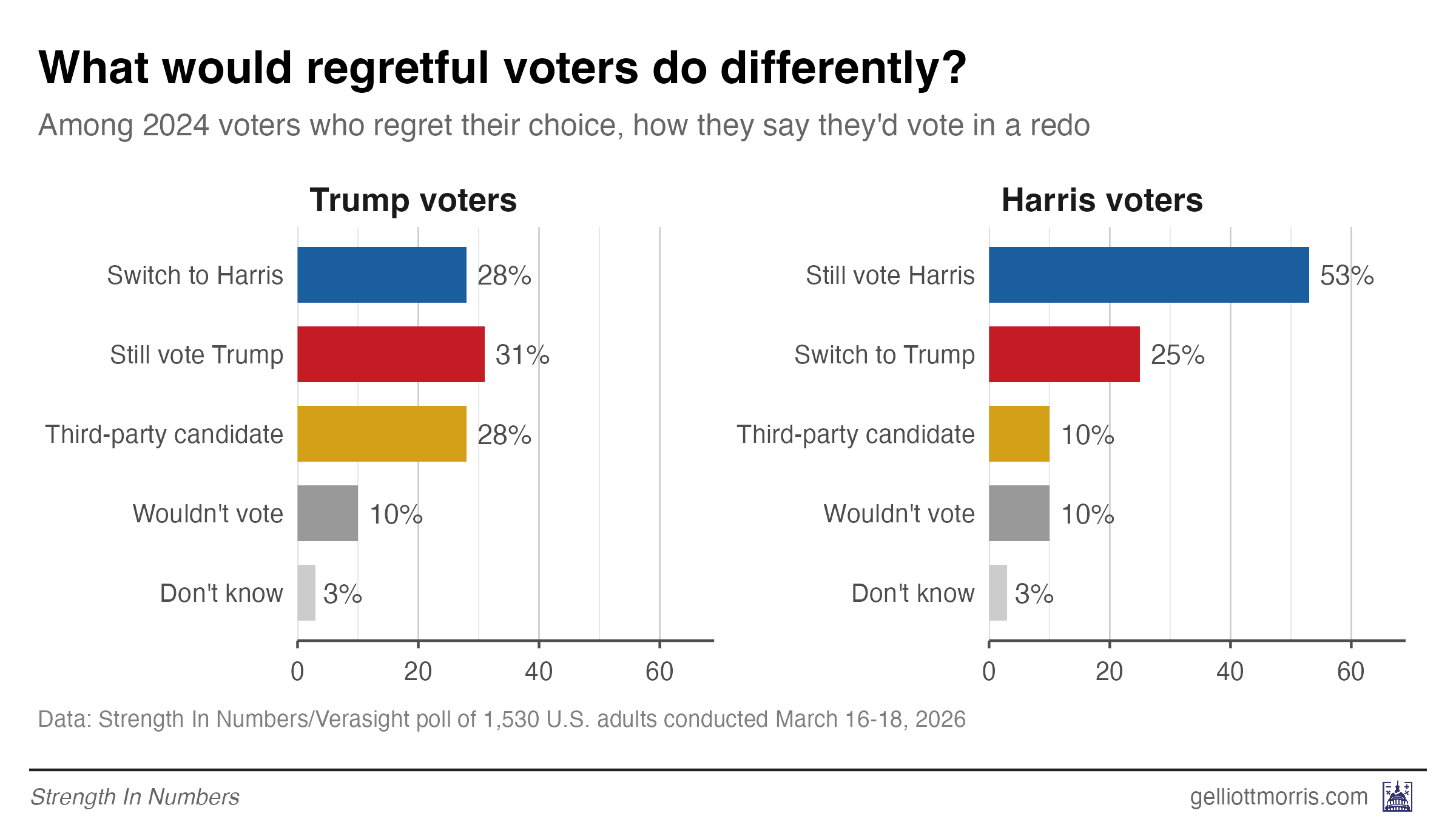
Regretful Trump voters split three ways, with roughly equal shares saying they would switch to Harris, stick with Trump, or leave for a third party. If you add up the non-Trump percentages, then 69% of Trump voters who say they regret their 2024 vote say they’d do something other than vote for him if they got the chance to do it again. Regretful Harris voters, meanwhile, mostly stick with Harris: a majority say they would vote for her again, and just a quarter would switch to Trump.
I have two reactions to this data. First, why would someone vote for someone in a hypothetical redo if they regretted voting for them in the first place? Maybe they just regret having to vote for them, but they still prefer doing so. Or maybe there is some level of survey measurement error going on here (see the footnotes for more).
Second — and this is the real point of this article — the partisan asymmetry in the 2024 vote regret really matters for electoral strategy and narrative purposes. If we do the math on a 2024 election, given the above percentages, Harris wins a clear victory.
The 2024 election on Earth-2
If people voted the same way they say they would in this poll, what would have happened in 2024? Specifically, who would have won the popular vote?
This hypothetical is worth answering for three reasons. First, it shows us how even “small” regret percentages (13% is not an obviously high number) can have big impacts on close elections. Second, it adds some stakes to the numbers. And third, it’s fun!
Here’s how we do the math. First, start with the results of the 2024 race: Trump won 49.8% of the popular vote, versus 48.3% for Harris. That makes Trump’s margin about 1.5 points.
Next, we account for vote-switching and turnout effects from the regret percentages above. (Shout-out to Strength In Numbers Discord user Esker for first spelling out this math in our server this week.) For each candidate’s voters, we subtract votes based on whether someone is switching to the other side, or to another party or not at all. A voter who switches candidates swings the margin by 2 votes (one fewer for their side, one more for the other), whereas a voter who moves to a third party or stays home costs their candidate 1 point without helping the opponent.
So the full math for Trump defectors is:
0.498 original vote × 0.129 defection rate × (2 × 0.277 switch to Harris + 1 × 0.409 switch to other/non-voter) = 6.2 points swing toward Harris
And for Harris defectors, the math is:
0.483 × 0.060 × (2 × 0.246 + 1 × 0.224) = 2.1 points swing toward Trump
Add those two together, and you get a net 6.2 − 2.1 = 4.1 points swing toward Harris. Applied to Trump’s 1.5-point margin, that flips the popular vote to roughly Harris +2.6 percentage points.
Where the party coalitions are cracking
2024 vote regret is higher among the groups that powered Trump’s 2024 victory. Let’s go group-by-group:
Young voters: 17% of voters ages 18-29 expressed regret for the 2024 vote, compared to just 4% of voters 65 and older. Voters 30-44 were close behind at 15%. Young voters were one of Trump’s signature gains in 2024, but the cohort is showing buyer’s remorse at four times the rate of the oldest.
Hispanic voters: 16% of Hispanic voters expressed regret — the highest rate of any racial group we tested. Black voters were next at 14%, followed by white voters at just 8%.
Lower-income voters: 11% of voters earning under $50,000 expressed regret. Among those earning $100,000–$150,000, just 6%. Prices are the top concern in our poll, and the voters feeling it most are the ones most likely to regret their choice.
The most interesting thing from this polling isn’t the raw regret percentages; it’s the tendency for regretful Trump voters to scatter across all the other options available to them. And the asymmetry is notable too: Regretful Trump voters split roughly into thirds (Harris, Trump, third-party/exit), whereas regretful Harris voters consolidated back to her. Trump voters who say they regret voting for him are comparatively less likely to say they’d vote for Harris or not vote at all, pushing up the percentage who say they’d instead vote for “someone else.”
This data also serves as a reminder that to win elections, campaigns should employ both vote-switching and vote-churning strategies. Persuasion is powerful because it’s worth twice as much as dropoff, but in close elections, depriving your opponent of even one net vote (rather than winning two) can make all the difference.
If you’re a frequent reader of Strength In Numbers, I’m confident you will get a lot of value out of a paid subscription. You’ll get access to all of my analysis, including weekly Tuesday Deep Dives, and you’ll be supporting independent data journalism.
Related Articles


Footnotes
Wonky note (wonk level 10/10): The Strength In Numbers/Verasight poll interviews U.S. adults who have enrolled in Verasight’s online panel to take surveys we send to them. Respondents tell Verasight their 2024 vote when enrolling in the panel, sometimes years ago — rather than at the time this survey was fielded.
This is relevant because it’s somewhat nonsensical that someone would say they “regret” how they vote and then tell us they’d vote for the same person now that they previously told Verasight they voted for! One hypothesis is that some of these voters are trying to mentally change who they voted for in the past — for example, the “Harris” voter who says they regret voting for her but would vote for her again might be acting now as if they were a Trump voter. Another hypothesis is that the user mis-clicked or wasn’t paying attention, or that there’s measurement error in the survey somewhere (maybe people didn’t know what “regret” meant?.
Do your family event, Mr. Morris.
I am sure I speak for all of us.
Here's your hall pass.
Take time off when you need it. Rest is important to keep doing the vital work you are doing. We don't want you to burn out. Stay healthy!