


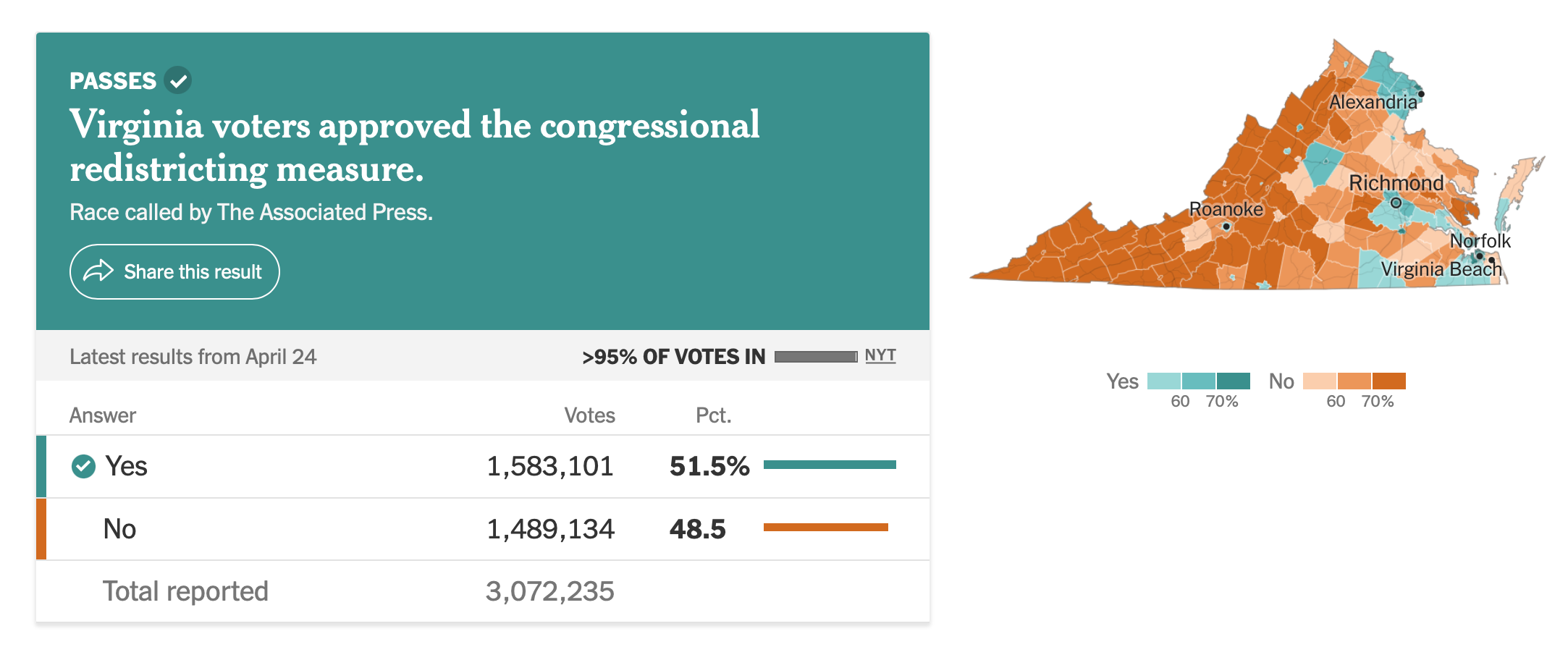
A ballot measure to gerrymander Virginia’s congressional districts passed on Tuesday, April 21, with a narrow three-point margin of victory. The new map — which a Republican state judge temporarily paused on April 22 — would give Democrats 10 of the state’s 11 seats, up from their current six. (For context, Democratic governor Abigail Spanberger won the statewide popular vote by 15 points last November, and Kamala Harris won the state by six points in 2024.)
Republicans are using the results of the referendum (which polling I helped conduct had at +5 in mid-April) to argue that they can hold on to their majority in the U.S. House of Representatives this November. Republican pollster Patrick Ruffini made the optimistic case last week in a piece titled “How to avoid a midterm blowout”:
Virginia provides Republicans with a rare optimistic counterpoint to the building narrative of a Blue Wave. If the fight is framed the right way, Republican voters will turn out the same or better relative to Democrats than 2024, even with an unpopular president in the White House. And if they recreate this performance even to some degree, they are virtually assured control of the U.S. Senate and will hold their own in the House, with a fighting chance to keep their majority.
“If the fight is framed the right way” is doing a lot of work in this paragraph. Ruffini goes on to argue that Republicans can win in the midterms if they make the election feel less like a referendum on Trump and more like a high-stakes fight over what Democrats would do with power. He continues:
Republicans beating the spread has less to do with coming up with better defenses of Trump’s policies than it does with getting Republican voters off the sidelines by convincing them that giving Democrats power is really a threat. [...] That could be around border security, deportations of criminal illegal aliens, or showing how their policies would increase costs for the average American—making the case that this was exactly what happened when they were last in power.
Ruffini says Republicans need “the kind of scorched earth campaign that Trump enjoys and knows how to run” to get Republican voters to show up in November.
In this telling, the GOP’s big problem for 2026 isn’t that its coalition has collapsed — i.e., voters have changed their minds about which party they align with and thus who they vote for — but that right-leaning voters haven’t yet been given a concrete enough reason to show up (i.e., they are low turnout). The Virginia referendum, because it put the consequences of Democratic power directly on the ballot, supposedly offers a model for how Republicans can re-mobilize their side.
The Ruffini theory boils down to one big assertion: that Republicans haven’t really done anything voters don’t like, and thus aren’t driving down their share of the vote among 2024 voters — their voters just aren’t turning out.
That’s huge, if it’s true! So let’s see what the data has to say.
In this week’s Deep Dive, I look at individual-level turnout records for regular and special elections conducted in 2025 and 2026 and show the Republican Party’s problem is bigger than couch potatoes. Since 2024, Democrats have been consistently better at both winning over vote-switchers and getting their voters back to the polls. That’s true in both low-turnout and high-turnout contests. The Virginia referendum is a noisy, probably biased measure of Democratic strength, and reading too much into it both misses this moment in politics and produces bad strategy.
1. “Yes” was not the same thing as “Democrat”
Before diving into the data, here is an obvious but important point: A referendum asking voters to authorize a pro-Democratic gerrymander is not a clean proxy for a Democratic-versus-Republican election.
In a normal contest, voting Democratic is a partisan signal. In this referendum, however, voting “Yes” meant not just voting for a Democrat, but endorsing mid-decade redistricting. And voters were not asked to support any old gerrymander, but to also bypass the usual process in a state in which reformers fought hard to establish a bipartisan redistricting commission, and for a greedy, greedy gerrymander (whether you agree with it or not, going for 90% seats for a party that wins at best 55% of the vote is definitionally far-reaching; Texas Republicans “just” went for 76%!).
So the ballot initiative effectively bundled two different questions:
Do you want Democrats to gain House seats?
Are you comfortable with Democrats doing it through an aggressive, mid-decade gerrymander?
Presumably, all Democrats would say “yes” to the first question. But plenty of Democratic-leaning voters answer “yes” to the first and “not really” to the second. Those voters are still very likely to vote Democratic for Congress in November even if they voted “No” on the referendum, skipped the question, or were less motivated to show up for it.
Plus, many political independents also evidently agreed with the first statement and not with the second; the State Navigate poll (fielded April 10-13) showed true independents breaking hard against the referendum — 56% against and 32% for. Those same independents had favored Spanberger by 24 points in our late October 2025 poll.
And this is the problem with treating the referendum as a proxy for partisan preference. The same voter who voted for Spanberger in a normal partisan election may be unwilling to authorize a Democratic gerrymander five months later. What is the better proxy for how they’ll vote in November: the confusing, aggressive gerrymander (with very pro-”yes” language, by the way), or the most recent major D-vs-R contest in the state?
So yes, the referendum was close. But a close win on a polarizing procedural question is not the same thing as a close Democratic performance in a normal election. If anything, the “Yes” margin is a lower-bound estimate of Democratic strength — it excludes the voters who pull the lever for Democratic candidates but balk at gerrymandering as a tactic. Ruffini says this election proves a path for Republicans to hold the House in November. But this is a maximally favorable example for that case.
2. Turnout is not doing most of the work for Democrats in 2025/26
The bigger problem with Ruffini’s theory, though, is the turnout data itself. I booted up the voter file to check some numbers, and the data suggests the simple story “Democrats are winning because their voters are turning out and Republicans are staying home” is just factually wrong.
Turnout matters, but it’s not doing most of the work; real vote-switching is. Democrats improved their vote share relative to 2024 in every major 2025 election, both special and regularly scheduled. But the change in the partisan composition of the electorate explains only a minority of that improvement. Now, it’s data time.
Start with New Jersey’s governor race. Ignoring votes cast for minor-party candidates (we call this the “two-party vote” in political science), Democrats increased their share of the vote from 53% in 2024 (Harris) to 57% in 2025 (Mikie Sherrill). That’s a sizable 4-point gain in vote share; for context, Trump did about 3 points better nationally in 2024 than he did in 2020.
