


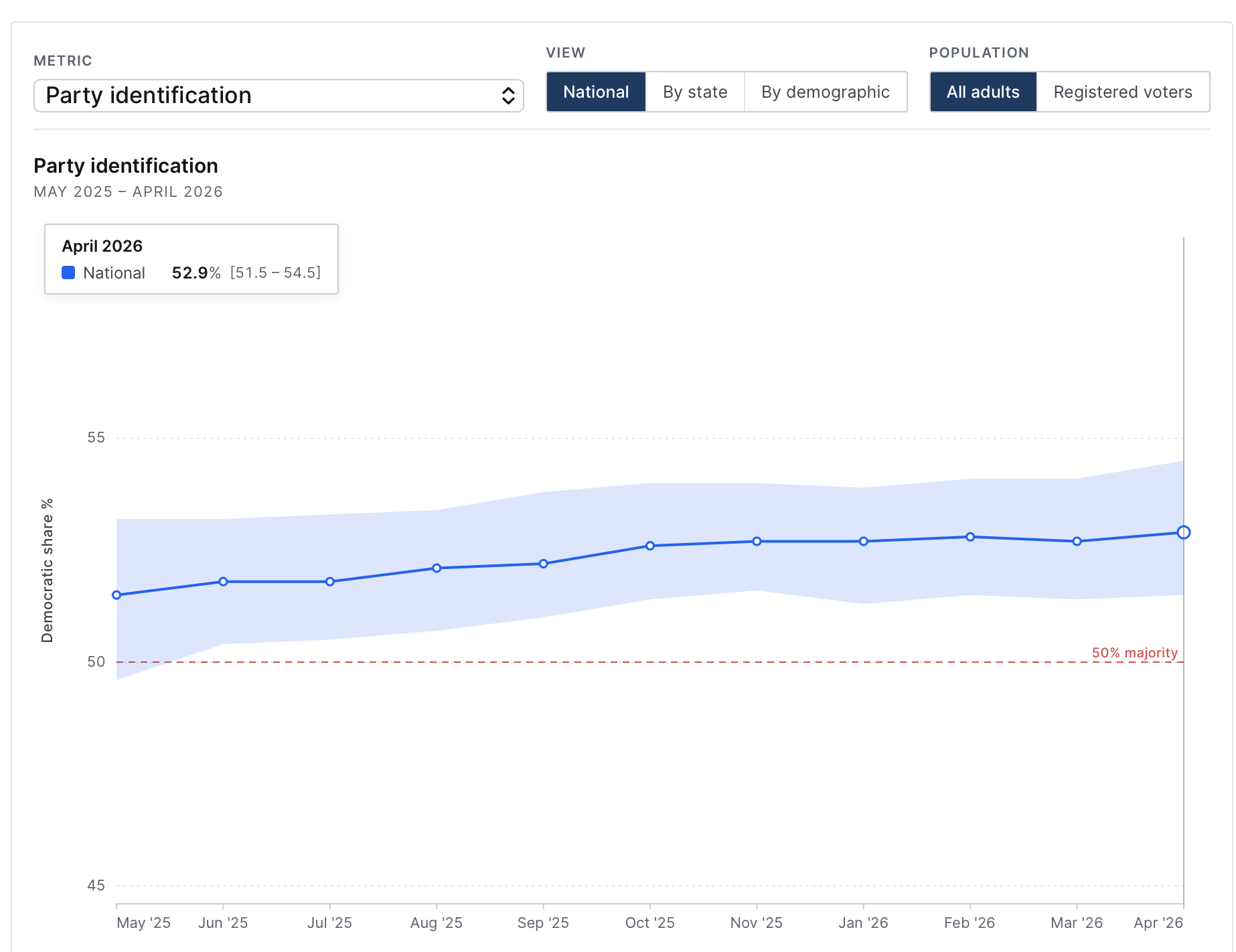
Last month, I unveiled new modeling of our Strength In Numbers/Verasight raw polling data that found Donald Trump’s job approval rating underwater in 135 GOP-controlled House and Senate seats. The Republican Party is similarly underwater on the midterm generic ballot in dozens of congressional districts and key states, and by a 6-point margin fewer Americans identify with the GOP than Democrats. Here’s a screenshot of another project prototype I’ve been working on recently:
But if things are so dire for Trump and the Republicans, why are GOP members of Congress still voting with Trump the vast majority of the time? Wouldn’t we expect them to be more responsive to public opinion in the face of very probable electoral defeat in November? Why are they passing $1 billion funding bills for his White House ballroom, giving Immigration and Customs Enforcement more money, and letting him make war against Iran without authorization?
The simple answer may be that most members fear losing their individual seats in primary elections more than they fear losing power overall — namely, via swing-seat members losing general elections. And we see why this is a legit fear via the primary elections in Ohio and Indiana that were held on Tuesday, May 5, 2026.
First, some context: Last December, 21 Republican state senators in Indiana voted against a mid-decade redistricting plan requested by President Trump that would have redrawn the state’s congressional map to create two additional GOP House seatsahead of the 2026 midterms. The vote was one of the first significant intra-party defeats of Trump’s second term — and in such a red state, the loss came as quite a shock.
Then on Tuesday night in Indiana (as of writing this paragraph at 1:12 AM ET on Wed., May 6), six out of eight of those Republican state senators who voted against the gerrymandered maps lost their primaries — five of them to challengers the president had endorsed, as The Downballot’s Stephen Wolf noted on Bluesky.
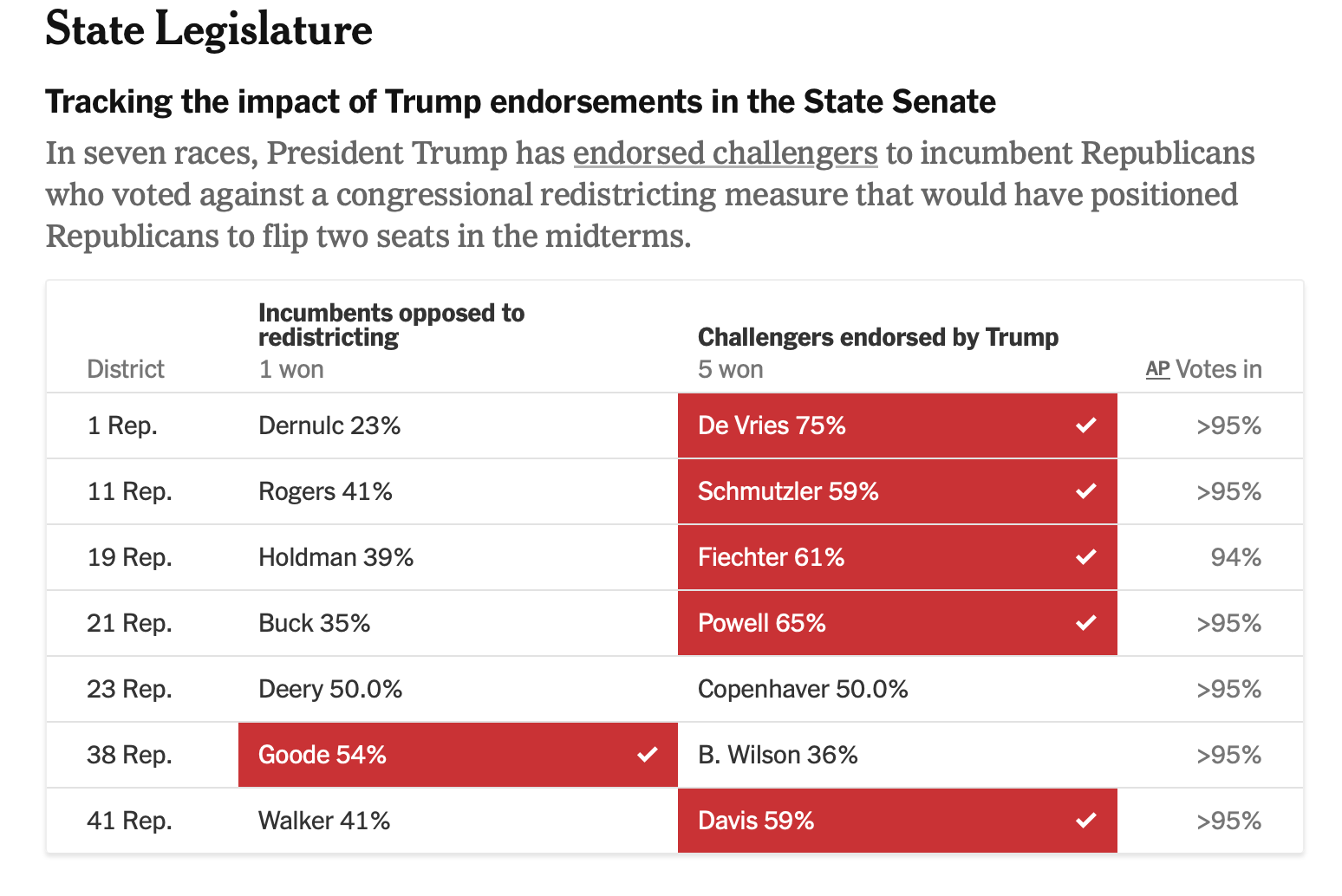
Since most state legislative incumbents seldom lose their primaries — the incumbent re-election rate is typically 95% or higher — these losses are notable. They were a direct test of how much sway Donald Trump still holds over the Republican base, and every other elected Republican in the country was watching. In the end, the results were not close.
Republicans are likely to control the Indiana state senate with roughly 40 seats to Democrats’ 10 after November’s elections. With these new six pro-redistricting votes, they will likely pass Trump’s new gerrymander before 2028.
I’ll have more to say in a column later this or next week about the new districting doom-loop playing out across the country. But for now, I want to explain how I think this episode illustrates a fundamental electoral tension for the GOP — one that is hard to impossible for members to escape, and which could lead to big losses in 2026 and 2028.
Safe seats, unstable majorities
I try to keep most of Strength In Numbers free because the news — what the polls say, what just happened in an election, etc — should be widely accessible; public data deserves public commentary. But premium analysis takes a lot of time, so I try to paywall a healthy number of posts for premium subscribers.
The rest of this piece connects the results in Indiana to the broader coalitional math heading into 2026 — including some thinking about how safe-seat Republicans are tanking their party’s future. To read it, become a paying subscriber for $10/ month, or $90/year if you’d rather pay once.
