


Strength In Numbers is a reader-supported publication. Paying members get articles like my weekly Deep Dive, bonus premium posts like this one, and access to polling crosstabs and trendlines before other readers. If you want more data-driven independent political journalism, join our community today as a paying subscriber.
The Democratic Party’s path to a majority in the U.S. House this November just got significantly narrower. On Friday morning, May 8, 2026, the Supreme Court of Virginia invalidated the redistricting referendum voters passed in April that would have given Democrats up to 4 additional seats in the U.S. House of Representatives (though they will likely pick up two anyway in a “blue wave” midterm).
Writing for the majority, Justice D. Arthur Kelsey declared the referendum "tainted" by a technical constitutional violation about when a general election actually happens — specifically, whether it's a single day or the whole multi-day voting process that includes early voting. Virginia's constitution requires the General Assembly to pass a proposed amendment, hold an intervening House of Delegates election, then pass it again. Clear enough, right?
Well, not according to Kelsey. The Commonwealth argued the relevant election was just Election Day (Nov. 4, 2025), so the legislature's Oct. 31 vote cleared the bar by four days. The Court rejected that, holding that an "election" encompasses the combined act of casting and receiving early, absentee, and in-person ballots across the entire voting window. Because early voting had begun Sept. 19, the Court ruled the Oct. 31 vote came in the middle of the intervening election rather than before it, thus invalidating the amendment and the new map.
So now we are left with the following map of the number of seats targeted by Democrats and Republicans (drawn by The Downballot’s Stephen Wolf), in eight states that have new maps in place for 2026.
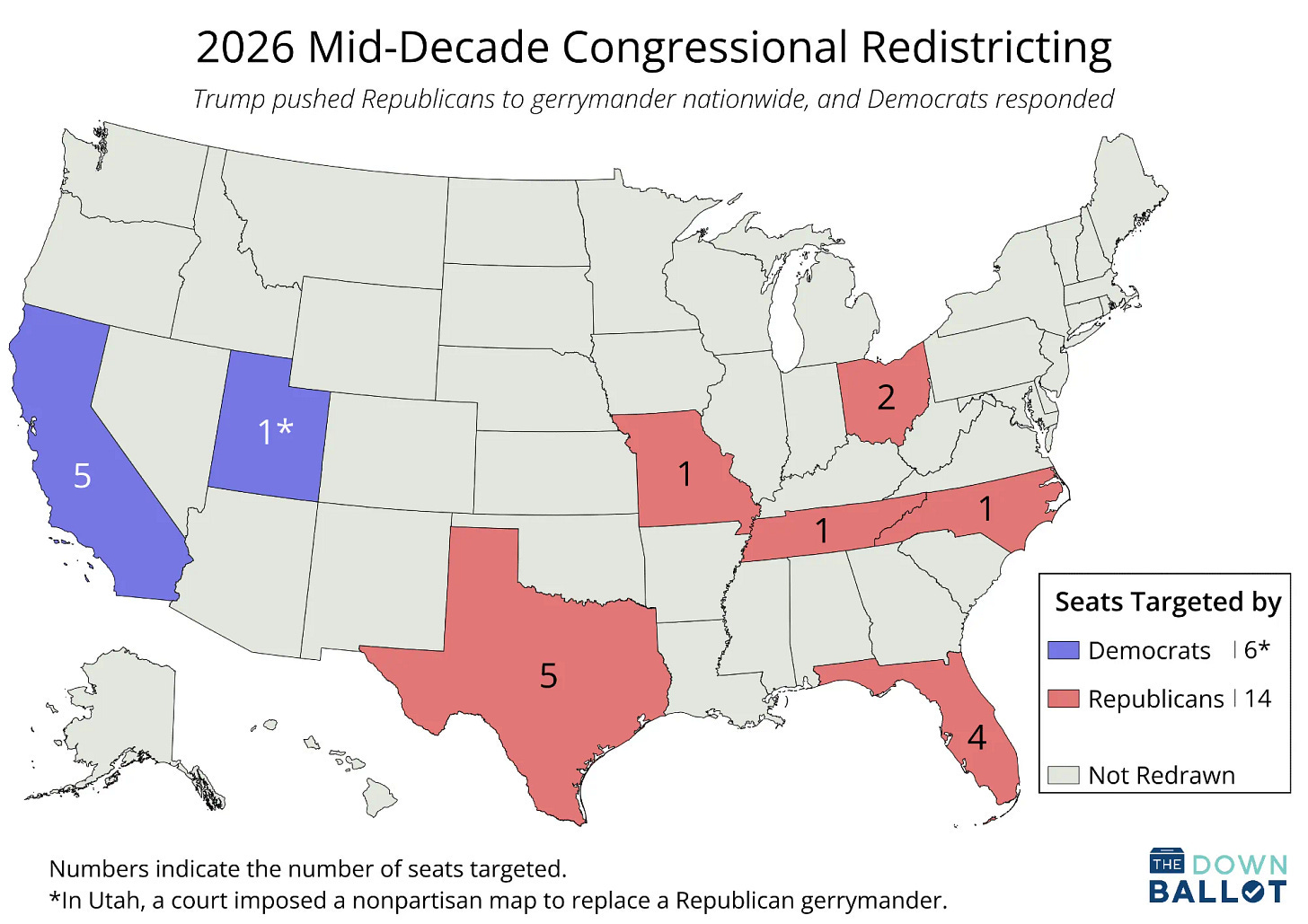
Judging by these figures, the Democrats are set to lose a net of 8 seats from redistricting this cycle (14R - 6D).
Except, that estimate of R+8 seats is not quite accurate. Despite how much I’ve seen these figures floating around online as the pseudo-official estimate of the number of seats Democrats are losing to redistricting, there are two complications: First, whether a seat was “targeted” does not mean it will necessarily “flip” — several Dem and GOP targets in CA and FL are still unlikely gains for the other party, which I’ll explain momentarily. And second, Democrats are likely to lose at least two more seats due to gerrymandering in Alabama and Louisiana.
So I think it’s time to do some math. How many seats are Democrats out now that their VA gerrymander is off the table? How bad could it get? And, accounting for that, how large a margin do they need in the House popular vote this November to still win the House majority? In other words, can a blue wave “save” them? In this article, I boot up mapmaking software and a House election simulator to find out.
That and more below the paywall. The upshot is that in a short two-week period, the functional end of the Voting Rights Act at the hands of Samuel Alito in his Callais decision and this invalidating of Democrats’ own partisan gerrymander in Virginia leaves the party on the brink of what once seemed like a distant doomsday scenario ahead of the midterms. They will have to make up a deficit of at least half a dozen seats due to aggressive GOP gerrymandering.
