


I try not to traffic in takes that can come off as moralism or scolding, but unfortunately, the news out this week about Graham Platner, the Democratic nominee for U.S. Senate in Maine, is simply disgusting. Given the credible accusation of sexual assault — only the latest of a slew of accusations that ranged from racism to antisemitism to adultery — the sole moral path forward is for him to drop out of the race and return to his life as a small-time oyster farmer in rural Maine. (I have my own biases, but I would find that more fulfilling than spending all of my time in the depths of the U.S. Senate office buildings anyway.)n
For Platner, withdrawing is the right choice — and for the sake of the Democrats’ chance of winning the Senate majority, it’s also the smart one. The reality of Platner’s campaign is that he was already polling poorly relative to expectations — numbers that are now likely to only get worse.
Plater was also always only the better of two bad options that entered the primary. His opponent in the Democratic primary, incumbeacnt governor Janet Mills, also polled poorly against current Republican Senator Susan Collins and is also viewed as too old to run for the seat. (Of course, it’s also likely now that Platner would have lost the primary and polled worse in hypotheticals vs Collins had voters known who he really was.) Being the better of bad options is a powerful argument in a party primary, but not an absolute statement of candidate quality. Nor is it a powerful argument in a general election.
In nominal terms, Platner was always a bad pick. Maine’s Democratic Party now has the option to organize effectively to find and put forth a better option. As a short bonus post on the blog today, let me show you the data on Graham Platner — and, hopefully, his exit.
Platner is/was one of Democrats’ worst recruits
For this data I’m going to rely on the new election “nowcast” model we published over at FiftyPlusOne earlier today (yes, that means three articles from me today).1 This model takes polls in a given state, adjusts them for things like pollster “house effects,” recency and the like, then infers what would happen in unpolled seats and simulates the outcome of the election as if it were held today. Here’s that post if you want to read more (it’s free).

Crucially, one thing the nowcast does is measure how competitive each Senate race is relative to expectations. Those expectations are set by taking the traditional partisan lean of each seat and shifting it by some amount that makes the resulting numbers, on average, predictive of current Senate (and House) polls. As the piece at 50+1 explains, that number today is 7.4 points — meaning we would expect Maine, which leans to the left by 8 points in presidential elections, to poll at D+8 + D+7.4 = D+15.4 with completely neutral candidate quality between the nominees.
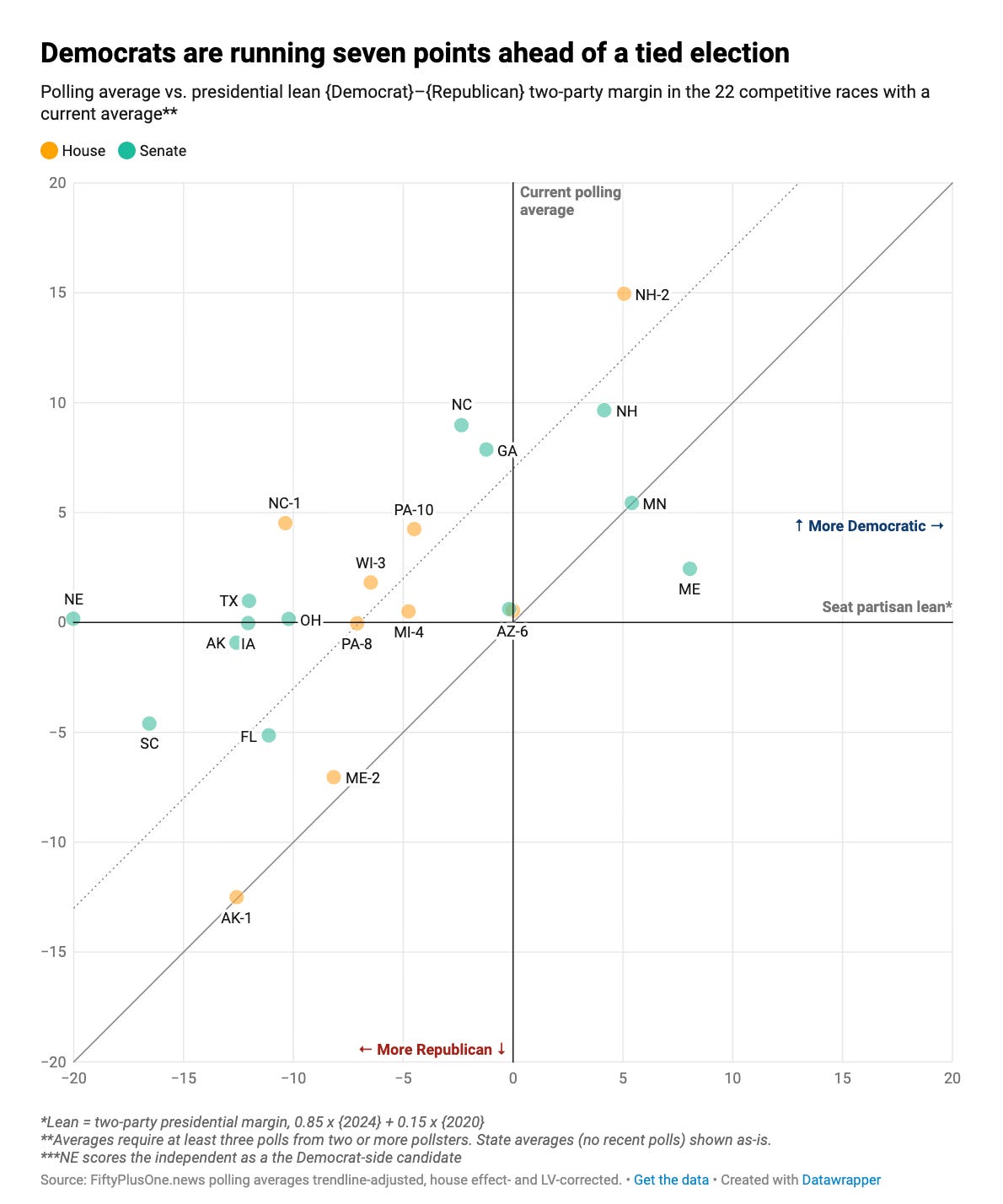
Platner, who was polling at just two points ahead of Collins in the polling released before the latest allegations against him, is quite a ways below that benchmark. This is visualized well via this plot:
Note that the Maine dot is far below the dashed line — which indicates the expected polling today at every value of seat partisan lean — but also the solid black line, which indicates what we’d expect for Maine in a tied national election. Given we’re looking at a D+7-8 national environment, Platner being at just D+2 is a huge miss and red flag.
Platner was also polling quite poorly compared to other Democratic nominees. The table below shows the top five and bottom five Democratic candidate effects for each House and Senate race that has been polled in the last 90 days:
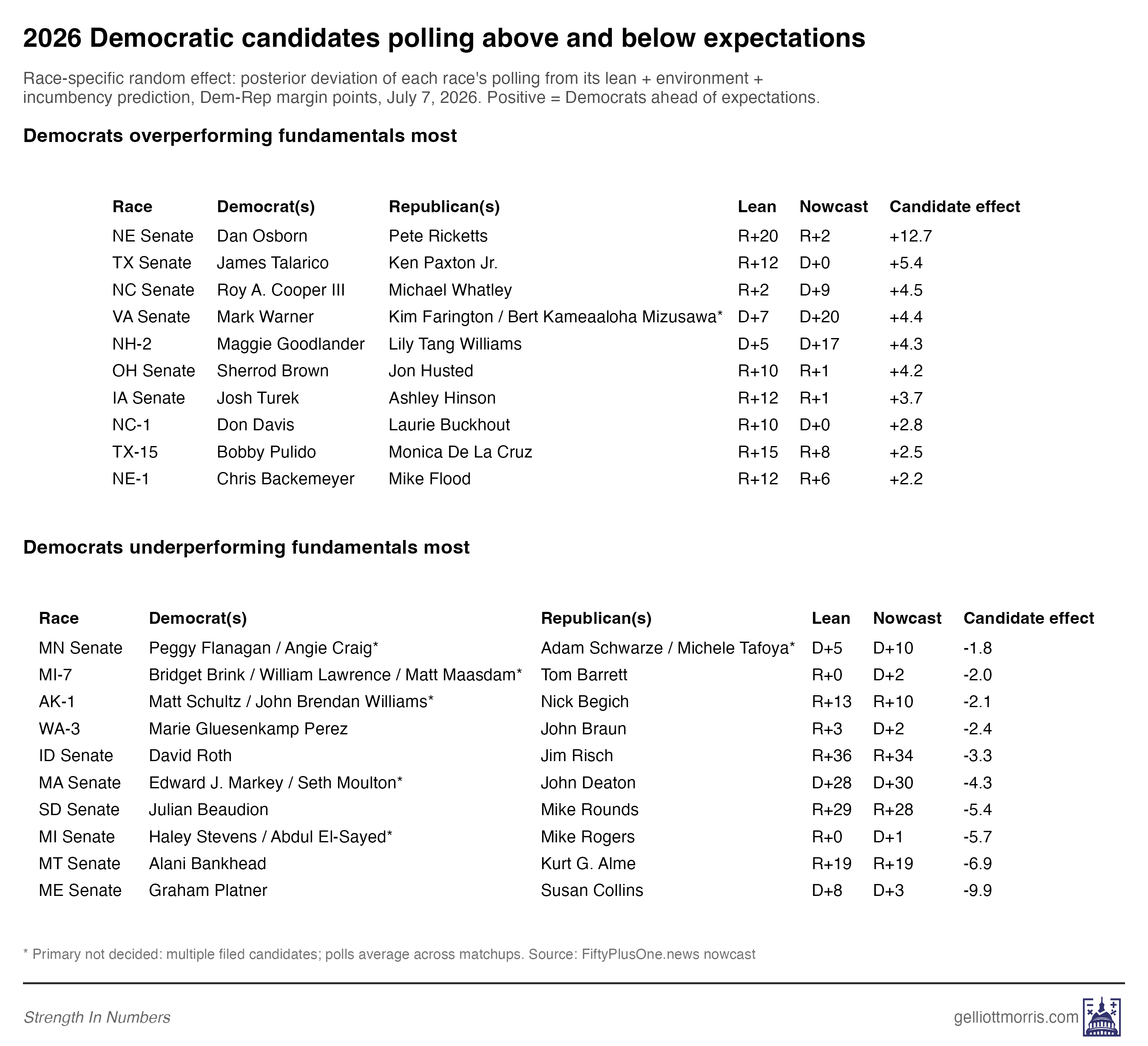
Platner is/was the single worst Democratic candidate for Senate in 2026 as per current polling and the 50+1 nowcast. And that’s before polls have the chance to adjust to yesterday’s news.
The only Democratic candidates polling worse are in Montana and South Dakota, where there are three-way races against both Republicans and independents who have siphoned off some otherwise Democratic-leaning supporters. Democrats are also polling worse than expected in Michigan, where voters will decide on August 4 who will face off against the lone Republican candidate, Mike Rogers.
A new nominee could be decisive for Senate control
One question you might have after looking at these numbers is: so what? Democrats are polling well in plenty of other Senate races, from Texas to Iowa to Alaska and North Carolina — where they are almost certain to pick up a GOP seat. So what if they flub Maine? And they have a potential effective pickup in Nebraska, where independent candidate Dan Osborn is hoping to knock off Republican incumbent Pete Ricketts.
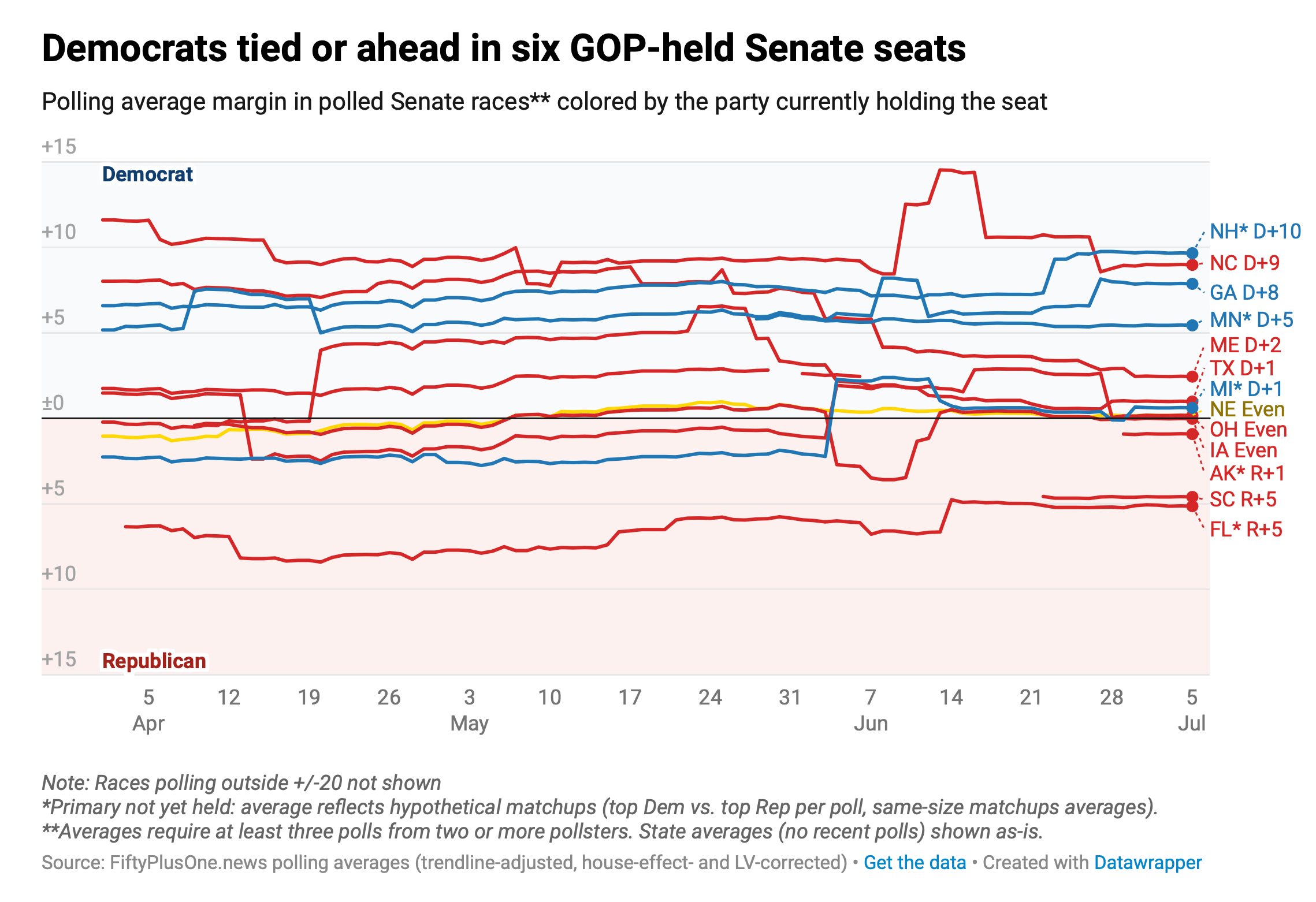
Well, let’s do the math. Democrats currently hold 47 seats in the Senate, and they need 51 for a majority to overcome JD Vance’s veto (or 50 if Osborn takes Nebraska away). Democrats are very, very likely to win NC, bringing them to 48, but are shaky in Michigan, which would cancel out the gain. Then they need 2-3 of Maine, Texas, Ohio, or Iowa, where they are even or ahead, or Alaska, where they are slightly behind, but ranked-choice voting makes results a little more unpredictable. In total, Democrats need to run the table in about 40-60% of competitive Senate races, which parties often do in “wave” elections.
But in a close race, every seat counts. If Democrats lose ground in Minnesota or Georgia, where they are also protecting ground, or Ohio and Iowa slip away from them, they are going to wish for a high-quality candidate in Maine. To directly quantify this, we can run our nowcast prediction model assuming Democrats in Maine nominate a candidate of different quality: one who directly replicates Platner’s skill (-10), one where polls put Maine at D+7, and one with Maine polls at D+15 — what you’d expect for a race with no candidate residual for either party.
The chart below summarizes the probability of Democrats winning the majority in an election held today with different candidates running in Maine. Going from the lowest- to highest-quality Democratic candidate is worth about 11 points in win probability today:
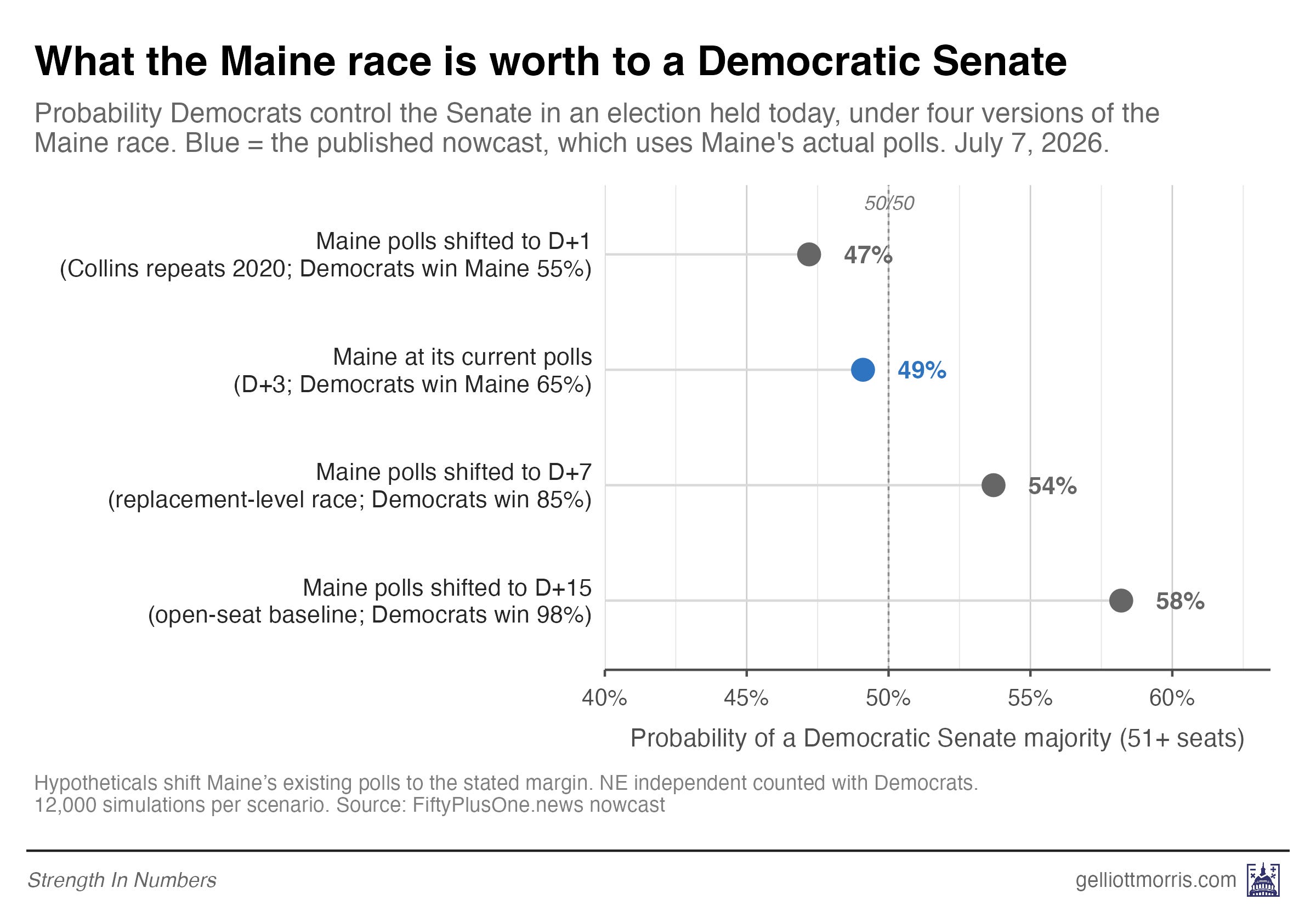
This may seem a bit underwhelming at first, but stick with me. The 11-point range (47% → 58%) is “small” because even the best-case scenario for Collins right now is probably a tied race; Even the harshest scenario — Collins repeating her 2020 overperformance — leaves Democrats winning Maine 59% of the time (a D+8 state in a D+6 year is hard to lose even with a −14 candidate effect once you add in the uncertainty about how polls translate to votes.)
But I would also argue that an 11-point increase in win probability is not small! Especially when what’s at stake is control of the United States Senate.
The other way to look at this is to see how often each of the following states tips the outcome of the Senate to the Democrats. Maine supplies the Democrats’ 51st seat in 10% of its wins, making it the third most important state to the party’s majority. Ignoring Maine, in other words, reduces Democratic win probability by about 1 in 10.
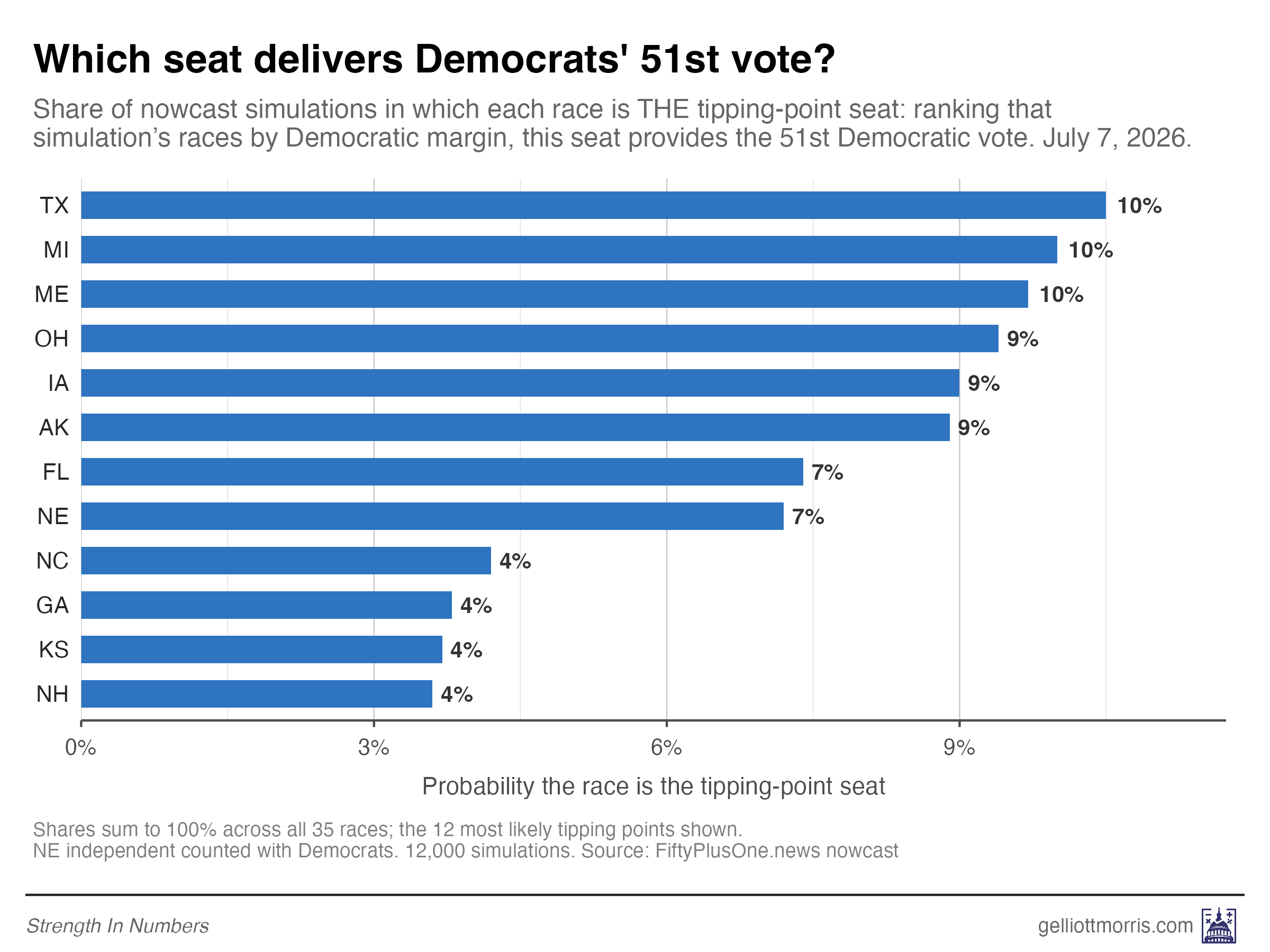
Figuring out how to get a high-quality candidate into the Maine Democratic seat is thus a problem worth taking very, very seriously.
One aside before we get there: Some will read the results above and remark that since Susan Collins is an above-average opponent (she typically beats the state’s partisan lean by multiple points), Platner is # ackshually a good challenger. I think this is too clever by half. For one thing, Collins’s overperformance is not an act of God, but inherent to the competition she faces and how the state Democratic Party runs its campaigns (more on that below).
And second, candidate overperformance typically decays over time — by about 63%, per my modeling, from year to year. That means even if you are giving Collins an inherent boost, it’s something like 10 points, not the 20-point residual she had in 2020. Do that, and the expected margin in Maine is D+5 — still three points higher than Platner was polling.
Finally, a sufficient rebuttal is that it is the job of parties to put forth candidates that compete on an equal footing with others. And it is also the job of candidates to meet the partisan benchmarks that are, on average, highly predictive of election results. Yet, Platner was not doing as badly as he could have been. That does not negate the fact he lagged expectations in absolute terms.
Democrats can do better than Graham Platner
By now, some of you are bound to be thinking that, well, given the choice between Platner and Mills, Democrats probably made the right choice at the time — so this isn’t really their fault. I agree in part: I don’t think this is the fault of Democratic voters, but it is a red mark against the Democratic Party — specifically the Democratic Party of Maine.
As scholars of international elections will tell you, the job of a political party in an election is to put forward the candidate (or, in countries where you elect multiple members in your electoral district, candidates) that has the best chance of winning the next election and to represent the interests of party members. That means organizing debates, an orderly voting process, and — yes — vetting candidates!
State party committees in America have practically abdicated their role in nominating procedures. They mostly just collaborate with state electoral administrators so they don’t have to organize their own conventions or other modes of selection.
But it doesn’t have to be this way! State parties can be as competent as they want!
Maine election law provides a mechanism for replacing a general-election nominee after the primary. If Platner withdraws by 5 p.m. on the second Monday in July — this year, July 13 — the Maine Democratic State Committee can name a replacement, and the party then has until July 27 to make that pick. And the law is nebulous enough that they can maybe just… pick however they want. They could even embark on a two-week memberhsip drive to collect contact information from likely member-voters, and then vote electronically on a new nominee using ranked choice voting! The options for a good nomination process are practically endless! Yeah, the party committee has to agree on them, but let’s flex our creativity and American exceptionalism on this our country’s 250th birthday.
And if Platner misses the July 13 window, the door essentially shuts. After that, the law allows a swap only for something like death or an incapacitating illness, and Platner stays on the ballot no matter how the campaign unravels.
In a Senate election that might — indeed, might probably — be decided by one seat, Platner’s name remaining on the ballot is a disaster scenario.
The good news is that Democrats can probably find another nominee to take his place. Recall that Platner’s appeal was never really about Platner: the surveys had him running ahead of Mills because he tapped a genuine populist, anti-establishment current that is currently animating a lot of American politics. Democrats might pick former state Senate President Troy Jackson — a fifth-generation logger with deep working-class roots — and, if he polls well, Democrats flip from underdogs to win the Senate to slight favorites.
The moral case for Platner stepping aside is straightforward, and most of his own party has already disavowed him, so I think that will happen sooner rather than later.
What the data adds, then, is the strategic point that he was never a good nominee in the first place. Maine’s state Democratic Party is now in the dream position of being unburdened by primary voting rules and able to pick whoever its members want to maximize their odds of satisfying Democratic voters and winning the general election in November. At least, if they act before July 13.
Can Maine’s Democrats get their act together? Can American parties start acting like functional organizations, like their European counterparts? Or will they get another Platner… or worse?
Read more about our new nowcasting model at 50+1 here.
And if you want more analysis of politics and polling, subscribe here at Strength In Numbers. I publish new analyses three times a week.
Footnotes
I would have preferred to hold this post until Wednesday to avoid saturating inboxes. But one principle I live by is that when there’s news to publish, you publish it before the news changes. Strength In Numbers is only at the mercy of the news gods and whatever Graham Platner decides on his own timeline. Because I don’t know what that is, here we are.
Dems probably need 52, to offset a Fetterman flip
Fingers crossed Platner withdraws for the good of the country. Having already elected a convicted felon who was accused of sexual misconduct, doubtful he could prevail anyway.