


Over the last five election cycles (the extent of my readily available historical data), polls of likely voters have typically leaned more Republican than polls of registered voters or all U.S. adults. That’s because Democrats have typically held an edge with lower-turnout groups, like young Americans and non-white voters, that skew coarser samples to the left. More reliable voters, historically speaking, have been more Republican-leaning than the population as a whole (this was not true in 2024).
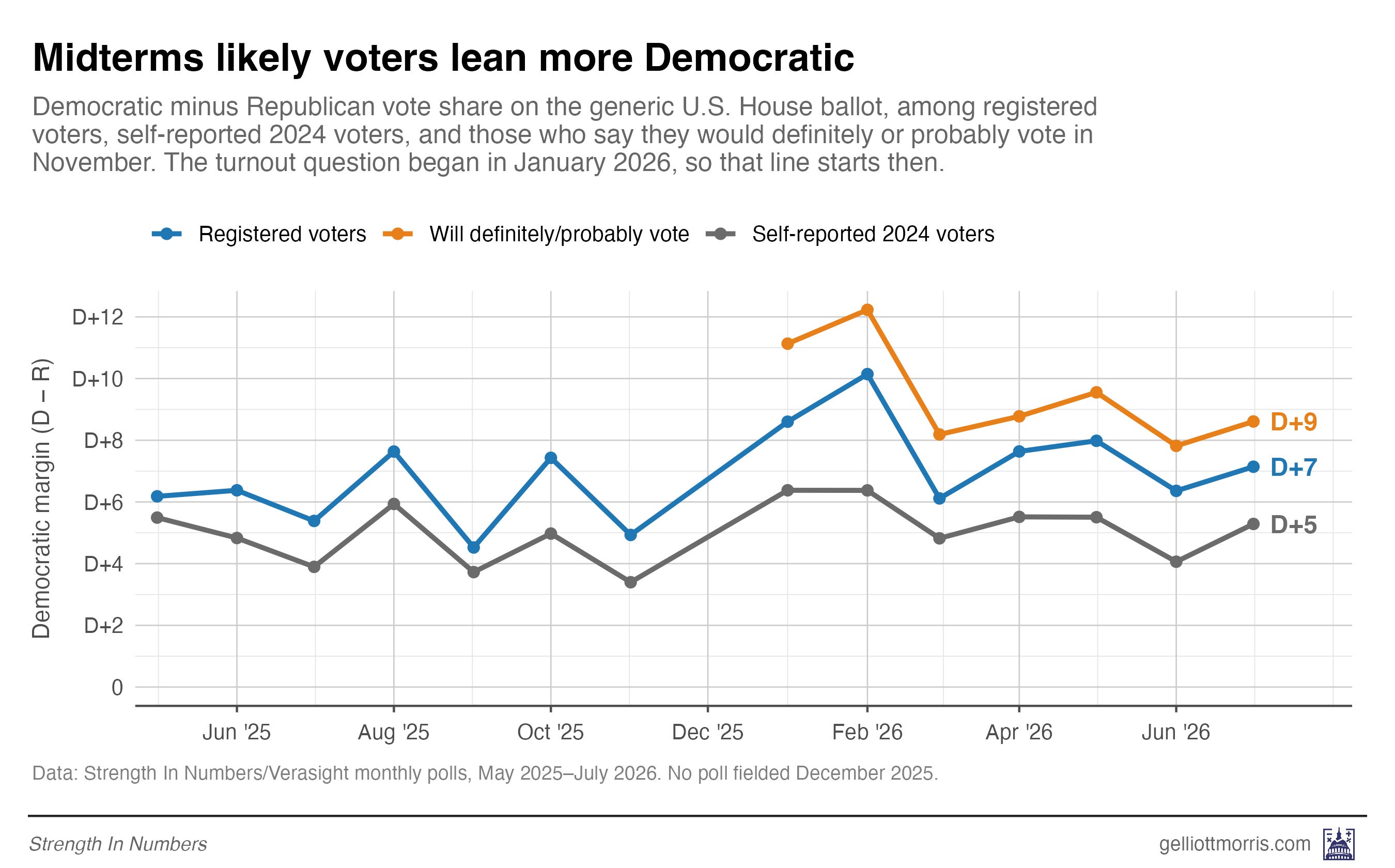
But data on likely voter turnout this election cycle points the other direction. According to a new analysis of pooled survey interviews from Strength In Numbers/Verasight polls since January 2026, Americans who say they are most likely to vote in November are actually more pro-Democratic than registered voters.
In fact, in every wave of our poll this year, the people likeliest to show up have leaned a little bluer than registered voters as a whole.
Strength In Numbers is independent and reader-funded. Paying subscribers get premium posts like this Deep Dive article, can access our community Discord server, and support the data collection and analysis work that powers this independent, data-driven journalism. If you want political analysis that’s honest and data-driven, not beholden to publishers’ ideological agendas or donations from corporate PACs, upgrade to a paid subscription.
Likely voters lean left lately
Our July poll has Democrats leading the generic congressional ballot by 7 points among registered voters, 50% to 43%. That 7-point advantage itself would be enough to flip the House majority (Democrats need to win the popular vote by about 3 points to win 218 seats) and to make the Senate majority competitive, and would be a swing of 9 points since the 2024 presidential race (about the same swing as from 2016 to 2018).
But when we filter our polling data to the people who say they’ll definitely or probably vote in November, the Democratic Party’s lead grows to almost 9 points — a boost of about a point and a half on average across polls. The size of the premium bounces around from month to month (see image below), but the direction never changes. In all seven surveys since we started asking the turnout question in January, likely voters have leaned bluer than registered voters, by anywhere from one to two and a half points.
Since 2025, Democrats have done well in special and statewide elections in large part due to higher turnout from their voters than Republicans. My review of voter file data earlier this year found that turnout was responsible for anywhere between 25 and 40% of the gains the party had made since the 2024 election. Democrats are running ahead of Kamala Harris’s 2024 vote margin by about 12 points in state legislative and congressional special elections, according to tracking done by The Downballot.
We can run some similar turnout-vs-persuasion math with this polling. In our July poll, Democrats lead by 5 points in the generic ballot today among people who said they voted in the 2024 election (the grey line in the graph) — a swing of 7 points. High-turnout voters are currently 4-points more pro-Democratic, at D+9 (11-point swing since 2024).
A quick approximation of the turnout gap is to divide the swing among voters in the past election by the full real-world swing in the electorate (for now, we have to approximate it using the likely voter number). That’s 7 / 11, or roughly 64% of the swing coming from constant-turnout voters. In other words, the Democratic turnout advantage is responsible for a little over a third of their current margin in the generic ballot.
In this month’s poll, we also asked Americans several questions on their level of enthusiasm going into the year’s midterm elections, and whether they wanted Congress to be a check on the president or enable his agenda. Looking at both their demographics and party ID, Democrats look more engaged across the board. More charts and data on those points after the paywall.
