


This article reports new results from the August 2026 Strength In Numbers/Verasight poll, fielded Aug. 14–19 among 1,514 U.S. adults (margin of error ±2.6 points). You can find the poll topline and methodology document at gelliottmorris.com/poll.
Original polling like the one covered in this article is funded entirely by readers. Become a paid subscriber to support this work and read the full analysis below.
At its summer meeting on Aug. 15, the Democratic National Committee passed a resolution calling for the abolition of Immigration and Customs Enforcement. Then, right after, it passed a second resolution calling for ICE to be reformed, but not abolished. Chair Ken Martin, quoted in an AP report, explained that the two resolutions are not official platform planks but signals about policy direction — the one thing that unites Democrats, he said, “is people believe that what ICE is doing right now — and CBP and the federal government — should stop.”
This apparent split personality disorder is part of a broader pattern among Democratic lawmakers and voters. One thing Democrats and Democratic-leaning independents agree on, according to our new poll, is that party leadership should “fight” more.
Few, however, have a handle on what that means in concrete terms. Fight who? For what? Do Democratic voters just want Congress to stop Trump, or is the target broader?
So in August we asked voters to tell us, in their own words, what they think a “better Democratic party would look like. This question was part of a battery of questions about the direction and values of the party in general — who it should listen to, what policies it should push forß, etc. (Republicans got a mirrored set about the GOP; their numbers appear below for comparison.)
What I uncovered is that Democrats are split between what they want their party to do now, and what they want it to be focused on in the long term. While Democrats say they want to be focused on resisting Trump in 2026 — much like how an opposition party would operate in other democracies — they also want the party to do a better job delivering for the average person, getting money out of politics, and “being honest.” In addition, 11% of Democrats responded to the open-ended question about party focus indicating they wanted the party to move left, compared to 6% who want it to be more “middle of the road.”
Republican voters also want some big changes, and view dishonesty and a neglect of affordability as chief problems their party should fix.
Democrats’ 2026 priority is fighting Trump
We showed Democrats a multi-select list of things the party could focus on and let them check as many as they wanted. Overall, 81% picked ending Trump’s corruption and abuse of power, 54% selected affordability, lower costs, and better wages, and 36% said the party should protect the rights of for women, people of color, and LGBTQ+ Americans. (Options are not mutually exclusive.)
The Democratic Party’s voters right now are overwhelmingly focused on Trump.
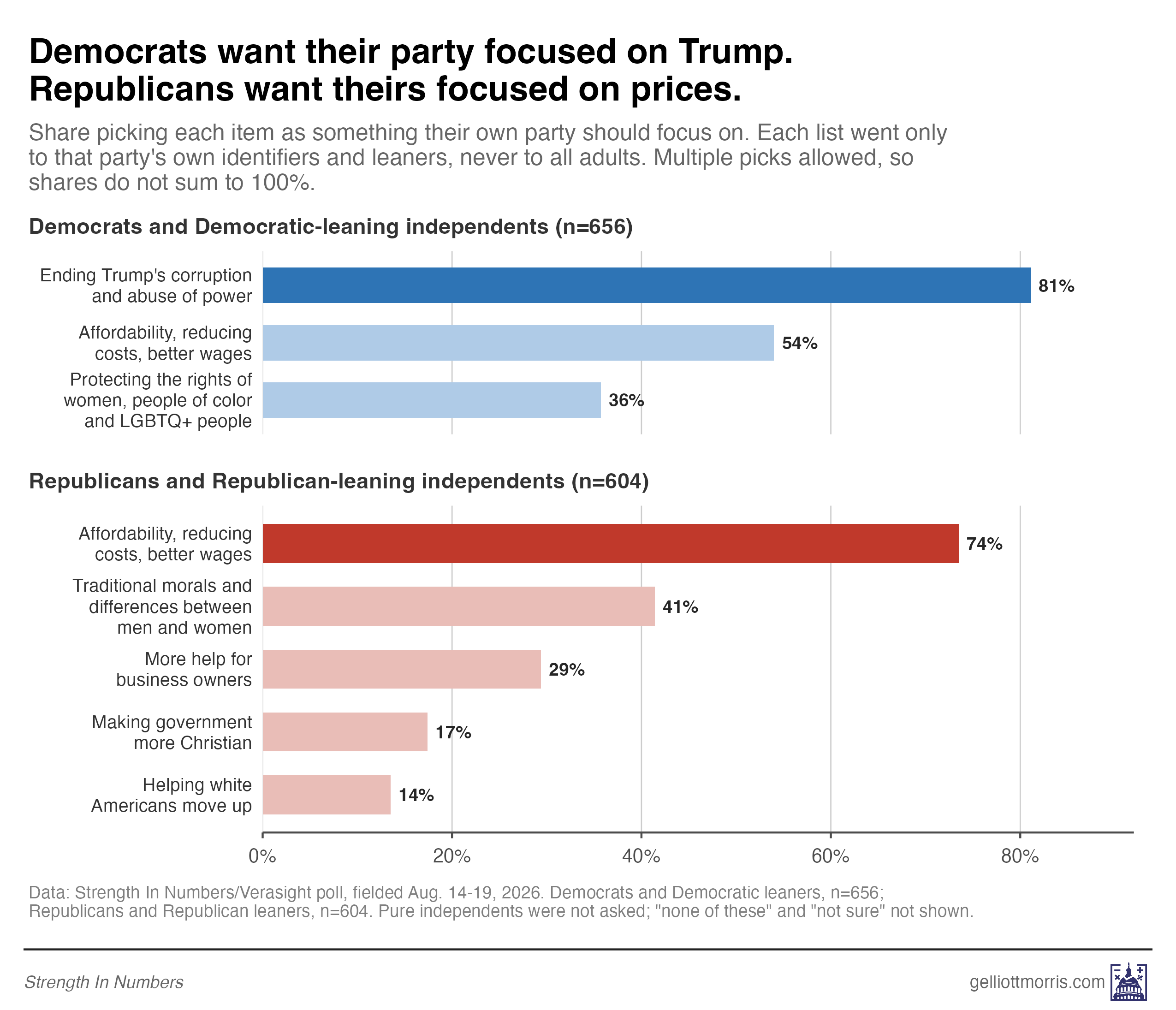
Comparatively, 74% of Republicans say the party should focus on affordability.
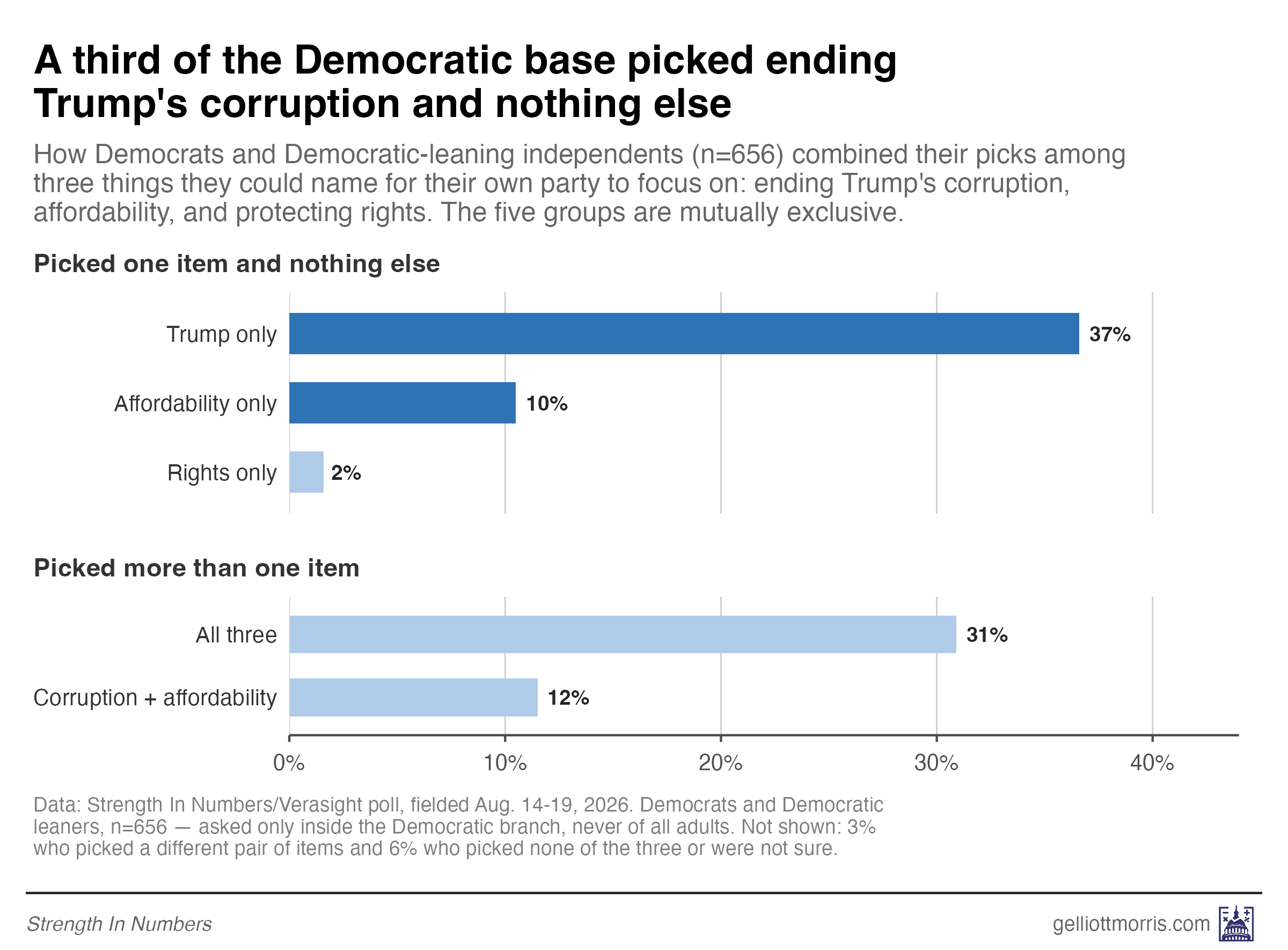
But the topline undersells what’s actually happening here. Respondents could check every box, so this isn’t a horse race between three options. Another way to cut the data is to check which option respondents would pick by itself. This tells us more about prioritization of Trump vs affordability vs other policy.
The results are not close. Overall 49% of Democrats and Democratic leaners picked only one option to the question above. Of those, 76% — or 37% of all Democrats — picked “ending Trump’s corruption and abuse of power” as one thing the party should focus on, and picked nothing else. In contrast, 10% picked affordability alone, and 2% placed minority rights above other priorities.
In total, 31% picked all three, and 12% said the party should focus on both corruption and affordability, but left minority rights off their list.
We can also look at the correlation between options people selected (though there are no surprises here, given the above). Among Democrats who picked affordability as a priority, 79% picked Trump’s corruption too. And among Democrats who picked corruption, only 52% selected affordability too.
In a second question, we asked Democrats to tell us which came closer to their personal view: “Democratic leaders are doing enough to oppose Trump” or “need to show more fight.” Overall, 83% of Democrats said they need to show more fight against Trump, whereas just 9% said they’re doing enough. Eight percent said they didn’t know.
What Democrats want the party to do, in their own words
It is somewhat unsurprising that Democrats, if given a box labeled “do you want to end Trump’s corruption and abuse of power?”, would check that box. But this doesn’t tell us much about competing priorities for the party’s long-term vision, or what it means to “fight.”
So we asked Democrats to tell us, in their own words, what they think “a better Democratic Party would look like.” This question is similar to one we asked for a Strength In Numbers greatest-hits article last November, which was later replicated by the Democratic polling firm Blue Rose Research. The result is 645 free-text responses from voters describing what their party would look like in its ideal form. I analyzed these responses and placed each into one of nine categories that I derived, with the help of an AI coder, by identifying common themes across them.
When you ask Democrats if they want their party to fight Trump, they say yes. But if you ask them what they want their party to look like, the president loses the top spot. The bar chart below shows the frequency of each of the nine themes I identified among all responses.
The rest of this Deep Dive is for paying subscribers. I write at least one post a week reserved for the members of this community who keep Strength In Numbers running. Upgrade to continue reading and support the time and data collection it takes to do analyses like this one.
