


Last month, I showed that error in how Americans report who they voted for in the 2024 election could be causing polls to underestimate support for the Democrats in the U.S. House generic ballot.
What’s going on here is that many pollsters now weight their samples so that the share of respondents who say they voted for Trump in 2024 matches the share of all voters who actually did. However, if some Trump voters who have soured on him stop saying they voted for him, the people still claiming a Trump vote are a more loyal group than Trump’s real 2024 coalition. Weighting them back up to Trump’s actual share of the 2024 vote would artificially inflate the size of the super-MAGA group of voters in the electorate.
At the time, I could only speculate about the size of the effect and simulate its effect on the polls. Using our August Strength In Numbers/Verasight polling data and published research on how often people misreport their past votes, I estimated this so-called “recalled vote bias” was shrinking Democrats’ lead on the generic congressional ballot by about 0.8 points.
This month, in our October Strength In Numbers/Verasight poll, we gathered the data to estimate the impact of recall bias directly. Because Verasight records each panelist’s 2024 vote when they sign up to take surveys on the platform, we can compare each person’s answer today (their “contemporaneous recall”) with their response stored in their panel profile (their “profile recall”), and identify any switchers and their political leanings.
We have both the contemporaneous and profile recall for all 2,028 respondents in our poll. Most of them gave the same answer twice, but a small and statistically meaningful group did change their recalled past vote. In our national sample, about 3% of the people whose profile says they voted for Trump now say they voted for Harris, more than twice the rate at which Harris voters now claim Trump. The Trump voters who now say they voted for Harris mostly disapprove of the job he is doing as president, and nearly all of them plan to vote for Democrats this fall.
The table below visualizes how respondents are changing their vote recall over time. About 96% of Harris voters still say they voted Harris and 4% changed, with 1.4% now saying they voted for Trump. And 94% of 2024 Trump voters still say they voted for him, while 6% have changed, including those 3.2% that have gone from Trump to Harris.
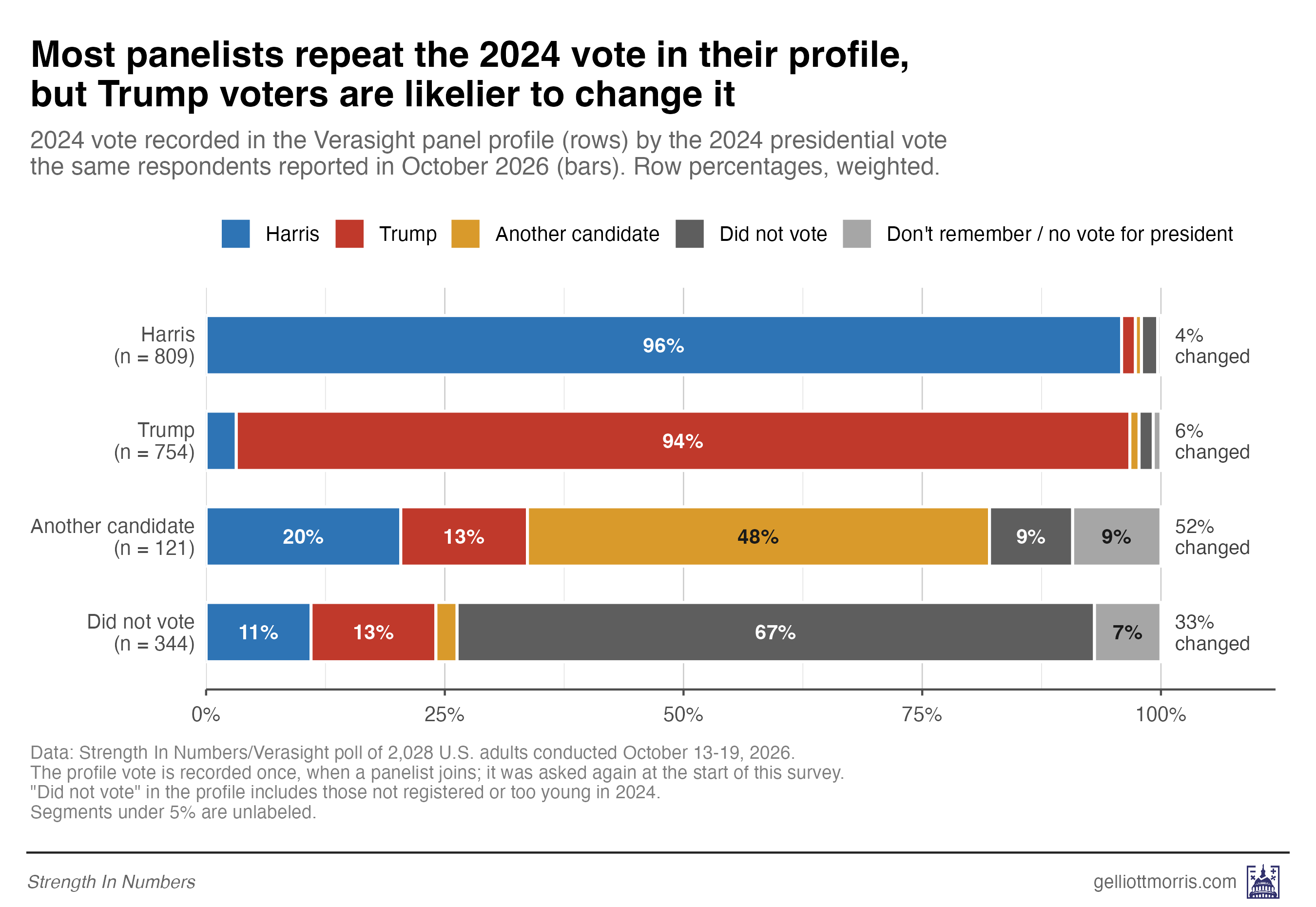
Those are small numbers — 22 people moved from Trump to Harris in our sample, and 11 moved the other way — so the attitude figures below come with wide margins of error. But the pattern holds across the main cuts of the October data we looked at: weighted or unweighted, among registered voters, and by age, gender, and race.
But now for the question we all want answered: how much does this impact our poll’s topline vote intention for November? Are we talking about the generic ballot being one point off? Two? three?
