


This week at Strength In Numbers: On Tuesday and Friday, I will publish the next two installments in my 11-part series about how Democrats won this year and why so many people got this election wrong. These articles will be exclusive to paying supporters of Strength In Numbers, who help fund this publication between elections, when search interest and traffic from social media decline.
Upgrade your subscription for full access to all the articles published here at Strength In Numbers, and get perks like a complimentary subscription to The Downballot and a private Discord server only for paying members.
Plus, fresh polling on the congressional agenda for 2027 and a first look at 2028. Our November Strength In Numbers/Verasight poll asks what voters want Democrats to do with their newfound power in the U.S. House and Senate, and asks a variety of creative questions about the 2028 presidential nomination process you won’t find in other polls (including an open-ended version of each party’s horse race).
Politics isn’t just about elections. Our work here at Strength In Numbers continues — and is, in some ways, more important — after November. Thanks for being part of this movement that puts data and evidence above partisan spin and noise.
1. 2026 wasn’t all turnout
On Friday, I showed that the polls underestimated Democrats this year, mostly because they got turnout wrong, overestimating how many Republicans would show up and discounting Democrats, especially young and nonwhite voters, who said they would turn out. This is good news in the sense that pollsters reached the right people initially (which they did not do in 2016, 2020, or 2024), but their likely-voter models — many of which overindex on historical data about who voted in past elections — were not calibrated for this high-turnout, anti-MAGA electoral environment.
It’s tempting to take that one step further and decide the whole election was a turnout story (in the past week and a half, I have seen many people do this). In this telling of the election, angry Democrats showed up, Republicans stayed home, and nobody really changed their mind.
I do not think this view is correct. Over the past two years, public opinion among voters and nonvoters alike has moved toward Democrats and against President Donald Trump on several key issues — and on some of them, opinion is further left than at any point on record. Minimizing 2026 as a turnout election lets the Trump administration off the hook for everything it has wrought since the president took office nearly two years ago.
To be clear, how much of the Democrats’ swing came from turnout vs persuasion is an important question. I’ve got numbers on that coming — not next week, because we are still waiting for states to publish their post-election turnout files, but the week after.
But you don’t need a voter file to see that a lot of Americans have changed their minds since 2024. Let me illustrate my point with a few long-running polling questions.
Americans trust Democrats on the big stuff again
First, consider the question of who Americans trust to handle the country’s most important issues. This June, I found Democrats had a 13-point lead on this question — remarkably close to their final vote margin in the House. That’s actually no coincidence, since this question has a near-perfect track record of picking winners in national elections.
Every September, Gallup asks Americans which party would do a better job handling the country’s most important problem (each respondent answers this question about the issue that’s personally most important to them), keeping the country prosperous and protecting it from terrorism and military threats. Ahead of the 2024 election, the Republican Party led Democrats on all three of these questions — by 5 percentage points on voters’ most important problem, 6 points on prosperity, and 14 points on national security.
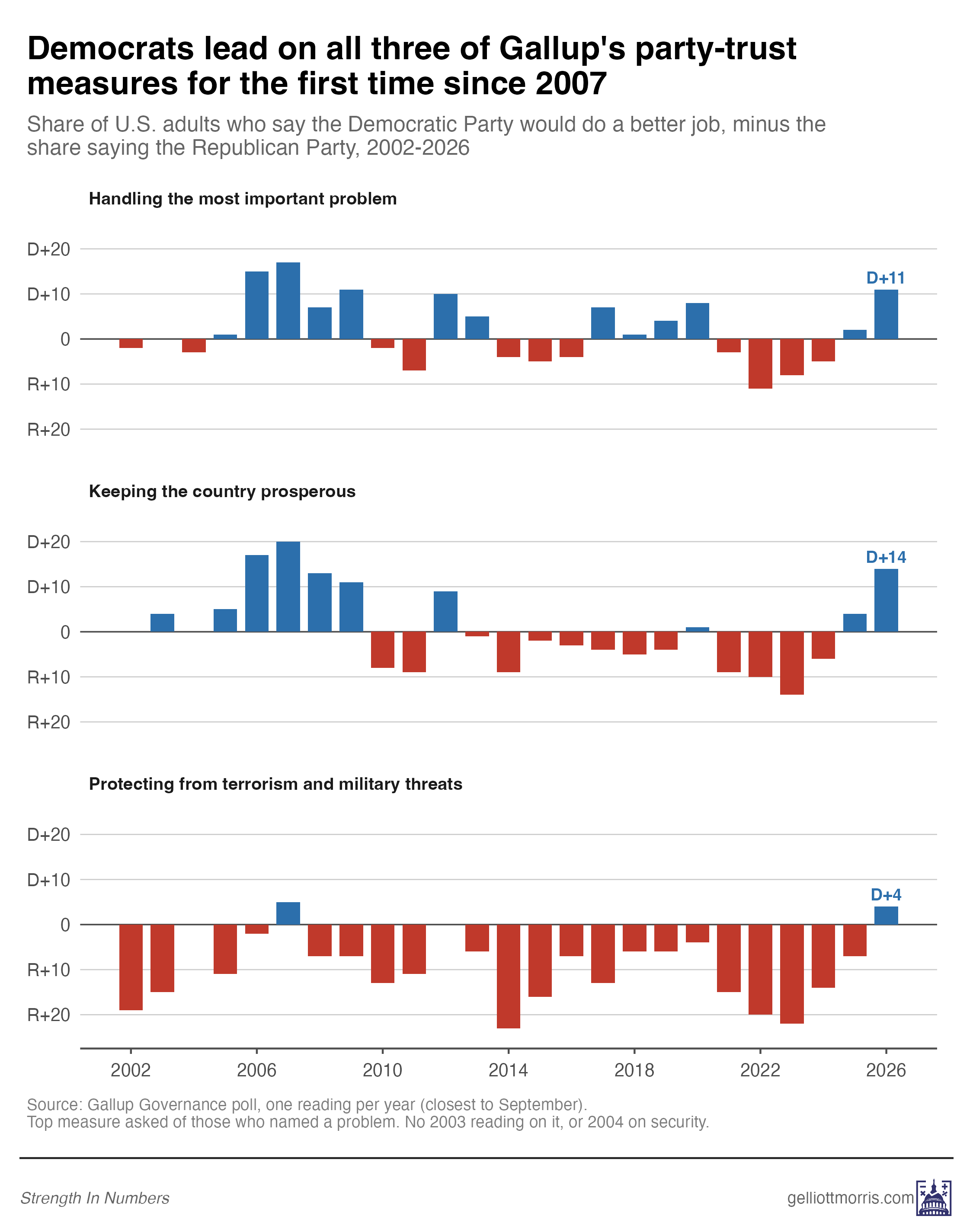
But there has been a marked shift to the left on these questions. This September, Democrats led Republicans by 11, 14, and 4 points, respectively. The party posted an even larger advantage on prosperity than in 2020 — when it held a bare advantage, even amid the COVID-19 pandemic — and its first lead on national security since 2007. In fact, 2026 was the first time the party had swept all three since 2007.
These questions gauge the opinions of all Americans, and thus (unlike elections) are not subject to the confounding role of voter turnout.
Pro-immigration opinion is back to 2020 levels
If you thought the above was significant, there has been an even larger change in opinion on immigration. In June 2024, 55% of Americans told Gallup they wanted less immigration, and just 16% wanted more — a net gap of 39 points in the Republicans’ direction. But this June, 31% of U.S. adults said they wanted more immigration while 29% wanted less — a 41-point change (on net) since Trump was last elected.