



This post is part of The Data Lab, a new section of Strength In Numbers for extra charts, general polling wonkery, and methods work that doesn’t fit into the normal editorial vertical. If you’re the type of person who wants to know how our polling is done or reads election forecasting methodologies, the Data Lab is for you.
Emails for posts on the Data Lab vertical are off by default, but you can easily toggle them on here. If you have a post to contribute to the Data Lab, email me.
Most Data Lab posts are free, but the occasional deeper ones are for paying subscribers, whose support makes all of this possible.
Following on from last week’s post about the importance of weighting surveys by party identity, a reader asked me whether our new MRP estimates are similarly sensitive to survey weights.
The short answer is no, but this is largely a technicality.
The graph below shows my model’s time-series national estimates of Trump’s approval rating and the U.S. House generic ballot among registered voters since May 2025. The blue line is the published estimates that include Verasight’s survey weights in the regression stage of the MRP model. The red line omits these weights.
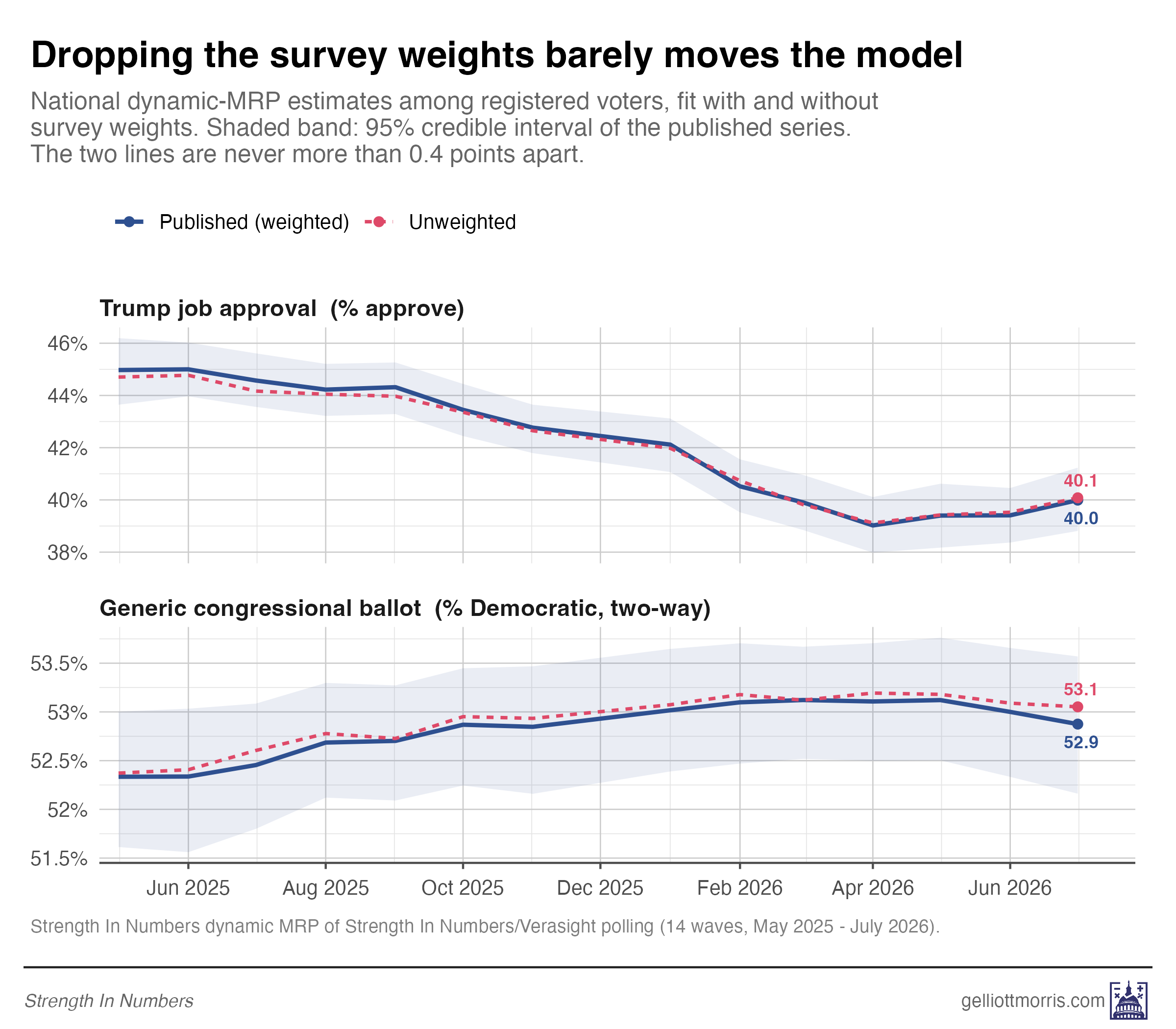
These differences are not significant to random variance in the MRP model itself.
So if weighting by party ID matters for surveys, but survey weights don’t impact MRP, what’s going on?
Well, this is largely just a trick I’m playing on you. The MRP model does not weight by party, because it includes a benchmark for the partisan composition of every type of voter in the country, based on their demographics and where they live. The model conditions on those shares to post-stratify by party… which is basically just another way of weighting survey data.
The MRP model I have designed to turn our Strength In Numbers/Verasight polls into state- and district-level estimates of public opinion, explained in detail here, works by first estimating the number of Trump voters, Harris voters, and non-voters as well as the number of Republicans, Democrats, and Independents among every demographic and geographic group in the country. I list these groups separately because they are estimated separately. We have precinct-level results on the former that can be aggregated up to the county level, but we have to estimate the latter.
I estimate that by pushing the raw data for Pew’s NPORS surveys into its own MRP model, which conditions on demographics as well as 2024 past vote, to predict the share of Democrats, Republicans, and independents in each demographic x past vote “cell.” Again, more details in the link above.
The point is that, once we reach the point of running the MRP model on the SIN/Verasight polls, we have already conditioned our projection on party and past vote. We just use “modeling” instead of “weighting.”
But this prompts a few additional questions. First, what if the party ID target used in our post-stratification frame is off? Great question. I take this into account in the post-stratification frame by randomly varying the party ID composition of the electorate in each county by a few percentage points.
Second, what if the Verasight survey were weighted by something not in the MRP model? What if we wanted to estimate not p(vote dem | demographics, geography, party, past vote) but p(vote dem | … + social trust + something else)?
Well, if that something else had no impact on p(vote dem) beyond what could be explained by party and past vote, then we’re in the clear. But figuring that out before an election is, of course, the billion-dollar question. After the 2020 election, YouGov found evidence of political non-response within the party and past vote groups of their panel. This is why communicating uncertainty is really valuable.
In the meantime, the narrow answer to the question we started with is “no, weighting by party doesn’t change the Strength In Numbers MRP estimates.” But that’s because party is in the post-stratification frame.
Thanks for asking!
This is an astute method- seems like it may take into account the realignment of voters that seems to be happening.