



On this week’s Strength In Numbers podcast, Elliott is joined by Rajiv Sethi , professor of economics at Barnard College, Columbia University, and author of the Substack Imperfect Information (currently on hiatus as he finishes a forthcoming book), for a deep dive into prediction markets. We talk about how they work, which types of markets work better than others, whether they beat statistical modelers at forecasting elections, and whether markets will soon replace the pollsters and journalists.
A couple of big takeaways from the conversation:
Markets are well calibrated probabilistically, but are not a 1:1 substitute for statistical forecasters. When information is sparse, markets cannot provide highly accurate forecasts of future events. And they can’t provide a standardized method for understanding the weight assigned to different types of information in anticipating outcomes, which limits their use journalistically.
But markets can be very useful when other models can’t function, such as when Joe Biden withdrew from the 2024 election, and forecasters had to spend a few weeks updating their models. Markets kept producing continuous probability estimates through that uncertainty. Rajiv made the point that prediction markets were able to react to new information during the COVID-19 pandemic when epidemiological models were still getting trained.
There is an under-studied potential bandwagon effect with the markets. Highly visible odds undoubtedly have an effect on consumers (and voters) psychologically, even if they are hard to detect. Market prices from Kalshi are now contractually embedded in CNN's election coverage — Rajiv and Elliott discussed whether that visibility could itself depress turnout for whichever side is being priced as the underdog. (If you are studying this, reach out to me!)
No, markets aren't going to replace polls or journalism. Rajiv makes the great point that markets depend on polls, since traders seek out measurements of opinion. And we know that traders even commission their own private polls, like the French "whale" who contracted surveys from the Trafalgar Group in 2024. If public polling actually became scarcer, Rajiv expects markets would get more volatile and less accurate.
Thanks to everyone who joined us for the weekly live stream on Substack, and we’ll be back next week!
As a reminder, paid subscribers to Strength In Numbers get to participate in our live Q&A! If you missed our video livestream, you can watch it by clicking play on the web version of this post at gelliottmorris.com.
You can also subscribe to us on your favorite podcast app to listen on your own time. And if you do listen via one of those apps, please drop us a five-star rating and review if you feel we’ve earned it — it really helps people discover the show!
If you value this work and want to help keep it going, please consider becoming a premium subscriber to Strength In Numbers. Paid subscriptions support this podcast, the newsletter, and the time it takes to do original data-driven analysis of politics and elections. Paying subscribers also gain the ability to send in questions during our live streams, so you can directly shape the conversations we’re having on the podcast.

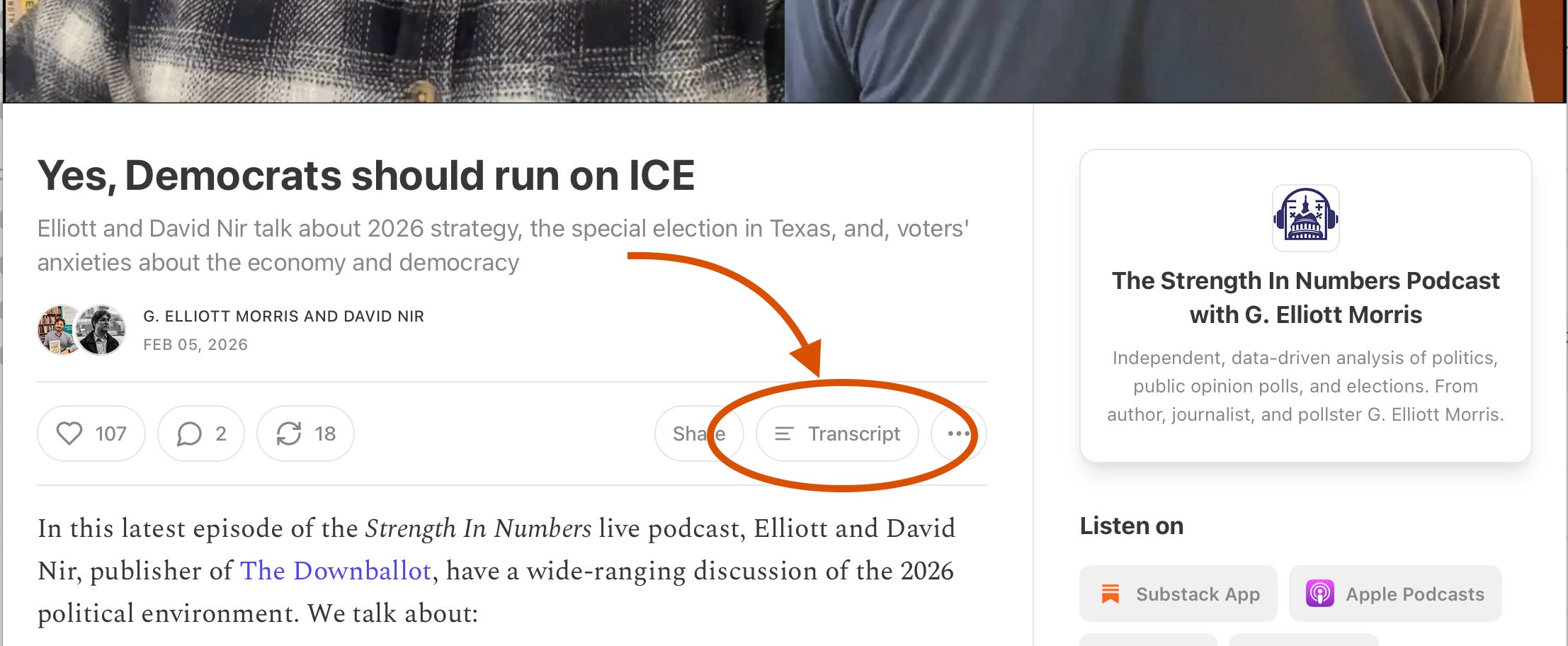
You can read the transcript of our conversation by clicking the headline of this article to take you to the web version of the podcast, then clicking the button just below the byline that looks either like a piece of paper or is labeled “Transcript,” like so:
If you’re a reader of Strength in Numbers and haven’t yet subscribed to David’s newsletter, head to the-downballot.com.
And if you’re coming from David’s site, subscribe here to get the numbers behind the news.


