



On this week's Strength In Numbers podcast, Elliott and David dig into why the Michigan Senate primary polls may have missed so badly, why the electability discourse about Abdul El-Sayed misses the mark, and how the new FiftyPlusOne election forecast that gives Democrats an 87% chance in the House and a 54% chance in the Senate actually works.
Here are the big takeaways:
Michigan’s primary polls missed by 12 points on Tuesday night. That is, in fact, better than the typical primary poll. The pre-election average had Abdul El-Sayed up about 13, but he barely skated by with just a 1-point win. When Elliott looked at Senate and governor primaries going back to 2014 earlier this year, he found the average poll was off by 13 points on the margin between the top two candidates—and about 20% of the time the candidate trailing in the polls won outright. Evergreen reminder: Polling primaries is hard!
The likely culprit in Michigan is either late movement (the polls were stale by primary day) or differential non-response bias, not just bad demographic assumptions. One pollster who was in the field in Michigan described to me a “death by a thousand cuts” rather than one big error as the culprit. It’s possible the rural, lower-income white voters he did reach may simply have been too El-Sayed-friendly, and his Black respondents broke 65-35 for Stevens when the real split may have been closer to 70-30 or 75-25.
The deeper problem is that primaries have fewer benchmarks of vote choice to weight to than general elections. That’s a structural problem with surveying primaries, and readers should expect more errors in the future.
The electability debate about El-Sayed is really stupid. Across public polling of Mike Rogers against either El-Sayed or Stevens, the gap between the two is statistically indistinguishable from zero. The only way to believe Stevens was clearly stronger is to weight a single Glengariff Group survey — which has also shown the strongest numbers for Rogers of any pollster — more than everything else. That notwithstanding, when we run all the data through our forecasting model, El-Sayed holds Michigan 64% of the time with Democrats taking the Senate 55% of the time; Stevens, performing similarly, comes in at 69% for Michigan and 56% to win the chamber. Mind the uncertainty, folks.
Democrats are in better shape now than they were in 2018. The 50+1 forecast gives them an 87% chance in the House and a median of 231 seats — four short of what they actually won in the 2018 “blue wave” — but the backtested model gave Democrats only around a 70% chance to win at this same point in that cycle. That’s because there are fewer “Lean Dem” seats the party might lose this go-around, plus district-level polling, fundamentals, and race ratings are looking more favorable for Democrats. The Senate is much closer, at 54%, with 51 Democratic seats the single most likely outcome and a 50-50 tie the runner-up.
Thanks to everyone who joined us for the weekly live stream on Substack, and we’ll be back next week!
As a reminder, paid subscribers to Strength In Numbers get to participate in our live Q&A!
If you missed our video livestream, you can watch it by clicking play on the web version of this post at gelliottmorris.com.
You can also subscribe to us on your favorite podcast app to listen on your own time. And if you do listen via one of those apps, please drop us a five-star rating and review if you feel we’ve earned it — it really helps people discover the show!
If you value this work and want to help keep it going, please consider becoming a premium subscriber to Strength In Numbers. Paid subscriptions support this podcast, the newsletter, and the time it takes to do original data-driven analysis of politics and elections. Paying subscribers also gain the ability to send in questions during our live streams, so you can directly shape the conversations we’re having on the podcast.

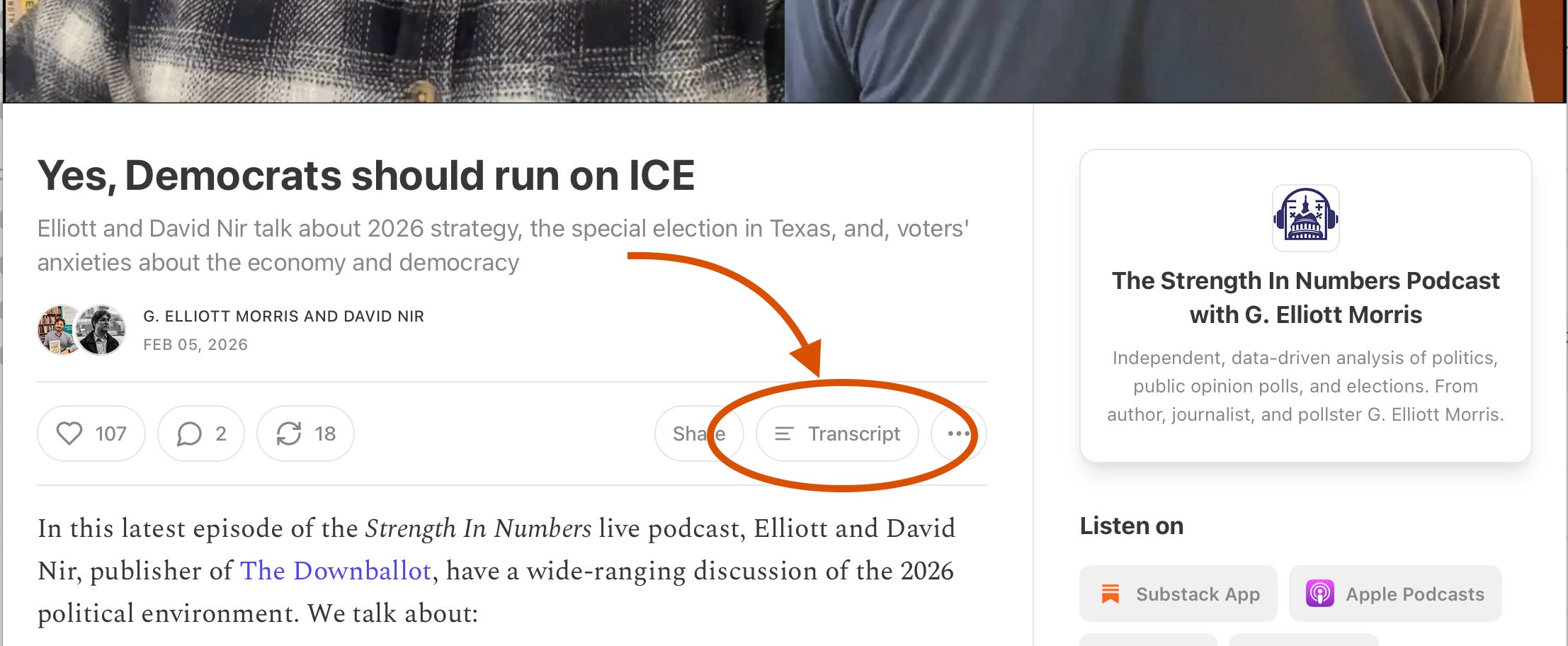
You can read the transcript of our conversation by clicking the headline of this article to take you to the web version of the podcast, then clicking the button just below the byline that looks either like a piece of paper or is labeled “Transcript,” like so:
If you’re a reader of Strength in Numbers and haven’t yet subscribed to David’s newsletter, head to the-downballot.com.
And if you’re coming from David’s site, subscribe here to get the numbers behind the news.


