Strength In Numbers is on a short summer break while Elliott takes paternity leave with his new baby. This deep dive episode was recorded in early May, and things may have changed since we recorded it.
In this Deep Dive episode of the Strength In Numbers podcast, Elliott sits down with Seth Masket, political scientist at the University of Denver and author of the Smotus Report Substack, to swap interviews on what political scientists got right (and wrong) about Donald Trump, the constitutional fallout of Trump’s second term in general and the post-VRA redistricting arms race, and what Democrats actually learned — or refused to learn — from the 2024 election. Masket is the author of the new book The Elephants in the Room, a review of what the Republican Party learned from its loss in 2020 and how that shaped its decisions (or not) in 2024.
Here are the big takeaways:
What political scientists got right about Trump in 2020 and 2024. Masket readily admits the discipline underestimated Trump’s ability to win the 2016 Republican primary, expecting his celebrity-without-insider-support campaign to flame out the way most do. But once Trump was in office, political scientists were largely correct in warning about election denial, attacks on the press, threats of political violence, and the refusal to commit to a peaceful transfer of power. And after 2020, plenty of pundits wrote that Trump would simply “fade away” — despite primary elections and media coverage showing his iron grip on the GOP.
The Callais decision is supercharging a redistricting arms race. With the Supreme Court effectively gutting the protections of minority-majority districts, Alabama, Louisiana, Tennessee, and other Republican-controlled states are moving to redraw maps mid-decade. Masket is optimistic and speculates that now that both parties are going to war over new maps, they may try to find some truce in new redistricting guidelines so they aren’t drawing new gerrymanders every two years.
Both Elliott and Masket are increasingly drawn to proportional representation as a structural fix to these problems. A system where politicians can’t draw their own district lines has its own advantages, and having third, fourth, and even regional parties could force coalition-building and blunt the worst effects of partisan sorting. Some sort of system that acknowledges the primacy of parties, instead of denying them wholesale, is probably way healthier for democracy in the long run.Media pundits and DC analysts learned the wrong lesson from 2024. Masket surveyed hundreds of Democratic county chairs after the election and found the single most common explanation for Harris’s loss was inflation and anti-incumbent backlash. He thinks that’s roughly right — and notes there is little the party could have done to avoid it. Joe Biden’s stimulus, labor support, and broadly effective economic policy yielded him “roughly nothing in terms of politics.” Elliott’s working theory for what actually moves voters is that highly visible, durable empathy with working-class people can buy an incumbent party that is presiding over economic stress some clout with voters, such as the case of Zohran Mamdani in NYC and Taylor Rehmet in Texas’ 9th state seat district. This is an are both agree the parties and policymakers are having trouble figuring out.
Thanks again to Seth for joining this second Deep Dive version of the show. It was a lot of fun, and I (Elliott) personally learned a lot!
If you value this work and want to help keep it going, please consider becoming a premium subscriber to Strength In Numbers. Paid subscriptions support the podcast, the newsletter, and the time it takes to do this kind of analysis well. Paying subscribers also gain the ability to send in questions during our live streams, so you can directly shape the conversations we’re having on the podcast.

A reminder: Elliott and David Nir record the usual Strength In Numbers podcast live every Thursday at 2:00 PM Eastern. We always discuss a few pre-planned topics and then answer questions submitted live by viewers.
You can also subscribe to us on your favorite podcast app to listen on your own time. And if you do listen via one of those apps, please drop us a five-star rating and review if you feel we’ve earned it — it really helps people discover the show!
A reminder that paid subscribers to Strength In Numbers get to participate in our live Q&A!
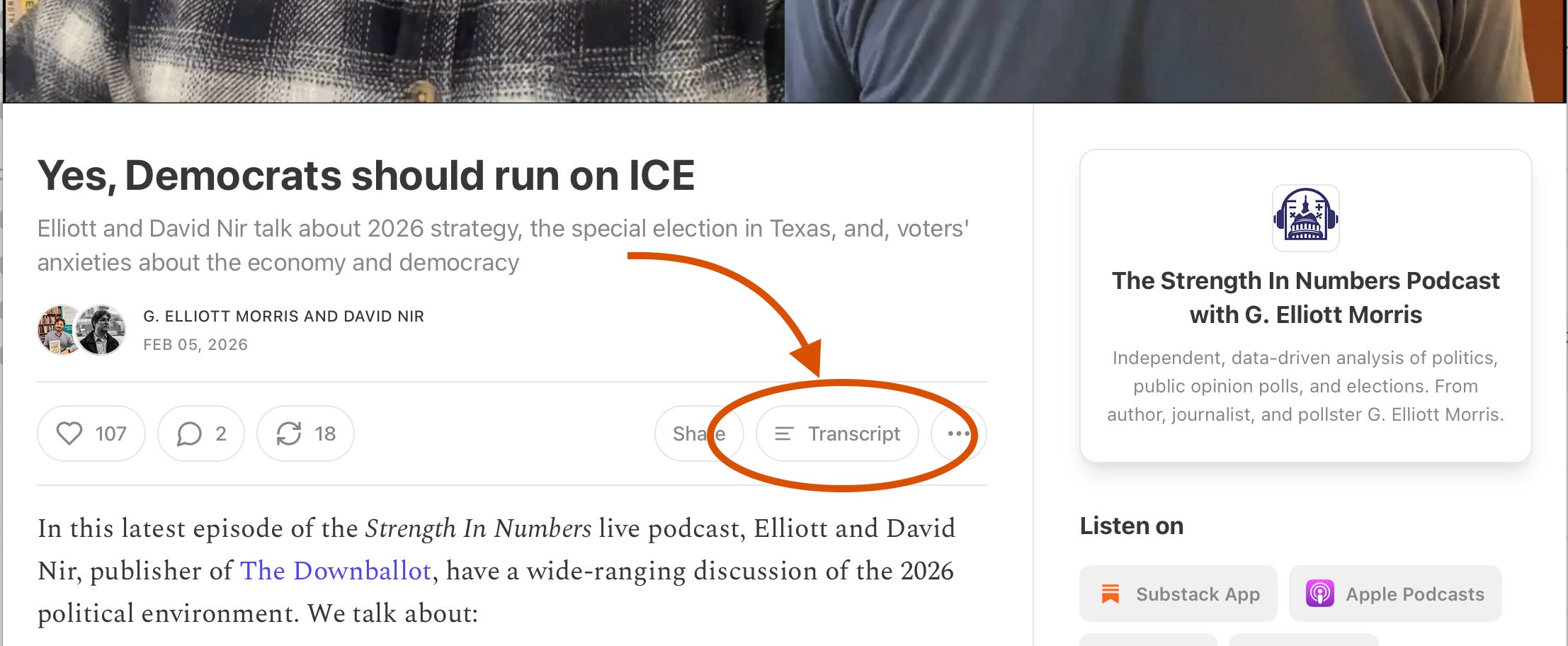
You can also read the transcript of our conversation by clicking the headline of this article to take you to the web version of the podcast, then clicking the button just below the byline that looks either like a piece of paper or is labeled “Transcript,” like so: