


Note: This article is free to read, but it was not free to produce. To help grow this newsletter business (doing so incurs costs like paying for polling data and modeling infrastructure, experimenting on biz dev, and hiring a couple of survey research assistants, a copy editor, and someone to help with the podcast/social media), I sometimes accept paying sponsorships for posts that are ungated and public. This post contains one short paragraph for a paid sponsorship, clearly marked, about halfway down the article.
Donald Trump’s approval rating hit a new low this week. As of April 2, the FiftyPlusOne average puts his net approval at -21.4 — 37.2% approve, 58.6% disapprove. That’s the lowest mark of his second term.
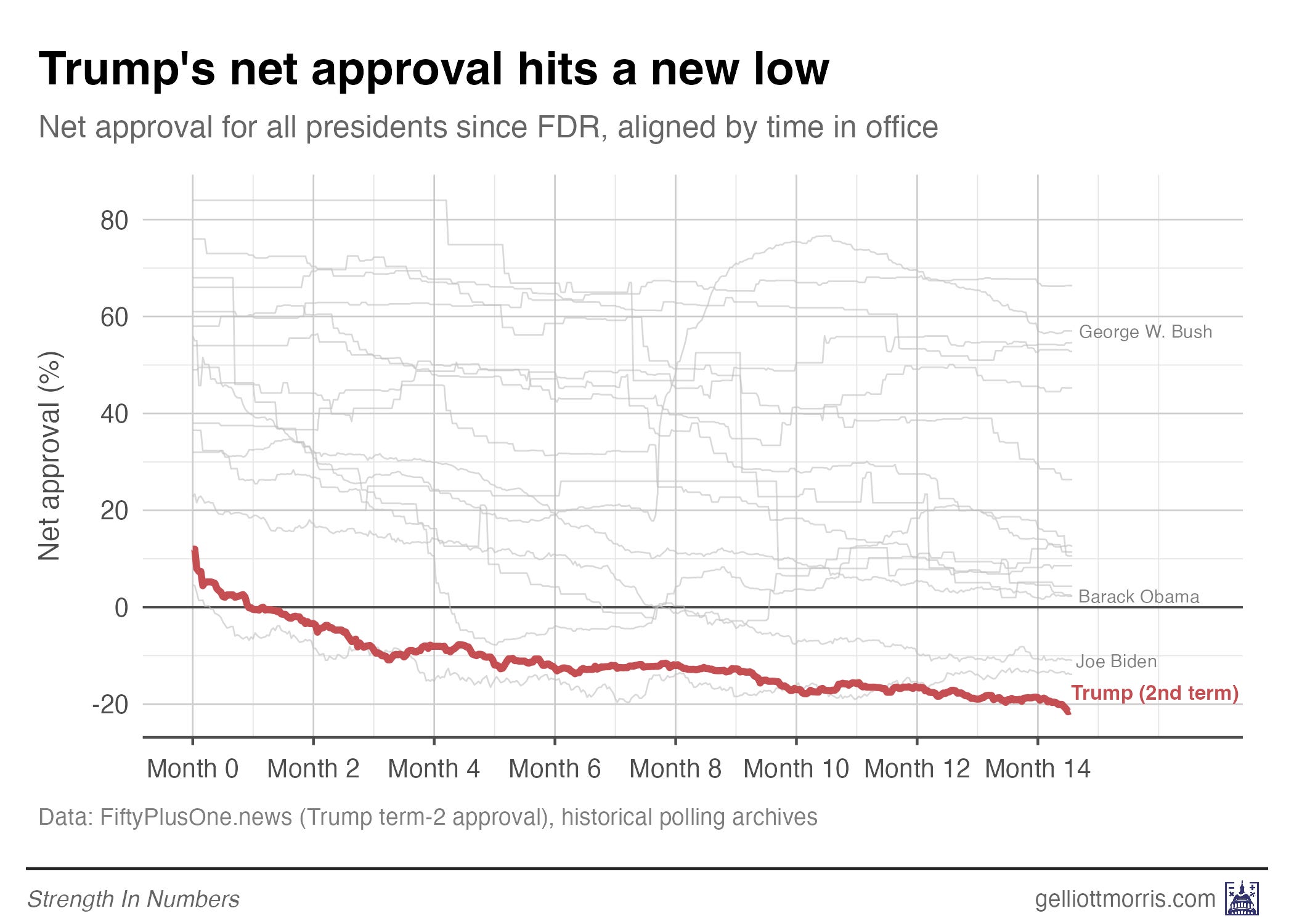
How bad is -21.4? When compared to past presidents, Trump’s ratings are the lowest of any president at this point in their term, going back to FDR. The spaghetti chart below lines up every president’s net approval by time in office. Trump’s red line is all the way at the bottom. Fourteen months in, no one else was this far underwater. Only Joe Biden, at the beginning of the 2022-23 inflation crisis, was close — and Trump is outrunning him by about 10 points:
If you treat Trump as a second-term president, his rating today is higher only than Richard Nixon’s after Watergate and tied with confidence in George W Bush after Katrina a worsening war in Iraq:
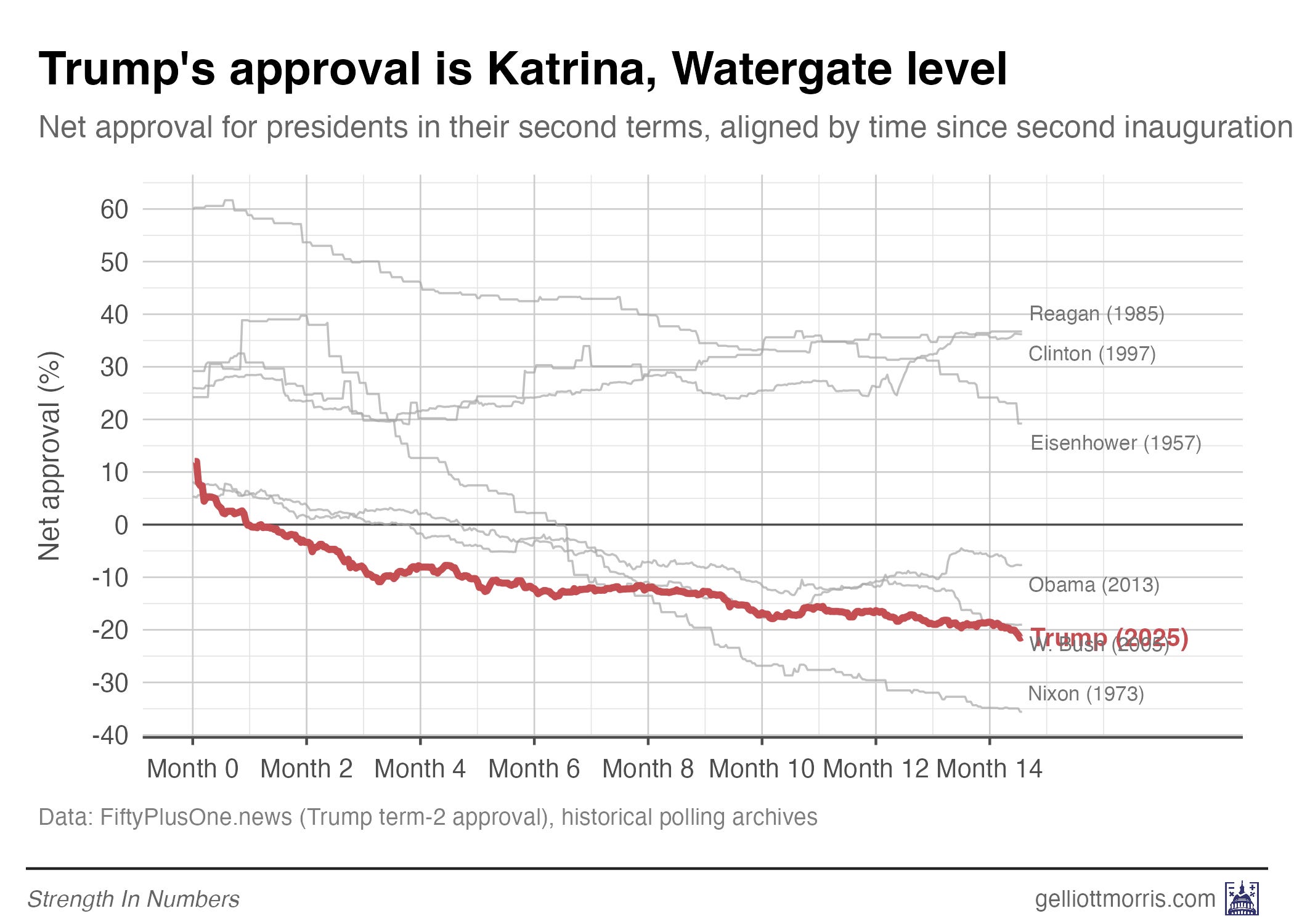
What’s striking about Trump is that he’s reached basically the same place without one singular catastrophe doing all the damage. Instead, he has accumulated several negative shocks to his presidency, including fallout from his tariffs, mass deportations, the Oct. 2025 government shutdown, and an unpopular war. None of them alone ended his presidency, but together, they’ve dragged him down to the same territory that ended other presidents’.
Looking closely at Trump’s approval rating over the last 14 months, six events stand out as primary inflection points for the public’s view of his presidency. One issue seems to be the dominant factor in his decline.
This week’s Chart of the Week takes a statistical approach to identifying “change points” in Trump’s approval trend, and triangulates one overriding cause of his bad numbers with fresh polling on voters’ economic anxieties.
Six events that have dragged down Trump’s approval
Trump’s approval rating hasn’t fallen in one clean, steady line. The trend is a mix of a secular negative slope and political shocks that cause brief stages of accelerated decline.
To examine what events have caused these shocks, I put Trump’s approval rating in the 50+1 average into a statistical model called a “Bayesian changepoints detector.” This is a mathematical program that looks for events in a time series that, statistically, cause something about the trend to change. Using this model, I can break Trump’s approval trend since Inauguration Day into seven distinct segments.
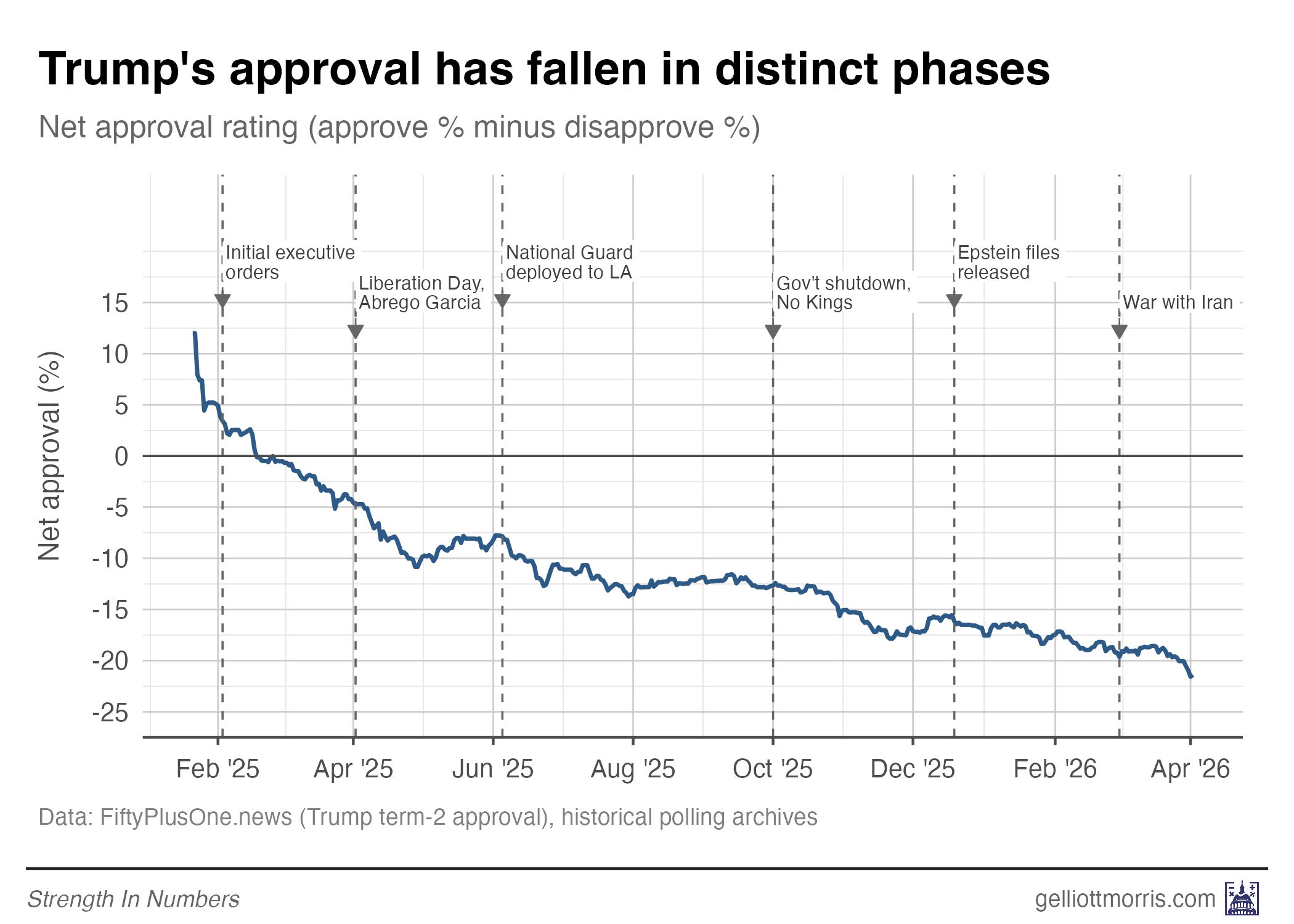
The first drop was by far the sharpest. In the couple of weeks after Trump took office and started signing a barrage of executive orders, his net approval cratered at a pace of about 15 points per month. That was the fastest decline of his whole presidency — basically, whatever political “honeymoon” Trump enjoyed after his 2024 victory collapsed almost immediately.
From early February through early April 2025, that decline slowed to around 2 points per month. Then came his “Liberation Day” tariffs announcement, a year ago as of this Thursday, April 2, and the press coverage around the Kilmar Abrego Garcia deportation. That caused Trump’s approval to drop another 5 points in just a month.
After that, things eased off a bit more. The National Guard deployment to Los Angeles in June 2025 coincided with a slower rate of decline, closer to 2 points per month. And from June through October, Trump’s numbers were almost flat, falling by less than a point a month. If there was ever a moment when things looked like they might be leveling off, that was it.
But it didn’t last. The government shutdown and the No Kings protests in October 2025 pushed the trend downward again, roughly doubling the pace of decline. The president lost support after the 2025 statewide elections across the country, then recovered a couple of points of ground.
The trend snapped back to the negative with the first round of the Epstein files release in December. And now the war with Iran has sped things up again, with Trump’s net approval falling at about 2 points per month again — the fastest sustained slide since spring 2025.
Surprisingly, one set of events the model doesn’t pick up is the murder of Nicole Good and Alex Pretti in Minneapolis in January. There looks to be a slight decline in Trump’s rating after these events, but the model does not pick it up as a “change point” — maybe because of the noise in the trend in early Feb. This is good point to stop and remind ourselves that analyzing aggregate trends in observational polling data often leaves information on the table and cannot provide for causal analysis. For example, there was a big dip in Trump’s immigration issue approval after Good and Pretti were killed, suggesting it did break through to the average American when they thought about immigration in particular, even if there wasn’t an obvious hit to Trump’s overall rating.
Looking at the events that stand out for their impact on public opinion, I have two takeaways from this analysis.
This post was sponsored by Incogni.
Every day, private companies called “data brokers” search the internet for your private data—phone number, DOB, SSN—and sell it to the highest bidder. This information can be used to target you with ads, scam you, or worse. I’m a pretty paranoid person, so I have personally been using Incogni for years to scrub my personal data from the web. Incogni helps remove sensitive information from corporate data brokers as well as shady people search websites.
You can try Incogni today and get 58% off annual plans with code GELLIOTT58.
Is economic anxiety a new albatross for all incumbents?
One common thread running through several of the events that hurt Trump most is economic anxiety. The “Liberation Day” tariffs, government shutdown over health care costs, and now the war in Iran — directly linked to a verging-on 40% increase in gas prices since Feb. 28 — all had consequences for the economy or Americans’ spending power that were negative and highly visible.
The public’s view of Trump’s handling of prices and the cost of living also hit a new low this week of -37.6 net:
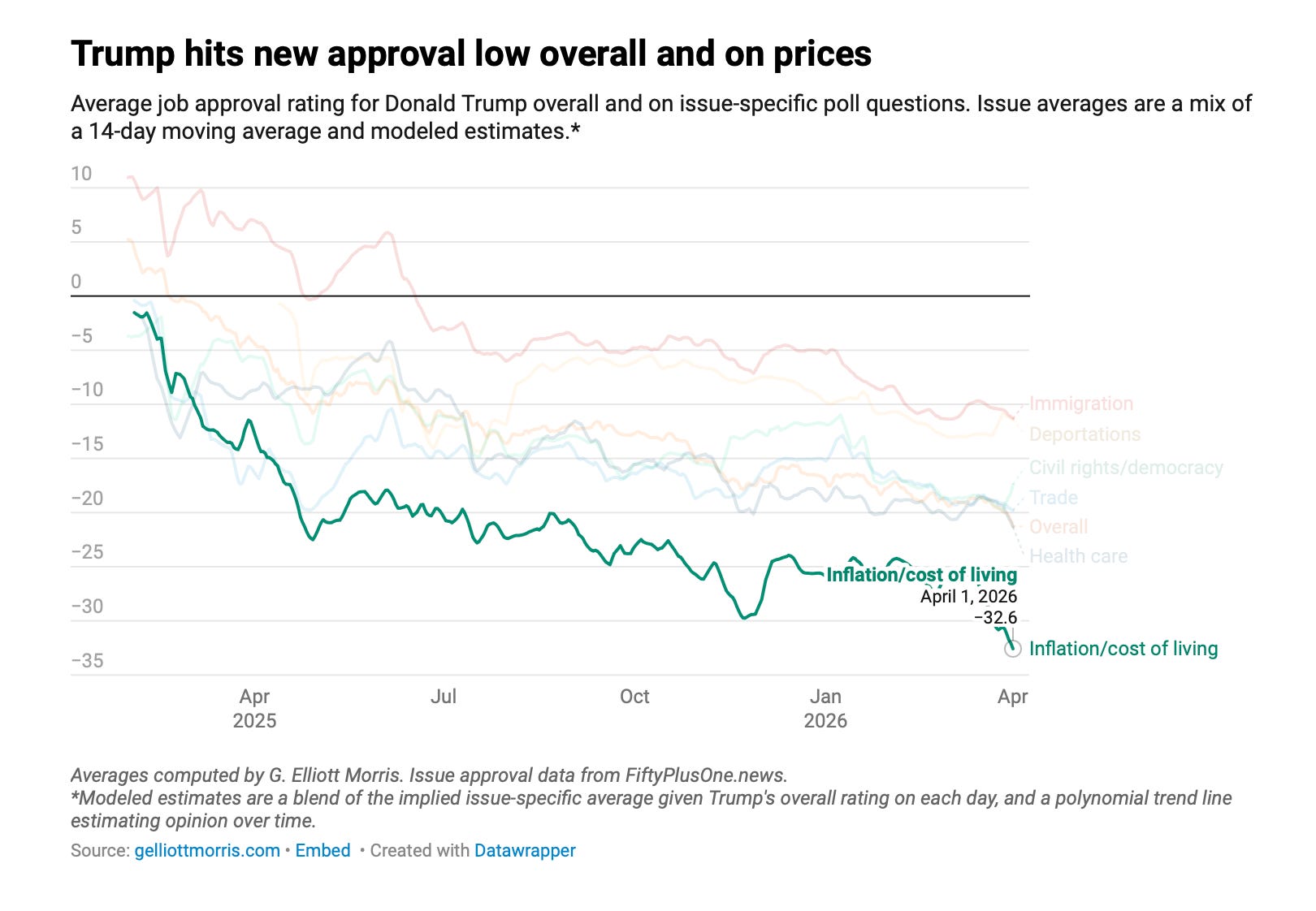
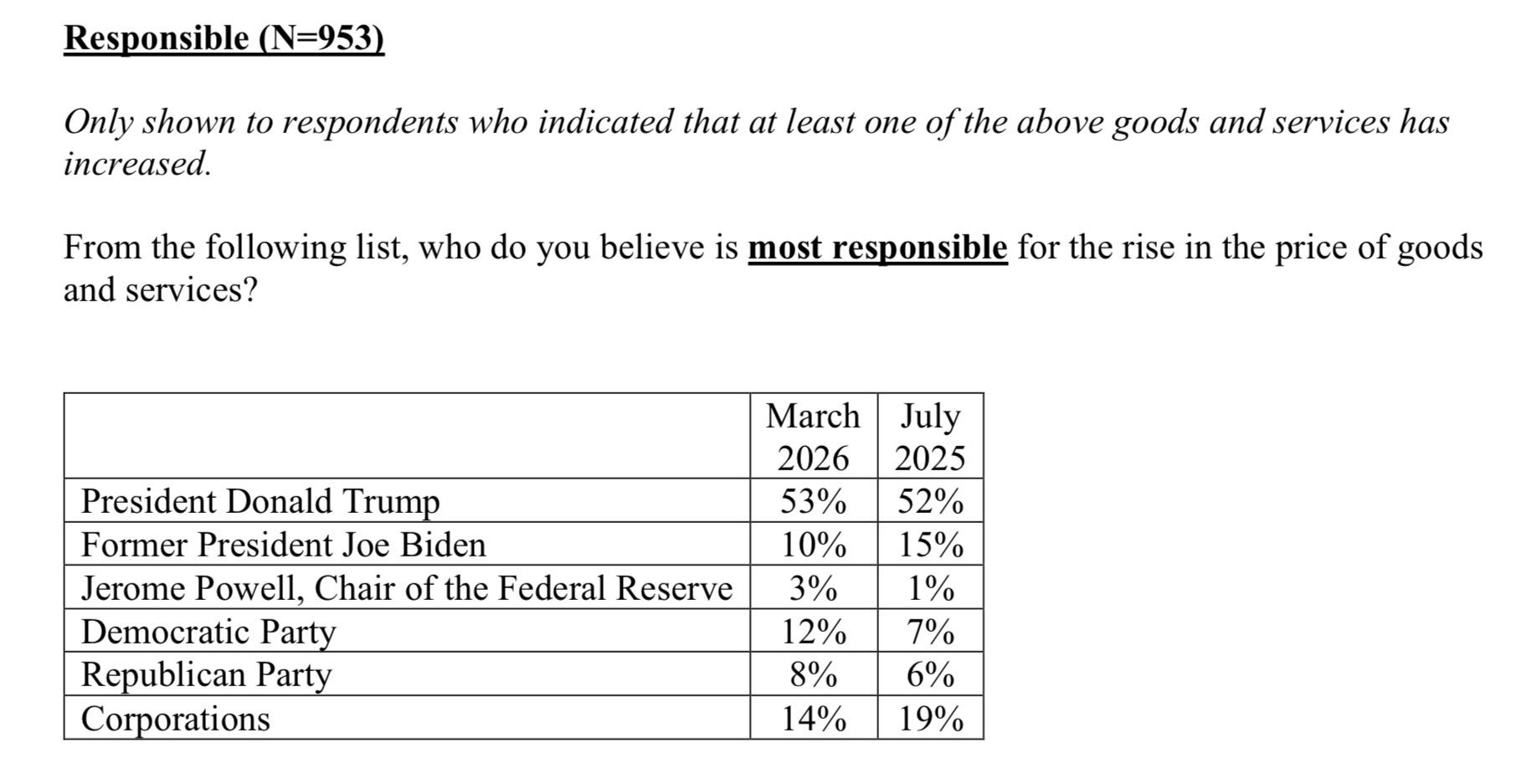
And the broader mood on the economy looks awful for him. A new University of Massachusetts Amherst poll out this morning finds that 53% of Americans say Trump is “most responsible for the rise in the price of goods and services” lately.
Apart from this, the only events that seem to move Trump’s approval are high-profile occasions of executive overreach, such as on immigration and interfering in the Epstein investigation. The Abrego Garcia case and LA protests both look to have hurt him badly. Few or no other events have interrupted the trend the way events that stoke voters’ economic anxieties have.
The more data we get, the more it looks like voters are just in the mood to punish the party in power for high prices and impaired economic mobility. Trump won in 2024 because of this, but now that his party is in power, he’s on the wrong end of the stick.
It’s hard to win back public support when your agenda is this unpopular
Finally, what really stands out about Trump’s trajectory is not just how low his approval is. It’s that it basically never bounces, either. Over 14 months, there hasn’t been a single sustained recovery in his overall approval rating. He got no rally from the Iran conflict, despite what history would suggest about the intervention, and no meaningful bounce from any of his legislative wins. Even the apparent “plateau” over the summer wasn’t really a rebound; it was just a slower decline.
Most presidents get at least some back-and-forth in their numbers. They lose support, then win some of it back after a successful policy fight or a crisis that pulls the country together. Trump hasn’t had that. His line only really moves in one direction.
This is to be expected from a president who has pushed the most unpopular policy agenda of all time. And if that pattern holds — and right now there’s not much evidence that it won’t — Trump will head into the 2026 midterms as the most unpopular president in modern polling history.
I wrote for my Deep Dive this week that Democrats aren’t doing as well as you’d expect based on Trump’s bad position. I would encourage you to read that investigation into the polling data if you want to understand why that is. But one important point is that Democrats don’t need to win the generic ballot by 20 points for Republicans to see the consequences of Trump’s most-unpopular-ever presidency. We’re already seeing them right now.
To sum up: Trump’s approval ratings slide doesn’t look like the result of one isolated crisis so much as the cumulative effect of a presidency that keeps making voters feel not listened to and less economically secure. Again and again, the biggest drops in his standing follow events that raised costs, heightened uncertainty, or reinforced a sense that the country is off track. And because the president has shown almost no ability — or interest — in winning back support, his unpopularity looks less like a purely political or economic liability and more like a defining feature of his second term.
If you’re a frequent reader of Strength In Numbers, I’m confident you will get a lot of value out of a paid subscription. You’ll get access to all of my analysis, including weekly Tuesday Deep Dives, and you’ll be supporting independent data journalism and original data collection.


Trump has pushed the oligarch agenda, where the country works for about 50 hyperwealthy people and fucks everybody else and the world
Excellent essay.