


When you ask voters to describe what kind of political party they want, in their own words, only 8% of self-identified “moderates” actually call for an ideologically moderate political party. Most instead want a party focused on affordability, political reform, or general left-leaning priorities — particularly economic ones.
This number comes from Blue Rose Research, which recently replicated my earlier LLM voter segmentation work at larger scale. Blue Rose asked thousands of Americans to describe their ideal political party, then used a large language model to cluster the responses. Most self-described moderates landed in left, right, affordability-focused, or anti-system camps — not centrist ones. Compared to my work, Blue Rose finds comparatively more Americans in the left-leaning and anti-system buckets.
That finding arrived almost simultaneously with a second, complementary piece of evidence: a major new paper by David Broockman and Joshua Kalla showing that candidates who move to the “elite middle” on issue positions gain, on average, just one percentage points of vote share — and they often lose votes by moderating on popular left/right-leaning issues. But they use a maximally favorable experimental design where every voter has complete information about politics — in a real campaign, the effect is probably half that or smaller.
These two new research findings suggest a more nuanced view of political ideology in America is more helpful than one that reduces politics to one axis and focuses exclusively on the (minimal) role policy preferences play in driving voter behavior.
Today’s Deep Dive covers new data showing voters in “the middle” are not asking for ideological centrism, despite what centrist analysts have written. And trying to win swing voters through generic moderation produces effects so small and inconsistent that the advice is practically useless.
1. The hollow center
Last fall, I used an LLM to classify open-ended survey responses about voters’ ideal political party and found that many self-described moderates were not describing especially moderate party goals. Then, in February, a reader named Steve replicated the result with ANES data and a different model. Now Blue Rose has done something similar again, at a much larger scale, with proprietary survey data and yet a different LLM.
These three analyses, on three datasets, with three different models, all come to the same basic conclusion.
Like my original survey, Blue Rose asked Americans to describe what their ideal political party would “argue for or believe in.” Then it placed each respondent into one of five buckets based on their responses: Left, Right, Affordability, Anti-System, and Moderate.
Here is the topline:
Left: 30%
Right: 25%
Affordability: 21%
Anti-System: 17%
Moderate: 7%
That alone is striking. The Moderate cluster is the smallest segment in the entire typology, eclipsed by anti-system voters, affordability voters, right-leaning, and left-leaning voters.
But the most interesting finding is what happens when you zoom in on people who call themselves moderate. Here’s the crosstab by self-identified political ideology:
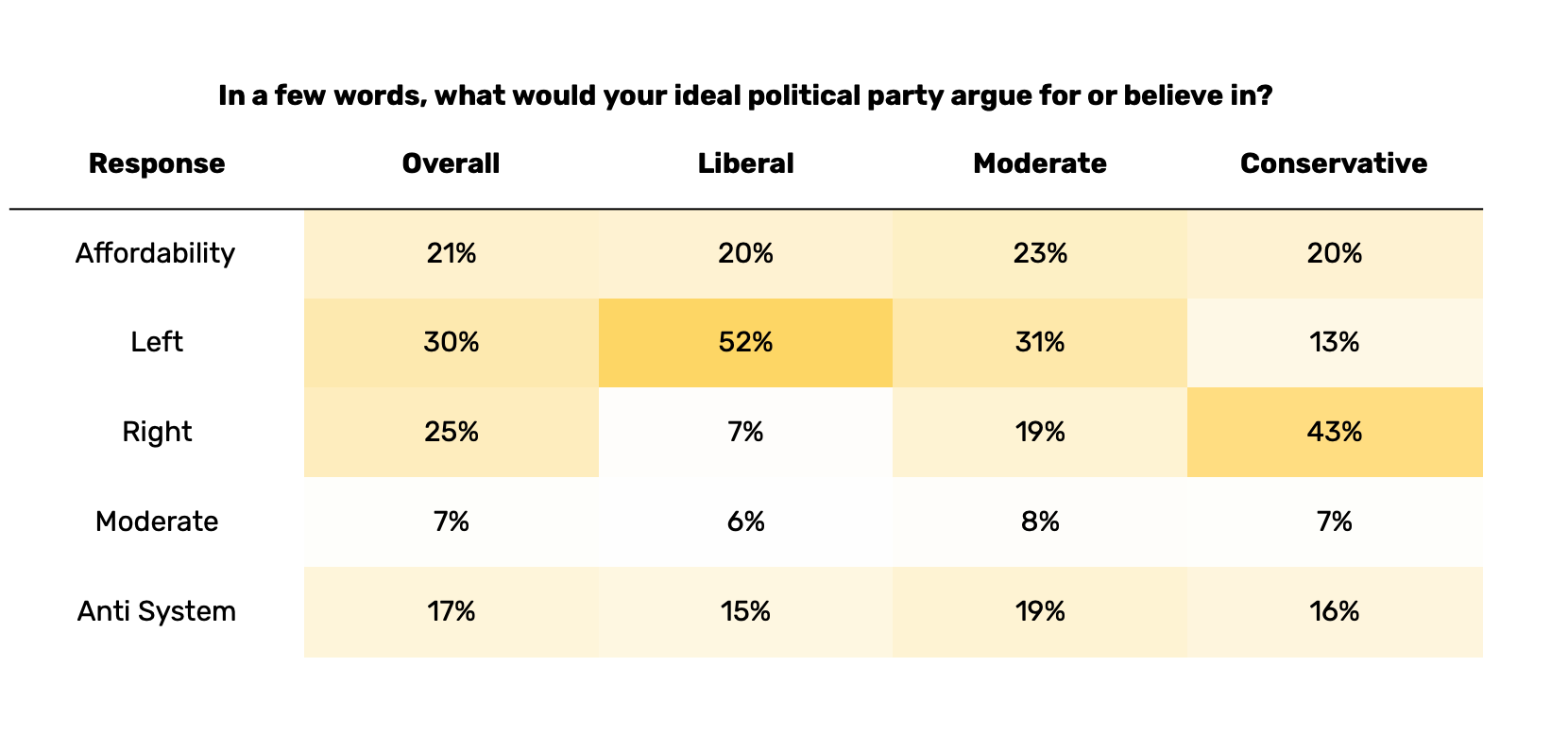
That’s right, only 8% of self-identified “moderates” fell into the Moderate cluster when asked what they want their party to fight for. The other 92% gave responses that clustered into left, right, affordability-focused, or anti-system camps. These voters describe their identity in ideological terms when forced to pick a label, but do not use centrist ideological language when they are allowed to think about politics in their own terms.
As I wrote in my original write-up, the right interpretation of this data is not “survey respondents are lying about their ideology” (although they might be, this data doesn’t land either way), it’s that the label moderate does not map cleanly onto what people actually say they want from a political party. A lot of voters probably use “moderate” to mean something like “I’m not an extremist,” or “I don’t like partisan conflict.”
But that is not the same thing as describing a coherent set of centrist party goals. When Blue Rose asked people to say what they actually wanted from politics, most self-identified moderates did not articulate anything that clustered into a recognizably moderate program. Some examples of what people said are listed in my original article.
That difference matters a lot for strategy. If “moderate” is mostly a weak or noisy label for what voters want from a party, then “win moderates” is not really a strategy; it’s a slogan.
Among swing voters — people who switched either from Biden to Trump or Trump to Harris from 2020 to 2024 — the biggest clusters were 25% left, 24% right, 23% anti-system, and 21% affordability. Just 8% were moderate. And among 2024 non-voters, even more were anti-system, and just 5% were labeled moderates.
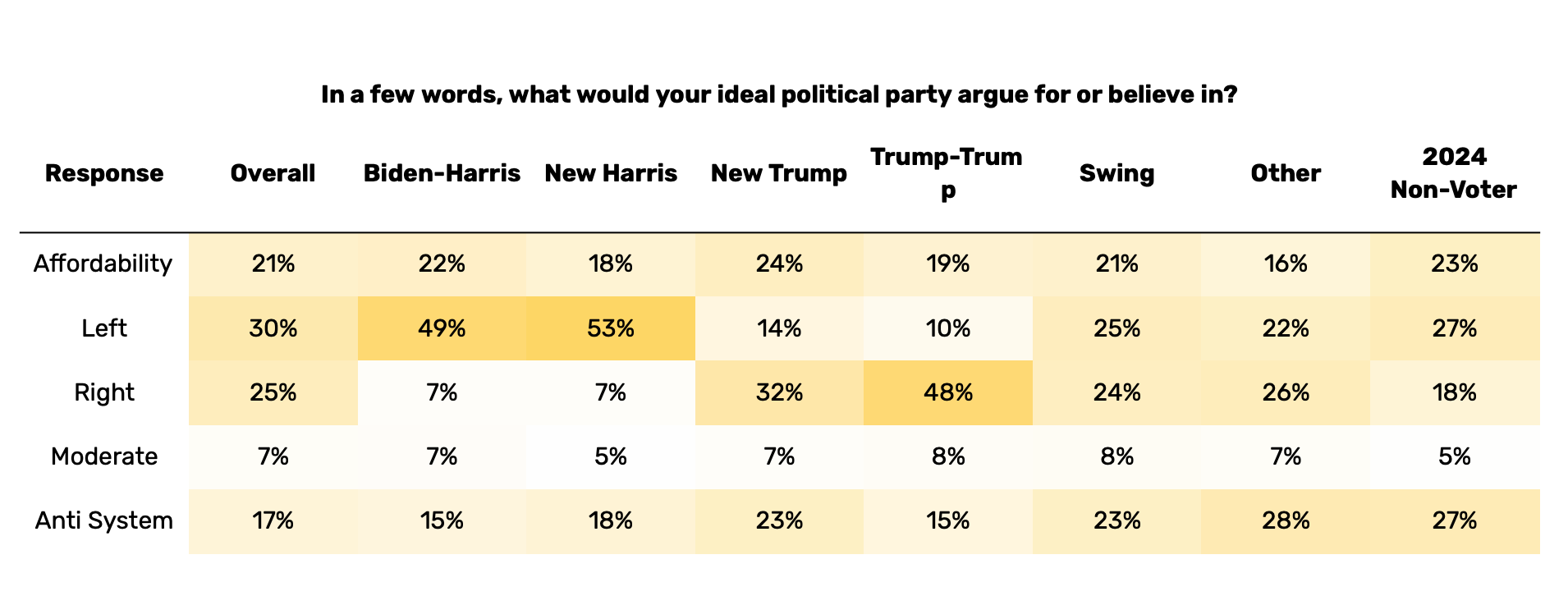
The voters campaigns most want to persuade or mobilize are not sitting in some tidy centrist lane, waiting for a consultant to shave a few points off a laundry list platform document. They are much more likely to be angry about prices, alienated from institutions, or structured by concerns that do not fit cleanly on a left-right ideological spectrum. Or left-wing!
Together, the anti-system and affordability segments make up roughly 44% of swing voters and 50% of non-voters. The explicitly moderate segment is just 5% to 8%. The most parsimonious interpretation of this data is to spend more time campaigning on conditions and anti-system sentiment and less time on centrism. It is important for a party not to be viewed as extreme, but a lot of people have spent a lot of time and money campaigning on and covering that over the last year, to the detriment of other important factors.
A caveat here: the fact that self-identified moderates do not describe coherent centrist ideology in open-ended text does not mean they will never reward candidates who seem less extreme, more restrained, or less conflict-driven. They might. But the label “moderate” is too noisy to tell campaigns which positions to change or which voters they are actually trying to reach. That is the practical problem. “Win moderates” sounds like a strategy, but without knowing what those voters actually want — and the data says they want very different things — it is closer to a wish.
2. Why “just be moderate” isn’t a strategy
That brings us to the second big piece of evidence published over the last month: a new working paper by political scientists David Broockman and Joshua Kalla testing how much voters respond to issue positions in a survey experiment.
Many people in the moderation camp have treated this paper as vindication. Matthew Yglesias cited it in a New York Times guest essay. The political strategist Liam Kerr, who helps run the centrist Super PAC “Welcome,” wrote it up on Substack in a sort-of communiqué to aligned funders and readers. And there was a rush on social media to claim that the empirical debate is now settled in favor of moderation.
To set the stage for the rest of this post, I do not think a fair reading of the paper actually justifies what the champions of moderation have been using it to claim. In fact, the paper is more of an indictment of the “just moderate” strategy than a vindication; it shows that moderation only works on a case-by-case basis and that the effect size is smaller than that for the national environment, fundraising, or candidate factors (you know, the types of things I was writing about a year ago) — and it does so with an experimental design that is maximally favorable to the Yglesias wing of the party.
But even if you take the results of the paper at face value, if the entire centrist operation dominant in the Democratic Party donor circles and among media elites today is only finding effects of one point for its core political strategy, that is actually a pretty big loss in two ways: First, because they’re ceding that other campaign tactics have higher efficacy; and second, because this coefficient is between one-half and one-third the size of the previous estimates people like Yglesias and Welcome PAC were pushing.
The average effects are small
Before getting into the gory political science details, some context. Yglesias’s NYT essay — “The Democratic Brand Is Toxic in Too Many States” — used the Broockman-Kalla paper to argue that Democrats should moderate strategically on specific issues where they are out of step with voters. That is a notable shift from the cruder version of the moderation thesis he and others were pushing a year ago, which was basically “Democrats should just be more moderate” as a generic brand strategy. Now, Yglesias argues that shedding certain issue positions would help the Democratic party establish a more “moderate” brand (whatever “brand” means).
That might be true, but it’s not actually what the paper says. One of the authors even said on social media that the effects they found in their experimental study almost certainly would not hold in the real world. Details time:
