


From time to time, Strength In Numbers accepts paid sponsorships on free, public posts to help pay for the costs of running this business. This money covers things like hired help with the podcast and polling, costs of data acquisition, and also helps offset churn in the monthly/yearly subscriber base. This post contains one short blurb from a paying sponsor, clearly marked, about halfway down the article.
Our June Strength In Numbers/Verasight poll asked Americans to rate a dozen political figures on a scale from 0 to 100, with 0 representing a completely “cold” feeling toward the person and 100 representing a “warm” feeling. Who’s popular — and who’s not — is fairly revealing.
This turns out to be an incredibly timely survey question. Last Tuesday, June 23, three Democratic candidates for U.S. House seats that were endorsed by Zohran Mamdani, the democratic socialist mayor of New York, won their primaries. Of note, former New York City comptroller Brad Lander buried incumbent Rep. Dan Goldman — whom Hakeem Jeffries, the Democrats’ leader in the House, had personally backed — by more than 30 points, and Darializa Avila Chevalier, a 32-year-old organizer, unseated five-term Rep. Adriano Espaillat by 3. Claire Valdez, a New York State Rep., won a primary for an open seat spanning Brooklyn and Queens by 20 points.
Also of note: all three of the above Mamdani-endorsed winners are allies or members of the Democratic Socialists of America. As such, the results were immediately interpreted as evidence for a Tea-Party-esque movement among Democrats to support lefty candidates and punish the establishment. After the wins, the DSA shared the graphic below, from a CNN segment, on Twitter/X:
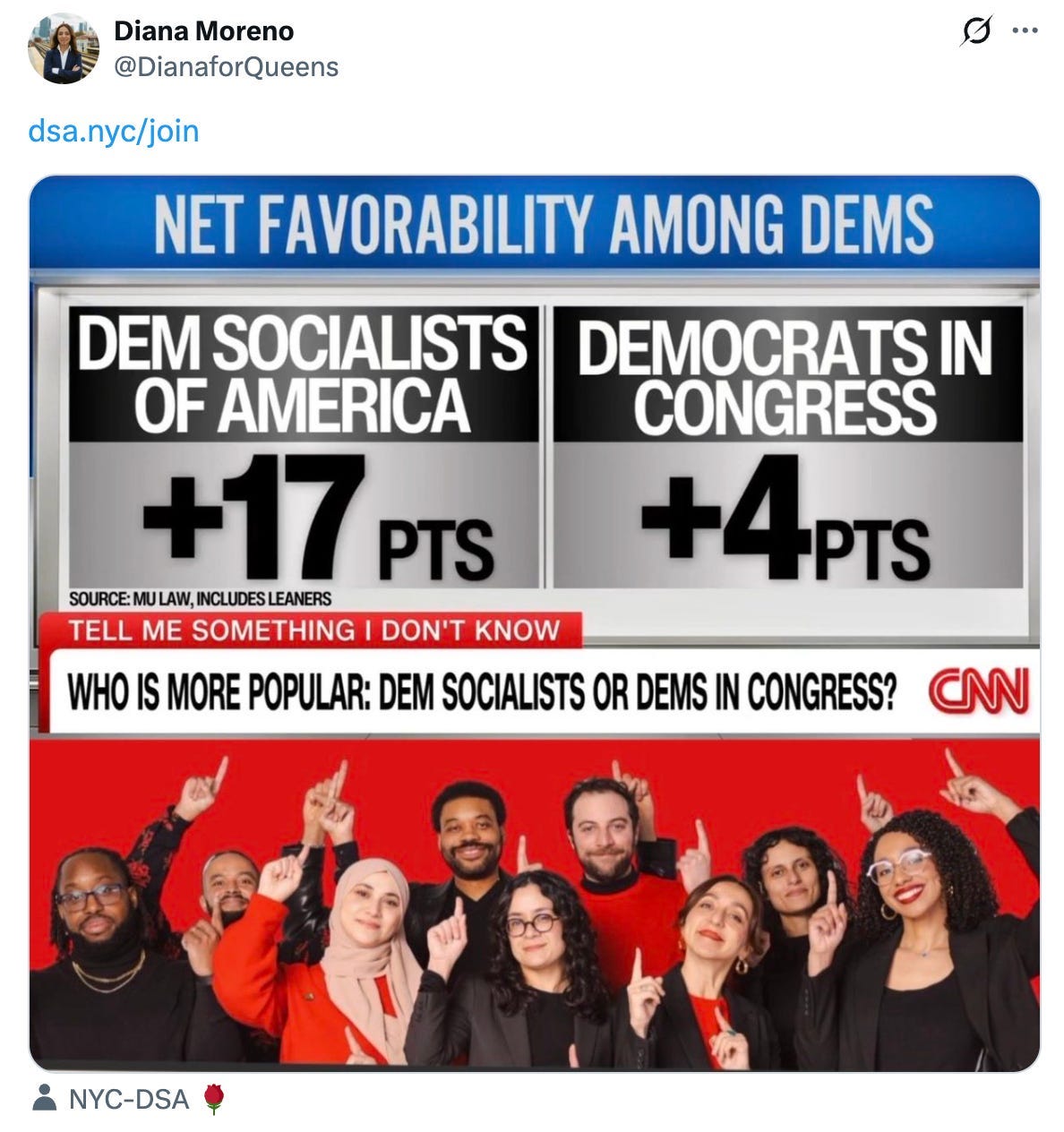
Centrists in the Democratic Party have responded to Tuesday’s losses by pointing out that, yeah, the DSA might be popular among Democrats, but it’s not popular among the general public — so these wins ought to be viewed as a cautionary tale about ideological polarization. Liam Kerr, who helps run the centrist Super PAC WelcomePAC, posted the following results from a Marquette University Law School poll:
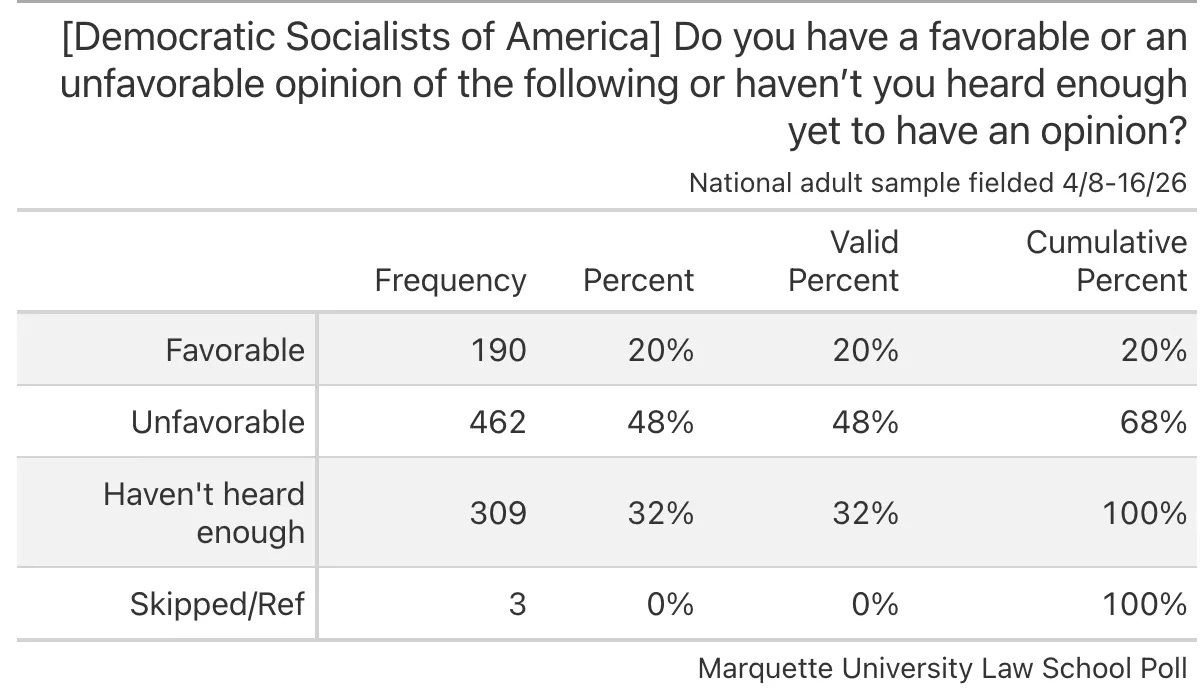
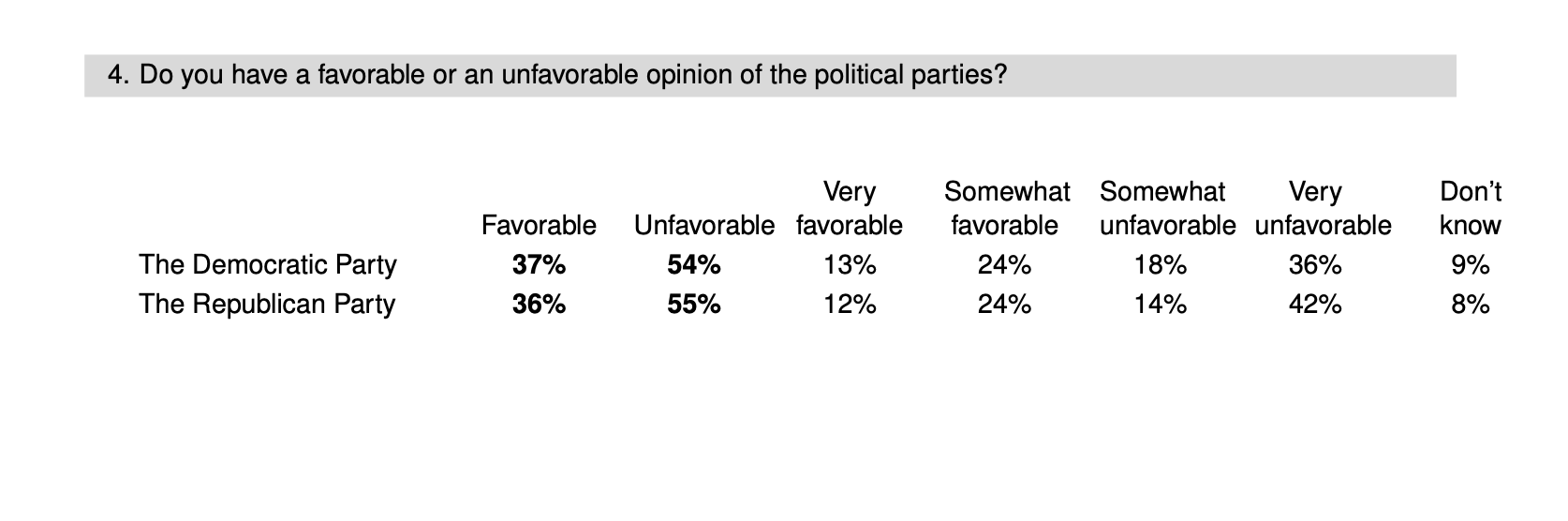
Reading the piece and social media posts, Kerr also appears to be trying to popularize the line that only 5% of Americans rate the DSA as “Very Favorable.” That’s true, if a bit misleading in terms of data: Only 12% of Americans rate the Republican Party and Democratic Party favorably, per YouGov. Twelve percent is higher than 5% but not anything to write home about. In general, all party organizations are very unpopular:
I’ll have more fresh data about the Democratic Party’s brand problem, and what to do about it, tomorrow.
I find discourse on this subject severely lacking in a few ways, but mostly that it centers on favorability toward parties but doesn’t deal at all with politicians. If, for example, Zohran Mamdani is more popular than the DSA, then it’s not right to characterize all DSA politicians as “toxic,” as Kerr does. And this can have consequences: One of the things Trump benefited from in 2024 was that voters viewed him more favorably than the Republican Party.
So what can we learn from the hard data on how people feel about America’s most well-known politicians and party organizations? And does that tell us anything about the supposed Democratic Tea Party, and where the parties are headed in 2028? (At the very least, can we make a chart of politician favorability ratings that looks really cool?) Let’s run the numbers!
You can read our previous poll releases at the Strength In Numbers polling data hub. Paying subscribers to this newsletter have access to additional trend charts and a full archive of crosstabs at this link.
Left-leaning politicians are the most popular Democrats, with one exception
Every few months, I ask Americans in our poll to rate the country’s leading political figures on a “feeling thermometer” scale — a 0-to-100 scale where 100 represents as warm and favorable as possible and 0 is as cold as can be. This is an alternative to the poll question that is popular in lots of media analysis asking if a respondent feels someone is “very” or “somewhat” un/favorable. (I find the distinction here somewhat nebulous.) I compile these ratings each year for a piece announcing America’s most popular politicians, per these ratings.
In June, we tested 19 figures and party organizations. The results are shown in the graphic below:
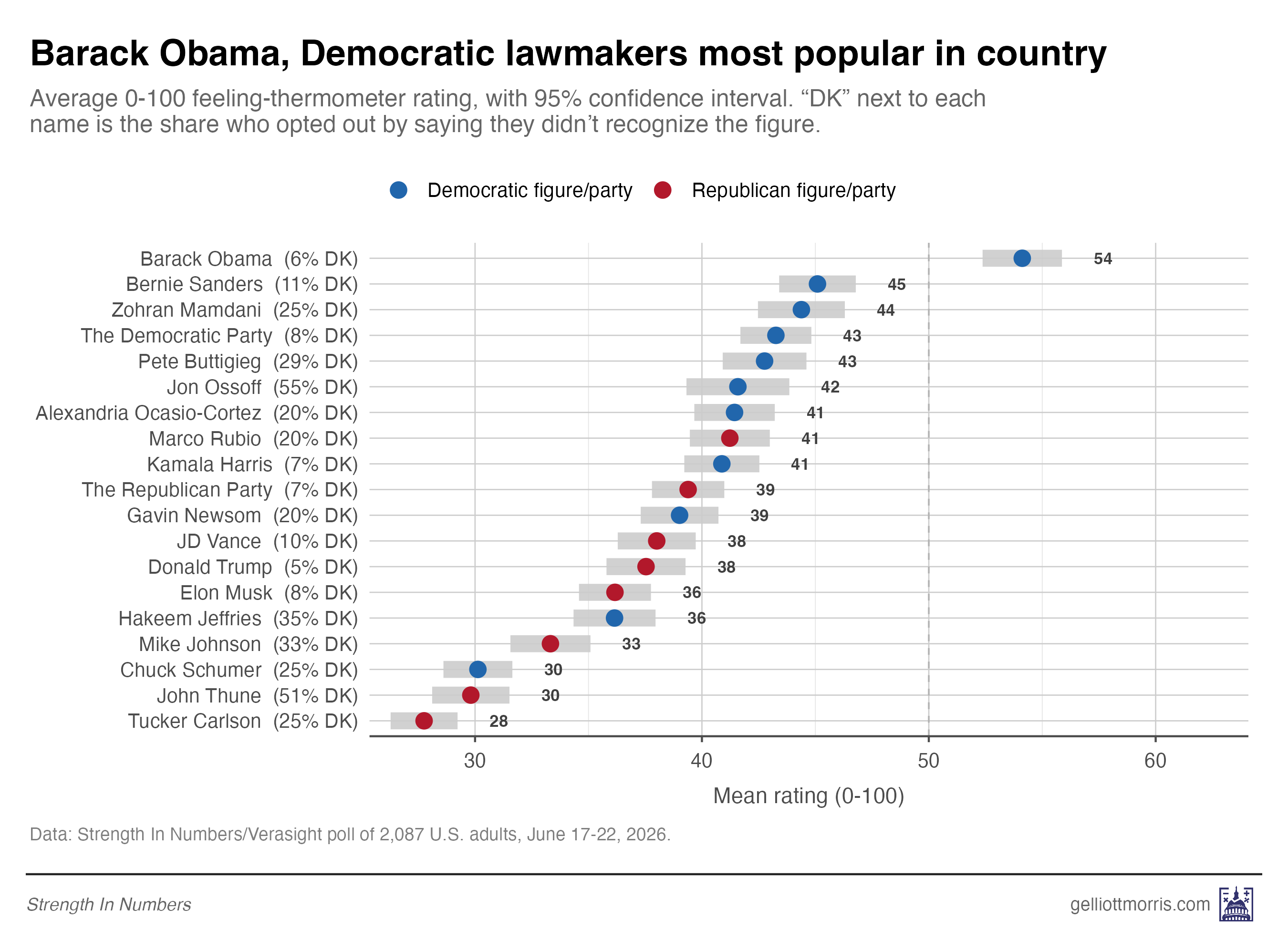
Americans view warmly, on average, to one political figure: Barack Obama. Everyone else is either slightly or significantly below a 50-50 rating.
After Obama comes a tight cluster of Democratic-aligned figures, all above an average rating of 40/100. We see Bernie Sanders at a 45, Zohran Mamdani at 44, the Democratic Party itself at 43 (very surprising result, IMO), Pete Buttigieg at 43, Jon Ossoff at 42, and Alexandria Ocasio-Cortez, Kamala Harris, and — the lone Republican to crack the top tier — Marco Rubio all at 41.
The bottom of the list is mostly Republican. Tucker Carlson is the single most disliked figure we tested, at 28. Senate Majority Leader John Thune (at 30), Speaker Mike Johnson (33), and Elon Musk (36) all sit near the floor. And Donald, at 38, is tied with his own vice president, JD Vance, and just below the Republican Party as a whole, at 39.
The only Democrats to poll worse than Donald Trump are the party’s Congressional leadership: Chuck Schumer is at 30 and Hakeem Jeffries at 36. Americans rate Gavin Newsom the same as they rate the Republican Party overall, at 39/100.
This is not the first time we’ve seen Democrats top the list of America’s most well-known politicians and key 2028 contenders. Here’s how each figure’s rating now compares to their past rating in Strength In Numbers/Verasight polling:
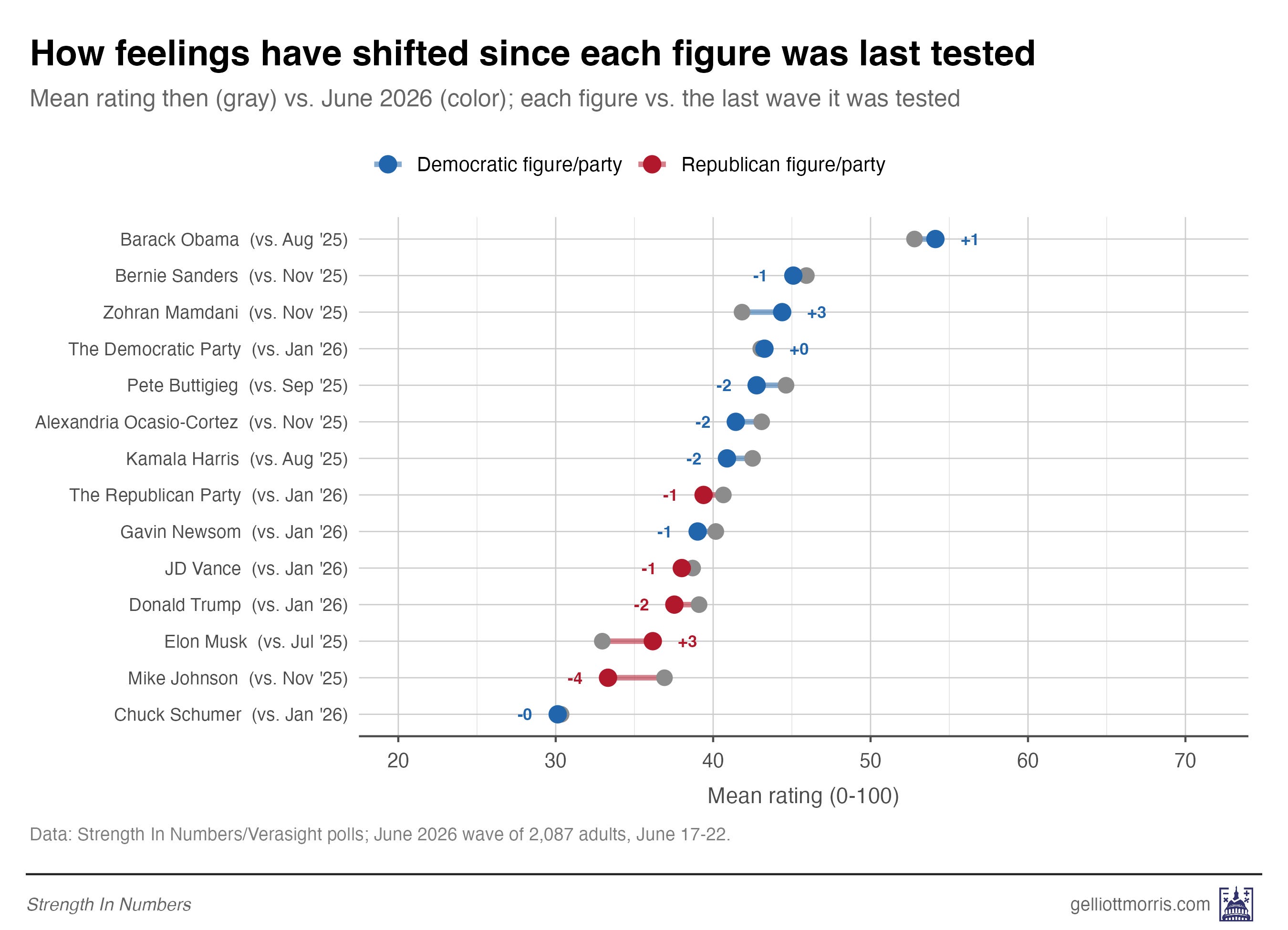
None of these are big swings, and most sit within the polls’ margins of error.
One caveat to keep in mind: By design we only ask Americans who know of each figure to rate them, but recognition of each varies widely. Take Jon Ossoff for example: over half of respondents (55%) say they didn’t know who he was, so his 42% rating could change as he becomes better known. The better-known a figure, the more their rating reflects views of the whole public (and the harder it is to move).
Today’s newsletter is sponsored by Ground News, a website and app I use to keep up with news from trusted sources and monitor what outlets from all sides of the political spectrum are saying about current events. Ground News gathers news articles from over 50,000 sources worldwide and shows you a measure of each outlet’s factuality, ownership, and political bias. You can also filter news by whether an outlet is owned by private equity or a corporate conglomerate — or is an independent outlet, like this Substack!
If you’re a news junky, consider Ground News. You can use it however you want: as a simple-yet-smart news aggregator or as a sophisticated tool that helps you navigate the challenges of our modern information ecosystem. The constant news monitoring and feature filtering help me keep my own news diet attuned to facts, not spin.
Today, Ground News is offering readers of Strength In Numbers 40% off their “Vantage plan,” which gives you a personalized feed as well as data on factuality, partisan bias, and funding information for basically every news outlet you could imagine.
How each party sees key 2028 contenders
The overall thermometer scores above tell you who Americans like overall, but not who has more purchase with their own party. The latter matters more if, like so many analysts are trying to do now, we want to benchmark 2028 or understand the unfolding “Democratic Tea Party.”
So in the graph below, I separated out our poll sample by self-described party affiliation and calculated how each party’s base feels about its top 2028 contenders.
Among Republicans, there’s a two-way tie at 68/100 between JD Vance and Marco Rubio. Notably, that’s lower than the highest ratings Democrats give their leading candidates. But the more interesting result is Tucker Carlson’s mean rating of 40/100. That serves as a good reminder that the MAGA media wing of the GOP does not speak for the rest of it. And if Carlson is going to try to run for president, as some people think he might, he’s going to have to either get those numbers up or get a new party.
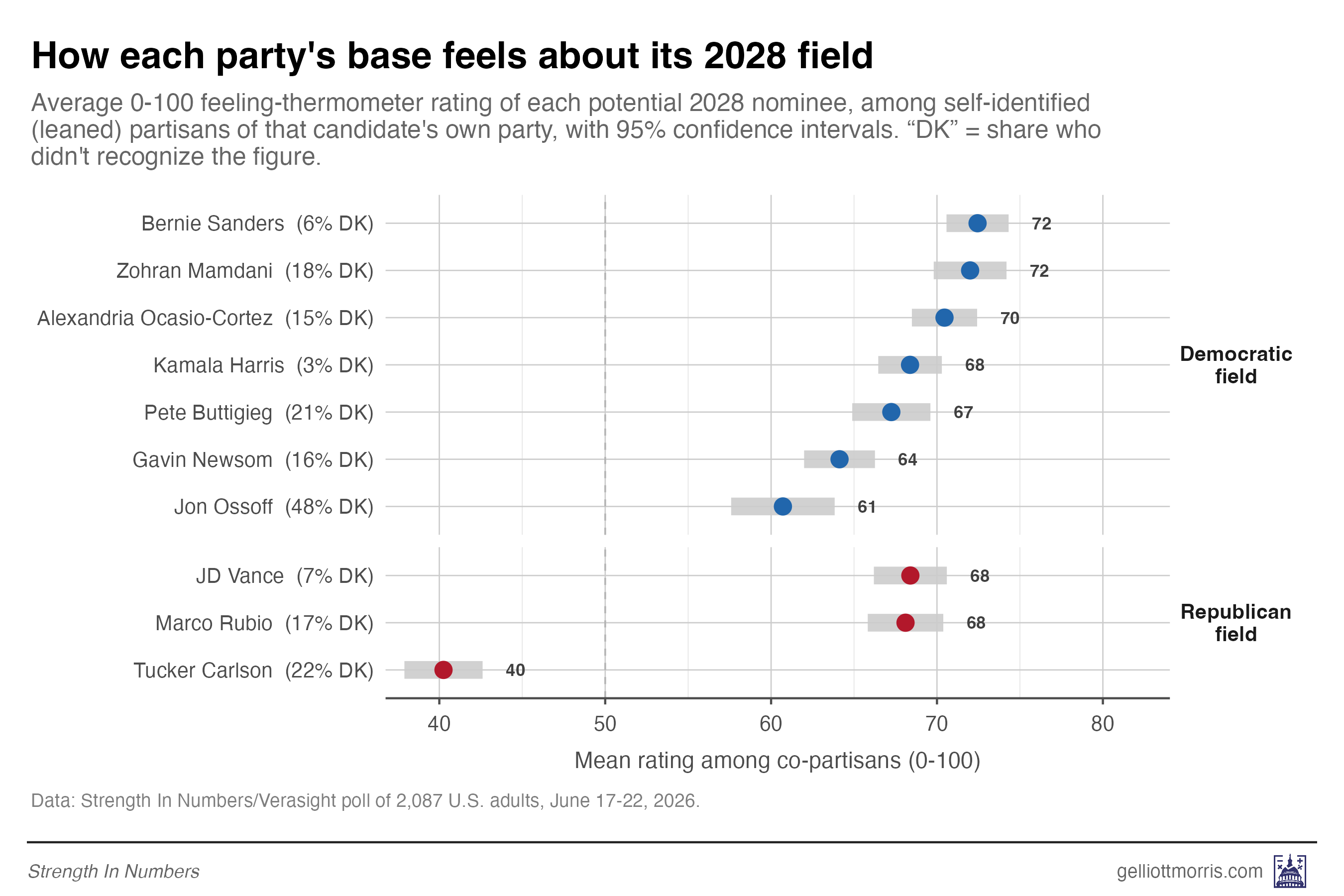
On the Democratic side, the pattern is clear: The party’s left-leaning stalwarts and next-generation insurgents are more popular than its relatively more moderate wing (I would hesitate to call Gavin Newsom a moderate in absolute terms). Bernie Sanders and Zohran Mamdani top the field at a mean rating of 72/100, with Alexandria Ocasio-Cortez just behind at 70.
Trailing them is the party establishment: Kamala Harris is at 68, Pete Buttigieg at 67, and Gavin Newsom at 64. Georgia Senator Jon Ossoff brings up the rear at 61 — though nearly half of Democrats still say they don’t know who he is, so I wouldn’t take that 61 to the bank.
Democrats want to vote for Democrats who fight
As for the DSA/Tea Party discourse, note that Democrats are generally feeling warmest toward fighter-coded figures such as AOC and Mamdani and less favorable of the establishment. It’s not surprising, then, that in New York City of all places, two fighter-coded candidates managed to knock off incumbents who garnered high-profile endorsements from party leadership. Across all the New York primary elections last week, the DSA won 9/10 key races.
Contra the messaging being pushed by MAGA Republicans, however (Trump is trying to paint all Democrats as communists now), I do think this is about fighting Trump and the weakness of the Democratic establishment, and not really about ideology. That’s how you get Jeffries and Schumer — certainly not “moderate” in any typical ideological framework — at a 30/100 feeling thermometer rating.
In general, polls have shown the big problem for Democrats today (such that there is a “problem” when you’re winning the midterms in a blue wave) isn’t being seen as woke, but as weak. And the apparent real-world demand among Democrats and independents who lean toward Democrats for “fighters” is proof this polling is picking up on something real.
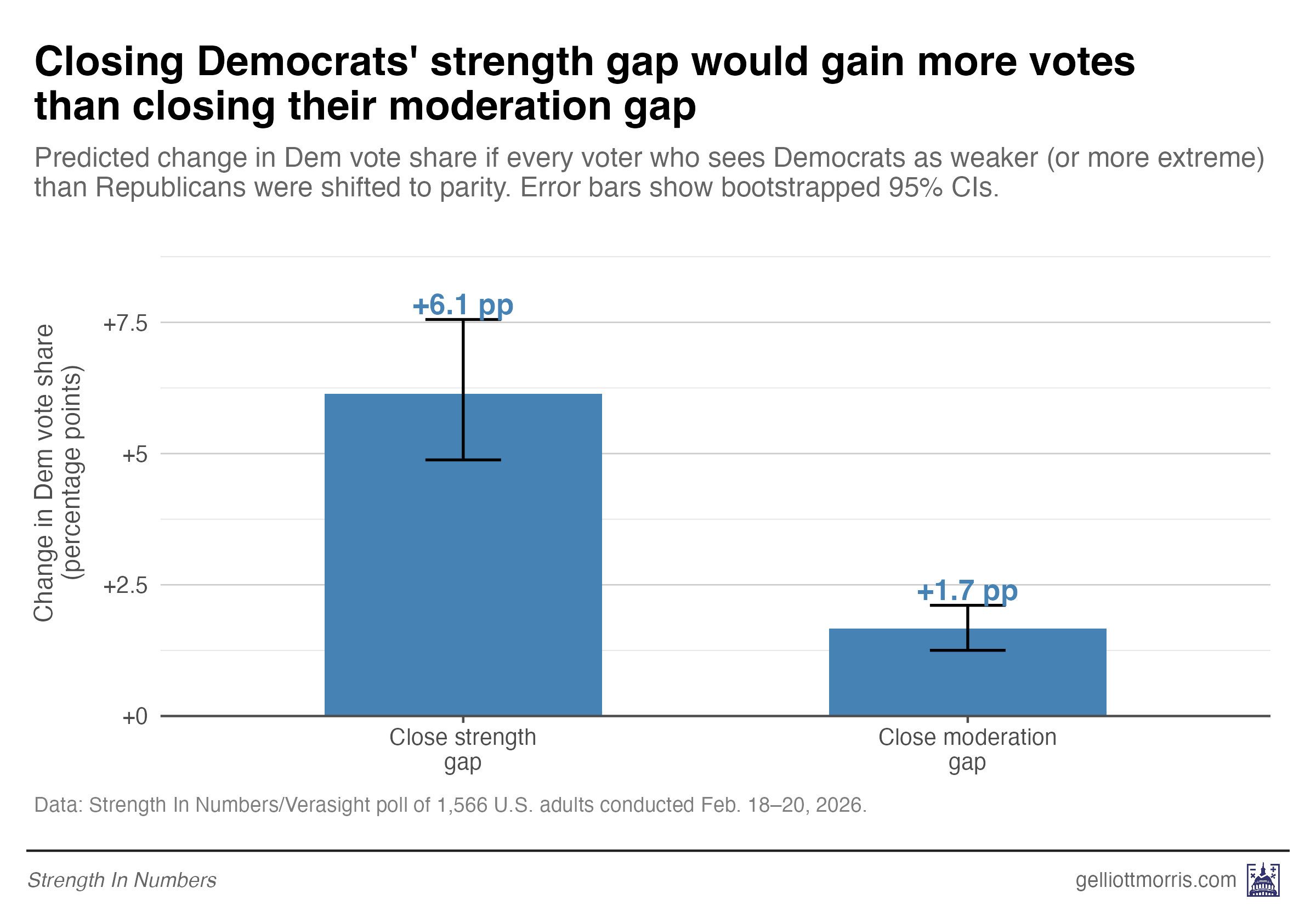
Democratic primary voters have evidently decided they want candidates who put their full energy into fighting Trump and raising the standard of living. That’s true in New York City, and in the feeling thermometer ratings. That may change by the time the 2028 primaries really heat up, but for now it’s worth reading this data clearly: The average Democrat feels about 10% warmer toward Zohran Mamdani than Gavin Newsom.
The June Strength In Numbers/Verasight poll surveyed 2,087 U.S. adults online between June 17 and June 22, 2026. The margin of error for the full sample is ±2.2 percentage points; subgroup margins (such as ratings among co-partisans) are larger. Full methodology and crosstabs are available at gelliottmorris.com/poll.
If you made it this far: Strength In Numbers is subscriber-supported. If this work is useful to you, upgrade to a paid subscription to keep independent polling alive — and to get the full crosstabs and weekly premium Deep Dive articles.


Why do Democratic "centrists" insist on forcing an endless debate on the precise mathematical position of every Democrat on the ideological spectrum? It's tedious, useless, and of zero interest to Democratic voters who want lower prices and accountability for lawlessness and corruption.
Next time, you should include Mark Kelly...and Ruben Gallego. I'm curious how many have a position, and how they rate among the general population.