


I’m popping my head up from paternity leave for a few hours this morning to write this note on a topical new poll that everyone seems to be reading incorrectly.
If you get value out of data-driven coverage of polling and public opinion, the best way to support my work is with a paid subscription to this newsletter. Paying readers get premium weekly analysis and access to new data and features before the rest of the public.
The New York Times released a new poll of potential Democratic primary voters last month, and one question in particular is still making the rounds among people I read and talk to. When they were asked which ideological direction they'd personally like to see the Democratic Party move, 47% of Democrats said toward the “center,” 28% said to the left, and 19% said stay put. The result was spread through the centrist data analyst universe as more evidence the party needs to move right to win future elections.
I’d recommend reading Dan Pfeiffer’s post about this poll at his newsletter The Message Box, in which he comments that the left-right frame is the wrong way to think about what voters want. That’s something we talk about often here: remember the Strategist’s Fallacy, in which pundits and other elites map high-knowledge, high-political-engagement concepts such as detailed ideological issue positioning onto the mass public, which is largely low-political-knowledge and low-engagement.
Yet there are several other criticisms to make of this data that Pfeiffer and others miss. One of the things we try to do here at Strength In Numbers is be smarter about reading and interpreting polls. Here, the big issue is that the poll does not seem to be measuring what people think it measures — namely, desire among Democrats to shift candidate issue positions to the right over the left.
This isn't inherently an argument against moderation, or for it. It's an attempt to urge readers of polls to figure out what they are actually evidence of, instead of seeking in every data point a way to reinforce their pre-existing beliefs. When you actually dig into the NYT poll, the topline takeaway changes dramatically.
This week's Chart of the Week is: why questions about party ideological identity are close to useless. How can Democratic voters want the party to be more moderate, but also rate socialists so highly?
Democratic voters want the party to move left, right, and center all at the same time
Here’s really this whole piece in one chart. A plurality of the same Democratic voters all say the party should move left, right, and stay put — simultaneously.
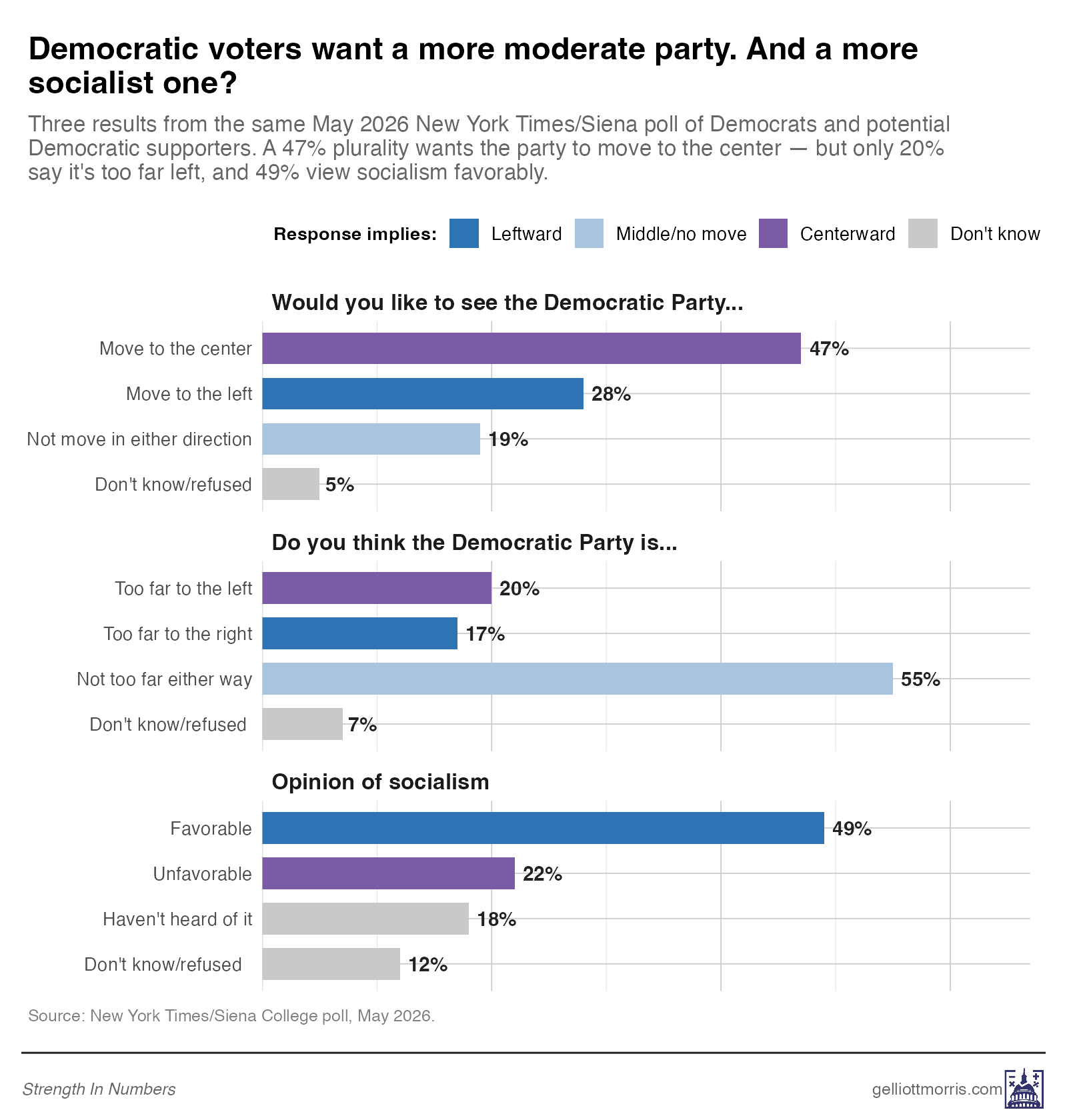
Going line by line: 47% of Democratic supporters say they want the party to move to the center, vs 28% left and 19% no direction. But if you ask the same exact respondents not which way the party should move, but what they think of its current position, just 20% say the Democratic Party is actually too far to the left, while 17% (within the margin of error) say it's too far to the right and a 55% majority says it's not too far in either direction.
And then there's the third panel. Asked their opinion of socialism, these potential Democratic supporters split 49% favorable to 22% unfavorable (the remainder said they didn’t know, including a sizable share that hadn’t heard of socialism at all).
So what we’ve got here is a Democratic electorate that is evidently pro-moderate, pro-socialist, and favors the party’s ideological status quo.
Now consider polls on policy. In our May Strength In Numbers/Verasight poll, we asked all Americans — not just Democrats — which federal policies would most ease their economic anxieties, and the most popular picks were middle-class tax cuts, higher taxes on the wealthy and corporations, and a crackdown on corporate price-gouging. Populist economics polls well across the board. Given the rosy results among all Americans, I expect the Democrats in the sample to be even more pro-D.
Either the electorate is hopelessly confused, or the "move left or center" question isn't measuring what pundits think it measures — or both.
What "move to the center" actually means
Now let me just say that the question people are trying to answer here — how Democrats can optimize their chances of winning in 2026-2028 — is a good question. The stakes of the next few elections are enormous, so the party should optimize its odds of winning them. If “moderating” ideological labels (whatever that means) accomplishes that, it’s worth it to try.
But there are a couple more problems with the way people are using this poll.
First, even apart from the error mentioned above, this poll result isn't an answer to that question. It really isn't even a proxy for one. Voters aren't strategists, and asking them whether the party should move to the center doesn't measure the electoral payoff of moving to the center — it measures whether they've absorbed, and agree with, the conventional wisdom that says moving to the center is how parties win. Those are different things.
When every pundit spends 16 months saying Democrats should tack to the middle to win in 2028, a poll finding that voters agree is of little value. It mostly just tells you the message got through, not anything about the strength of the case. The strategy question is an empirical one about voter persuasion and turnout, and you answer it with experiments and election results — not by taking a vote on the idea.
Then, there’s the problem of what is meant by “left” and “center.” When a poll asks whether a party should move in a certain direction, that means something different for every respondent.
And let’s not overlook the fact that the Times did not poll “left” vs “right” but “left” vs “center.” They might as well have polled “extremist” and “normie.” Because of the normative characterization of polarization in America today, when people hear “left” vs “center,” many likely see the contrast in loaded terms — e.g., "should the party be fair and pragmatic, or ideological and extreme?"
And it’s not clear Americans have a good understanding of ideology anyway — or, at the very least, that that understanding translates in any way to policy and other outcomes. Gallup found in September 2024 that voters were about as likely to call Kamala Harris "too liberal" (51%) as to call Donald Trump "too conservative" (48%) — a statistical tie. That is implausible for two reasons. First, the candidates were nowhere near equidistant from the center on most policy domains, with Donald Trump farther to the right than Harris was left on entitlement spending, immigration enforcement, and trade policy, to name a few.
Finally, nearly a third of the Democratic supporters couldn’t tell the Times what they thought about socialism — a concept considered pretty basic among most elites. This indicates a low level of engagement with these subjects among the general public. A related finding: I showed in April that only 8% of self-described "moderates" actually want moderation when you let them describe their politics in their own words.
A choose-your-own-adventure poll for pundits
Many actors and organizations in the general orbit of the Democratic Party are jockeying right now to get legislators to adopt their (and their donors’) positions on pet issues and party strategy ahead of the 2028 election. One such organization is the Times itself, which by my count has published a dozen articles arguing the party should run to the center to win in 2026/8, often with thin evidence, and few exploring alternative paths or contrary evidence.
Given the issue with the poll question discussed in this piece, unfortunately, it will lend itself to generating less objective insight about party strategy and more confirmation bias for whatever the person reading the poll already believes. It is akin to a political Rorschach test. If you want the party to move right, you quote the 47%. If you want it to move left, you quote the 49% on socialism and the 17% who say the party is too far right. Everyone gets a crosstab — nobody gets an answer.
This is not meant as a criticism of the Times’ pollsters, who have mostly written about the general consensus among Dems that the party is positioned well ideologically (see panel 2 in the chart above). Rather, as with a lot of the articles here at Strength In Numbers, it’s a reminder that not all polling — and not all poll-based punditry — is what it seems at first glance.
This article is free to read, but it was not free to produce. Subscribers to Strength In Numbers get exclusive weekly data-driven analysis of politics and elections, access to premium polling data and data interactives, and support this independent media company supplying original, unbiased political journalism. Consider joining as a paying member today:
If a paid subscription is not in the cards for you, the best thing you can do is share this article with a friend. Word of mouth is the #1 way new people learn about this publication! Thank you.


From the Dan Pfeiffer newsletter:
"Based on focus groups, anecdotal data, and common sense, it seems like people are pissed at the party for losing the 2024 election and not doing a better job of standing up to Trump. This is why Democrats are simultaneously telling pollsters that their party sucks and then voting for that same party at every opportunity like their lives depend on it (and they may)."
We risk over-complicating things here.
People are unhappy with our party because WE ARE OUT OF POWER.
Simultaneously, it's a lot harder to "stand up to Trump" when he has the House, the Senate, the Whitehouse, and the Supreme Court to weaponize for the interests of his MAGA cultists and tech billionaires.
The real meaningful polls will begin in January of 2027, when we regain the House and Senate. Then it will be critical for Dems to have priorities that will MAKE LIFE BETTER for their voters ASAP.
Reverse the tariffs. Reverse the Medicaid cuts. Renew the ACA subsidies. Release the rest of the Epstein files. (Trump can't veto that one.) That will get us started.
Then promise to tackle Citizens United, so we can put power back into the hands of the PEOPLE, and out of the greedy hands of the Epstein class.
While you’re on paternity leave, it doesn’t show in the quality of your posts! They are often illuminating in ways that are incredibly useful to even thinking about canvassing work we are doing in North Carolina now for NC General Assembly seats in November.