


In the past two weeks, several high-profile events have shown voters that President Donald Trump is not focused on their top issues — inflation, jobs, and elections/democracy. On August 31, 2026, Trump won the Supreme Court’s permission (for now) to keep building his 400-600 million-dollar ballroom. In July, he announced new tariffs on Canada, and, on Aug. 27, ordered Lake Ontario be renamed “Lake America.” And this week he told Americans in communities wary of data centers to “Let Data Reign,” while pushing new development of AI data centers and gas power plants onto federal land.
This is not what voters want the president to be focused on. And this mismatch in priorities has been showing up in the polls for months.
A February poll from Wave Polling and Research (my polling firm) found 69% of U.S. adults agree the Trump administration is “focusing too much on deportations and not focusing enough on fixing the economy, inflation, and the rising cost of living.” That includes 87% of voters who didn’t back Trump in 2024, 77% of his 2024 voters who now say they’ll vote Democratic in the generic ballot — and 32% of Trump’s 2024 voters who are still voting Republican in November.
My take is that this mismatch in priorities will have electoral consequences for Trump and the GOP. Generally speaking, I have noticed American pundits spend a lot of time writing about how policy positioning affects candidate success, and comparatively little time on how perceived prioritization does. But the latter is equally, if not more, important.
Today’s Chart of the Week is about the growing gap between what Trump is working on and what voters are actually asking him to fix, and about the overlooked importance of issue prioritization to most voters.
This post is free to read, but it was not free to produce. If you want to support our independent, data-driven political journalism and get premium posts sent to your inbox 2x a week, become a paying subscriber to Strength In Numbers today. Members also get early access to data products, a private community on Discord for our political data nerds, and an ad-free newsletter experience.
They’re calling it “Hoover-maxxing”
Where else to begin but by noting the absolutely insane politics of building a giant marble ballroom with money from taxpayers and your billionaire friends while people are struggling to put food on the table. If any other president had tried this — in an election year, no less — he would have been sidelined by his own party’s congressional leaders the next day.
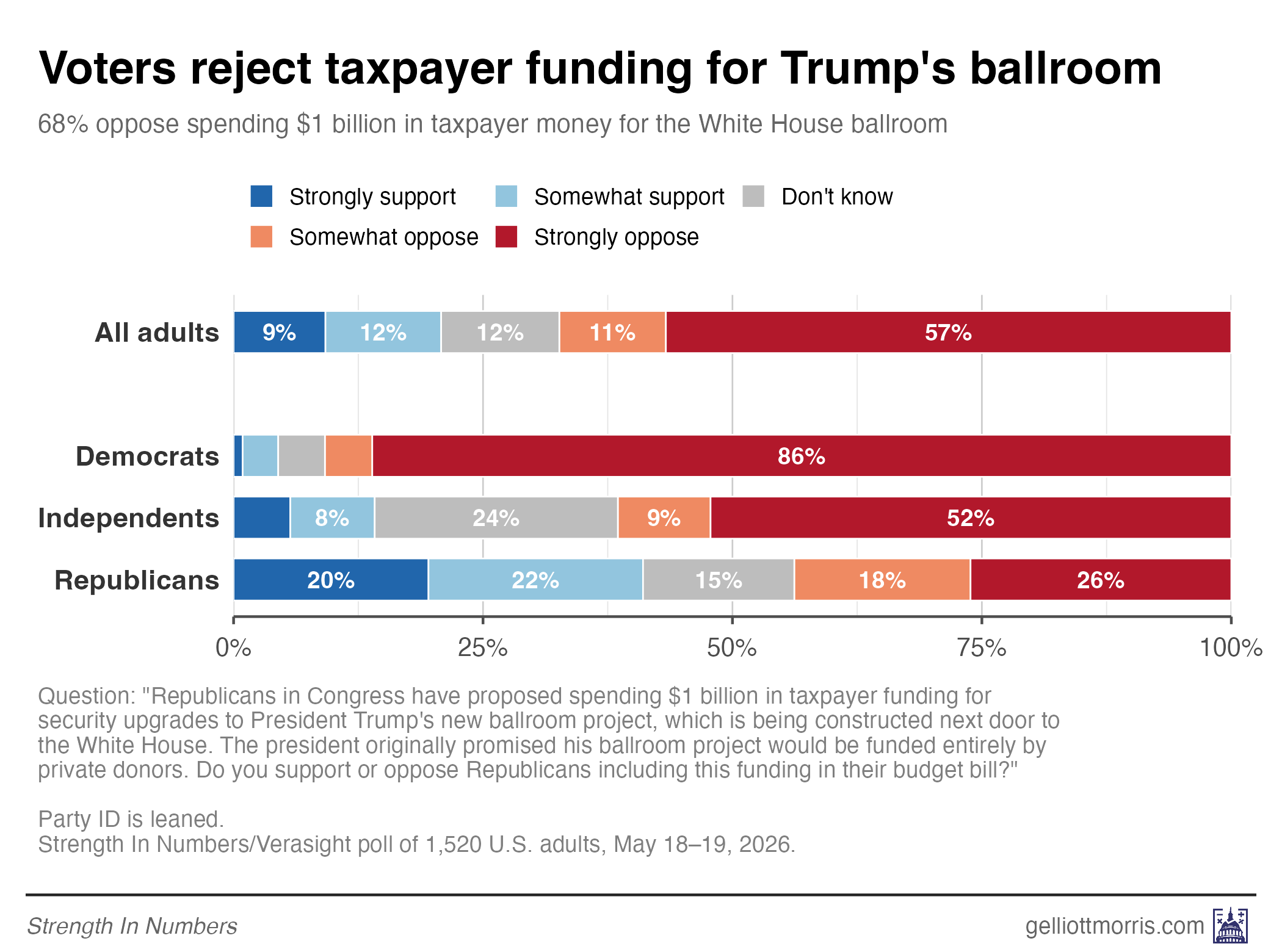
Back in May, our Strength In Numbers/Verasight poll found that 68% of voters opposed spending taxpayer money to build Trump’s ballroom. This included a plurality of Republicans, at 44% opposed to 42% in support of funding construction.
And our August poll shows the cost that focusing on projects like this has had for Americans’ evaluation of the president. Nearly 60% of adults now name prices/inflation as one of their top-three issues facing the country today, 20 points higher than the second issue “jobs and the economy.” And the president’s net approval on prices is at an all-time low, and approaching a net rating of -50.
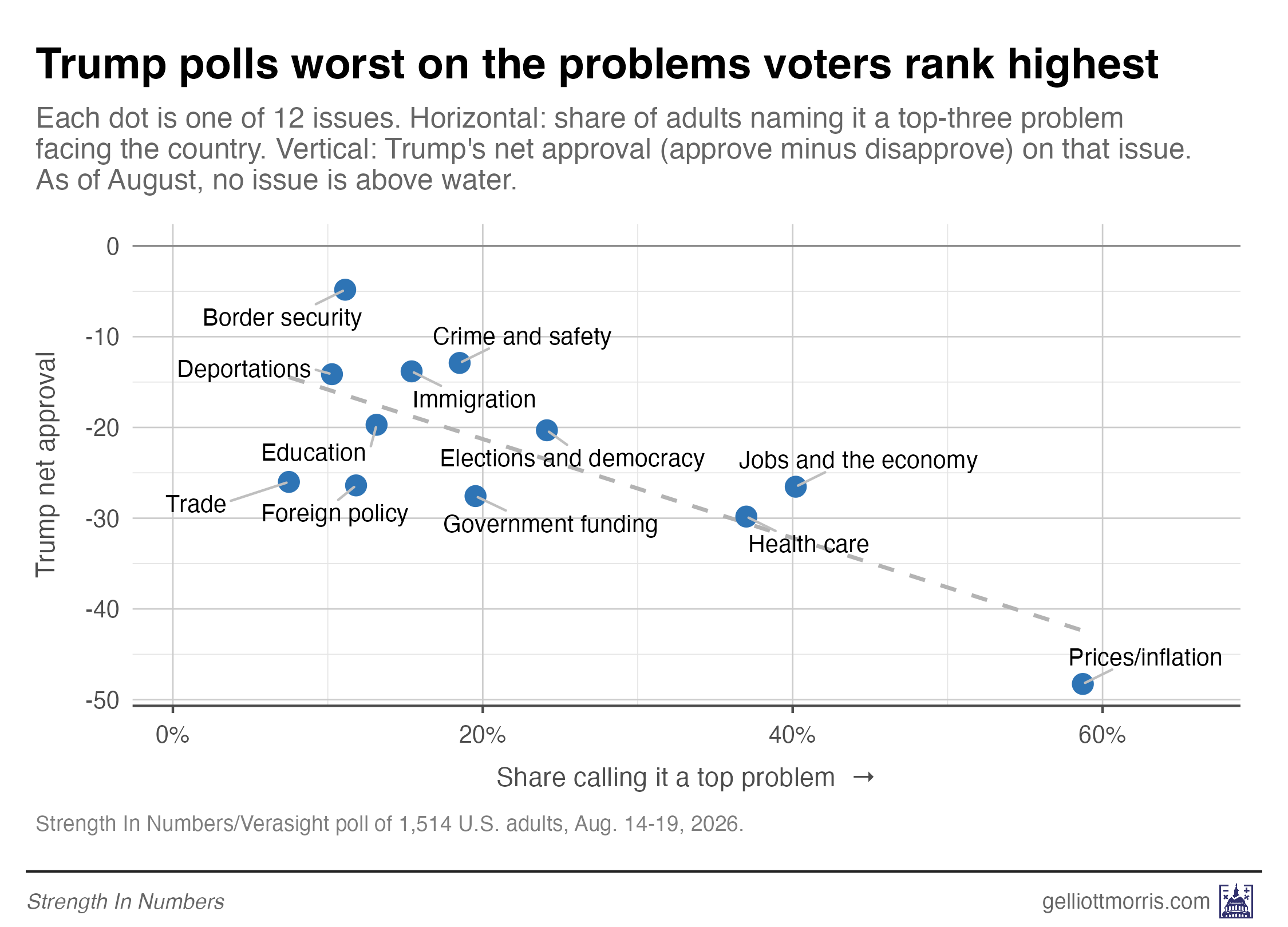
Generally, the more important voters say an issue is right now, the more voters dislike how the president is handling it. The issues Trump and Republicans are strongest on, border security and crime, are rated as the most important problem by the fewest voters. (The correlation across all 12 issues is r = -0.76.)
And it’s not just my polling showing this. A CNN/SSRS survey found in July that just 27% think Trump has had the right priorities, and 73% say he hasn’t been focusing enough on what matters most to them. That itself was a record in CNN’s polling, which has been negative for the president since last year.
Voters don’t like when politicians ignore their issues
So what does the empirical political science say about the importance of issue prioritization? In their book “News That Matters,” Shanto Iyengar and Donald Kinder’s classic “priming” experiments found that whichever issues dominate the news become more important to voters in both (a) evaluating the performance of the president and (b) choosing between candidates in future elections.
And in a study of the 1968, 1980 and 1984 presidential elections, Stanford political scientist Jon Krosnick found that voters’ views on policies had a substantially larger effect on their evaluations of candidates — and ultimately their votes — when they considered those policies personally important. Patrick Fournier and four coauthors later found the same pattern looking specifically at incumbent performance: voters put more weight on how the government was handling an issue when they considered that issue important, while performance on issues they considered unimportant had little effect on whether they supported the incumbent.
But you do not need a political science research paper to understand that a president spending all his time on things voters don’t care about — indeed, spending a lot of time and energy on policies that exacerbate their top problems — would be bad. If you're hungry, and your parents don’t feed you, you understandably get upset at your parents.
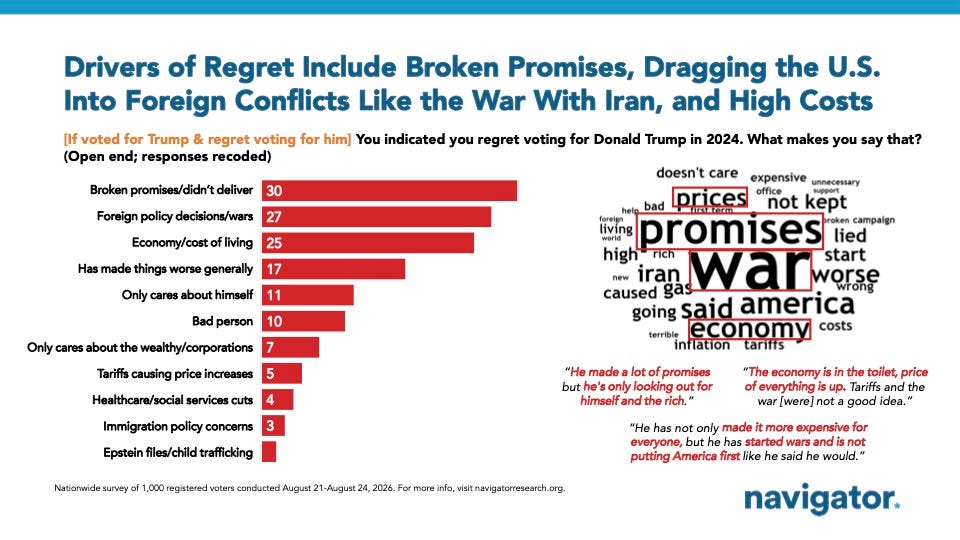
It is thus not surprising (but still worth emphasizing) that Trump has lost support not only with the average American, but also his own voters, because he has been focused on the wrong issues. An August Navigator Research poll found 20% of 2024 Trump voters now regret their vote, with the war with Iran (45%) and prices (43%) at the top of the list of reasons and healthcare cuts close behind (38%). More than a third of Trump vote regretters said they changed their mind on him because the president was “focusing on the wrong priorities like the White House ballroom.”
As David and I put it in the weekly podcast on Thursday, Trump is doing everything you’d expect from someone who wants to lose an election.
That brings us back to the one thing voters want: They want the president to work on the problems they see as the most pressing. And in Donald Trump’s case, they get a daily reminder that the president is simply not prioritizing those issues. Right now, Americans are preoccupied with prices and jobs, while Trump keeps giving them constant evidence that he is not dealing with them.
Trump’s electoral problem — and a big problem for the Republicans this November — is not merely that voters dislike the president’s policies, but increasingly see him as distracted from the country’s most pressing problems. And they’re right.


Trump is not "distracted" from our most pressing problems. Rather, he lives in a delusion in which they do not exist for him. Ds must stop all squabbling and work to support all D candidates--since Trump is insane and refractive to psychiatric intervention, political intervention in the midterms is absolutely essential if our nation is to have any chance to survive as a democracy.
There are limited things we as individuals can do, but there is a clear first step. Not only vote, but vote against every Republican on the ballot to demonstrate to the Republican Party that the days of enabling his behavior are over and they need to rebuild their party into a responsible, adult group of elected officials that deserve our support.