


A reminder for Founding Members: our private pre-election briefing with Strength In Numbers and The Downballot is this Tuesday, October 27, at 6:30 p.m. ET. Details here. And I’ll be live on election night, Tuesday, November 3, with David Nir starting around 7:00 p.m. ET.
It was a very busy week at Strength In Numbers and associated projects this week, and this week will be busy too. So I’m writing a more informal main post here, and then have a shorter-than-usual list of other links below.
As a reminder, comments on the Sunday roundups are unlocked for all readers of SIN, so feel free to share your own links with the rest of the community there.
1a. Undecided voters
I did a TV hit yesterday morning in which the hosts wanted to know about undecided voters. How many are there, and is there anything we can glean about their likely vote?
To answer this, I combined data from the last four Strength In Numbers/Verasight polls to get a small sample of 391 registered voters who still say they “don’t know” who they’ll vote for on the generic ballot after we ask which way they lean.
Well, the TV hosts didn’t end up asking me about undecided voters, so I’m going to share the findings here with you all now instead:
First, relatively few voters are undecided. Depending on the poll, about 5-10% of voters are undecided after being pushed. This number is smaller than the percent of voters in traditional exit polls that say they decided who to vote for in the last week (about 15-20% in 2022 and 2024), but for complex reasons having to do with how those polls sample people on Election Day, that’s likely an overestimate. In 2025, only about 5% of voters in Virginia told The Voter Poll — a new version of the traditional exit poll from partners at media organizations, SSRS, and the pollster Verasight that relies heavily on pre-election interviews — that they were undecided.
Undecided voters also care more about prices than decided voters. According to our combined polling data, 45% of undecided voters name prices and inflation as the most important problem facing the country, and another 18% pick jobs and the economy. That’s 63% naming prices or the economy, compared with 48% of voters who say they’ve already decided for whom and whether to vote.
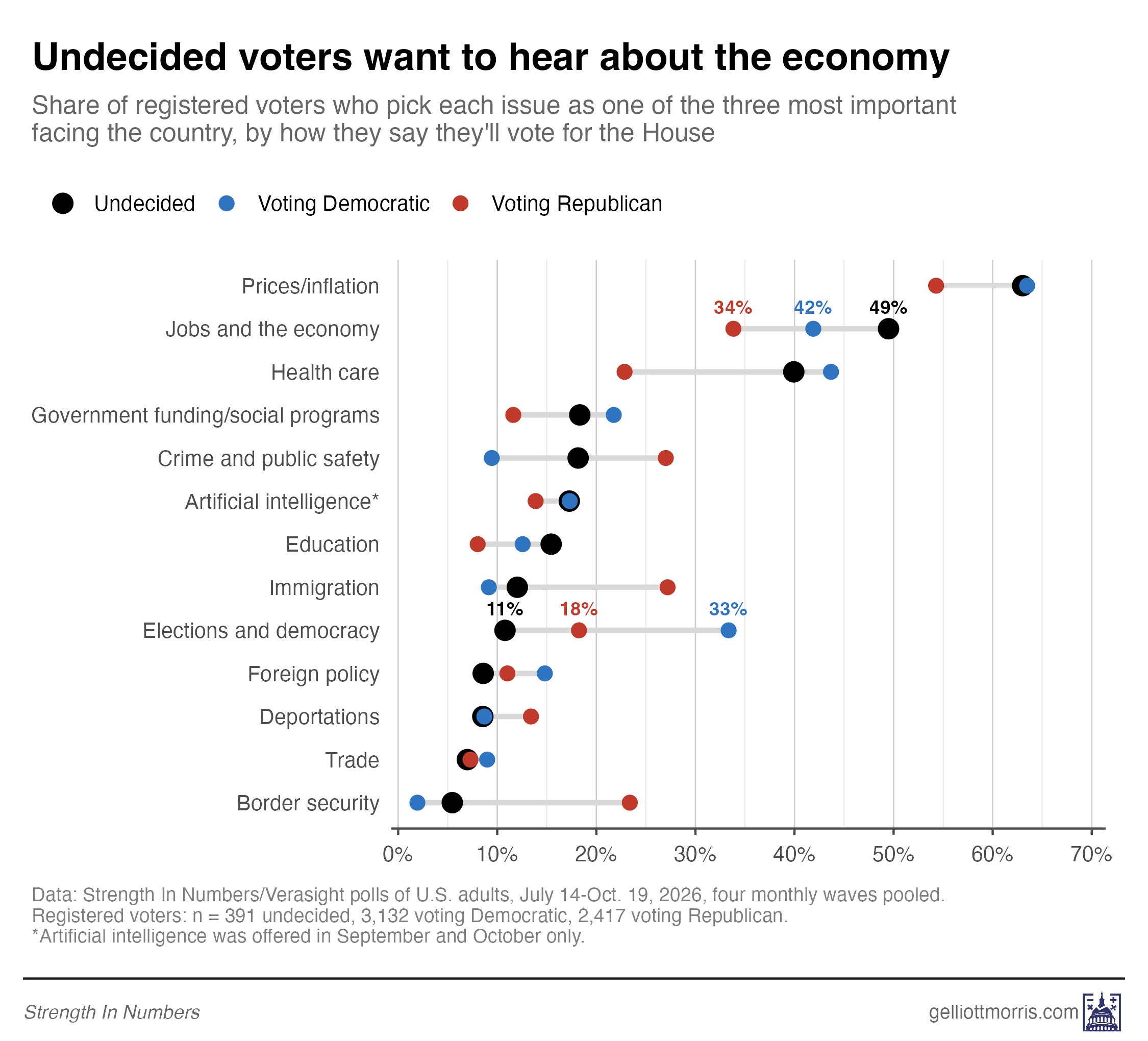
On the relative prioritization of almost every issue, undecided voters look more like voters who have already decided to vote for Democrats than those who say they’ll vote Republican.
They also really don’t like how Trump is handling prices. If undecided voters are just tuning in, and if they rank prices as a top priority, then how they feel about the incumbent’s performance on prices is likely to be decisive. Overall, 69% of undecided voters disapprove of the job Trump is doing in general, and just 14% approve. On prices, they are split 77% disapprove to 8% approve. If you are ignoring people who say they don’t know how they feel about Trump, fewer than 1 in 10 undecideds approve of his handling of inflation.
Finally, many of them are disappointed Trump voters. About 6 in 10 undecideds voted in 2024, according to the data Verasight recorded for its panelists when they joined the survey community. Among those who voted for Trump or Kamala Harris, Trump voters outnumber Harris voters nearly 2 to 1. Altogether, 28% of undecideds voted for Trump and 15% for Harris. The rest didn’t vote (38%) or backed a third-party candidate (18%).
Those undecided Trump voters have turned on him. They give him a net approval rating of −31, a bit worse than registered voters overall (−25). On prices, he’s at −59.
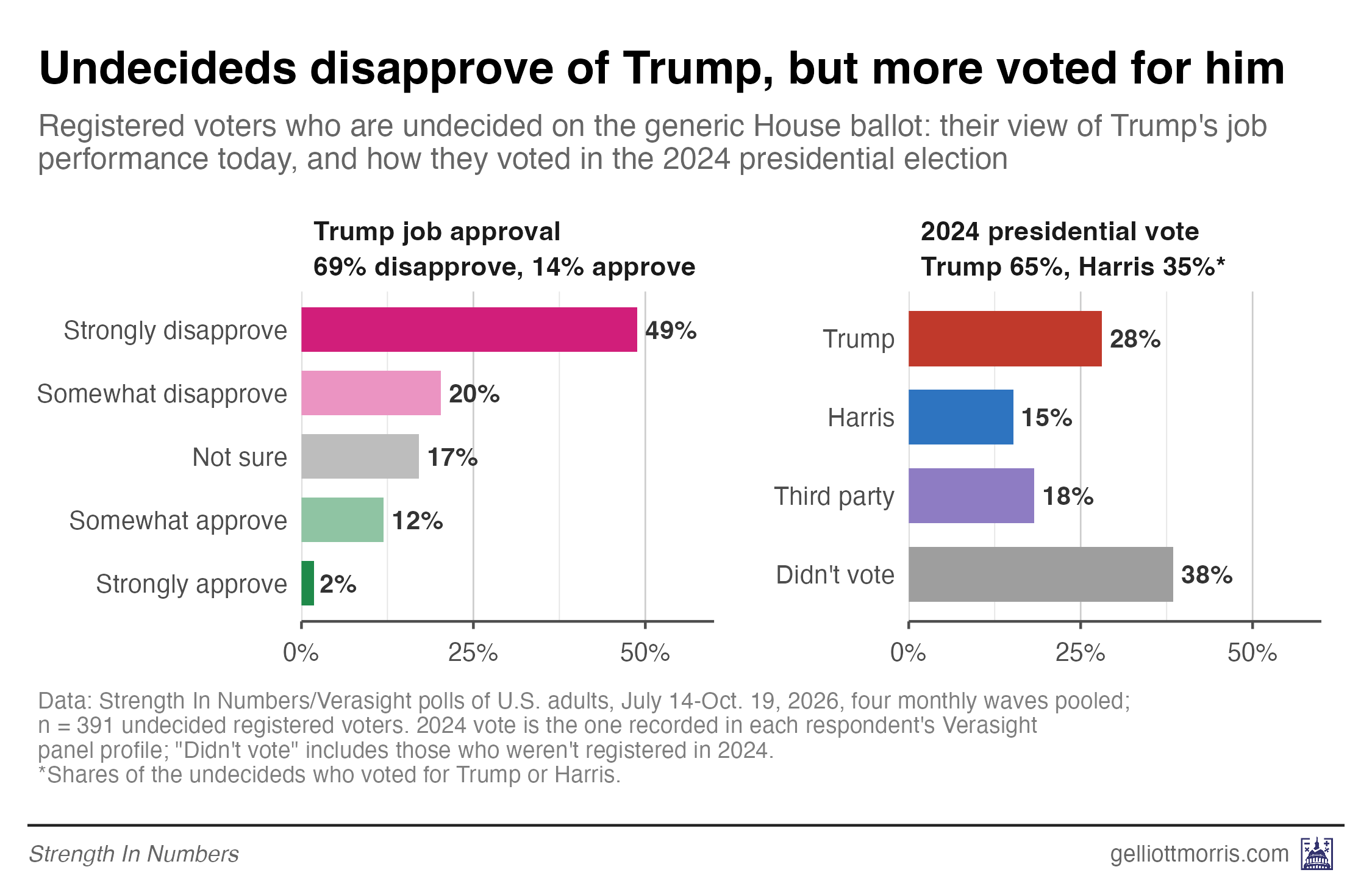
A large portion of undecided voters are aggrieved former 2024 Trump voters. Many of these are young people who have turned against Republicans in incredible numbers.
This fits with what I found on Friday, when I wrote that the low-information voters who helped elect Trump in 2024 have turned hardest against him. Undecideds are disproportionately low-information voters; in October, 63% of them missed at least one of two basic questions about which party controls Congress, compared with fewer than 1 in 4 voters who’d picked a side.
This means undecided voters are most likely reacting to two pieces of information as they tune in: prices, and “vibes.”
And what is the closing message they are hearing from Trump and the Republican Party? Aside from his weird fixation on Senator Jon Husted’s rear end, not a whole lot — and especially not a lot about prices. Most of the president’s recent speeches focus on the alleged ideological extremity of various Democratic nominees, when he’s not being Islamophobic against Democratic Senate nominee in Michigan Abdul El-Sayed, whom he calls ”Abdulalalalallahdbaba Mohammed El-Sayed.” That may work with his base, but it’s not what undecided voters care about.
And it’s not just Trump. The New York Times found only a small fraction of recent GOP broadcast and streaming are even trying to go positive on his presidency. The Wall Street Journal found Democrats are pummeling Trump and Republicans over his tariffs. It’s not like sending Smiley Kevin Hassett out to explain high gas prices helps here.
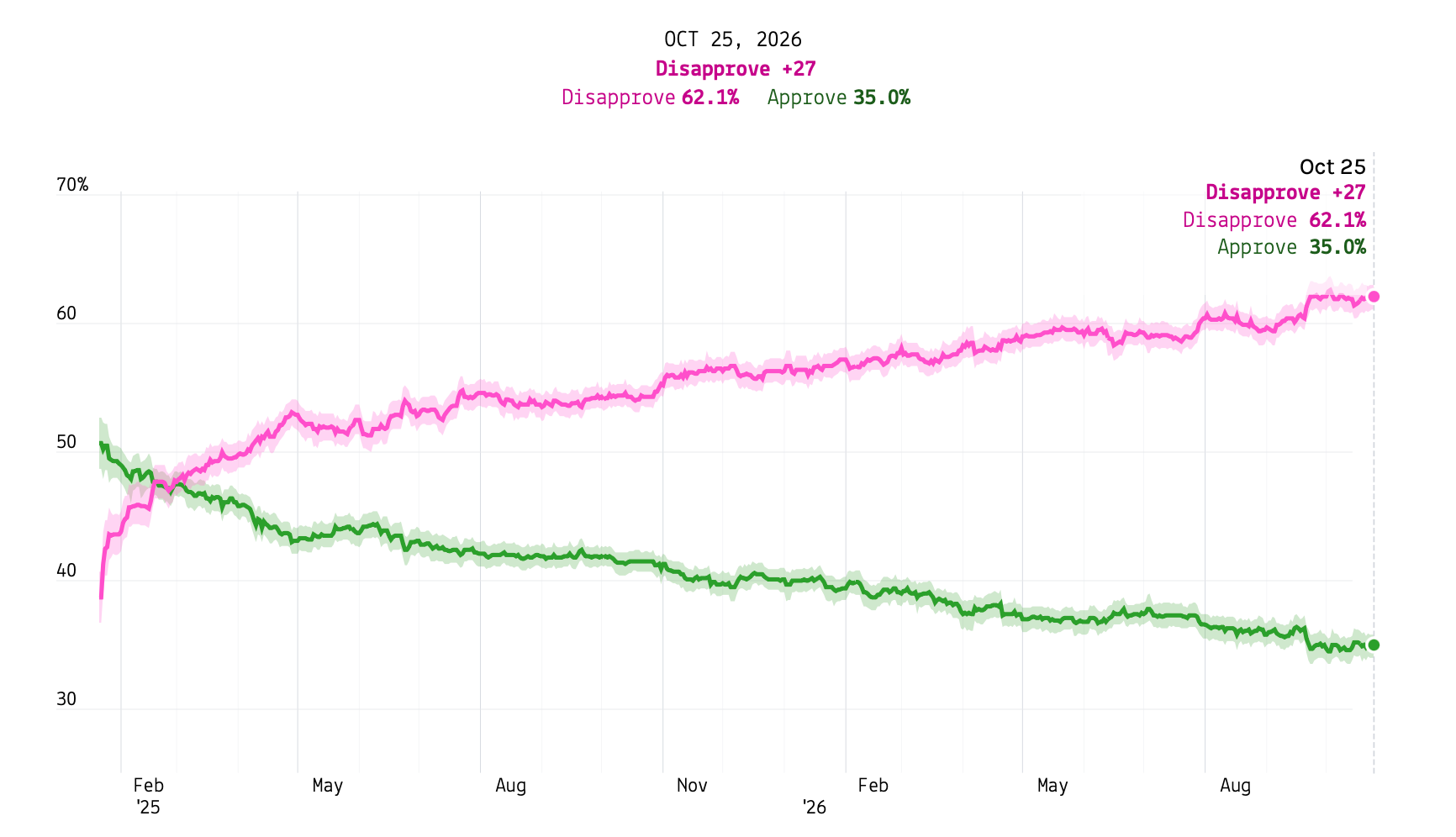
So, in a sense, the cake is mostly baked. To the extent things can change, it’s because of volatile low-information voters who have yet to decide who to vote for. Our survey shows these voters respond mostly to general information about performance of the incumbent. That’s… not a good bet for Republicans this year:
1b. The early vote
I’m working on another update to the early vote blog with data from more states. As I wrote last Monday, the signal we get from EV analysis increases sharply at a week out, when uptake is really high. Well over half of Americans, and maybe verging on 70%, will vote early (either in-person or by mail) this year. As the denominator (number of people voting early) grows, the numerator (number of people in each party that have voted) becomes more meaningful.
I’ve gathered quite a bit of current and historical data on early voting over the past month. I will make some of this data available via the link below, and then give a quick update on where things stand.