


This is Part 1 of 2026 By The Numbers, a series of posts that uses transparent analysis of our polls (reweighted to match election returns), the exit polls, election results down to the precinct level, and other data to understand how Democrats won the 2026 midterms and why so many people failed to see their “blue tsunami” coming. The rest of the series runs Tuesdays and Fridays through Dec. 18.
If you like the free version of SIN, consider becoming a paying subscriber to get access to our private community and additional premium analysis at least once weekly. Paying members of this community keep Strength In Numbers running by supporting the time and data collection it takes to do analyses like this one.
Once all the votes are tallied, Democrats are expected to win the national House popular vote for the 2026 midterm elections by at least 13 points — they currently lead by 13.4, though with a lot of ballots left to count out West, that tally could rise further in the coming weeks. This makes for the party’s best midterm margin since 1974 — actually, the best midterm for either party since then — and the largest swing toward Democrats in any House election since 1948. They gained at least 39 House seats and are approaching 45 (putting them at 260-ish total), and they won at least 54 Senate seats, and could have 56 (we are waiting for votes in Alaska and Mississippi).
Why did the party score such a radical victory? In this series of analytical articles diving into the party’s success (and the media’s failure to see it coming), I take the view that a multiplicity of factors combined to produce the Democratic tsunami we saw last week. While some analysts point to single “mono-causes” of the electoral blowout, a more holistic view emerges from a broader accounting of all the data.
That being said, I’d be doing you a disservice if I didn’t start with the most obvious factor in the GOP’s demise: Donald Trump. While the president claimed his party only did poorly because he wasn’t on the ballot, the evidence suggests that his unpopularity and policy decisions created significantly more defections than the president’s party faces in a normal midterm.
Many Republican strategists spent months arguing that getting Trump out in front of the American people — such as via the party’s disastrous “Trumpapalooza” gathering in Dallas in September — was the only way to prevent significant losses. But the evidence in this piece, and in the analysis of turnout and persuasion later in this series, suggests the opposite.
Trump may not have been on the ballot. But Trumpism was. And the American people voted overwhelmingly against it.
In this piece, let’s see if we can estimate what share of Democrats’ huge midterm gains were (a) a product of normal midterm backlash, (b) specific to Trump, including his personality and policy, (c) what other policies may have added (to the extent that can be separated from Trump’s unpopularity on the whole), and (d) what remains unexplained after that.
But before getting there, a word on where this series of posts is going. I plan to post 10 more articles diving into various factors of the Democrats’ huge victory, and the media’s coverage of it, between now and Dec. 18. These pieces are as follows (some will move around or change slightly as new data comes out):
Trump wasn’t on the ballot, but Trumpism was (this piece)
Not just prices: Immigration and corruption cost Trump, too
What’s behind the swing among Latino voters?
What the Democratic Socialists and Blue Dogs have in common
It took both turnout and persuasion to give Democrats the Senate
The Democratic brand didn’t sink Democratic candidates (or: why party favorability is mostly a useless metric)
Voters gave Democrats a mandate: Check Trump, on all issues
Expert race handicappers have a status-quo bias. Democrats won every House race that Cook, Inside Elections and Sabato rated a tossup in mid-September. Since 1998 the handicappers have missed about half of the typical House wave, but their miss was larger than average this year.
Trump’s youngest voters were his least loyal. Voters under 30 backed House Democrats by somewhere between 35 and 48 points, depending on the source, among the highest on record. This after some analysts claimed young men were looking like the “most conservative in a generation.”
The “X-Factor” in American Politics. The people who run and comment on American politics for a living spend too much time on X, and it’s distorting their worldview.
Looking forward to 2028.
As I mentioned in the announcement post for this series, most of these analyses will be paywalled for paying supporters of Strength In Numbers, who keep the lights on here and help me pay for data necessary to do these analyses. Paying members also get a few valuable exclusive perks, like access to a private Discord server just for paying members. I hope you’ll join us!
Trump added 5 points to the normal midterm swing against the president’s party
Take a trip with me back to January of this year. Back then, I wrote that midterms are backlash events, not typically referendums. The historical pattern, I pointed out, is for the party of the president to get humbled pretty much regardless of how it’s doing or how voters feel about it.
But Trump managed to do so poorly, and move policy so far to the right, that he activated the referendum mindset among voters, too. His party didn’t merely lose; it got pummeled. The projected swing against his party (15.5 points) beat the swing against Harry Truman’s Democrats in 1946 (13.4). Of the 21 midterms since 1946, only 2010, at 17.8 points, saw a bigger swing against the president’s party — and that’s partly because 2008 was just a massive victory for the Democrats (they started higher, so had further to fall). About 3.4 points of the overall swing can’t be explained by Trump’s approval or the average change alone (it could reflect turnout effects, prices, popular Democratic candidates, etc.).
So Trump got about double the normal historical backlash, as seen in the chart below:
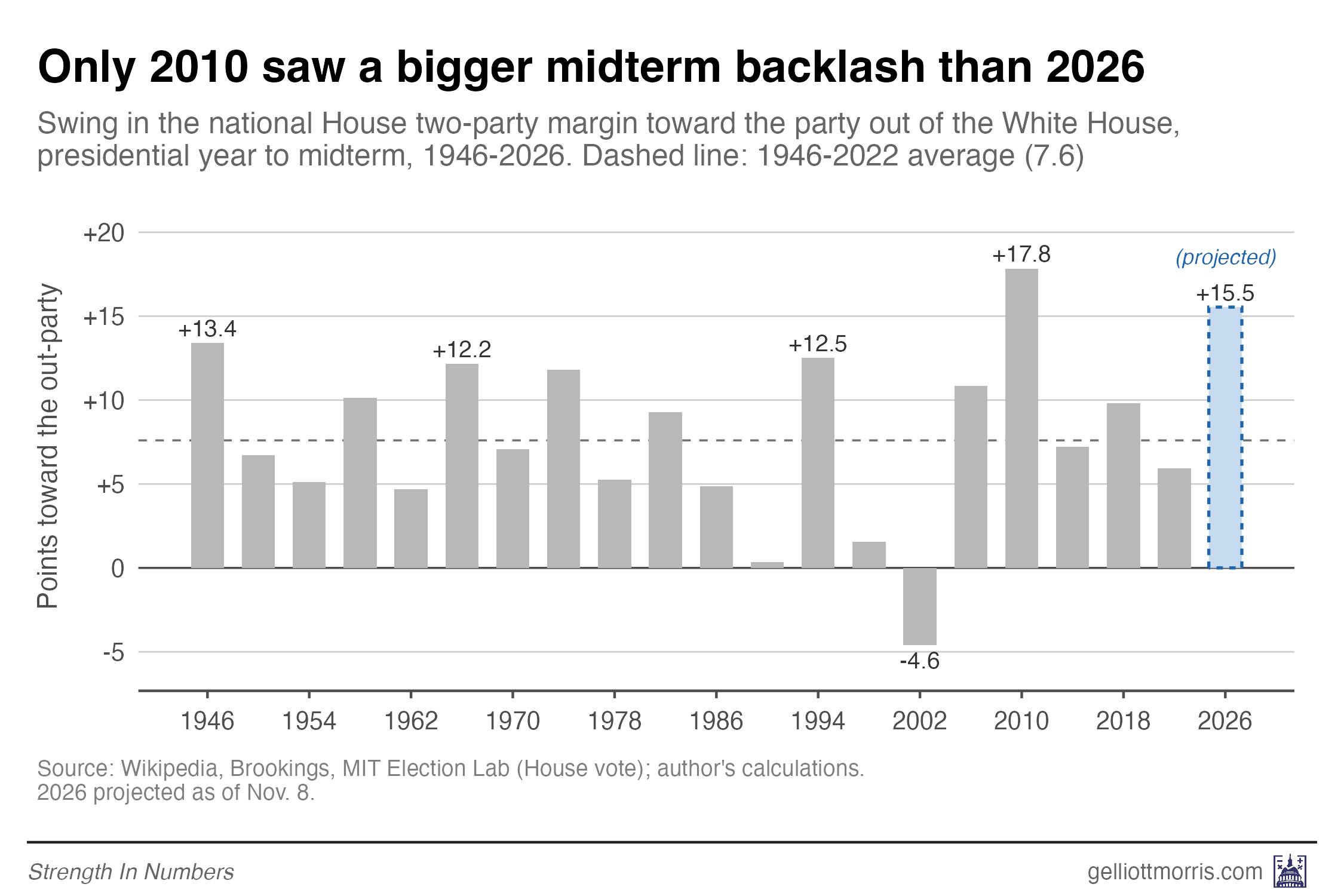
What explains this swing? My takeaway from the data is that backlash to Trump and his policies caused his party to struggle more than average this election. I can show this to you, with numbers.
