


I’m breaking my rule of not covering breaking news to write about tonight’s election results in Texas, my home state. (And hey, with a baby on the way, who knows how much longer I’ll get to stay up late and write when I should be resting?)
Attorney General Ken Paxton defeated incumbent U.S. Senator John Cornyn in the Republican Senate runoff today, giving Democrats their preferred and weaker opponent. That’s not because Paxton is all that much more “conservative” than John Cornyn (whatever that means these days), but because he’s just generally a bad dude who has earned a lot of bad press over the last year. Paxton has what we call in political science a “negative candidate residual.”
The general impression that Paxton is a worse general election candidate than Cornyn would have been is not misguided. Empirically, hypothetical general election polling showed Talarico doing about 1-2 points better against Paxton than Cornyn across many polls. That is not an earth-shattering difference — but it might be enough in a close race.
And this race is looking really, really close.
Texas hasn’t elected a Democrat statewide since 1994. For 32 years, every cycle has come with a fresh round of “is this finally the year?” pieces, and for 32 years the answer has been no. I’ve written some of those pieces myself — including one for The Economist back in 2019 calling Texas the Democrats’ “white whale.” Then 2020 happened, then 2024 happened, and the state seemed to drift further from the party’s reach.
Given that, I expect that people will view this piece skeptically, and I want to be careful here. But the data is the data, and right now the data on Texas’s 2026 Senate race looks genuinely different from past cycles. I think we have a genuine tossup on our hands. Could this year be the Democrats’ year?
This article is free to read, but it was not free to write. Subscribers to Strength In Numbers get exclusive analysis of politics and elections, access to premium polling data, and support independent, interactive data journalism. Consider joining as a paying member today:
If a paid subscription is not in the cards for you, the best thing you can do is share this article with a friend. Word of mouth is the #1 way new people learn about this publication.
Texas has all the makings of a Democratic victory
Start with the polling. Hypothetical general election numbers at FiftyPlusOne currently show Talarico running a couple of points ahead of Paxton (and there have been some particularly bullish surveys for Talarico recently).
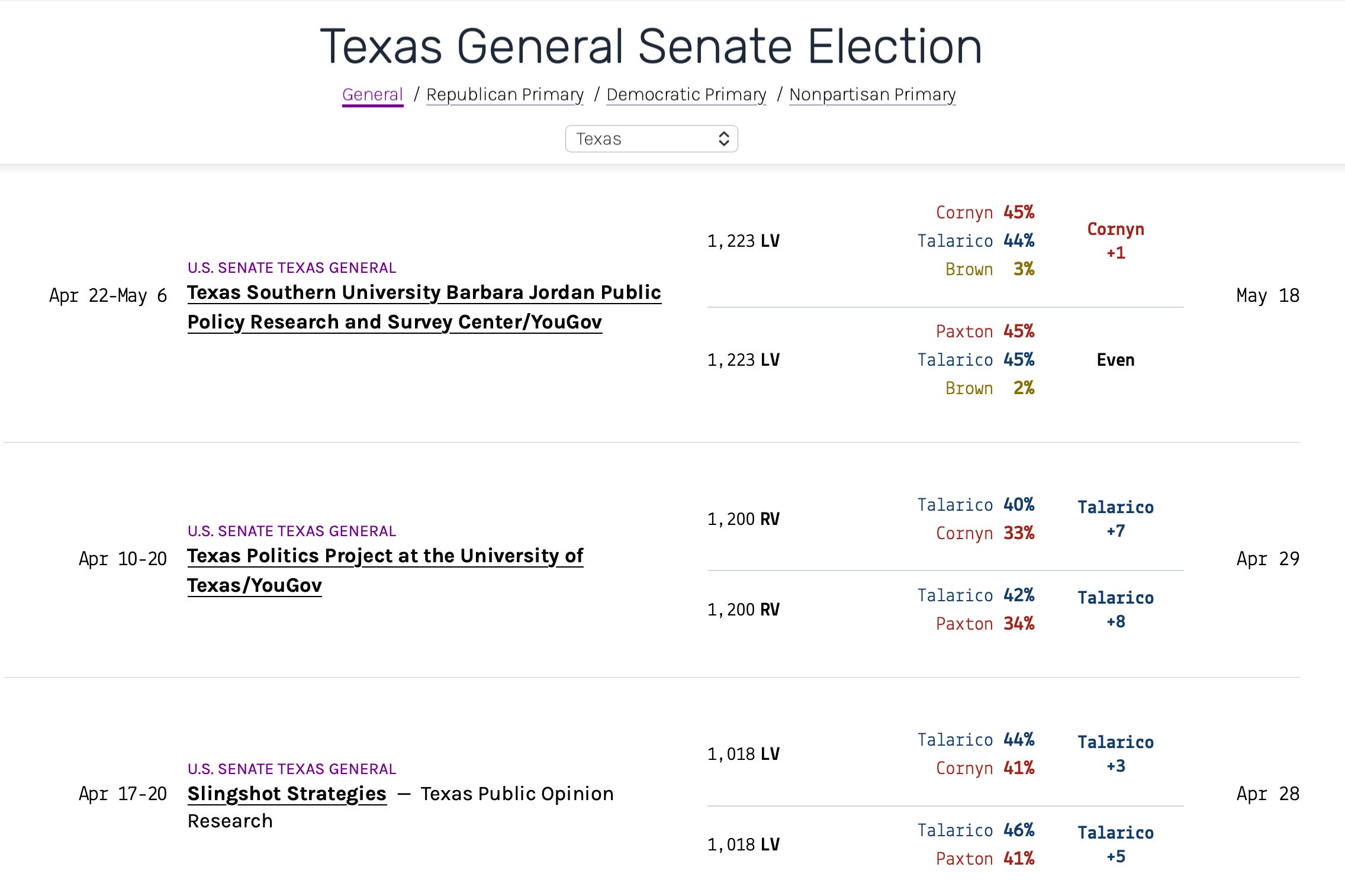
That alone is promising data for the Democrats, even if it is early (and somewhat hard to believe).
But remember, Texas is not all crimson red all of the time. Back in 2018, Beto O’Rourke lost to Ted Cruz by 2.6 points. That was the closest a Democrat had come to a statewide Texas win in decades. Importantly for our benchmarking purposes, it happened in a year with a roughly D+7 to D+8 national environment. In other words: Democrats came within striking distance of Texas in a very good year for their party — about 9-10 points to the right of the national vote.
Now look at where things stand for 2026. The national generic ballot today is roughly D+6 to D+7 — not quite 2018, but close. In fact, Democrats seem to be running even with Democrats at this point in that last “wave” election — the generic ballot at this point in 2018, per my historical average, was also D+6. If Democrats gain another 1-2 points in the next 6 months (which is extremely doable in a midterm), that puts them in line with 2018 or better.
And there’s a real argument that the D+6 national number understates Democrats’ actual position in non-presidential electorates today. I’ve made this case in detail at this blog already: the people who turn out in midterms and specials have been disproportionately Democratic this cycle, and special election results have been running well to the left of 2024 presidential numbers. This alone means we should expect Democrats to do better in 2026 than in 2018, all else being equal.
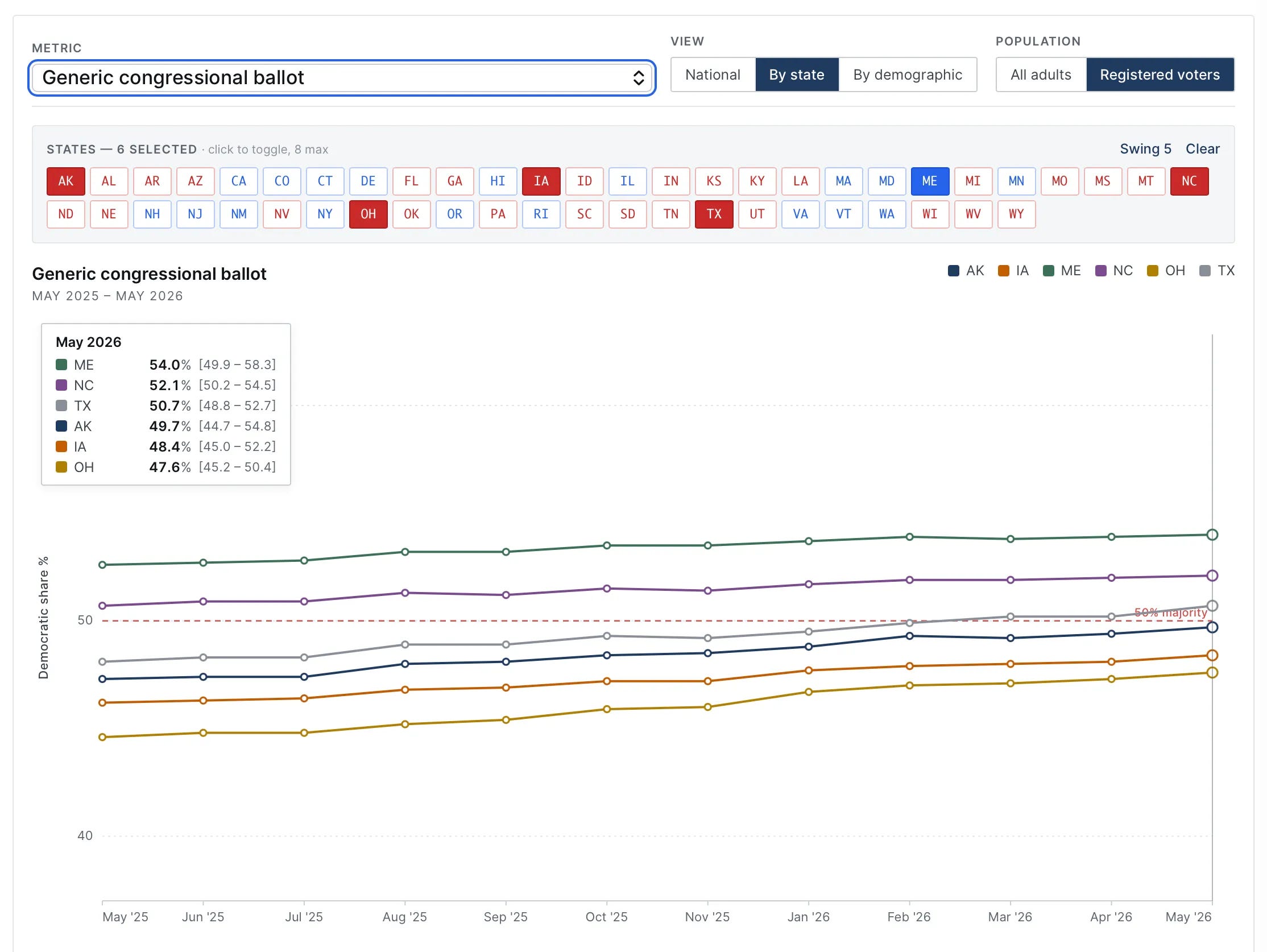
Zoom in to Texas specifically, and the picture gets even more interesting. My state-level generic ballot estimates now have Democrats at 50.7% of the two-party vote for House candidates in the Lone Star state — essentially even with, or slightly ahead of, Republicans on the generic ballot in a state Trump won by 14 points just 18 months ago.
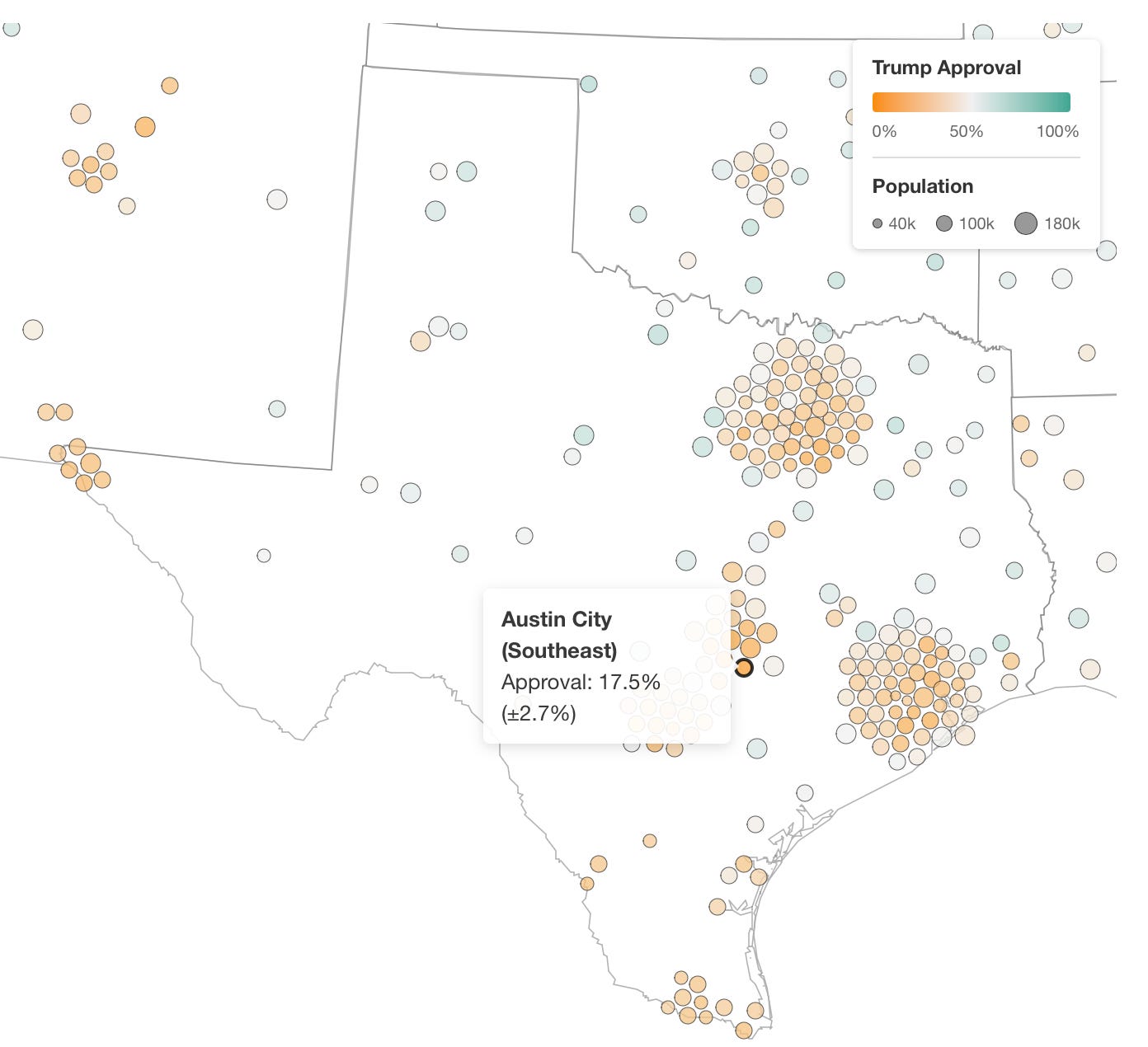
That’s a remarkable shift, and it lines up with what my MRP model of Trump approval is showing in Texas, too: the president is about 20 points underwater with registered voters in Texas, with most of the state’s metro areas — including the Houston and DFW suburbs — registering net-negative approval. When the leader of the GOP is upside-down in your state, every Republican on the ticket inherits some of that drag.
In a separate piece breaking down the race in March, I laid out six reasons Texas could actually flip: a potentially very weak Republican nominee in Paxton (scandal-ridden, polling 2-3 points behind Cornyn in head-to-heads against Talarico), a Democratic recruit who plays well with independents and suburban voters, eye-popping primary turnout numbers, a diversifying Democratic electorate, a continued Latino swing back toward Democrats in special elections, and Trump’s poor numbers in the state. Generally, the environment has only gotten better for Democrats since then.
Texas also has higher-than-average shares of Hispanic and low-income voters, both of which have trended away from Trump and the Republicans at higher rates than the population as a whole.
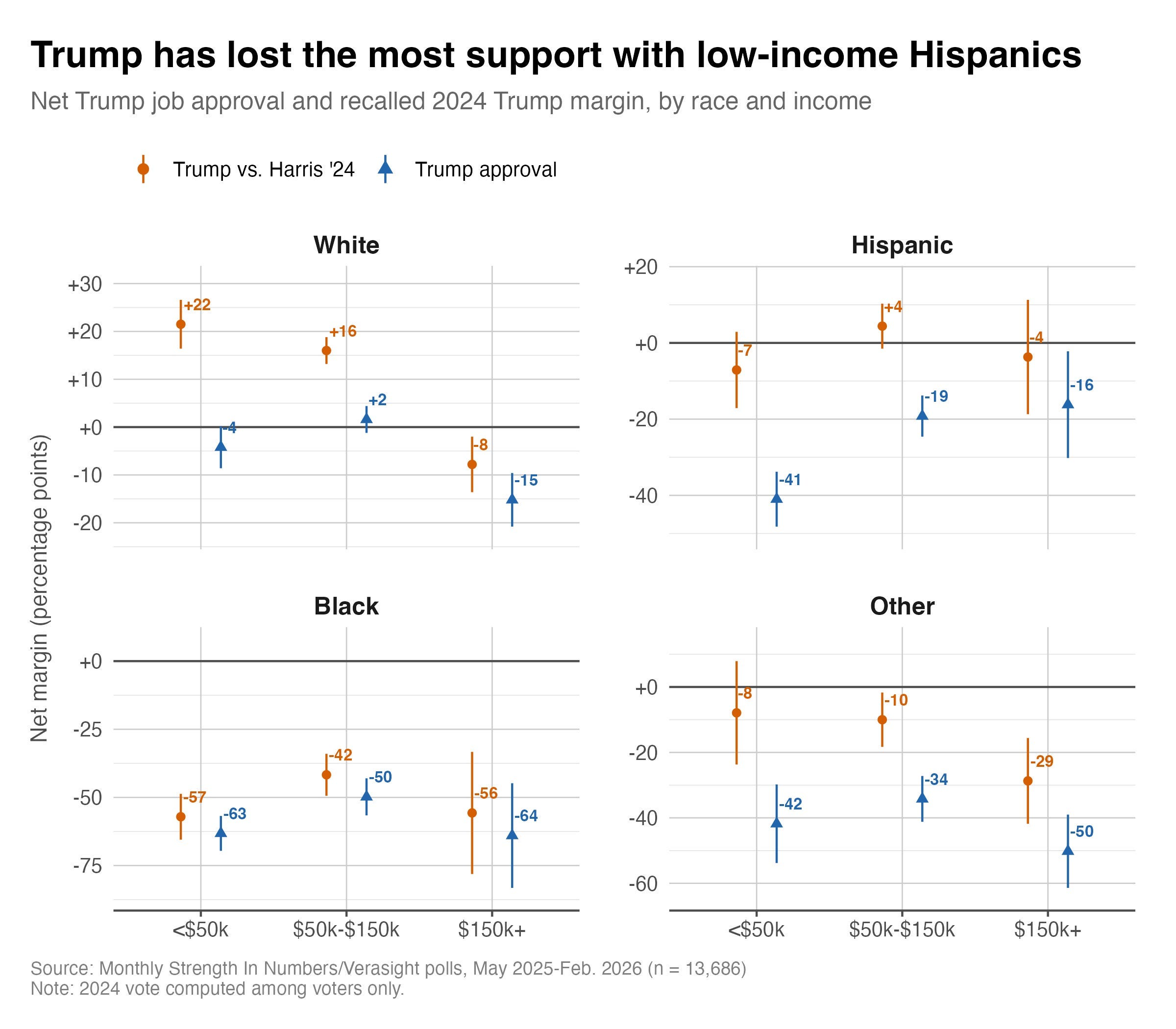
The data is hard to argue with
None of these factors is individually decisive on its own. But that’s largely the point — they don’t have to be.
Beto O’Rourke’s loss in the 2018 Texas Senate race shows how genuinely competitive the state can be, with the right candidate and a favorable national environment. In a D+7-8 year, our expectation should be for a close race. If the environment is comparable to 2018 — and the Texas generic ballot, Trump’s sagging approval, and recent special elections all suggest it might be — and Talarico campaigns as well against Paxton as he has so far, the math starts to add up.
The Texas Senate race is looking close. My gut is telling me to be shy here. History is telling me to be shy here. But the data is compelling, so I’m going to be bold… I think it’s a genuine tossup.
And now, back to editing tomorrow’s poll release…
The kind of original polling analysis and data journalism I’m publishing here at Strength In Numbers doesn’t exist anywhere else in the media today. Paid subscribers make it possible for me to run custom surveys, build models like the MRP estimates cited above, and spend my time on public-interest journalism full-time. If that’s a mission you can get behind, consider supporting Strength In Numbers today, and get access to tons of exclusive data-driven journalism like this.
I’m glad you decided to weigh in tonight, and I’m glad Texas gets to claim you! You’ll let us know when the little one arrives, won’t you?
"I'll go boldly out on a limb and say it's a toss up. " You are definitely being you!