



In this latest episode of the Strength In Numbers live podcast, Elliott and David Nir, publisher of The Downballot, have a wide-ranging discussion of the 2026 political environment. We talk about:
A Democratic shockwave in Texas. Democrats flipped a Texas State Senate seat in a district that Trump won by 17 points in 2024. We explain why turnout alone can’t account for the massive swing.
Is Texas redistricting a “dummymander”? The conversation turns to Texas Republicans’ aggressive attempt to gerrymander five Democratic congressional seats. David argues it’s not technically a dummymander, since Republicans didn’t endanger their own incumbents, but points out a wave election could still put unexpected GOP seats in play.
And on that note: Democrats could even net a few seats out of the 2025-2026 redistricting wars. Democratic gains in California, Virginia, and Utah could outweigh GOP gerrymandering in Texas, Missouri, and North Carolina, turning Trump’s mandated mid-decade map redrawing into a real strategic blunder.
And in our main section, we cover why Democrats should talk about ICE. Elliott lays out new polling showing that Trump’s immigration enforcement agenda is deeply unpopular once voters see the real-world consequences. Support for ICE reforms is overwhelming, including majorities favoring banning ICE agents from wearing masks and withholding DHS funding unless reforms are enacted.
Democratic intensity advantage. David points out that polling toplines understate how intense anti-ICE sentiment has become, pointing to mass protests and the lack of comparable pro-enforcement mobilization. Highly engaged voters are also, for now, substantially more Democratic on the generic ballot than the broader electorate.
A subscriber submits a question about Trump’s approval rating ticking up slightly in recent days, so Elliott explains why small changes in polling averages often reflect statistical noise — especially given the influence of low-quality partisan pollsters that inject volatility into aggregations.
Economic anxiety and democratic decline. We discuss a new Gallup global survey showing people increasingly cite politics/government and the economy as top concerns. In America, recent economic insecurity has made voters more volatile and less committed to traditional democratic values — a repeat of historical patterns of post-material politics.
Another live subscriber question: Texas Democratic Senate primary uncertainty. Elliott and David close with a discussion of early polling in the Texas Democratic Senate primary (Talarico vs. Crockett), emphasizing that primary polls are notoriously unreliable and that large undecided shares make toplines misleading.
Plus: why we think everyone should avoid being a “margin bro.”

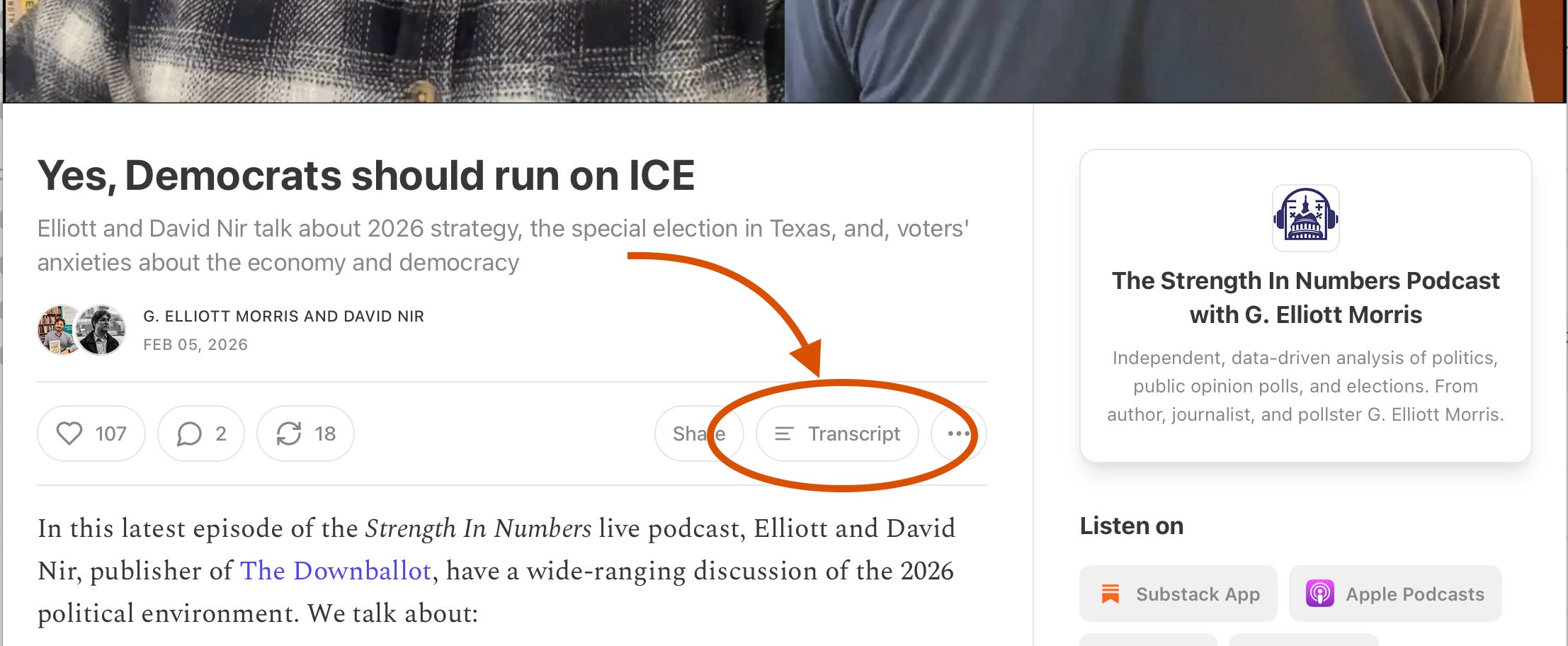
If you missed our livestream, you can watch it by clicking play above. You can also read the transcript of our conversation by clicking the headline of this article to take you to the web version of the podcast, then clicking the button in the bottom right of the player box that looks like a piece of paper, or the button labeled ‘Transcript’ to the right of our names and just below the player. Like so:
If you’re a reader of Strength in Numbers and haven’t yet subscribed to David’s newsletter, head to the-downballot.com. And if you’re coming from David’s audience, subscribe here to get the numbers behind the news!


