


Strength In Numbers is a reader-supported newsletter that covers politics, polling, and public opinion from a data-driven perspective. If you want clear-eyed analysis of what the numbers say about American democracy today, consider a paid subscription. Paying subscribers make posts that are free to read — like this one — possible.
Asked how much Americans’ financial situations were motivating him to make a deal with Iran, President Donald Trump told reporters on May 12, 2026: “Not even a little bit. I don’t think about Americans’ financial situation. I don’t think about anybody.” Stopping Iran from getting a nuclear weapon, he added, was “the only thing that matters.”
Statements like these exacerbate the White House’s problems getting the average person to view Trump’s presidency favorably. And they are especially damaging when it comes to prices.
Now think about the broader political context under which this episode happened.
Republicans across half a dozen states spent the last year passing new congressional gerrymanders to give themselves an unfair advantage over Democrats in this November’s midterm elections. After the Supreme Court blew up Section 2 of the Voting Rights Act in Louisiana v. Callais two weeks ago, GOP legislatures in Alabama, Louisiana, Tennessee, and elsewhere have moved to cut even more Democratic seats from the map. Democrats could end up needing to win the popular vote in the House by 4 points or more in order to win the majority of seats.
This is a huge boon to a party that, just three weeks ago, was staring down the barrel of a virtually assured loss of the House and likely loss of the Senate, too.
And yet, it doesn’t change the big picture of how Americans feel about the president today. As I repeated in my podcast episode on Thursday, very few Americans actually like what Trump is doing.
This week’s Chart of the Week is: An update on Trump’s approval rating. Nobody really likes this guy.
How low can he go?
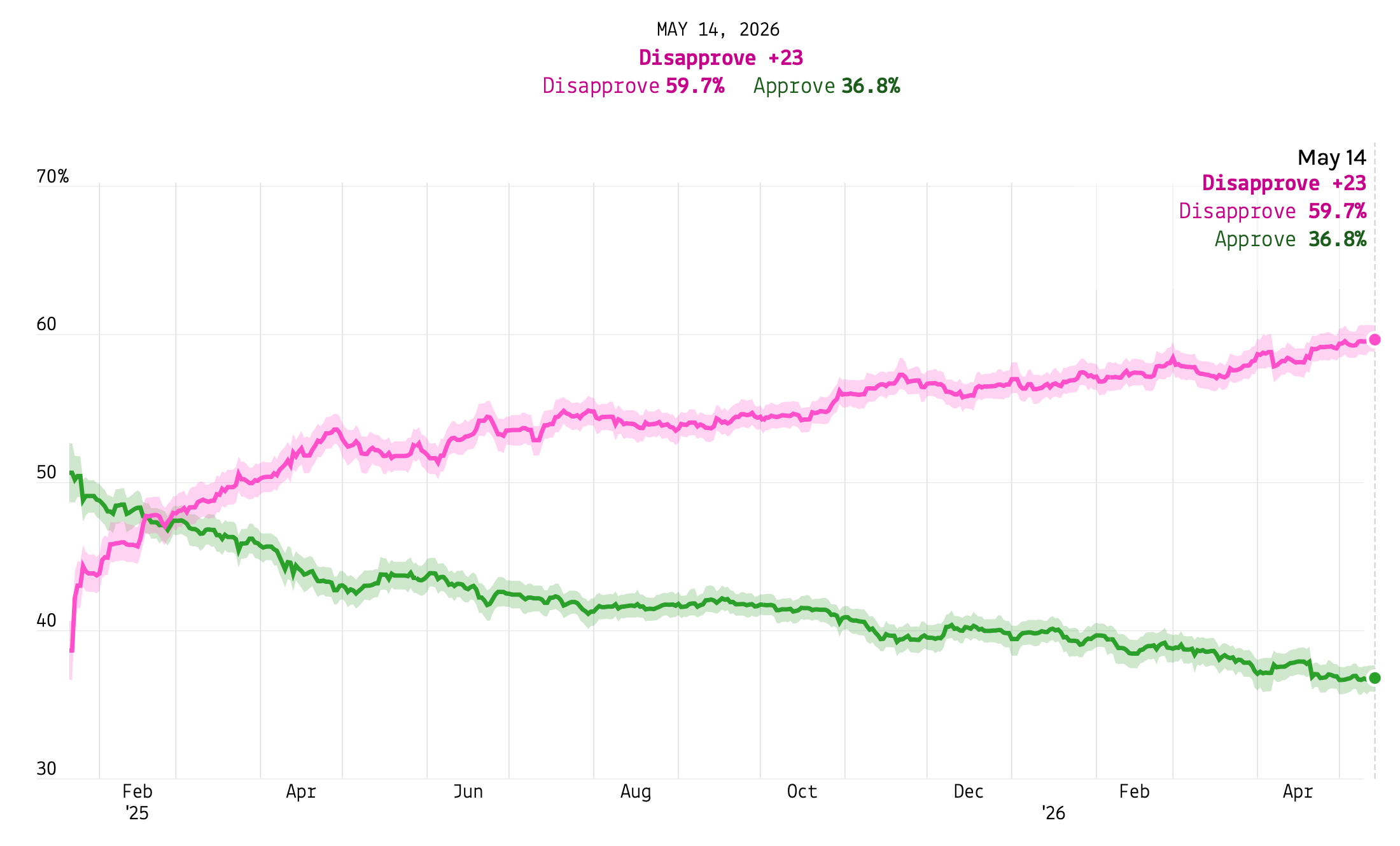
In the average of polls at SIN sister site 50+1, Trump has a roughly 37% approval rating today and a 60% disapproval rating.
Looking at the approval data for the past 18 years, this 37% rating makes Trump worse off than any president at any point since the end of George W. Bush’s second term:
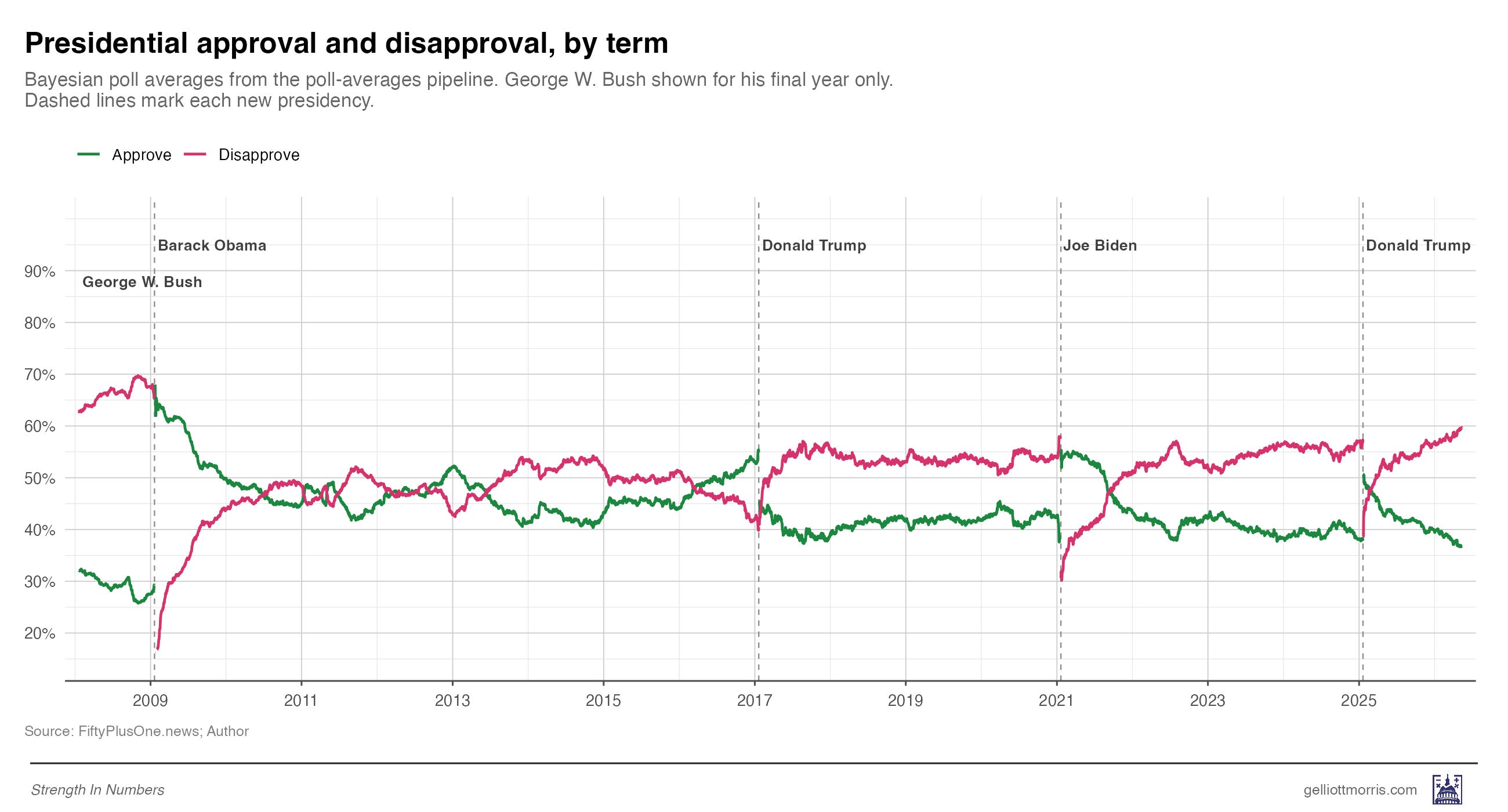
Note from this graph that not only is Trump’s rating at the all-time low for a president since 2009, and lower than that of any president at this point in their term, but it also shows no sign of slowing down. Zoom in and you can see how he is predictably losing support with the American public week after week after week:
Measured in terms of the difference between his approval and disapproval — what we in the biz call a “net approval” rating — Trump is also lower than any modern president at this stage of a term. The previous floor on the chart belonged to Biden, who sat near -21 in mid-2022 — a number which likely cost Democrats the House that year.
The chart below shows the same data as above, but recalculates approval into one number: net approval. The line is green when a president is “above water” (has a positive rating) and turns pink the moment more people disapprove than approve.
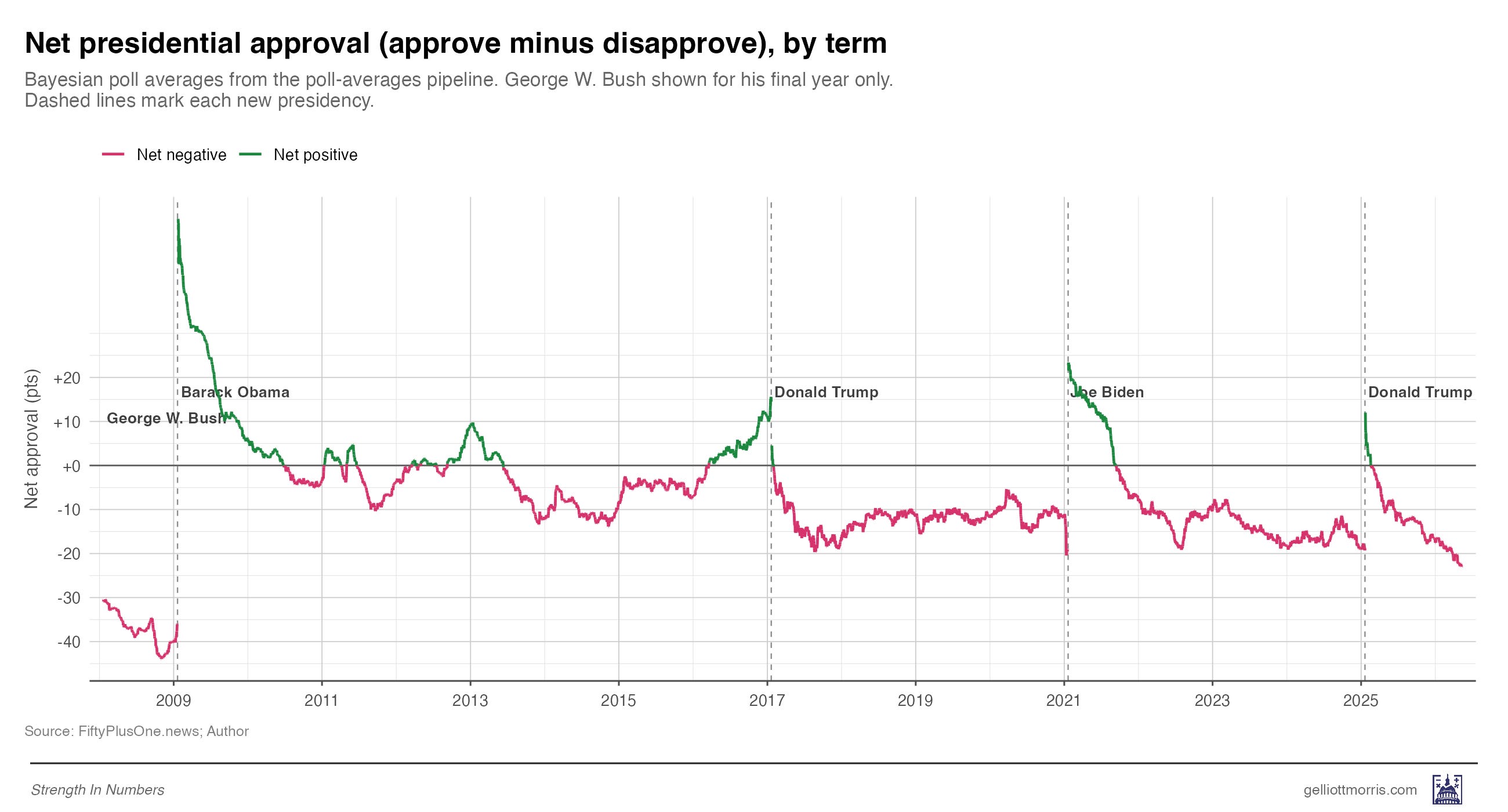
It’s the fairest way to stack presidents against each other — and it’s brutal for Trump.
Now, maybe you are thinking that since Trump 2.0 is serving a non-consecutive second term, the graph should reflect that instead of treating him as having a second first term. If you do that, you see it is indeed true that Trump isn’t as low as Richard Nixon or George W. Bush were at the nadir of their presidencies. As I wrote in early April, Trump’s are essentially Watergate-level numbers.
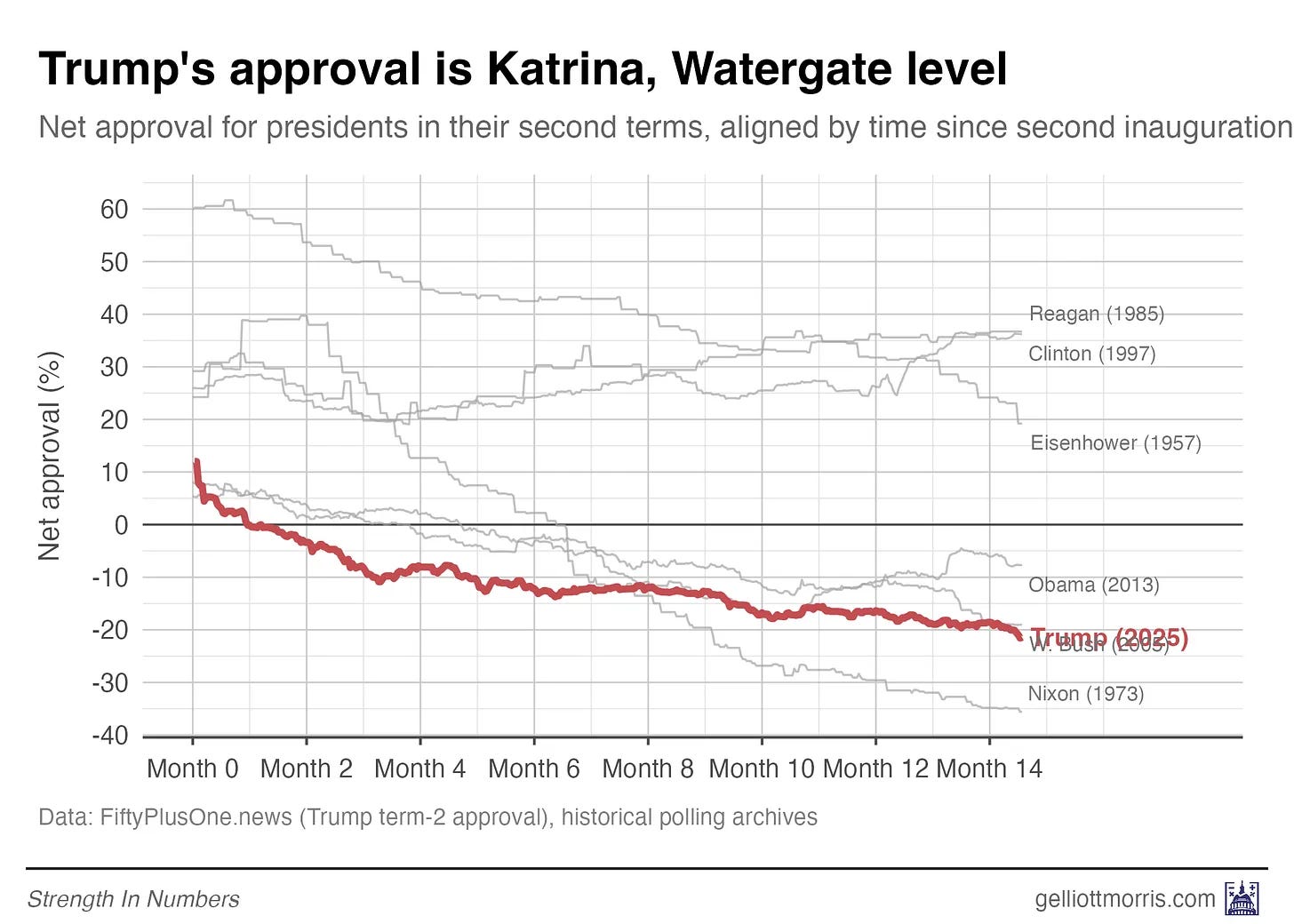
But that is both cold comfort, and it’s worth taking into account that those troughs came deep into their presidencies, after years of accumulated damage and (in Nixon’s case) history-changing presidential scandal. On net approval this early, no one has been lower.
Trump’s problems are only partly about prices
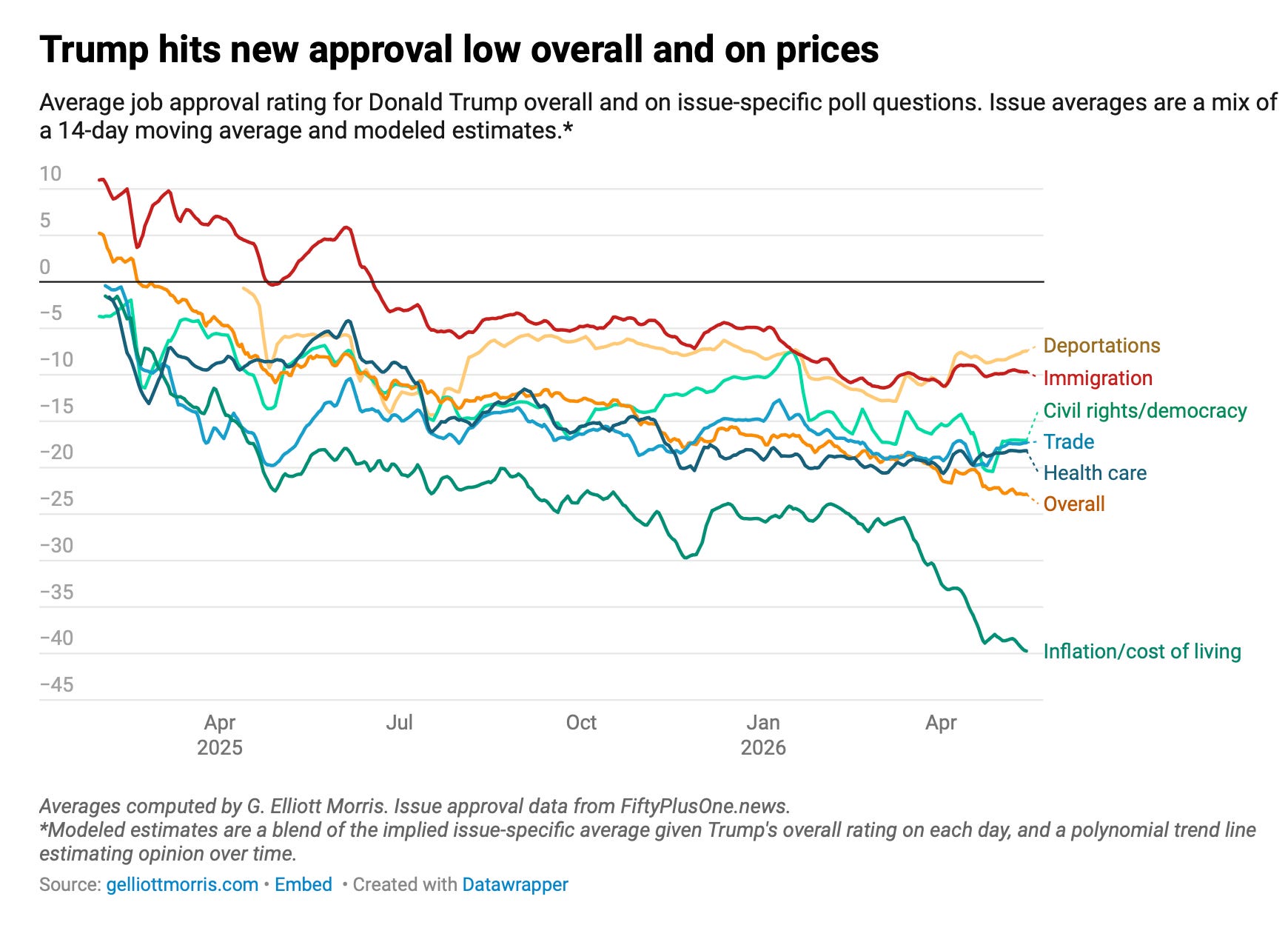
Probably the biggest drag on President Trump’s approval right now is prices/inflation.
Voters blame him for the high cost of living and say (correctly) that his policies have been inflationary and reduced growth. A CNN/SSRS poll fielded April 30–May 4 found 77% say Trump’s policies have raised the cost of living in their own community. This includes a majority of Republicans.
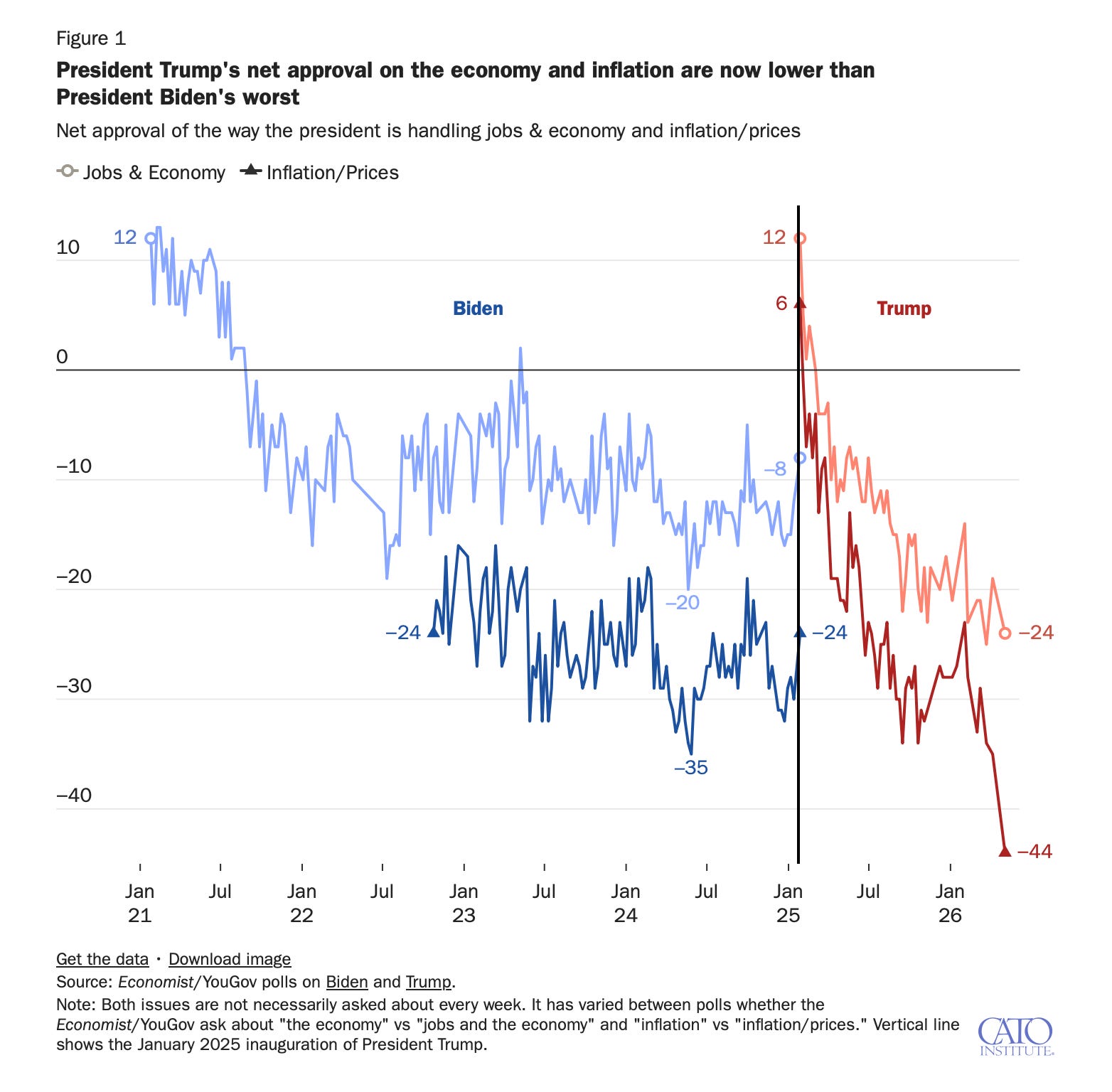
The president’s net approval on inflation has also recently cratered to around -40 — and shows little sign of recovering. A new Economist/YouGov poll put it at 25% approve, 69% disapprove — a net of -44:
Worth noting: These numbers are lower than at any point in the Biden presidency:
And things are probably only going to get worse for Trump as time — and the war in Iran — go on.
The April Consumer Price Index report, released May 12, showed prices up 0.6% on the month, putting annual inflation at 3.8% — the highest since May 2023 and up half a point from March. Energy prices jumped 3.8% in April alone — after rising 10% in March — and accounted for more than 40% of the headline gain. The CPI release says real average hourly wages fell 0.5% on the month, while the price of gasoline was up 28.4% over 12 months
And due to some quirks of how the CPI gasoline data is collected, that is a severe underestimate. According to EIA.gov, the retail price of a gallon of gas was flat through much of 2025 — the national average sat near $3 a gallon all year. Then the Iran war began on February 28, and by early March the average had risen to about $3.15; by mid-March, $3.85; by the end of March, about $4.13. And by mid-May, when I’m typing this, it hit roughly $4.63 — a climb of about $1.50 a gallon or roughly 50% from the late-February low, most of it in the four weeks right after the war started.
The chart below shows Trump’s approval on inflation over time (in blue) and the change in the price of a gallon of gas (orange, inverted) since the start of Trump’s second term (I inverted the gas price chart on David’s recommendation, such that the two lines tell the same directional story). When the blue and orange lines move together and downward, it means gas is getting more expensive and Trump’s approval is getting worse. For most of 2025 the orange line is flat while there is a steady chipping away in the blue line. Then, at the end of February, both lines fall off the table together.
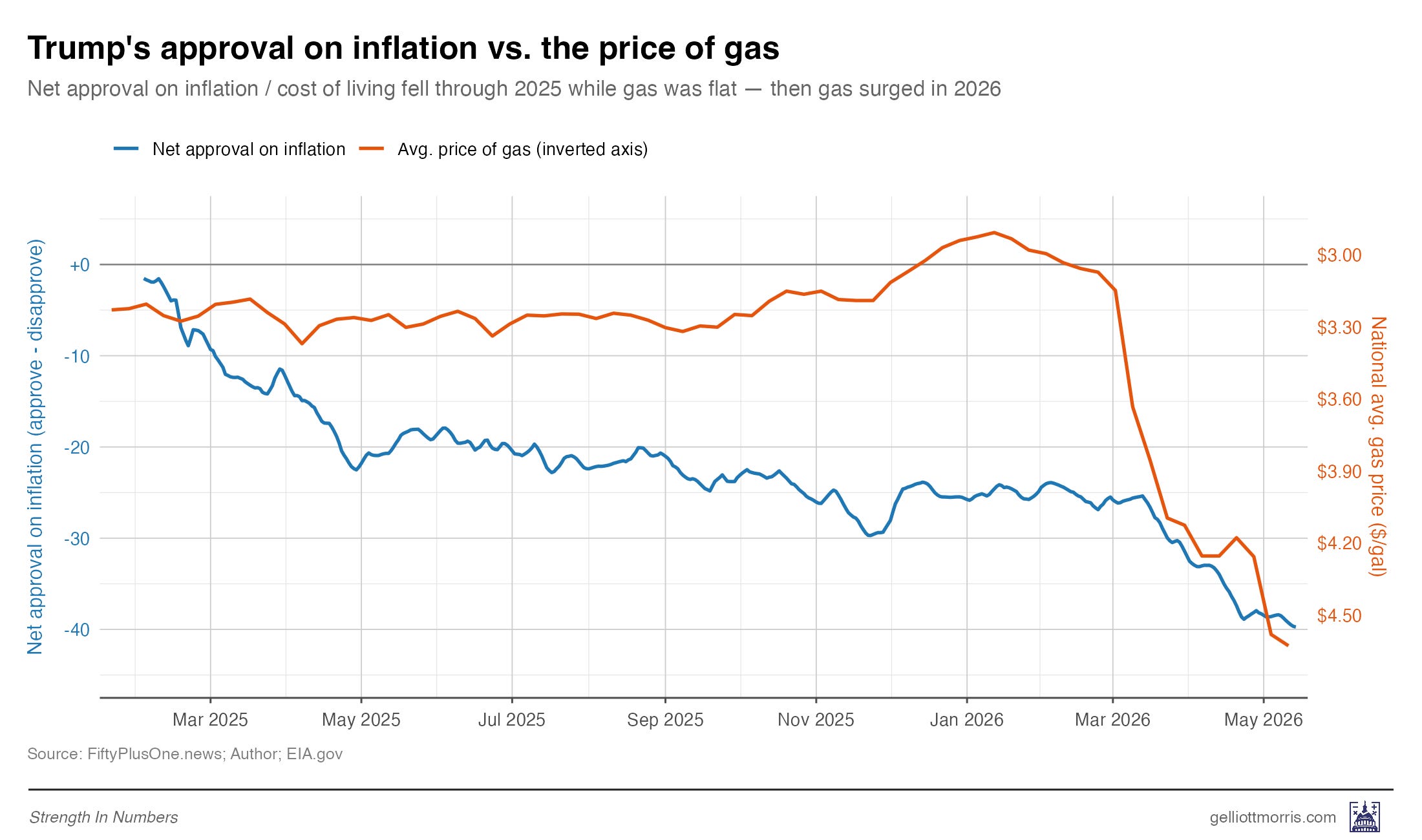
Trump’s inflation approval started falling within a week or two of the price spike. Or at least, that’s when pollsters started picking up the shift.
This is textbook “retrospective economic voting.” Voters punish the incumbent for the economic conditions they’re living through, whether that punishment is fair or not.
Redistricting can’t erase the midterm math
But the price of gas isn’t Trump’s only problem; he was at -25 for his handling of prices and -20 overall even before he started his war in Iran. If the November elections had been held on February 27, the day before the bombing in Iran started, his party would have gotten shellacked.
And here is a good reminder that even via gerrymandering and voter suppression efforts, redistricting and registration purges, you cannot artifically alter your approval rating. People either like you or they don’t. And for most of his political career — certaintly from the vantage point of today, May 15, 2026 — voters simply do not like Donald Trump.
This matters for small-”d” democratic reasons and for electoral reasons. On the democratic side, a president governing with the consent of barely a third of the country has a legitimacy problem that even the most biased map cannot paper over. The whole point of representative government is that those in power answer to the people they represent. When 60% of Americans disapprove of the job Trump is doing, and his party responds not by changing course but by redrawing districts to insulate itself from that disapproval, the feedback loop between voters and their government breaks down. One response to this is to remind ourselves and our leaders that, hey, very few people actually want this!
And if legislators won’t listen now, they will listen later; The electoral arithmetic is unforgiving. Democrats lead the generic ballot by roughly 5 percentage points today, which (1) would very likely be enough for them to win control of the House of Representatives; and (b) will likely grow over the next 6 months (the opposition party tends to gain in the polls). Presidents below 50% approval have presided over an average House loss of 36 to 37 seats. You can run the numbers yourself with our Midterm Seat Loss Calculator.
And that is exactly the context in which the GOP’s gerrymandering should be understood. A 5-to-7-seat redistricting advantage is real, and in a neutral environment, it would matter a lot. Via partisan gerrymandering — legalized cheating — Trump has tried to change how big a wave has to be to flip the House.
But even these serious GOP gains would not be enough to overpower the current caused by a pro-Democratic wave election this November. And on this front, Trump’s catastrophic approval rating is a strong positive indicator for the Democrats.
And it’s likely he will soon be haunted, in television advertisements and internal polling memos, by the replay of those words I excerpted at the beginning of this article.
Donald Trump may not be paying attention to the cost of living for the average American. That much was, frankly, already evident.
But you know who is thinking about their cost of living? The average American! And by and large, they are saying — across polls, questions, geographic questions, and the like — that they do not support what Trump is doing as president. That will cost him, regardless of all the rigging.


Yes, but Dems have to campaign in such a way to take advangage of that level of disapproval. I sort of understand, but not exactly, how you get to Dems having to win by 4 points in November. Then I read about Planned Parenthood PAC jumping into the CA-22 race in favor of the moderate Dem who sort of opposes Medicaire for all (sometimes). To me, healthcare -- or poor healthcare delivery -- hits everyone alike, especially in rural America. Look how hard Platner in Maine hits the subject, based on his experience with the military's version, the VA, and how it 'saved' his life.
"a good reminder that even via gerrymandering and voter suppression efforts, redistricting and registration purges, you cannot artifically alter your approval rating. " Kind of irrelevant. A category error -- he wasn't trying to up his approval he was trying to barricade the House.