


This article reports results from the May 2026 Strength In Numbers/Verasight poll. You can read our previous poll releases here. Subscribers to Strength In Numbers have access to additional visuals and a full archive of crosstabs here. Subscribers can suggest questions for future polls in the comments section below!
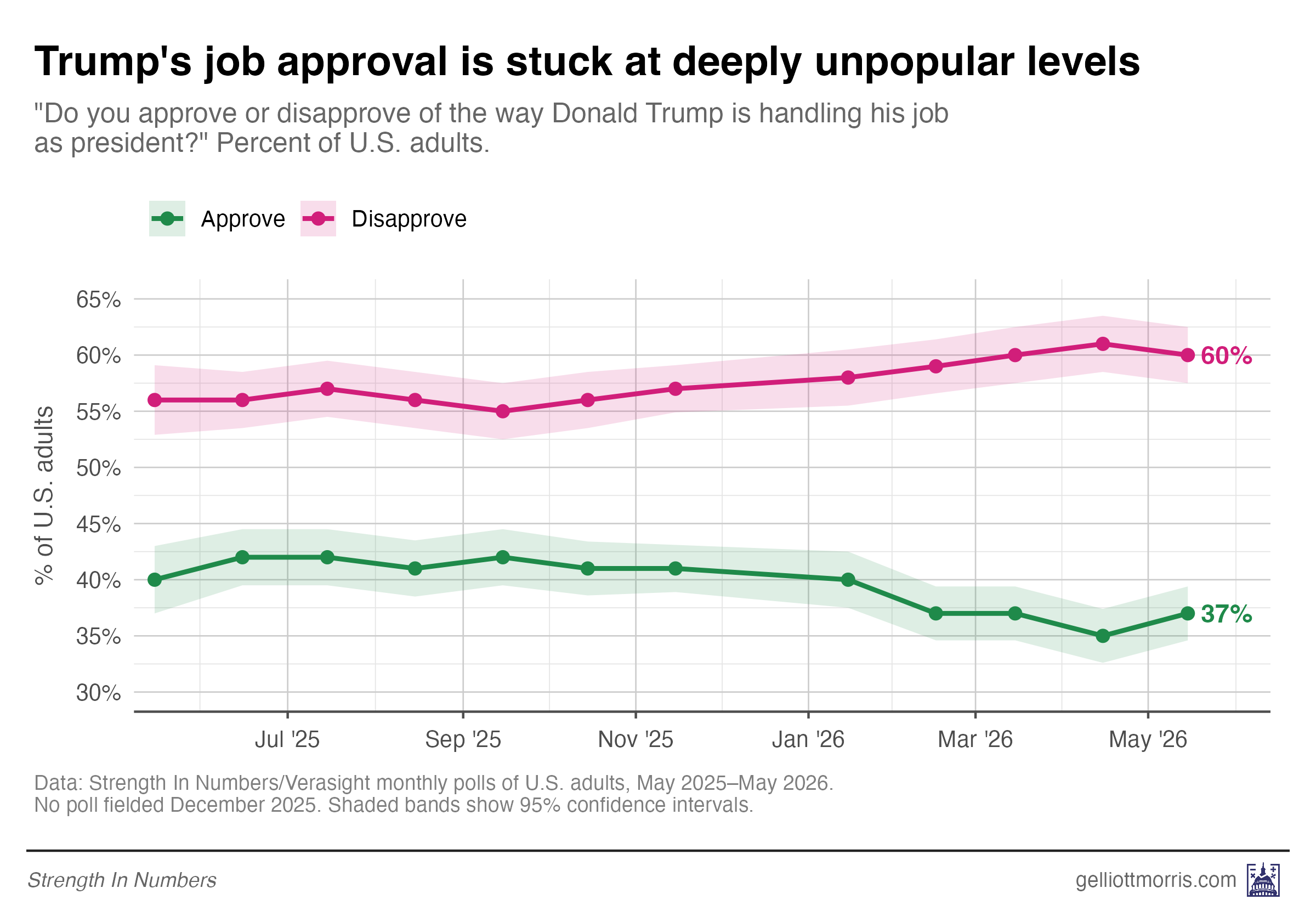
President Donald Trump’s approval rating is essentially where it was a month ago — and a month before that, and a month before that. Our latest Strength In Numbers/Verasight poll, conducted May 18–19, finds 37% of U.S. adults approving of his job performance and 60% disapproving. The net rating of -23 is within the margin of error of April’s -26 and is the second-worst reading we’ve recorded since we began tracking the question a year ago.
Yet despite his stable topline rating, the president’s net approval on prices and inflation — the issue voters say they care about most — fell to a new record low of -47, a 1-point drop from April’s -46. Just 25% of Americans now approve of the way he’s handling prices, while 72% disapprove. 57% of all U.S. adults disapprove strongly.
This has been the basic math of the president’s popularity for the last year. He cannot dig himself out of a hole with the average American if he continues to marginalize them on their core priorities. The issue voters care most about — the one they say is the single most important problem facing the country today — is also the one where the president is most unpopular.
Below, I report the results from the monthly political tracking questions in our May Strength In Numbers/Verasight survey. In another article tomorrow, I’ll dive into our new data on how stress over prices and job security affects the average American, and what policies they want leaders to pass to address those challenges.
Headline poll findings
Job approval: 37% of U.S. adults approve of Trump’s job performance; 60% disapprove (net -23, essentially unchanged from -26 in April and the second-worst reading in our trend)
Generic ballot: Democrats lead Republicans 51% to 43% among registered voters — an 8-point margin — and 51% to 41% among all adults. Democrats have led the generic ballot in every poll we’ve conducted.
Direction of the country: 52% say things are going poorly and major, disruptive changes are needed. Just 8% say things are going well. This is a continuation of deepening pessimism from last month.
Prices: Trump’s net approval on prices and inflation has fallen to -47, a new record low. 39% of Americans now name prices as the single most important problem facing the country — also a record in our polling.
Issue approval: Trump is underwater on every single issue we tested except border security, where he sits at net 0 (48% approve, 48% disapprove).
Party trust: Democrats lead Republicans on 8 of the 12 issues we tested, including all the top voter priorities — prices, jobs, health care and, elections and democracy.
Strength In Numbers is able to publish original, independent political polling thanks to the paying subscribers who support this site. To become a paid member and support work like this, plus get at least one exclusive premium analysis article each week, click the button below.
Democrats have led the generic ballot in every poll we’ve conducted
On the generic congressional ballot, Democrats lead Republicans 51% to 43% among registered voters — an 8-point margin. Among all U.S. adults, the lead widens to D+10 (51% to 41%). 7% of registered voters — and 8% of all adults — say they don’t know who they would vote for.
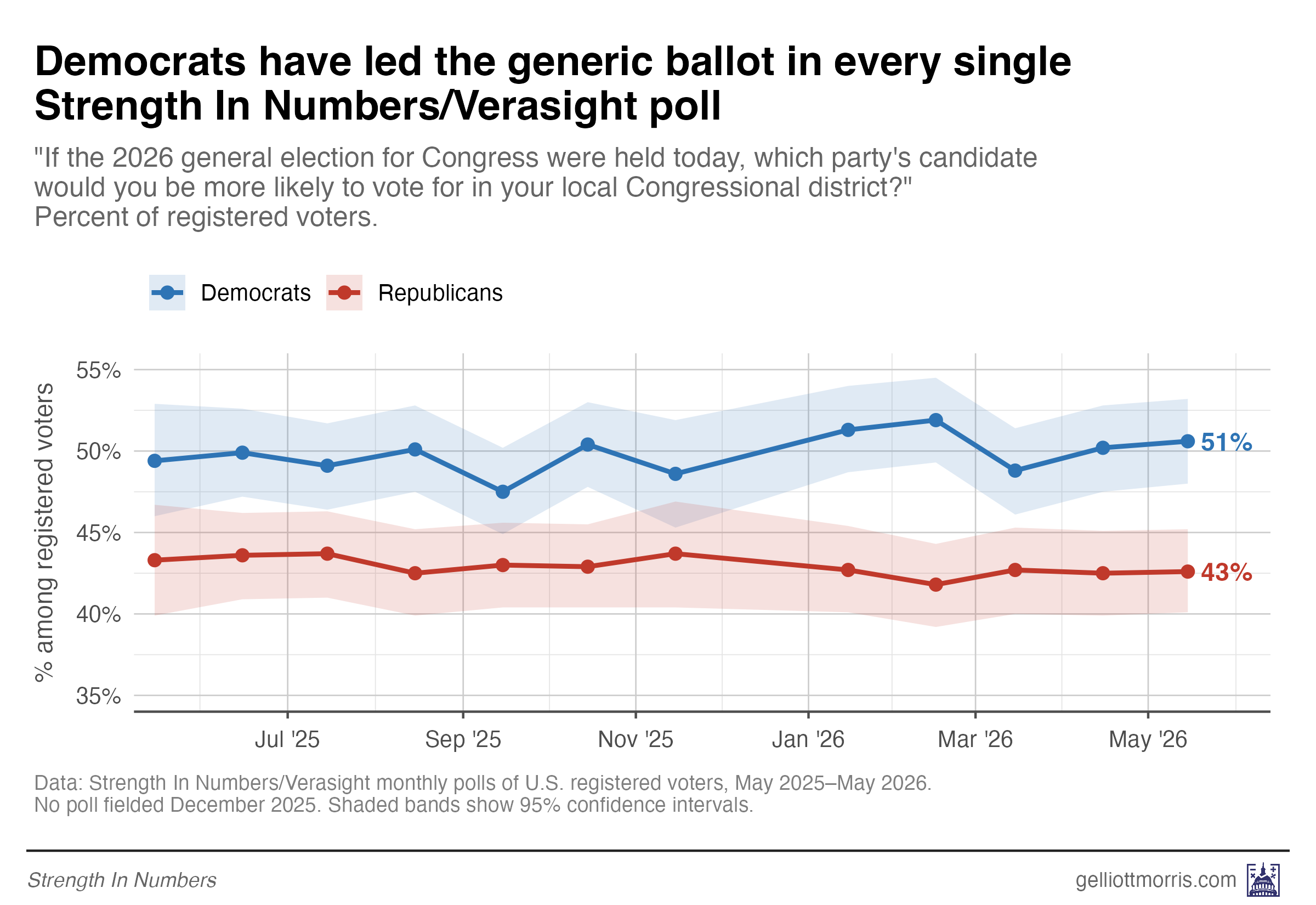
Democrats have led the generic ballot in every single Strength In Numbers/Verasight poll since we began fielding in May 2025. Across 12 monthly polls (we skipped December 2025), Democrats have never trailed, with margins ranging from +5 to +10 points among registered voters.
The May D+8 among registered voters is essentially in line with April’s D+7 result and within the normal range of poll-to-poll variation. It also matches the May aggregate of public polls (roughly D+6 to D+8 depending on the source); the New York TImes/Siena poll last week had Democrats up 11 among registered voters.
Trump’s rating on prices hits a new record low
And if you thought Trump’s position on inflation and the economy couldn’t get any worse...
Our new polling of Trump’s popularity at the issue level shows a continued slide for the president. Trump is underwater — sometimes deeply so — on every issue we tested except border security, where he sits at exactly net 0 (48% approve, 48% disapprove).
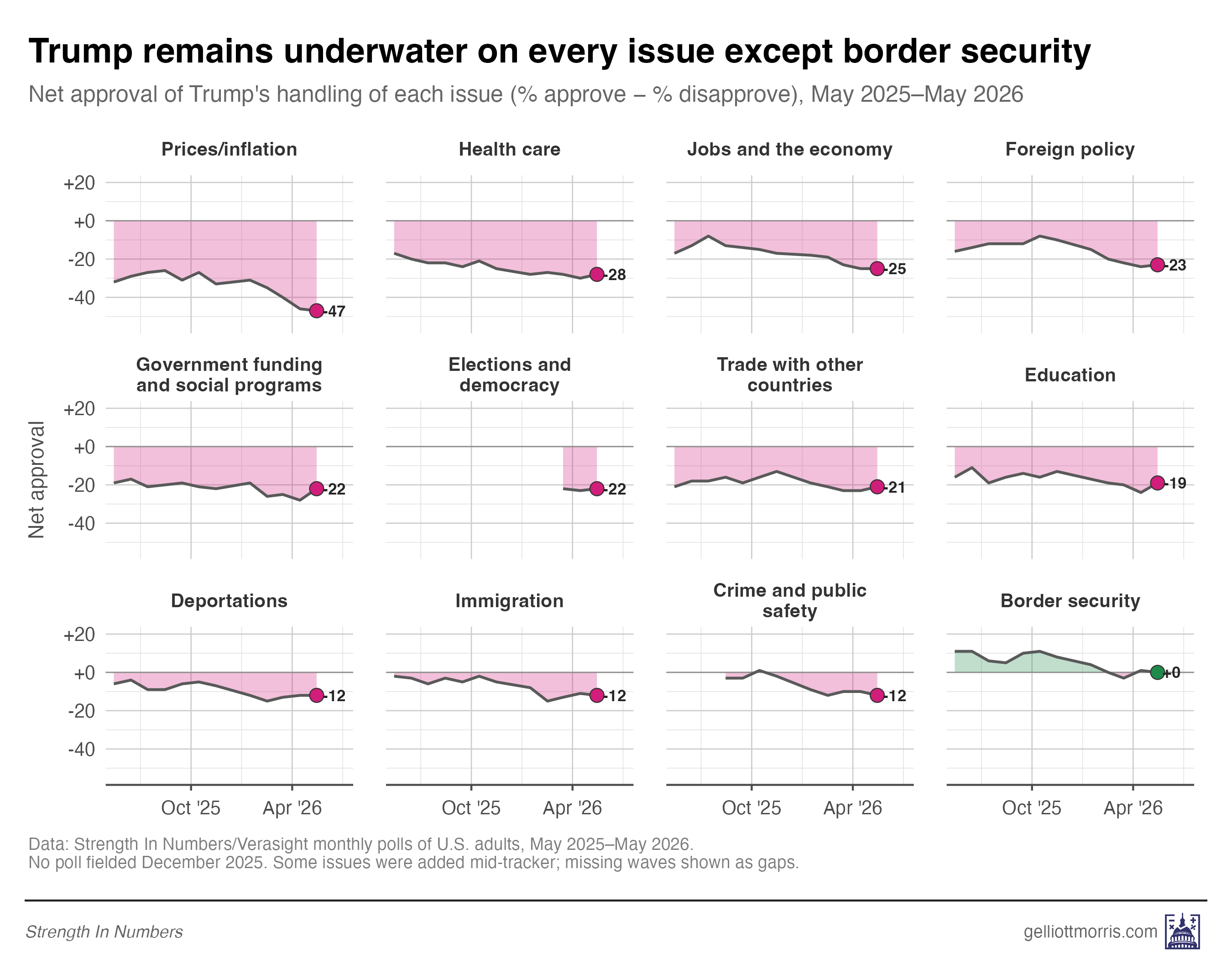
His worst rating, by a wide margin, is on prices and inflation: at -47. Trump’s approval on prices has now gotten worse in every single month of 2026 — -31 in January, -35 in February, -40 in March, -46 in April, and now -47 in May. Just 25% of Americans approve of how he’s handling prices, while 72% disapprove. Worse, 57% strongly disapprove. More than half of all U.S. adults don’t just disapprove of how the president is handling the cost of living, but say they strongly disapprove.
Trump’s other issue numbers are scarcely better. He’s at -28 on health care, -25 on jobs and the economy, -23 on foreign policy, -22 on elections and democracy, -22 on government funding and social programs, -21 on trade, and -19 on education. Even on his strongest non-border issues — deportations, immigration, and crime — he’s at -12 across the board.
As for most of our recent surveys, border security is the lone exception; Trump is tied on the issue. Forty-eight percent approve, 48% disapprove.
Prices keep climbing as the country’s top problem
When we ask Americans to name the single most important problem facing the country, 39% say prices and inflation — the highest share we’ve ever recorded for any issue. That’s a 5-point jump from April (34%), and prices outpace the next-closest issue, elections and democracy, by nearly three to one.
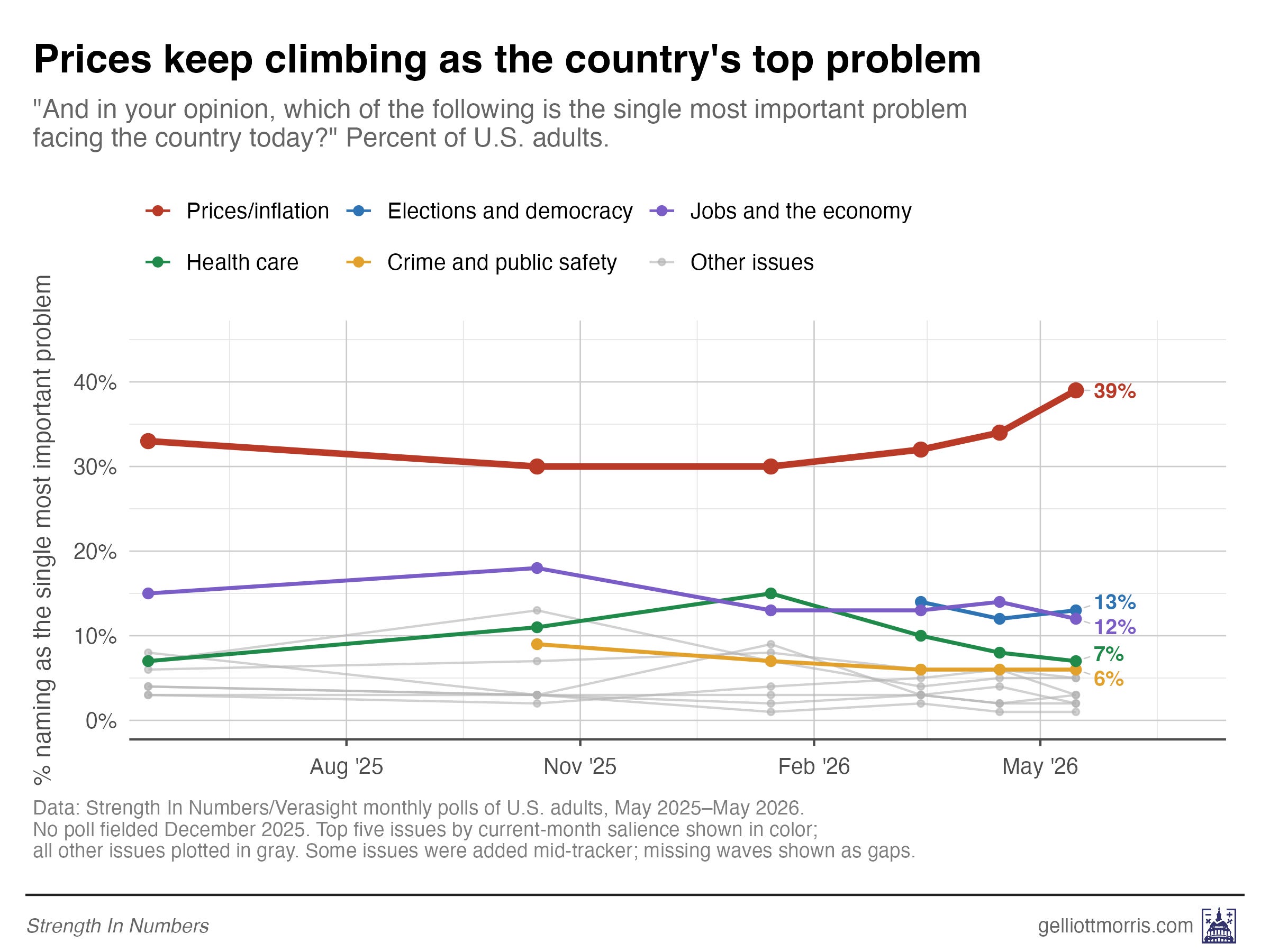
13% name elections and democracy, 12% name jobs and the economy, and health care rounds out the top four at 7%. When we let respondents name their top three problems, instead of forcing them to pick one, the gap widens further: 62% select prices, 40% name jobs and the economy, and 33% pick health care. Elections and democracy comes fourth at 25%.
The tough reality of the math for Republicans is that the issue where he is most unpopular is also the issue Americans care about most. And this isn’t just a Trump problem anymore; our poll shows this is also having severe consequences for the Republican Party, too.
Democrats lead on the issues voters care about most
When we ask voters which party they trust more to handle each issue, Democrats lead on 8 out of 12 policy areas. They hold their biggest advantages on health care (D+20), education (D+15), government funding and social programs (D+15), and elections and democracy (D+10). They also lead on prices and inflation (D+10) and jobs and the economy (D+8) — the two issues voters rate as the country’s biggest problems, and on which Trump and Republicans had a clear lead in the 2024 election.
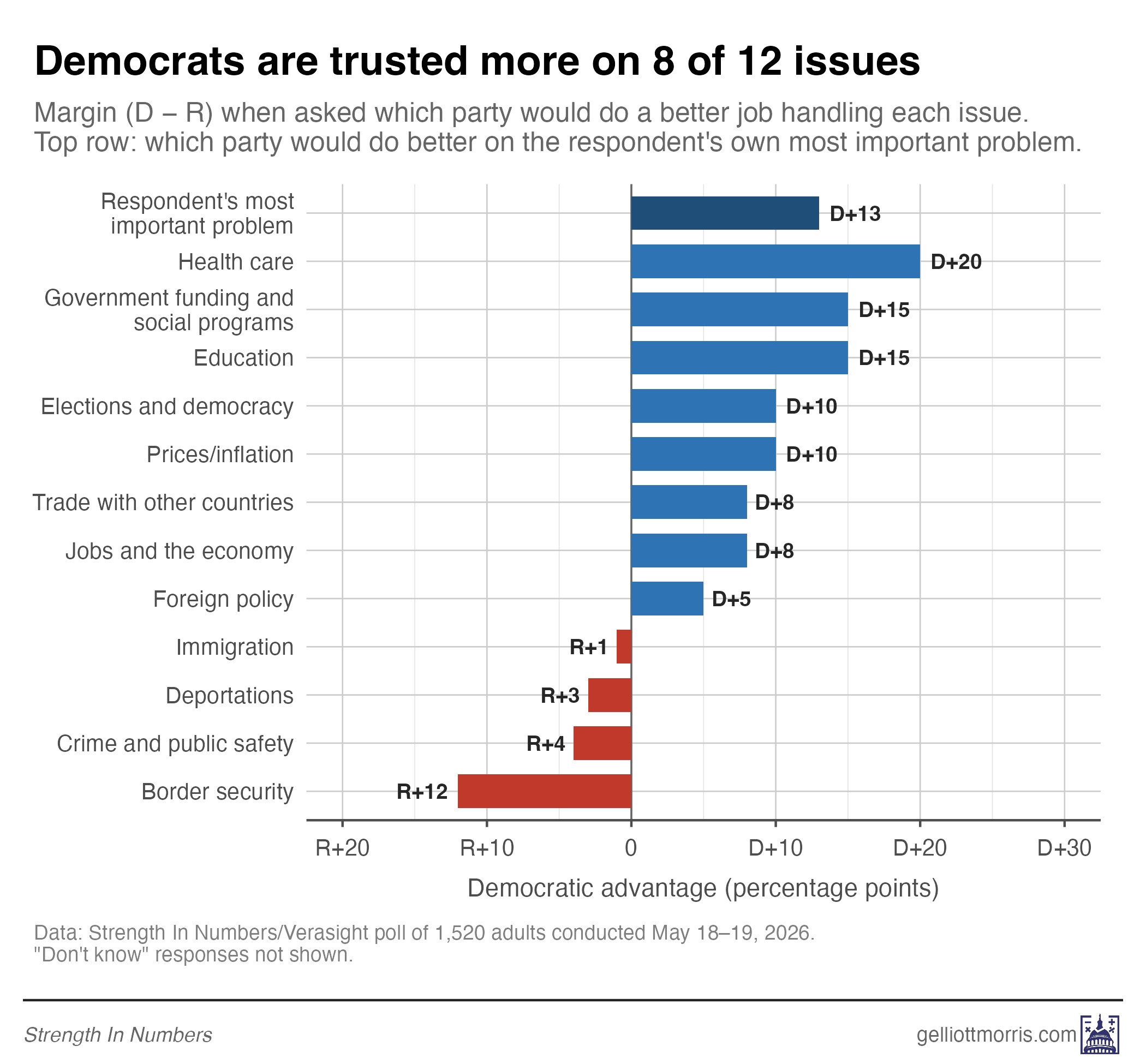
Republicans lead on just four issues, all in their traditional wheelhouse: border security (R+12), crime and public safety (R+4), deportations (R+3), and immigration (R+1).
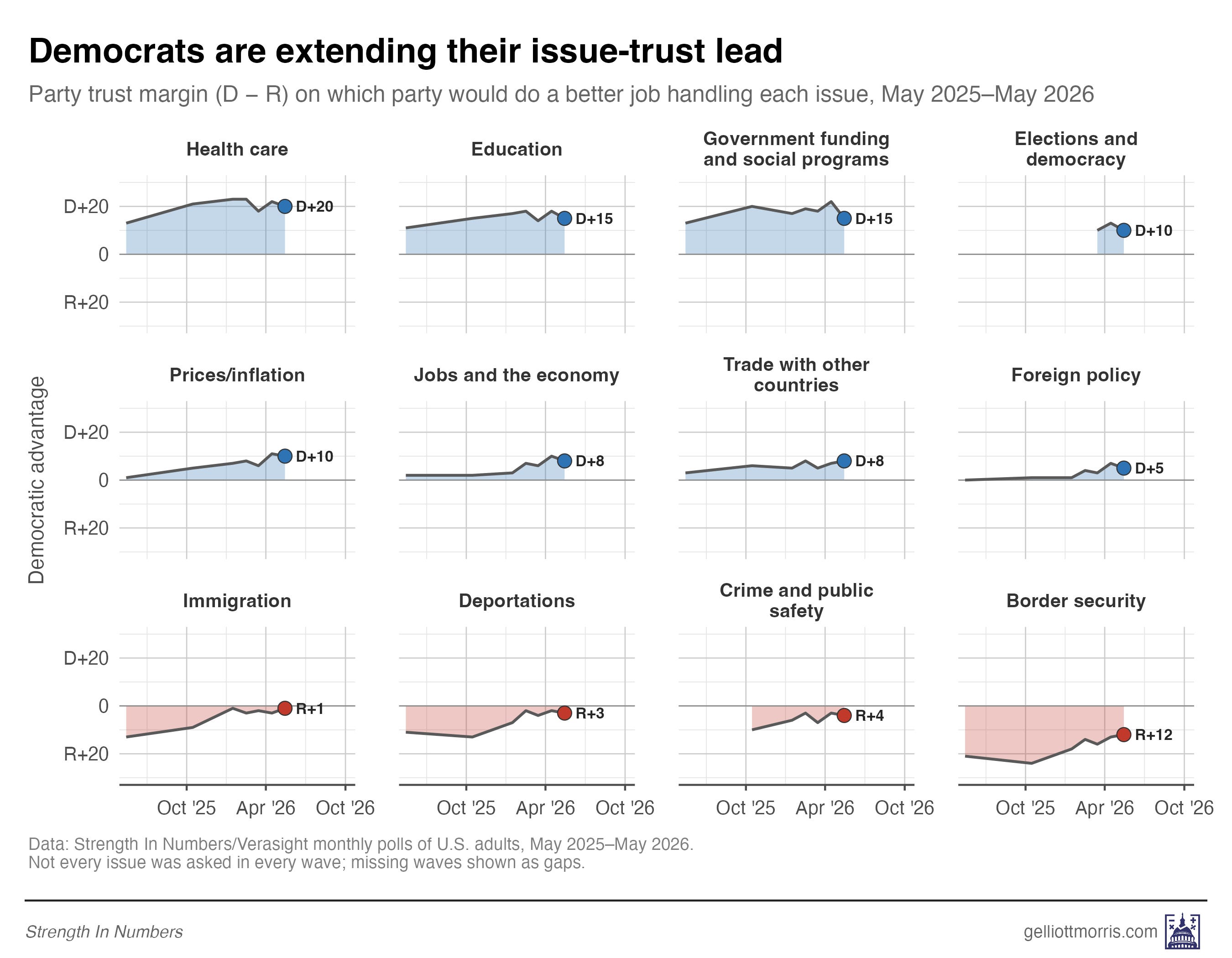
And the data has been moving generally in the Democratic direction over the last year. The biggest shift since we began polling is is on inflation, where Democrats have gone from D+1 in May 2025 to D+10 today, and on immigration, where the Republican lead has decreased from R+12 last year to R+1 this month.
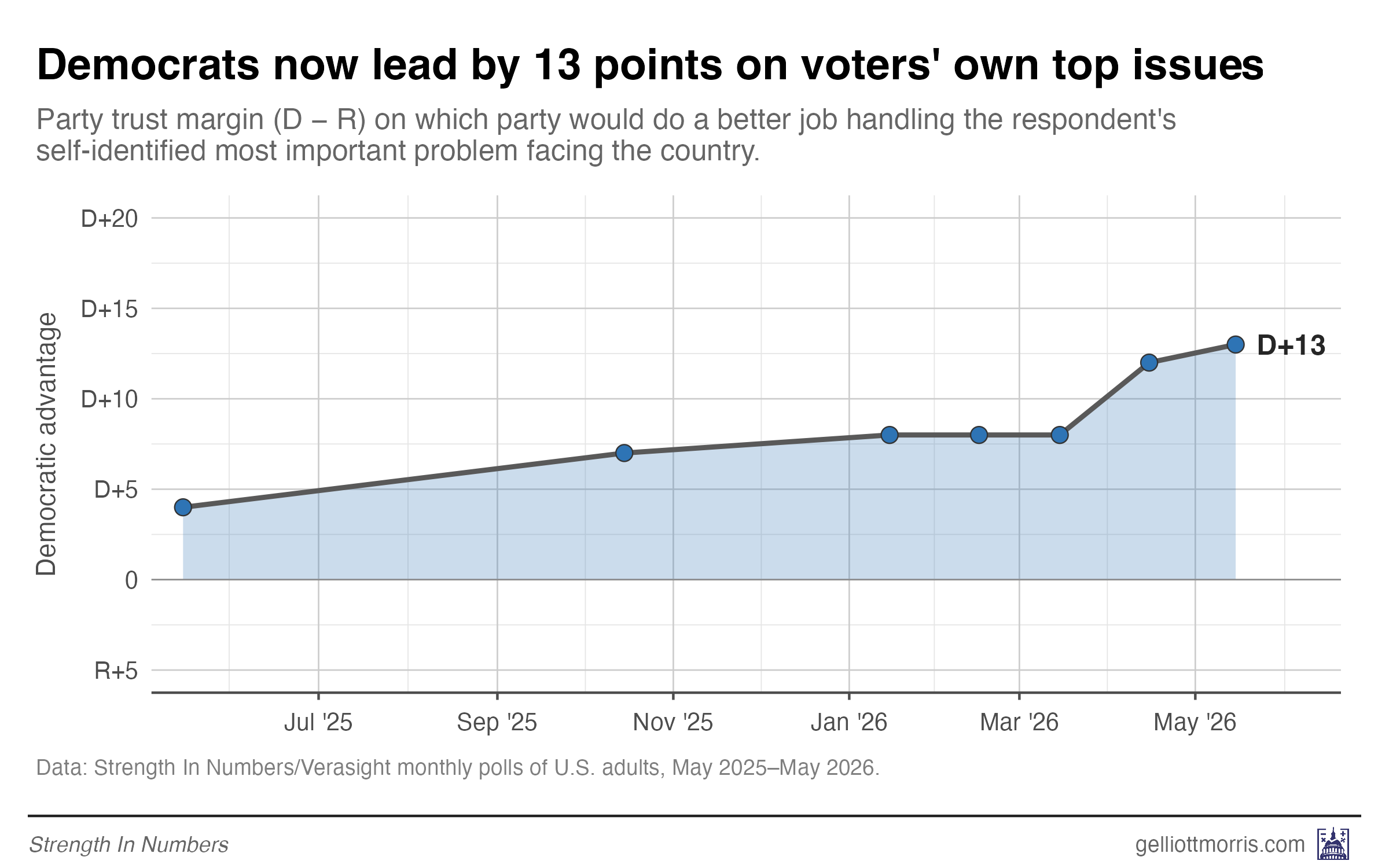
When we ask voters which party would do a better job handling their personal most important problem, Democrats lead 49% to 36% (15% are unsure). That 13-point advantage is a 1-point improvement from April’s D+12 and a more significant rise from previous months, with the Democrats at D+8 in February and March 2026 and D+4 in May 2025.
52% say things in the country are going poorly — still near a record high
The share of Americans who say “things are going poorly and major, disruptive changes are needed” sits at 52% in May, down slightly from April’s record high of 55%. Just 8% say things are going well; 36% say things could be going better. Combine the two and 88% of Americans are dissatisfied with the direction of the country.
The trend is (still) not Republicans’ friend
Trump’s overall approval has stabilized at a deeply unpopular level. Since January, his approval has fallen from 40% to 37% and his net rating from -18 to -23. His rating on prices — the issue voters care about most — has fallen every single month this year, and now sits at a record -47. That is significantly worse than rating for Joe Bien at this point in his term in 2022.
Aside from approval, other indicators are also flashing red. The country is very dissatisfied, with the vast majority saying major political and economic changes are needed. The president is underwater on almost every issue, and if you ask voters who they trust more to handle their personal most important issue, they say the opposition party by a growing 13-point margin.
In terms of electoral consequences for this poor performance, Democrats have led the generic ballot in every poll we’ve conducted since May 2025. Their margin has grown in recent months. When a president is this unpopular this close to a midterm, his party usually loses badly. Bush, at this same approval level in May 2006, saw his party lose 30 House seats and the majority later that year.
If our May numbers are anywhere close to where things stand in the fall, Republicans should be preparing for significant losses, up and down the ballot.
Over the next few days, Strength In Numbers will release more data from our May survey with Verasight — including a closer look at how Americans are feeling about their personal finances, who they blame for the cost-of-living crisis, and what they want Congress to do about it. These data will offer a lot of information to readers looking to inform debates about policy agendas that could be used to blunt the power of anti-incumbent sentiment in 2028 and 2032, as I wrote about last Friday. Subscribe today to get those fresh polling dispatches delivered straight to your inbox.
Methods statement: Verasight collected the data for this survey from May 18–19, 2026. The sample consists of 1,520 United States residents ages 18 and above. The data are weighted to match the April 2026 Current Population Survey on age, race/ethnicity, sex, income, education, region, and metropolitan status, as well as to a running three-year average of partisanship distributions from the Pew Research Center NPORS benchmarking surveys and population benchmarks of 2024 vote. The margin of sampling error is ±2.7%.
G. Elliott Morris prepared the topline document for Strength In Numbers. Strength In Numbers had input on question wording, but all other methodological decisions were made and carried out by Verasight to ensure independence of the data-generating process behind these results. Verasight also reviewed the questionnaire.
You can download a full topline file, key crosstabs, and full methodology statement at the Strength In Numbers/Verasight polling portal. The paywalled section containing crosstabs and more interactive graphics has been updated with these numbers.
If you have any questions about this poll or the release, please email polling[AT]gelliottmorris.com.
Have a suggestion for next month’s poll? Leave it in the comments below.
If you’re a frequent reader of Strength In Numbers, I’m confident you will get a lot of value out of a paid subscription. You’ll get access to all of my analysis, including weekly Tuesday Deep Dives and other exclusive posts, and you’ll be supporting independent data journalism — like this original polling.


If there were any rationality to US voting patterns, low-information voters would be turning against Trump and his party for exactly the same reasons that they turned against Biden and the Dems: he's too old for the job, and prices are too high. Of course, even minimal rationality is a high bar to clear in these days of "vibe" politics...
Am I correct that this poll was conducted before the $1.776 billion slush fund was announced, along with future immunity from the IRS for Trump and his family?