


This article reports results from the June 2026 Strength In Numbers/Verasight poll. A methodology description is included at the end of this article. You can find toplines and crosstabs for this, as well as our previous poll releases, here. Subscribers to Strength In Numbers have access to additional visuals and a full archive of crosstabs here. Readers can suggest questions for future polls in the comments section below!
Intro
A clear majority of Americans support a deal to end the war between the U.S. and Iran, our latest Strength In Numbers/Verasight poll finds. According to the survey, which was conducted June 17–22, 2026, adults back the deal by a margin of more than two to one: 59% of U.S. adults support the deal to end the war, while just 24% oppose it.
But Americans do not think the deal is good, or that the war was successful. Rather, our poll indicates voters support the agreement because they see it as ending a war few supported. Only 18% of Americans say the U.S. actually achieved its goals in Iran, while nearly half — 46% — say the country should never have gone to war in the first place. Overall, 61% of adults say they are not confident the deal will stop Iran from building a nuclear weapon, as the Trump administration claims.
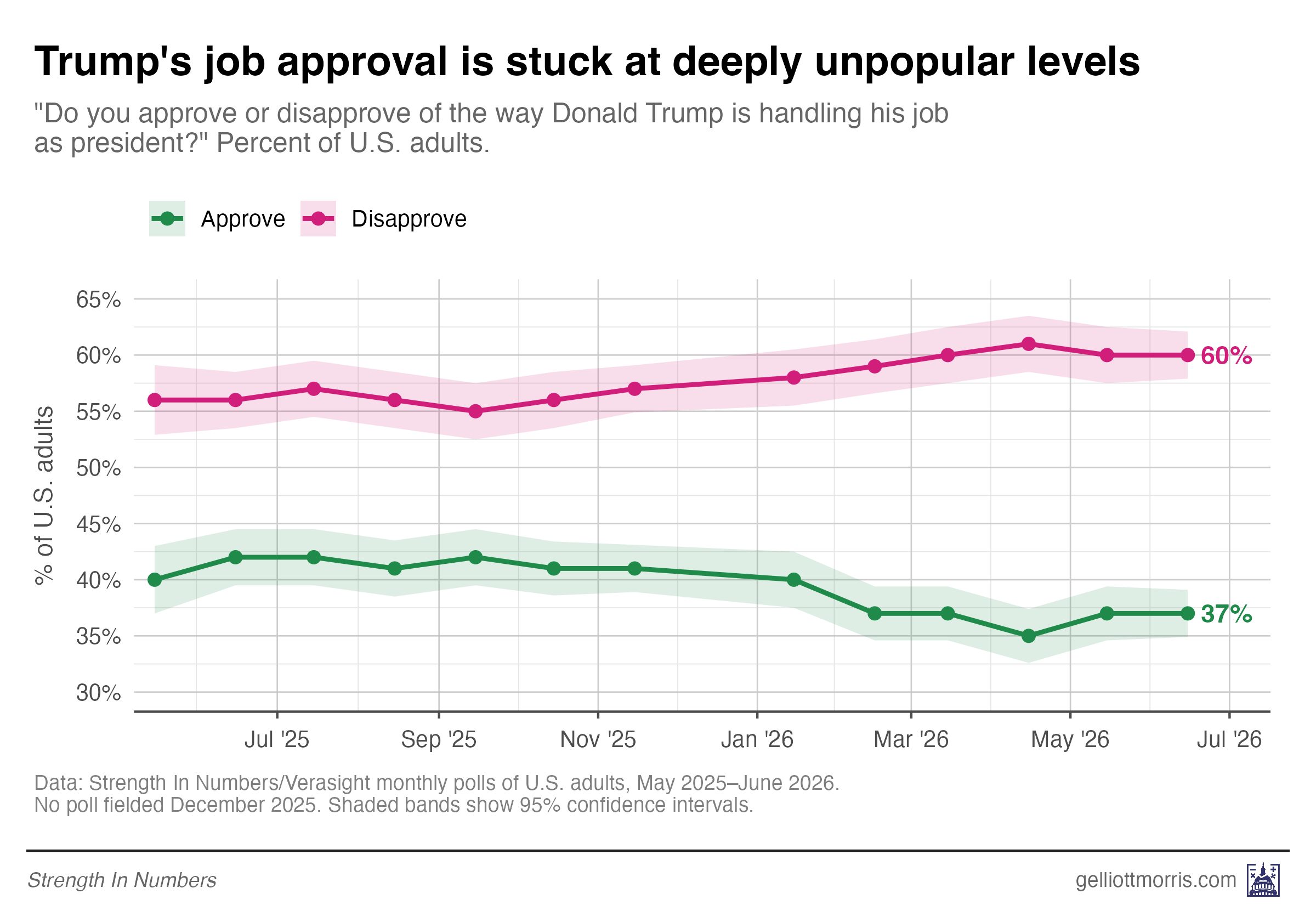
While the war — and its effect on gas prices — led to a large decrease in Trump’s approval rating, the announcement of the deal (even if it doesn’t stick) and a drop in prices at the pump have not yet helped him. Overall, 37% of U.S. adults approve and 60% disapprove of his job performance as president, identical to May’s reading and still among the worst readings we’ve recorded since we began tracking the question a year ago.
So June looks less like a turning point than a brief reprieve for the president. The president remains underwater on 11 of 12 issues we test, Democrats still lead the generic ballot, and the public still trusts Democrats more on the issues it cares about most.
Below, I report results from our monthly Strength In Numbers/Verasight political tracking questions. This month, we also asked respondents about the war in Iran, conducted a survey experiment testing different ways Democratic candidates can distance themselves from their party’s national brand, and fielded two questions subscribers asked us to field: one on impeachment and one on which group of Americans voters think Trump’s policies have actually helped. The Iran and group-benefit results are covered here, while the other questions will get their own articles.
Headline poll findings
Iran: 59% of Americans support the deal to end the war with Iran; 24% oppose. But only 18% say the U.S. achieved its goals, 46% say it never should have gone to war, and 61% are not confident the deal will stop Iran from getting a nuclear weapon.
Job approval: 37% of U.S. adults approve of Trump’s job performance; 60% disapprove (net -23, unchanged from May)
Generic ballot: Democrats lead Republicans 50% to 43% among registered voters — a 7-point margin — and 48% to 42% among all adults.
Direction of the country: 50% say things are going poorly and major, disruptive changes are needed to get the country back on course. Just 8% say things are going well.
Prices: Trump’s net approval on prices and inflation is -46 — still by far his worst issue. Perhaps the good news for the president is that for the first time in 2026 his rating didn’t get worse since last month. 36% of Americans name prices as the single most important problem facing the country.
Issue approval: Trump is underwater on every issue we tested except border security, where he sits at net +2 (48% approve, 46% disapprove).
Party trust: Democrats lead Republicans on 8 of the 12 issues we tested, including the top voter priorities — prices, jobs, health care, and elections and democracy.
Who Trump’s policies helped: 63% of Americans say the wealthy and large corporations have benefited more than average Americans from Trump’s policies; just 8% say average Americans have come out ahead.
This is the first of several articles releasing data from the June Strength In Numbers/Verasight poll. Subscribe to Strength In Numbers to get them in your inbox.
Americans support the Iran deal because they want out, not because they think the war worked
On paper, Trump’s deal to end the war with Iran is one of the president’s rare policies a clear majority of Americans support. Overall, 59% of the public says they back the deal — including 27% who support it strongly — while only 24% oppose it. (The remaining 17% say they are not sure.)
But their support is a vote to end the war, not for the president’s handling of it. A 46% plurality of adults said the U.S. should never have gone to war with Iran in the first place. Just 18% said the U.S. achieved its goals and the deal is the right move, while another 14% said the war failed, but ending it is still right. Responses and question wording included in the image below:
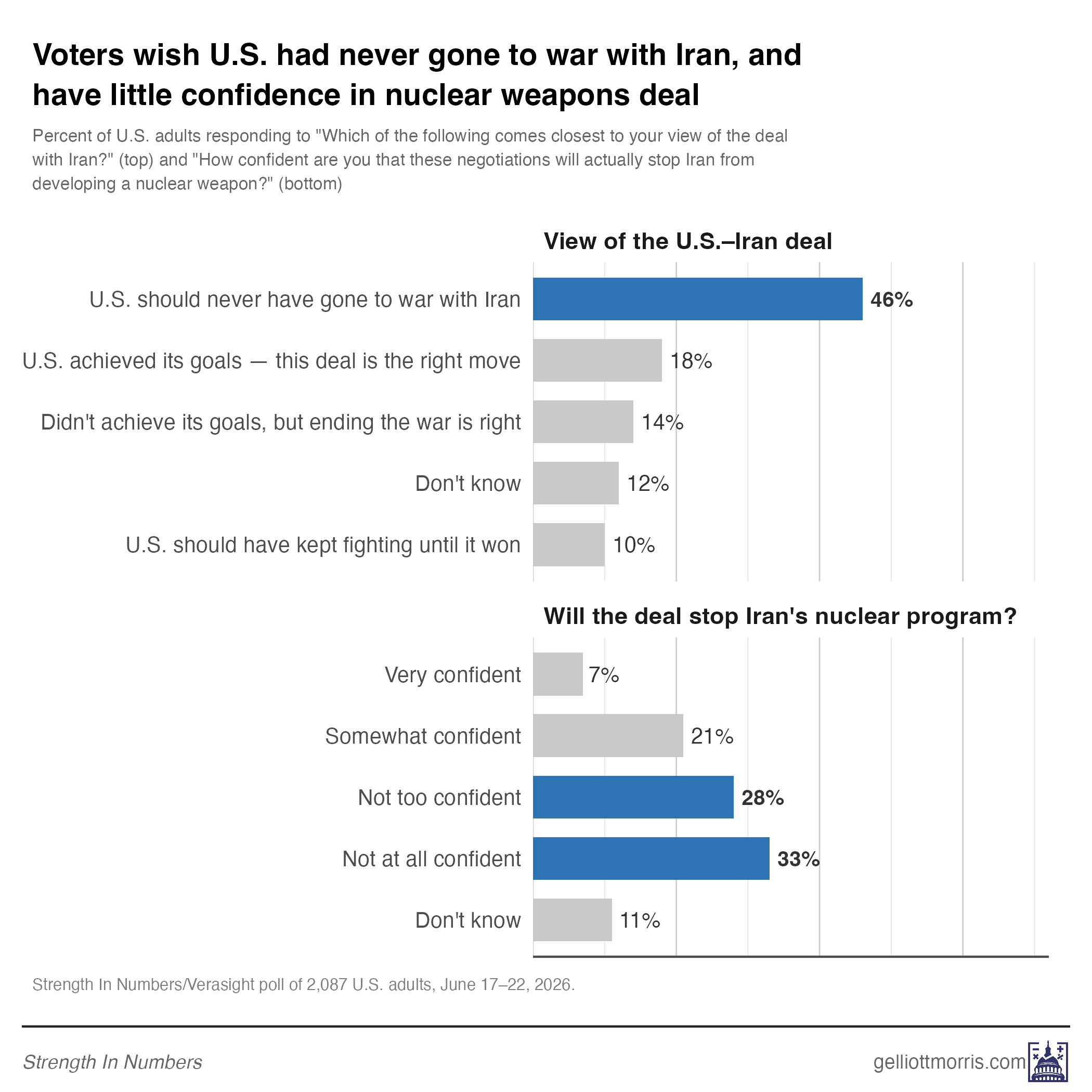
Voters also aren’t sure the deal will even accomplish the goal the Trump administration now claims it started the war for: to destroy Iran’s capability of developing a nuclear weapon. We asked respondents how confident they are that the deal will actually stop Iran from building a nuke, and 61% said they were not confident, with 28% saying “not too” confident, while 33% were “not at all” confident. Just 7% think the agreement will be successful.
This polling is very revealing about the state of public opinion on the U.S.-Iran war. Voters are relieved the shooting has stopped, but they doubt anything was accomplished and do not give the president credit for the cessation of hostilities. As we also found in our May poll, this month’s survey found a majority of Americans with an opinion think Trump shouldn’t have started the war in the first place. That is hardly a victory.
Democrats hold their lead in House generic ballot
Turning to the midterms, the Democrats lead Republicans on the House congressional ballot by a margin of 7 points, 50% to 43% among registered voters. That is within the margin of error of our poll’s reading of an 8-point margin for the party in May. Among all U.S. adults, the lead is D+6 (48% to 42%). 7% of registered voters say they don’t know who they would vote for.
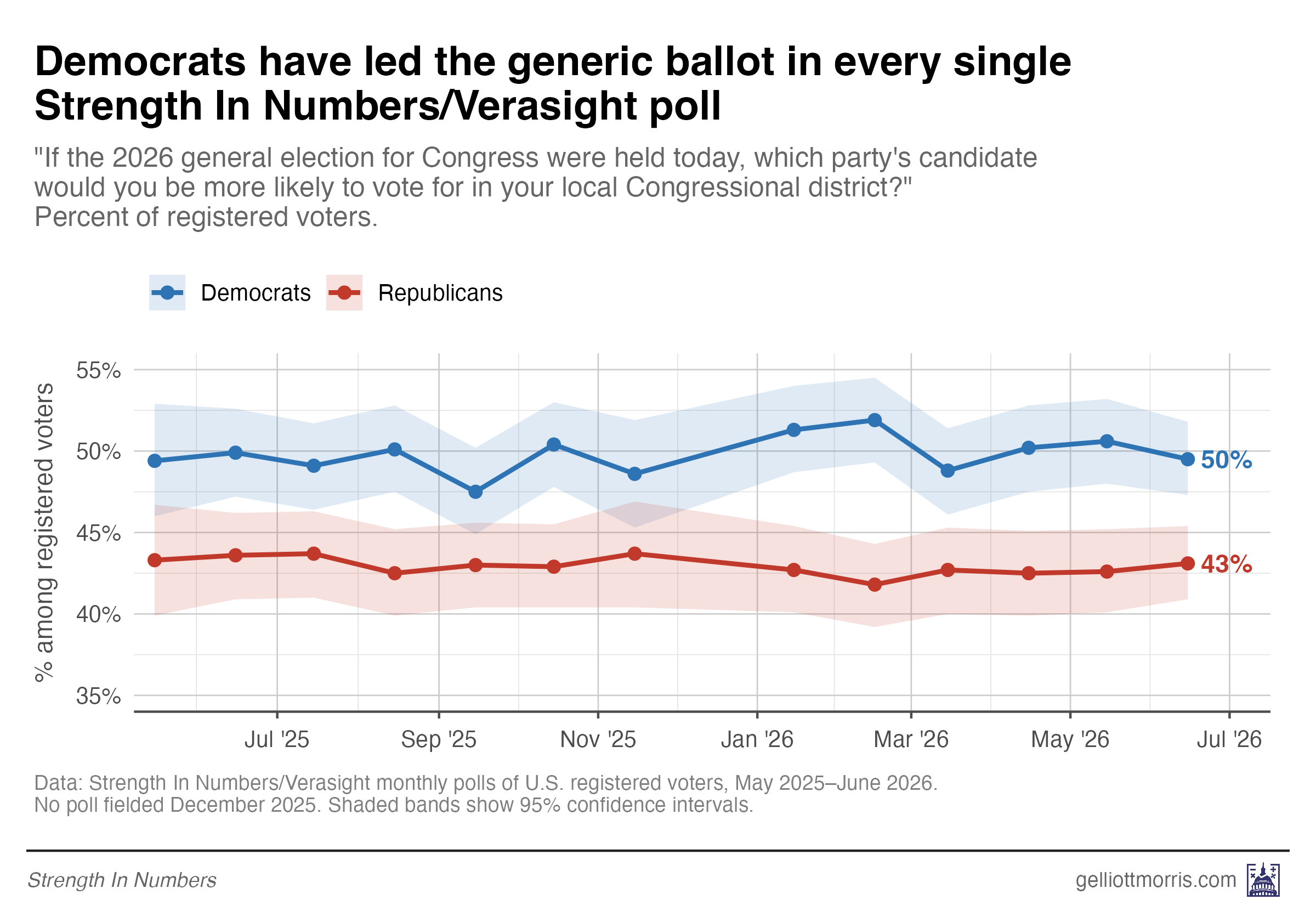
Democrats have led the generic ballot in every single Strength In Numbers/Verasight poll since we began fielding in May 2025. Across 13 monthly polls (we skipped December 2025), Democrats have never trailed, with margins ranging from +5 to +10 points among registered voters.
Trump’s rating for handling prices finally stopped falling — but he’s still underwater on almost everything
Our poll finds Donald Trump’s overall approval rating among U.S. adults stable at 37% this month, with 60% of Americans disapproving of how he’s handling his job as president:
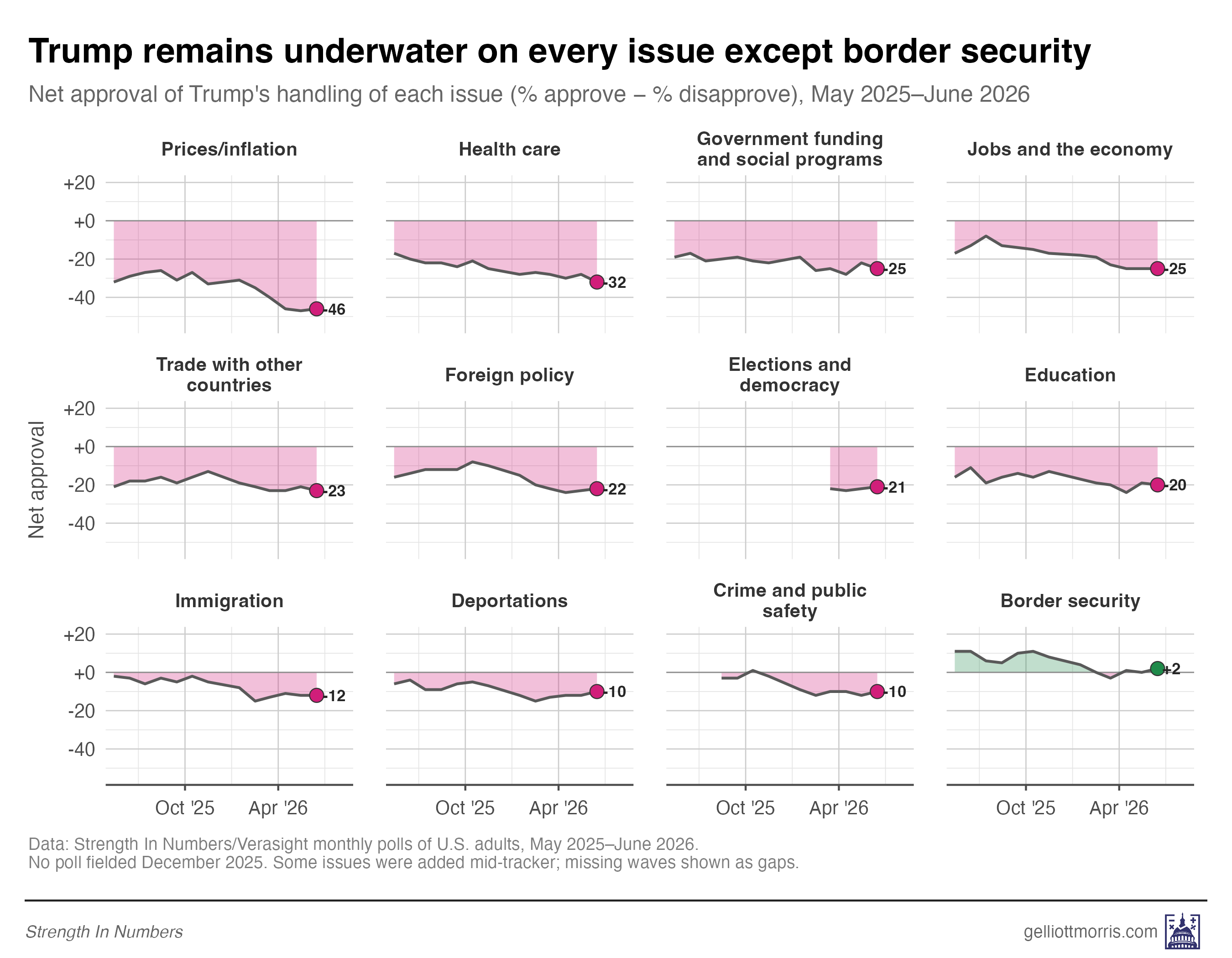
For the first time all year, Trump’s net approval on prices didn’t fall this month. His rating on inflation sits at -46, a technical 1-point improvement from May’s record -47. The president’s net rating on every issue is shown in the graph below:
While the president may be pleased that he has stopped the bleeding, that is a long way from a good rating. In raw percentage terms, just 25% of Americans approve of how he’s handling prices, while 71% disapprove and 54% disapprove strongly. That is a tough number to post on the issue people say is the most important to them (see next section).
The president’s numbers are similarly bad pretty much everywhere else. He is underwater on 11 of the 12 issues we tested. His health care rating fell to -32 (from -28 in May), and on government funding and social programs, he has slipped to -25. He’s stuck in the low-to-mid 20s nearly everywhere else — including -25 on jobs and the economy, -23 on trade, -22 on foreign policy, -21 on elections and democracy, and -20 on education.
The one exception, as in most of our recent surveys, is on border security — where the president is in positive territory at a net rating of +2 (48% approve, 46% disapprove). Yet he is still negative on related issues, including immigration at -12, crime and public safety (-10), and deportations (-10). It is a simple truth but worth repeating: this is not the political environment the president entered office with a short 15 months ago.
Prices are still the country’s top problem
When we ask Americans to name the single most important problem facing the country, 36% say prices and inflation — down a few points from May’s record 39%, but still nearly three times the next-closest issue. Tied for second place, 13% name jobs and the economy, and 12% name elections and democracy as their top issues. Following that, 8% say health care is most important to them.
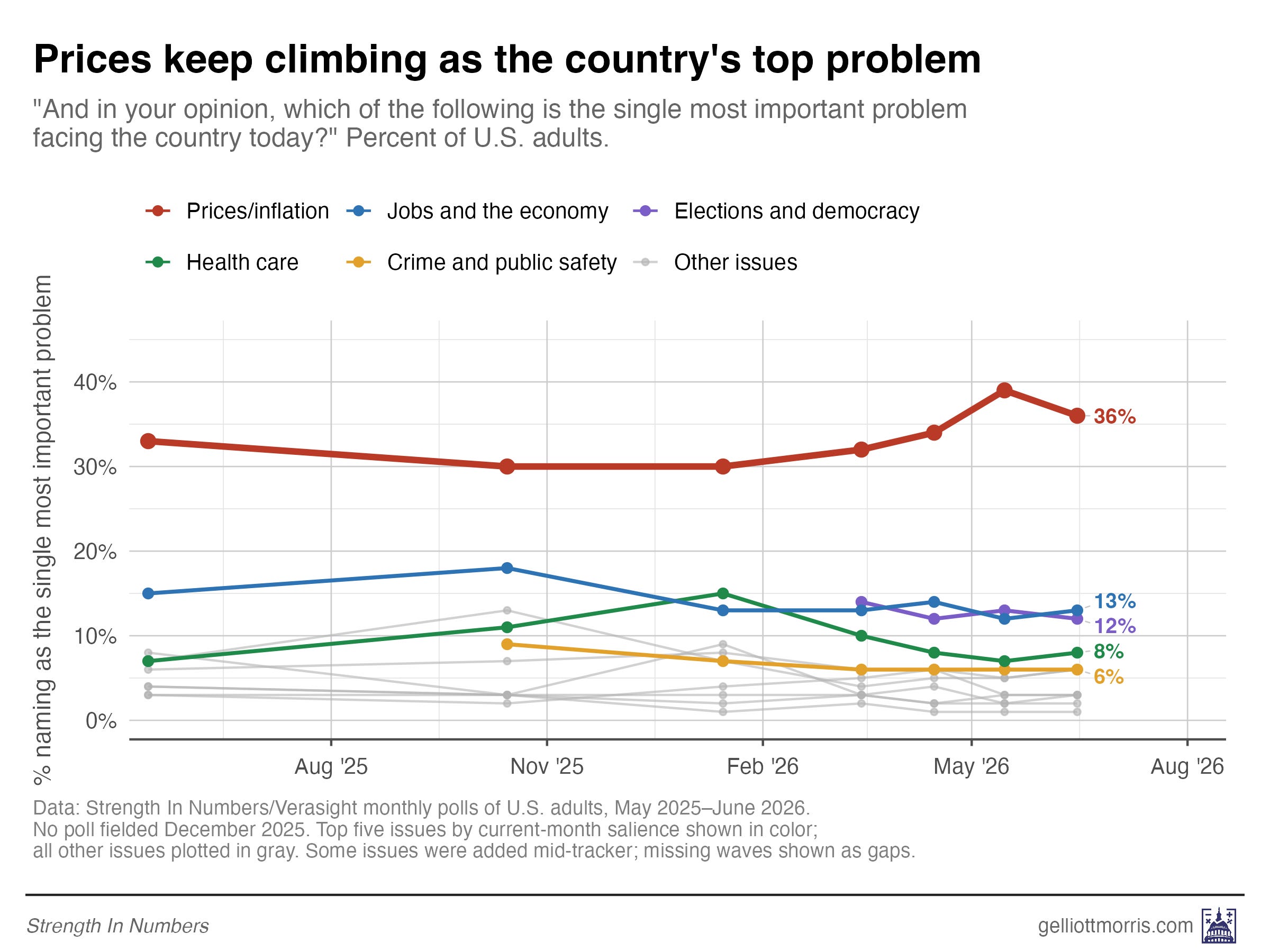
When we let respondents name their top three problems instead of forcing a single choice, the dominance of the cost of living is even clearer. Nearly six in ten — 59% — name prices, well ahead of jobs and the economy (40%) and health care (34%). Elections and democracy come a distant fourth at 22%.
The problem for Trump — and the Republicans ahead of the midterms — is the same one it’s been since early in the president’s second term: The issue Americans care about most is also the issue where the president is weakest.
Democrats still lead on the issues voters care about most
When we ask voters which party they trust more to handle each issue, Democrats lead on 8 of 12 policy areas. Their biggest edges are on health care (D+20), government funding and social programs (D+17), education (D+15), and elections and democracy (D+11). And they’ve taken the two issues Republicans ran and won on in 2024: prices and inflation (D+8) and jobs and the economy (D+7). Again, those latter two are the same two issues voters now rate as the country’s biggest problems.
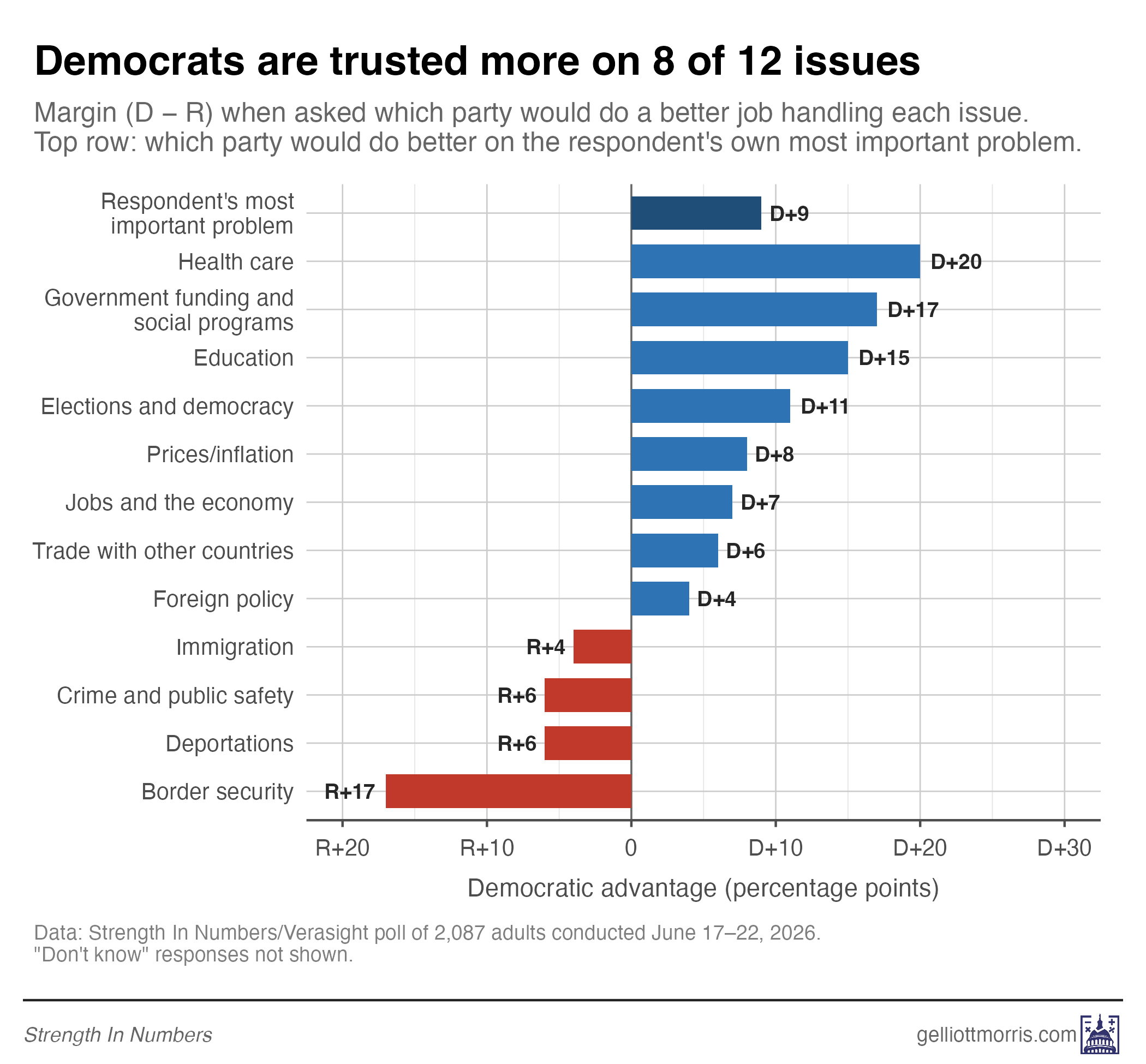
On the other end of the spectrum, Republicans lead on four issues, all in their traditional wheelhouse: border security (R+17), deportations (R+6), crime and public safety (R+6), and immigration (R+4).
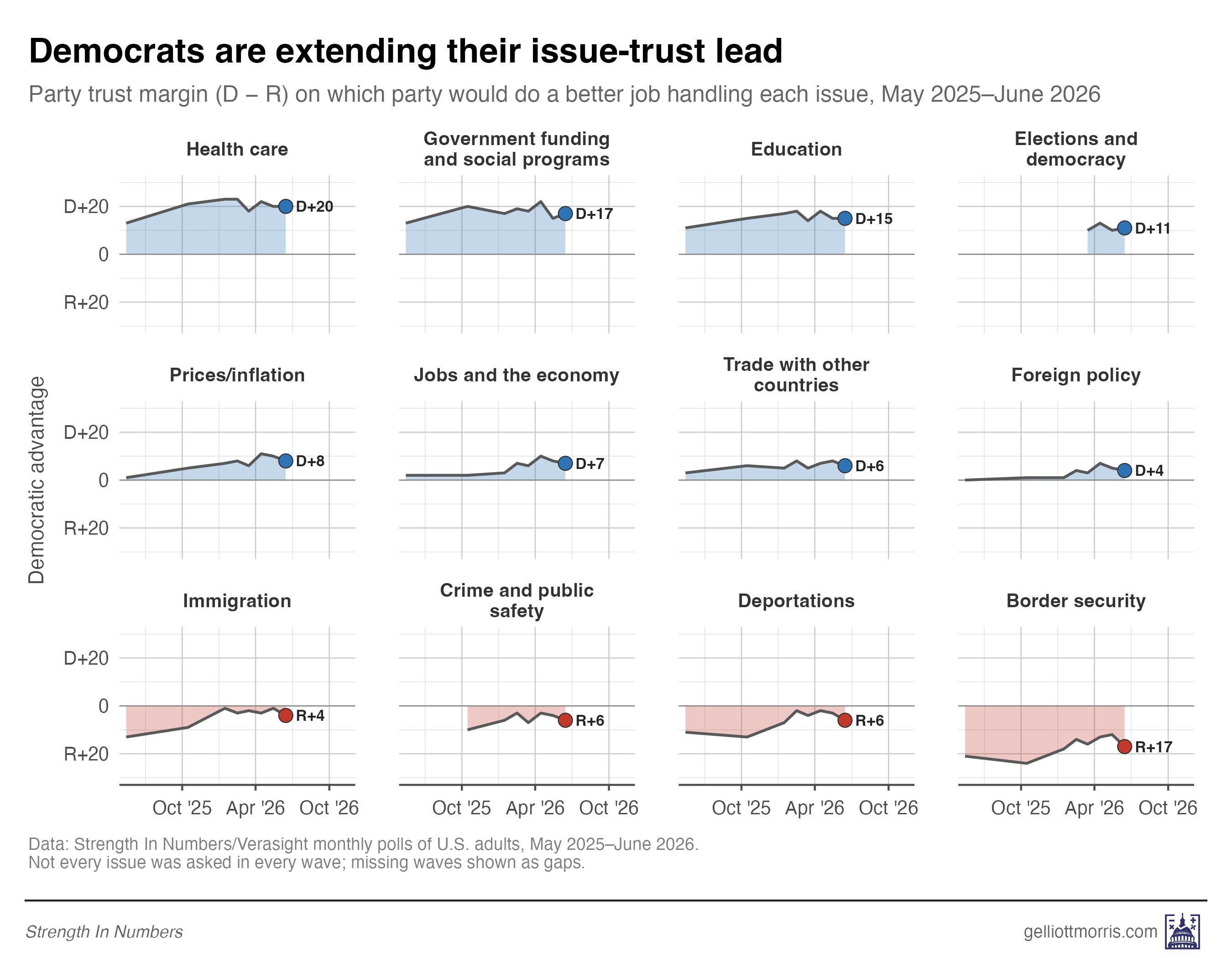
Compared to our May survey, the Republicans have recovered a few points on the margin for some issues, but the differences are not statistically significant:
There is one additional number worth flagging for Democrats. As I wrote about last week, one question we ask here at Strength In Numbers that no other firm regularly tracks is which party would do a better job handling the issue they say is personally most important to them. Today Democrats lead 46% to 37%, with 17% unsure:
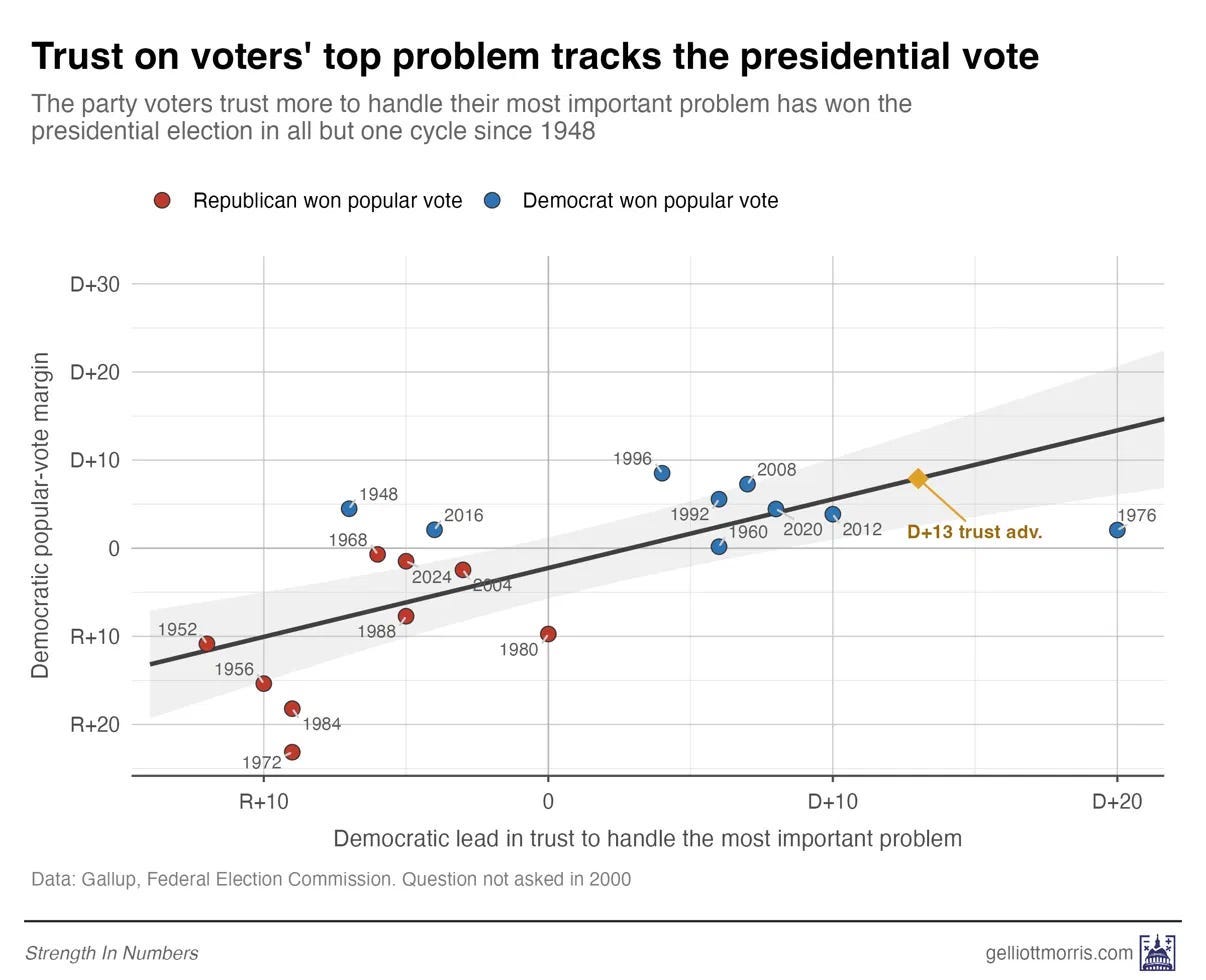
Technically that 9-point edge is down from D+13 in May, but (1) that could be noise and (2) even a 9-point margin is a recent record — on par with the 2020 and 2012 elections, and about double the Republicans’ edge in 2024.
This number predicts elections pretty well, so the number is worth keeping an eye on:
Half the country still says things are going poorly
The share of Americans who say “things are going poorly and major, disruptive changes are needed” sits at 50% in June, roughly even from 52% in May and down from a record high of 55% in April. Just 8% say things are going well. If you add the 38% who say things could be going better to the half who want disruptive change, then the conclusion is that 88% of Americans are dissatisfied with the direction of the country.
This level of pessimism is generally a dire warning for the incumbent party.
Subscribers’ question: who Trump’s policies have actually helped
And now for the fun part. Each month, we let Strength In Numbers subscribers suggest questions for the poll, and I pick a few to run. This helps keep the questions attuned to what people actually care about in a moment in time. This month, subscribers asked who they think the president’s policies have actually benefited.
On the question of which groups are benefiting from Trump’s presidency, few see the working-class president that Trump promised he’d be.
We asked whether they thought wealthy individuals and large corporations have benefited more than average Americans from the Trump administration’s policies. 63% said yes — including a sizable portion of Republicans — and nearly half of all Americans (47%) said the wealthy have benefited “much more” than the middle. Almost no one saw it the other way, with just 8% saying average Americans have come out ahead. About 17% said the two groups have come out the same and 12% are unsure.
Trump ran in 2024 as a champion of the working class who would fight inflation and lock up the elites taking advantage of America. Eighteen months in, by a margin of nearly eight to one, Americans say the people his policies have actually helped are the wealthy and the corporations.
The White House needs numbers to go up, not just stay flat
Zooming out, June is the first month in a while when our survey results are merely bad for the president, and not trending down. His approval held steady at -23 rather than falling, and the president got a foreign-policy deal that a clear majority of the public supports — if not for the reason he wants.
But a pause is not a recovery. Trump is still underwater on 11 of 12 issues, and the public still gives Democrats more than Republicans to handle its top problems. Democrats still lead the generic ballot by high single digits — enough to take the U.S. House majority in November and make the Senate genuinely competitive. And while voters back the Iran deal, they don’t think it accomplished its goal — 61% aren’t confident it will stop Iran from getting the bomb. Most also say the fighting was generally not worth it.
When a president sits this far underwater this close to a midterm, his party usually pays for it. George W. Bush was at roughly the same approval rating as Trump’s today in June 2006 and went on to lose 30 House seats that fall. One stable month doesn’t change the reality of the tough situation the president and his party are in. If June’s numbers are anywhere close to where things stand in November, Republicans are still headed for big losses, up and down the ballot.
Later this week and next week, Strength In Numbers will release more data from our June survey with Verasight — including on support for impeaching Trump, our annual feeling thermometers on major political figures, including the party’s top 2028 contenders, and the results of a new experiment testing how Democratic candidates can distance themselves from their party’s less-than-stellar national brand. Subscribe today to get those polling dispatches delivered straight to your inbox.
And if this type of work is useful to you or you believe in supporting it for the public good, consider becoming a paid member of this Substack. Paying subscribers to Strength In Numbers make it possible for me to spend time on this original, independent, data-driven political journalism that’s not beholden to any corporation or billionaire donor. Support my work and get access to articles like this one for $10/month or $90/year.
Methods statement: Verasight collected the data for this survey from June 17–22, 2026. The sample consists of 2,087 United States residents ages 18 and above. The data are weighted to match the May 2026 Current Population Survey on age, race/ethnicity, sex, income, education, region, and metropolitan status, as well as to a running three-year average of partisanship distributions from the Pew Research Center NPORS benchmarking surveys and population benchmarks of the 2024 vote. The margin of sampling error is ±2.2%.
G. Elliott Morris prepared the topline document and this write-up for Strength In Numbers. Strength In Numbers had input on question wording, but all other methodological decisions were made and carried out by Verasight to ensure independence of the data-generating process behind these results. Verasight also reviewed the questionnaire.
You can download a full topline file, key crosstabs, and full methodology statement at the Strength In Numbers/Verasight polling portal. The paywalled section containing full crosstabs and more interactive graphics has been updated with these numbers.
If you have any questions about this poll or the release, please email polling[AT]gelliottmorris.com.
Have a suggestion for next month’s poll? Leave it in the comments below.


This is a little beside the point, but insofar as it remains a question, it would be interesting to know the extent to which those supporting Trump's various policies all share a common perspective. An obvious, direct measure is just to look at the correlation between answers of individuals. But, it would also (to me, at least) be interesting to understand the larger information bubble in which they exist. To this end, a question like: "How likely do you think it is that the problems with the Reflecting Pool were deliberate sabotage?" might be enlightening.
Translating disapproval numbers into numbers of House seats won is tricky because the number of competitive seats has fallen drastically over time. I don’t think you can point to past years and say “In year X we had a lead of Y points in the generic poll of Republicans vs. Democrats and we won Z number of seats” and expect that to be replicated in 2026. Gerrymandering has reduced the number of competitive seats, and we need to make some adjustment for that in forecasting how many seats we can expect to pick up.