


A new poll shared exclusively with Strength In Numbers shows likely voters in Montana would vote for independent candidate for U.S. Senate Seth Bodnar (50%) over Republican Kurt Alme (44%) if a head-to-head election were held today. Democratic candidate Alani Bankhead would lose 44-52 in a two-way against the Republican.
But Bodnar only wins when Bankhead isn’t on the ballot. In the current four-way race, Alme wins with 41%. The graph below shows five different versions of the general election horse race in Montana. The first row is the actual ballot voters will see if all candidates stay in the race, whereas the other four show vote intention if you vary which non-Republican candidate drops out.
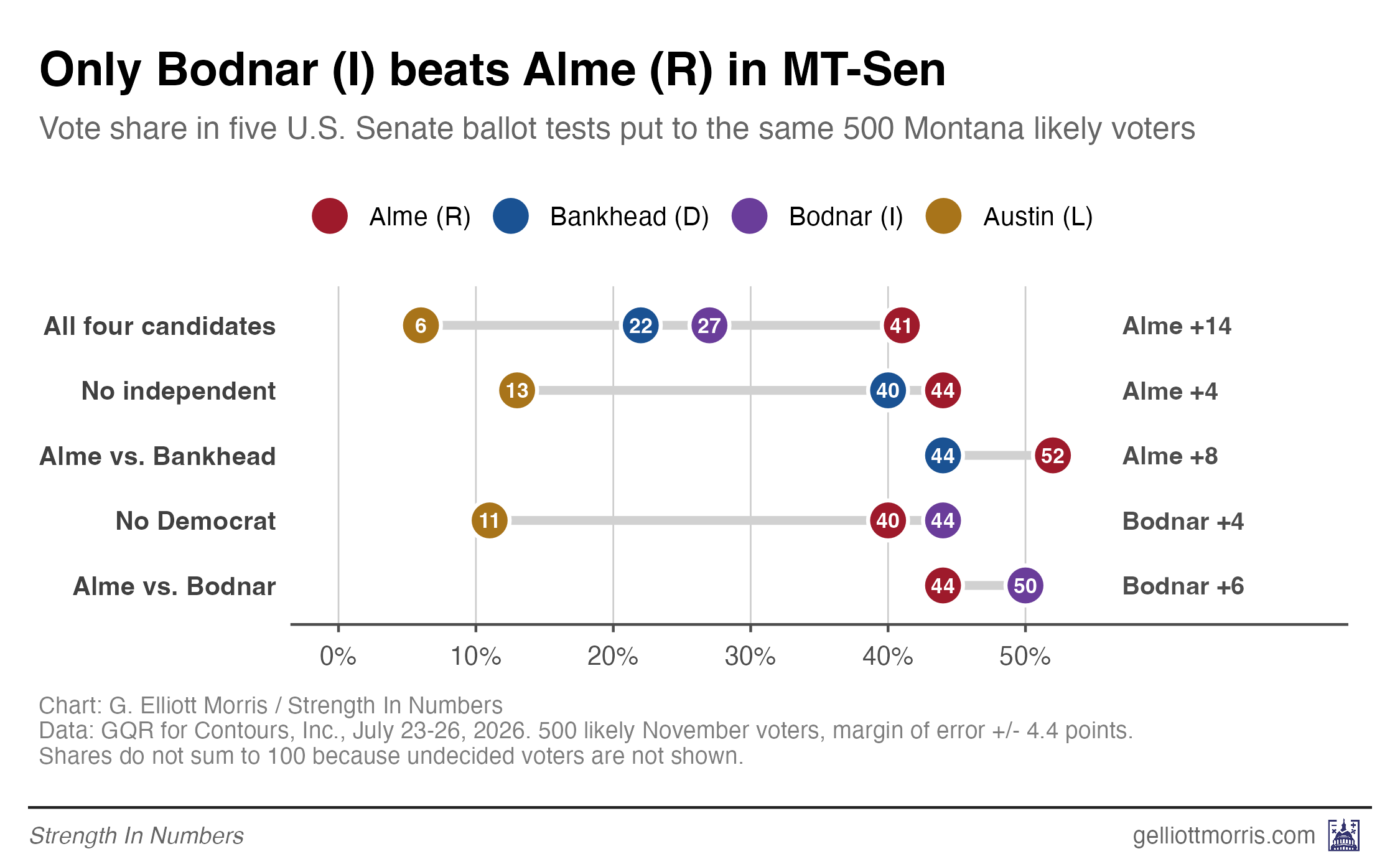
The upshot of the poll is that Bodnar beats Alme in every configuration where Bankhead isn’t on the ballot. Bankhead, on the other hand, loses in every configuration. The anti-Alme vote in Montana is big enough to win the state, but only if voters don’t view the race as the usual D-vs-R choice — and only if the Democrat and independent don’t split the vote.
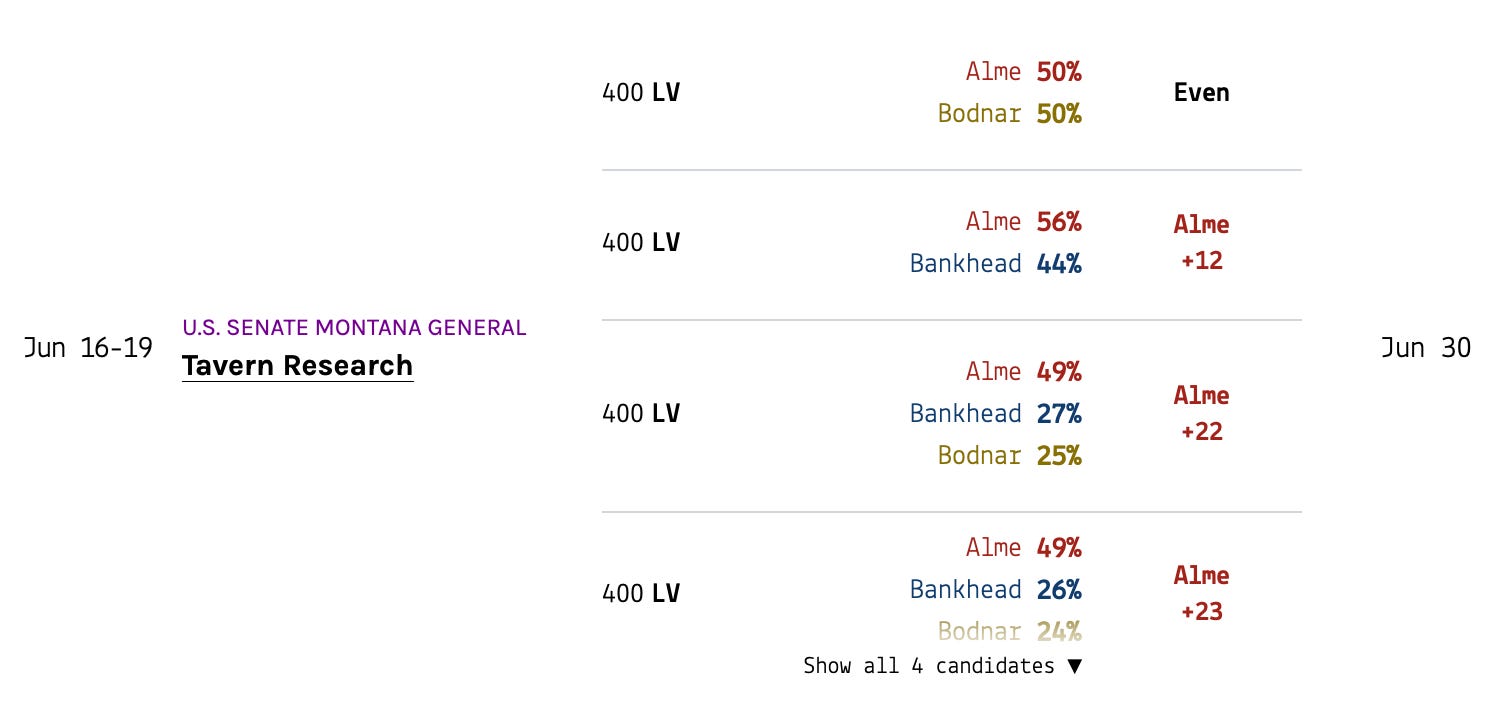
The poll was paid for by Contours, a non-profit, and conducted independently by GQR. It is linked at the bottom of the article. For the record, this is not the first poll to show Bodnar doing better in a head-to-head vs Alme than Bankhead:
I’m delaying the usual premium Deep Dive to Thursday this week to bring these results to SIN subscribers before anyone else sees them. The poll dovetails nicely with two things I’ve written about before here: the need for Democrats to think creatively about how to defeat Republicans, and what multiparty democracy would look like in practice in America.
This post is free to read, but if you want to support independent data-driven political journalism, become a paying subscriber and get early access to polling data and premium analysis at least once weekly.
Do you want your party to win or the other one to to lose?
One way to think of this poll is as prompting the following question: What do you want more, for a Democrat to win or a Republican to lose? People are used to consuming polls as evidence for their side rather than against their major opponent, but in a system with more than two parties, the latter choice is just as legitimate.
The tradeoff is stark once you put it in probabilistic terms.
I took the historical dataset of polls compiled by my colleagues over at 50+1 and pulled every survey of a U.S. Senate general election taken between 60 and 120 days before Election Day since 2014 — nearly 600 polls across 93 races — and compared each one to the November results. The average error of these polls, in vote margin, is 7.2 points.
We can use that to calculate the probability that any of the current Montana candidates would win the November general election, given their leads in the various hypotheticals of this GQR poll. Do that, and you get the following probabilities that Alme loses his seat:
All four candidates (the ballot as it exists today): 3% chance Alme loses
Alme one-on-one against Bankhead: 13%
Bankhead and the Libertarian, no Bodnar: 29%
Bodnar and the Libertarian, no Bankhead: 71%
Alme one-on-one against Bodnar: 80%
What this polling is telling us is that the single highest-leverage action anyone can take against Kurt Alme is to get Bankhead to drop out. If you read the numbers above in the most generous possible way for Bankhead, Seth Bodnar is 42 points more likely to beat Kurt Alme than she is.
For Democrats, this is just the unfortunate reality of an electorate that is sorted by party. As I wrote in June, Montana Democrats aren’t losing this seat because they picked the wrong nominee or ran the wrong message; They’re losing it because the party is viewed too negatively to win in deep red states. And the drag on vote share that this toxic brand causes is not only a product of one candidate’s views or identity, but an irreducible fact of the candidate’s association with the party. Former Democratic Senator Jon Tester lost in Montana in 2024 by essentially the same margin Bankhead trails by now, and he was by definition someone who fit the profile of a blue lawmaker in a red state.
The partisan heuristic voters are using when evaluating candidates is just that strong.
If Democrats stand down and let their voters flow toward the independent candidate without that toxic association, the probability of the Republican losing rises from 3% to 71%.
If, on the other hand, Bankhead stays in the race, she is actually costing the Democrats a potential win at the chamber level. That’s because by depriving Republicans of a seat in Montana, a Bodnar win would increase the probability of Democrats controlling the Senate.
Here’s some light math: Democrats and their allies currently control 47 U.S. Senate seats. Because JD Vance breaks ties, Republicans keep the Senate at 50 seats while Democrats need 51. So Democrats have to net four seats this November to gain control of the chamber.
That is, unless Bodnar takes a Republican seat. He wouldn’t count as a Democrat, be he also wouldn’t count for Republicans. In theory, if he walks onto the floor in January and votes for neither party’s organizing resolution, the Senate is left with 99 partisan senators — and since 99 is an odd number, there would be no tie for the Vice President to break. This is the same way Osborn winning in Nebraska helps Democrats.
So long as Bodnar and/or Osborn don’t end up caucusing with Republicans, this means Democrats could organize the Senate with 50 seats instead of 51. A victory for these independents thus directly increases the chance Democrats win the Senate.
So, paradoxically, by standing down their candidate in Montana, Democrats actually increase their chance of victory nationally.
America’s parties should embrace electoral “pacts”
In my recent podcast interview with Ben Wikler, former chair of the Democratic Party of Wisconsin, we talked over some out-there ideas for Democrats could think creatively about how to beat Republicans. In a state as red as Montana, with a viable independent candidate, simply not running a candidate is a better option than most.
The evidence suggests this strategy can work. In the 2024 election, independent candidate for Senate in Nebraska Dan Osborn came within 7 percentage points of defeating incumbent Senator Deb Fischer, who has held the seat since 2013. Osborn won 46.5% of the vote, and there was no Democrat on the ballot. Put that in context. A Democrat hasn’t cracked 42% of the vote in a presidential election in Nebraska since 1964, hasn’t won a Senate race there since 2006, and hasn’t won a race for governor since 1994. Osborn cleared the modern Democratic ceiling there by five points — the same year Kamala Harris lost by 20.
Osborn is running again this year, and every public poll of the race has been a statistical tie, with the most recent putting him up 5. Nebraska Democrats endorsed him back in August 2025; the Democrat who won the primary anyway filed to leave the general election on July 17.
If all of this feels vaguely unorthodox, you should know that’s a particularly American reflex. Parties in other democracies negotiate exactly these deals, typically called “pacts,” to give candidates from parties that share more of their interests a better shot at beating their true rivals.
In the United Kingdom in 2019, for example, Nigel Farage instructed candidates from his Brexit Party to stand down in 317 Conservative-held seats rather than split the Leave vote. In France’s 2024 legislative elections, more than 200 candidates from the left-wing New Popular Front and Emmanuel Macron’s Ensemble withdrew from three-way runoffs within days of qualifying for them, specifically to keep the far-right National Rally from winning a majority.
It is not completely fantastical to imagine a world where Democrats don’t run candidates in ruby red states and instead let independents or third-party candidates take a shot. But the party must decide what its ultimate goal is. If it is to run a Democrat in all fifty states, then Bankhead is their only choice. But if it’s to defeat Republicans, the path forward is clear: To maximize the chance the Republican loses, the Democrat should drop out.
Link to poll PDF from GQR:


Great article. In red states, traditional democratic party political strategies are not working. Its time to embrace this strategy of defeating the republican, not neccesarily the demo winning.
Your proposition here most likely also holds true in Deep Red South Dakota. Brian Bengs is running there as an Independent for Senate. His newsletter arrives in my email box where he described how in South Dakota a voter can AGREE with all your policy positions but STILL reject you SOLELY on the basis of being a bonafide Democrat. (It does not say much for the fine folks of South Dakota, but we need to accept this reality.). Bengs ought to know - he ran as a Democrat in the past and lost. These Independents might be the required "bridge" democracy loving politicians need to eventually "convert" these voters. It would be VERY intriguing to see an overlay of Fox News & Sinclair network viewership (e.g "Where is your source for news and information?") on the entire country. One last point: Elliott YOU KNOW how I feel about the "SIN" acronym! How about calling us "Numbers Subscribers"??