


Abdul El-Sayed beat Haley Stevens by a point and a half in Michigan’s Democratic Senate primary on Tuesday. Some were quick to brand his victory as, ackshually, a defeat for the left, since he underperformed his polls. But in politics, what ultimately matters is your wins and losses — and El-Sayed beating Stevens is undoubtedly a win for the left. El-Sayed’s victory also comes after a dozen other prominent victories for left-wing and Democratic Socialist candidates over the past year.
Next Tuesday, the left has another shot at a big win in the Wisconsin Democratic primary for governor. There, Francesca Hong, a state house representative from Madison and member of the Democratic Socialists of America, leads the polls in the race. (Not all left-wingers are created equal.)
What politicians such as El-Sayed, Hong, Zohran Mamdani in New York City, and others have in common is that they’re running against the current political and economic system, advancing a theory for a new economically populist politics that threatens establishment Democrats as much as billionaires and corporations. It’s the playbook of Bernie Sanders and Alexandria Ocasio-Cortez, but supercharged with backlash to Donald Trump’s second term.
Look at the polls, and you’ll find this anti-system sentiment is pervasive on the political left, and highly correlated with support for the left-wing candidates winning Democratic primaries across the country this year. That's this week’s Friday column.
This is post is free to read, but if you want to support my independent data-driven political journalism and get premium posts like these sent to your inbox 2x a week, become a paying subscriber to Strength In Numbers today. Members also get early access to data products, a private community on Discord for our political data nerds, and an ad-free newsletter experience.
If a paid subscription is out of reach, the next best thing you can do is to share this article with a friend. Organic recommendation is the #1 driver of new readers here at Strength In Numbers.
Every month for our Strength In Numbers/Verasight poll, we ask the same question about voters’ evaluation of the current direction of the country. Instead of the typical responses of “good track” and “bad track,” we offer respondents these options:
Things are going well in America and no major changes are needed
Things could be going better
Things are going poorly, and major, disruptive changes are needed
Not sure
Pooling all seven of our 2026 polls together (11,260 adults), we can break down the “major, disruptive changes” bloc by party identity and self-described ideology. Doing so reveals stark differences by both party ID and ideology in the sentiment that the political system needs to be remade:
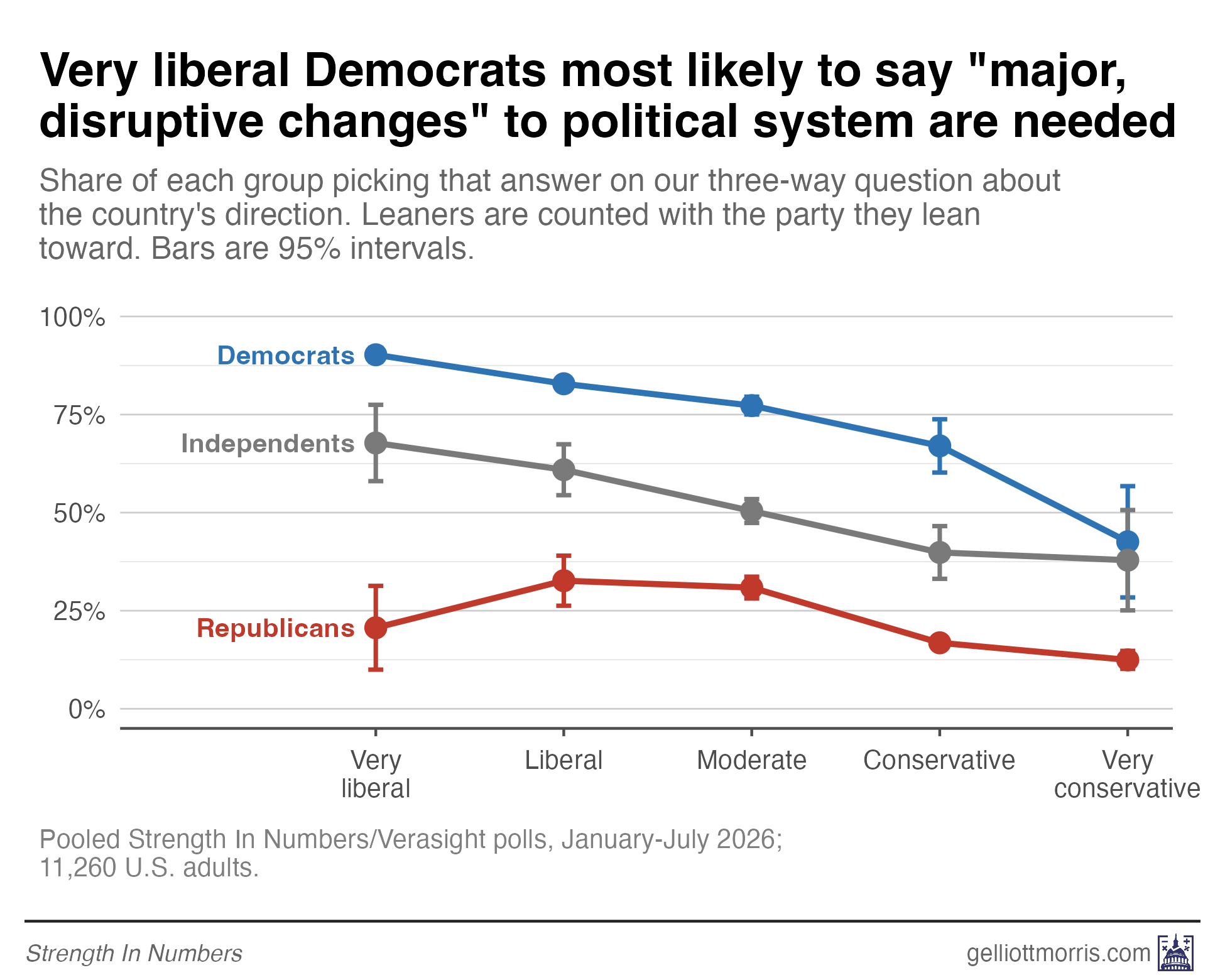
Among Democrats, 90.2% of the people who call themselves “very liberal” say the country needs “major, disruptive changes” to get back on track. That percentage declines as you move right on the ideological scale: 83% of self-ID’d liberals agree, as do 77% of moderates and 67.0% of conservatives.
The relationship between ideology and “tear down the system” mindset is just as high for independents who don’t lean toward either political party, but agreement takes a uniform step down. The comparative percentages for independents run from 68% agreement at the very left down to 37.9% at the right. Among Republicans, agreement peaks at 33% among liberals, holds at 30.9% among moderates, then falls off a cliff to 17% and 13% among conservative/very conservative voters.
The partisan differences here indicate many Americans see this question as one of partisan loyalty, or perhaps of loyalty to Donald Trump. But the fact that the ideological curve persists within party reveals a residual connection with anti-system thinking.
Anti-system voters favor progressive figures
The chart above is important because of what it implies about the current infighting in the Democratic Party. The “tear down the system” sentiment is a key part of the DSA appeal to normie voters.
We can observe, statistically, that this anti-system sentiment is predictive of supporting left-leaning candidates, even controlling for party, ideology, age, and other variables.
Our June poll of 2,087 adults, fielded June 17-22, asked respondents both the above question about the direction of the country and to rate 19 people/party groups on a “feeling thermometer” scale running from 0-100 (0 = cold, you hate the person; 100 = warm, you loooove them).
I use this data to compare how Democrats rate different political figures based on how they’re feeling about the direction the country is headed. The chart below visualizes the gap in feelings toward each figure between Democrats who say the country needs major changes and those who say either that “things are going well in America and no major changes are needed” or that simply “things could be going better.”
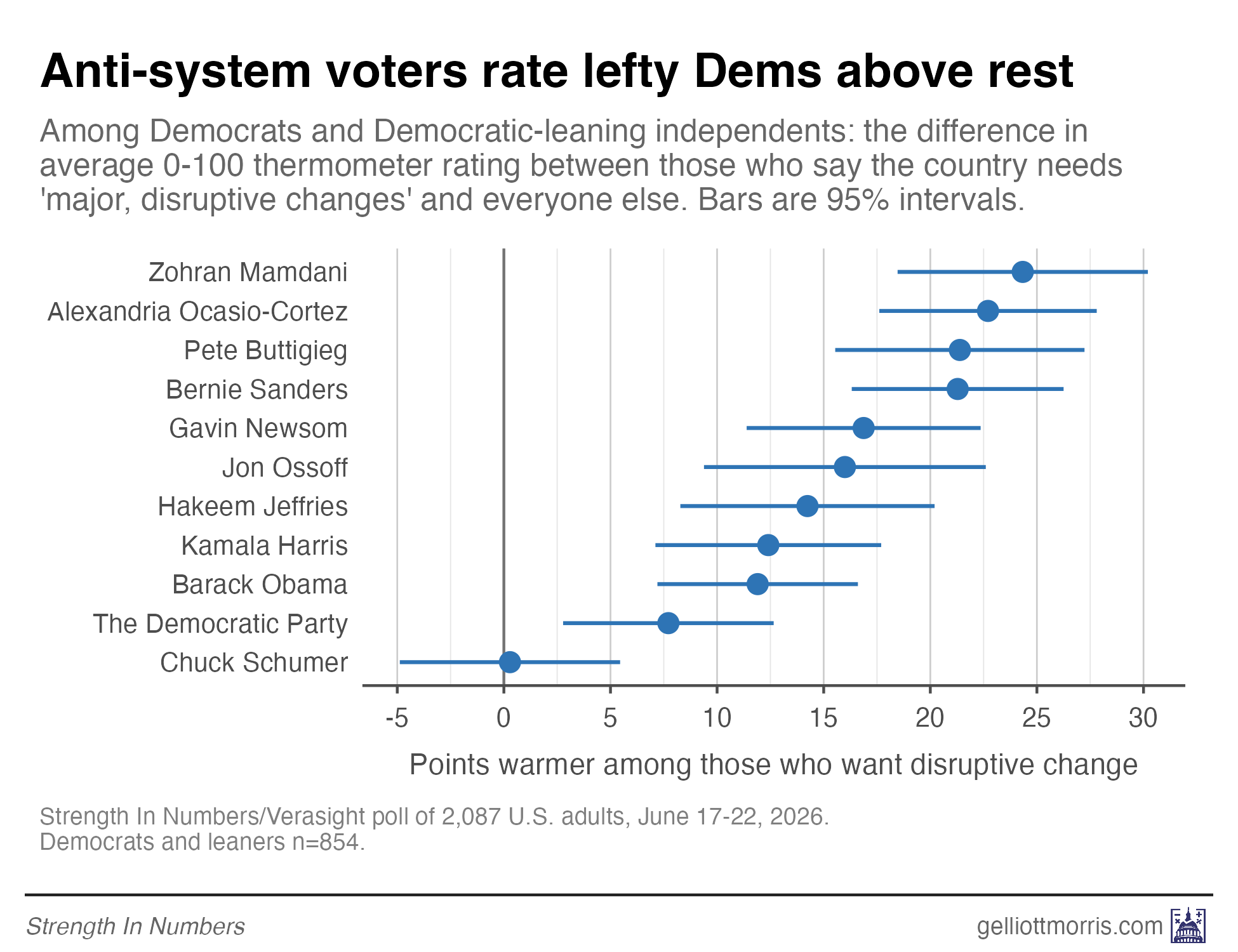
The way you read this chart is that as a dot moves to the right, evaluations for that figure are higher (”warmer”) among Democrats who want “major changes” than other Democrats. So, for example, wanting the system torn up makes a Democrat warmer toward Zohran Mamdani by 24 points. Those anti-system voters also rate Alexandria Ocasio-Cortez warmer by 23 points, Pete Buttigieg by 21, Bernie Sanders by 21, Gavin Newsom by 17, Jon Ossoff by 16, Hakeem Jeffries by 14, Kamala Harris by 12 and Barack Obama by 12. The Democratic Party itself gets a 7-point boost among anti-system voters. Chuck Schumer scores a +0.3 points, within the margin of error of zero.
Two things to note here: First, there is a general skew among anti-system voters toward Democratic politicians today. This is probably part of the general anti-incumbent — that is to say, anti-Republican — mindset in politics today. We’re in a wave election where Democrats are very likely to win the House and might win the Senate. It’s no surprise that voters who think things aren’t going well like Democrats, on average.
I ran the same comparison on Republicans, and there the “direction of country” question turns people against Trump and other GOP leaders:. Republicans who want disruptive change rate Trump 37 points colder than other Republicans do, Vance 34 colder and the Republican Party itself 26 points cooler. The only Republican-ish figure who is not rated more negatively by anti-system voters is Tucker Carlson.
Yet there is a clear tendency to additionally rate highly those left-leaning Democrats who are running campaigns for populist economic change higher than other Democrats. Anti-system voters rate Mamdani and AOC about 10 points higher than Barack Obama and the Democratic Party.
Yes, I ran a regression on this
The obvious objection to the above analysis is that it’s just another way of segmenting voters by ideology. By looking at Democrats and grouping by anti-system orientation, haven’t I just selected a bunch of people who call themselves progressives, as shown in the first chart? That’s totally fair, but to this objector I say: we can control for that!
I ran a linear regression predicting feeling thermometer ratings for Zohran Mamdani as a function of (1) someone’s political party, (2) their self-described ideology, (3) their age, and (4) their anti-system orientation (whether they said the country needs “major, disruptive changes”).
Among the adults who rated Zohran Mamdani on a 0-100 scale, being anti-system alone is worth 45 points. If you then add political party to the regression (as per the chart above), that coefficient falls to +21. If you add controls for ideology, it falls further to 17, where it stays even controlling for age. (For the nerds: This effect is significant at the p=0.001 level).
Among Democrats specifically, age does nothing at all once you know someone’s ideology and whether they want the system torn up.
While this is not a causal analysis — I can’t say that becoming anti-system makes you a bigger fan of Mamdani — I can tell you that being anti-system is additionally predictive of liking left-wing candidates. In other words, even among very liberal Democrats, being anti-system is still predictive of supporting figures like Zohran Mamdani.
I can’t honestly tell you this is the single reason why Abdul El-Sayed won his primary Tuesday night. It’s one national survey with no direct vote-choice question, and even with a regression model, we aren’t evaluating the counterfactual.
But what I can say is that the rise of left-wing candidates in the U.S. over the last year seems associated with the increasing frequency with which Americans express anti-system attitudes. Given the trajectory of the country’s political system (away from, not toward, the ability to solve problems), figuring out how to campaign on that — regardless of ideology — is likely worth a premium.
Our August Strength In Numbers/Verasight poll goes into the field on Wednesday, and we’ll be asking Democrats and Republicans even more questions about how they feel about their leaders and what they want their parties to stand for. Particularly among Democrats, we’ll be asking directly whether voters think their leaders are doing enough to oppose Trump, and how important that is to their vote.
If you get value out of data-driven coverage of polling and public opinion, the best way to support this work is with a paid subscription to this newsletter.


I was interested in this because, to my mind, this is what Pete Buttigieg has been talking about all over the country for more than a year. While I like him, I didn't know whether or not the actual content of what he was saying was getting through in this fractured media environment, especially given his extremely calm manner. So I was pleased to see that it did show up in your "Anti-system voters rate lefty Democrats above rest," with him in third: the chart with that title lists Mamdani at 24, AOC at 23, Pete at 21, Sanders at 21, and so on.
The problem I continue to see with these voter responses is a potential conflation of two unrelated variables. We all know about the left/right spectrum for policy positions, but earlier this year Elliott did some groundbreaking work showing that there is another spectrum that’s orthogonal to the first—the weak/strong axis. It seems to me that voters are assuming that because many Progressives are quite vocal about their proposed policies that somehow equates to strength. I’m not sure that’s accurate.
Most of the candidates from whom I’ve heard are talking about legislation they’d like to see passed. However, I have yet to hear anyone, ranging from centrists to the DSA types talk about precisely how they’d pull that off. We’re still facing a Supreme Court with six far-right ideologues who would be ready to quickly declare any of the left wing’s policies that got codified into law unconstitutional. That’s precisely what we saw during the Biden Administration and there is no reason to think the justices will act differently just because we have a different Democrat sitting in the White House. That’s preceded by the brick wall of the 60 vote cloture requirement in the Senate (aka the filibuster) which would stop anything emerging from the House in its tracks. These firewalls won’t spontaneously evaporate because the White House has a new occupant and there are some new faces in Congress.
My litmus test for an effective would-be politician is increasingly one who not only talks about what they want to accomplish, but has concrete ideas on how they’d surmount these very real-world roadblocks. For me, that defines Elliotts weak/strong spectrum and is really where we need to focus a large part of our attention as the first of our two critical elections draws closer.