


This article reports results from the September 2026 Strength In Numbers/Verasight poll. A methodology description is included at the end of this article. You can find toplines for this as well as our previous poll releases at the Strength In Numbers polling portal.
Paying subscribers to Strength In Numbers have access to additional visuals and a full archive of crosstabs, and can suggest questions for future polls in the comments section below!
Forty-two days before Election Day, and as tens of thousands of early voters have already cast their ballots, our new Strength In Numbers/Verasight poll finds President Donald Trump and the Republican Party at their lowest point in the last 18 months.
In our new poll, 33% of Americans approve of the job Donald Trump is doing as president and 63% disapprove, a net rating of −30 (using unrounded approval figures) and the worst reading in the 16 waves of this poll since May 2025. The previous floor was −26 in April.
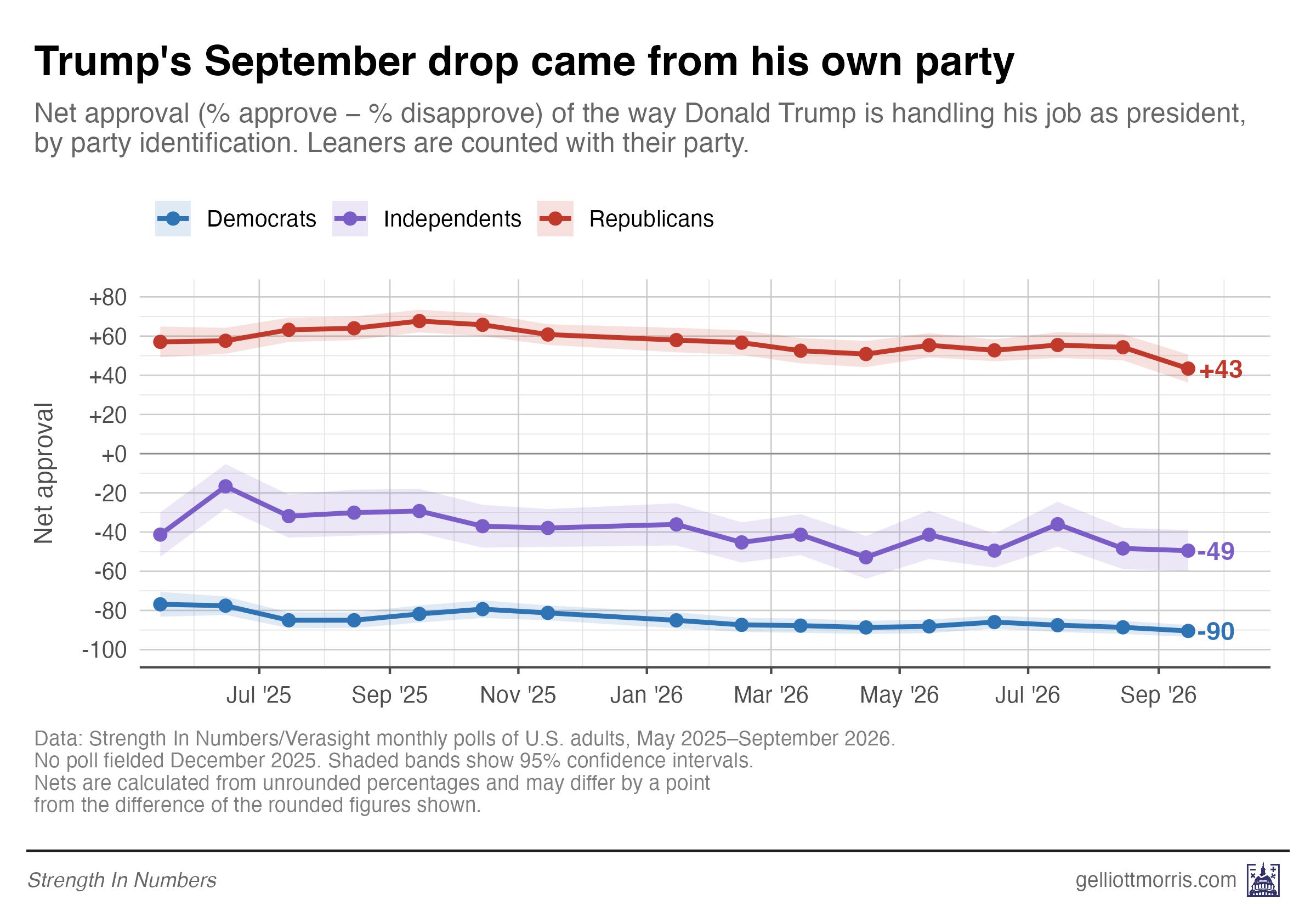
While our past surveys documented that the president has lost significant ground with non-college-educated white voters, independents, non-voters, Hispanics, and young people, this month’s survey reveals Trump slipping significantly with his own party. The president’s net approval rating among Republicans and Republican-leaning independents fell from +54 in August to +43 this month, with 71% approval to 27% disapproval. That’s an 11-point drop and the lowest we have recorded.
Democrats (−90) and independents (−49) barely moved, suggesting GOP holdouts may be responding more negatively to recent crises like the escalating war in Iran, resurgent increase in gas-price inflation, or the president’s pledge to give $5,000 to every U.S. adult if his party wins the midterms.
In this poll, Democrats have a 10-point lead among likely voters in the “generic congressional ballot,” which asks voters which party’s candidate for U.S. House they’ll vote for in their local House district.
Below, I report full results from our monthly Strength In Numbers/Verasight political tracking survey. That includes a record low for Trump on handling prices and findings on voters’ trust in each party to handle various issues, now including artificial intelligence. We also asked Americans whether they are better off than they were four years ago, what they think of Trump's $5,000 check attempted bribe, and who should fund new electrical infrastructure needed for AI data centers.
Headline poll findings
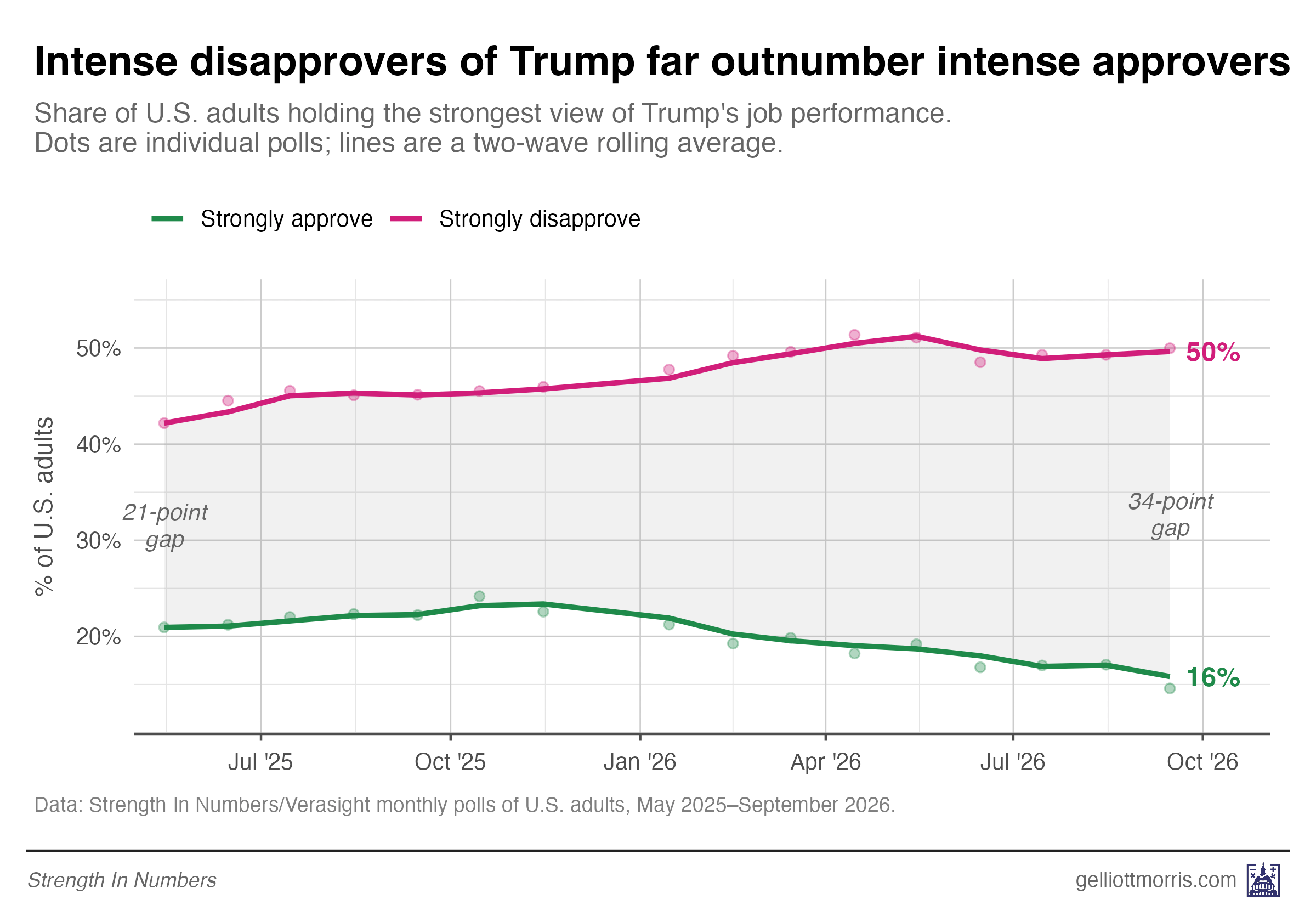
Job approval: 33% approve / 63% disapprove (net −30 before rounding), down from −24 in August and below April’s −26 floor. Among adults, 50% strongly disapprove vs 15% who strongly approve — a record 35-point intensity gap in the president’s approval.
Republicans: net approval among Republicans and Republican leaners fell from +54 to +43, the lowest in the tracker. Among 2024 Trump voters, strong approval is 35%, down from 53% in May 2025.
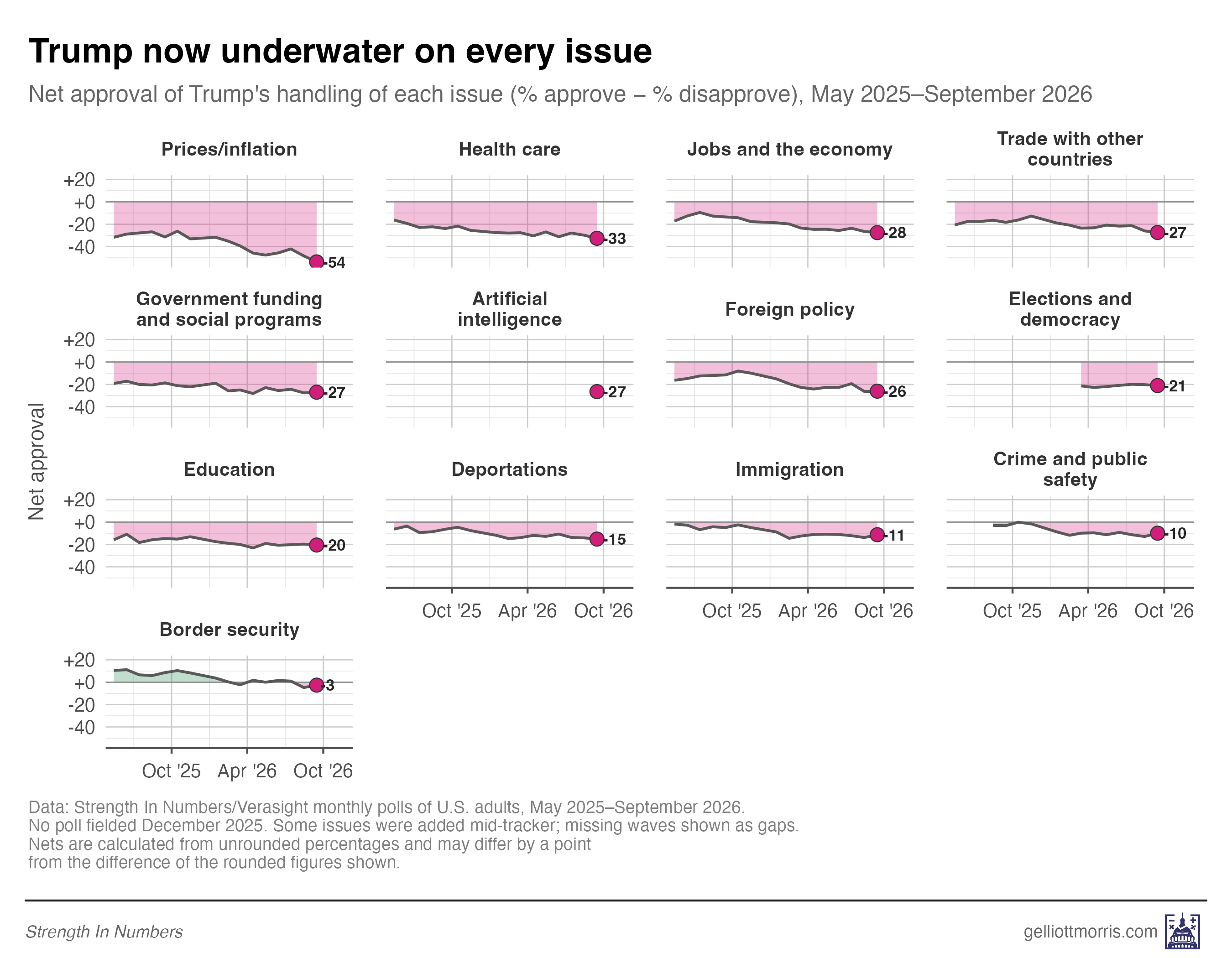
Prices: The president now has a net approval on prices of −54, a new record low for any issue, down from −48 in August. 21% approve, 75% disapprove.
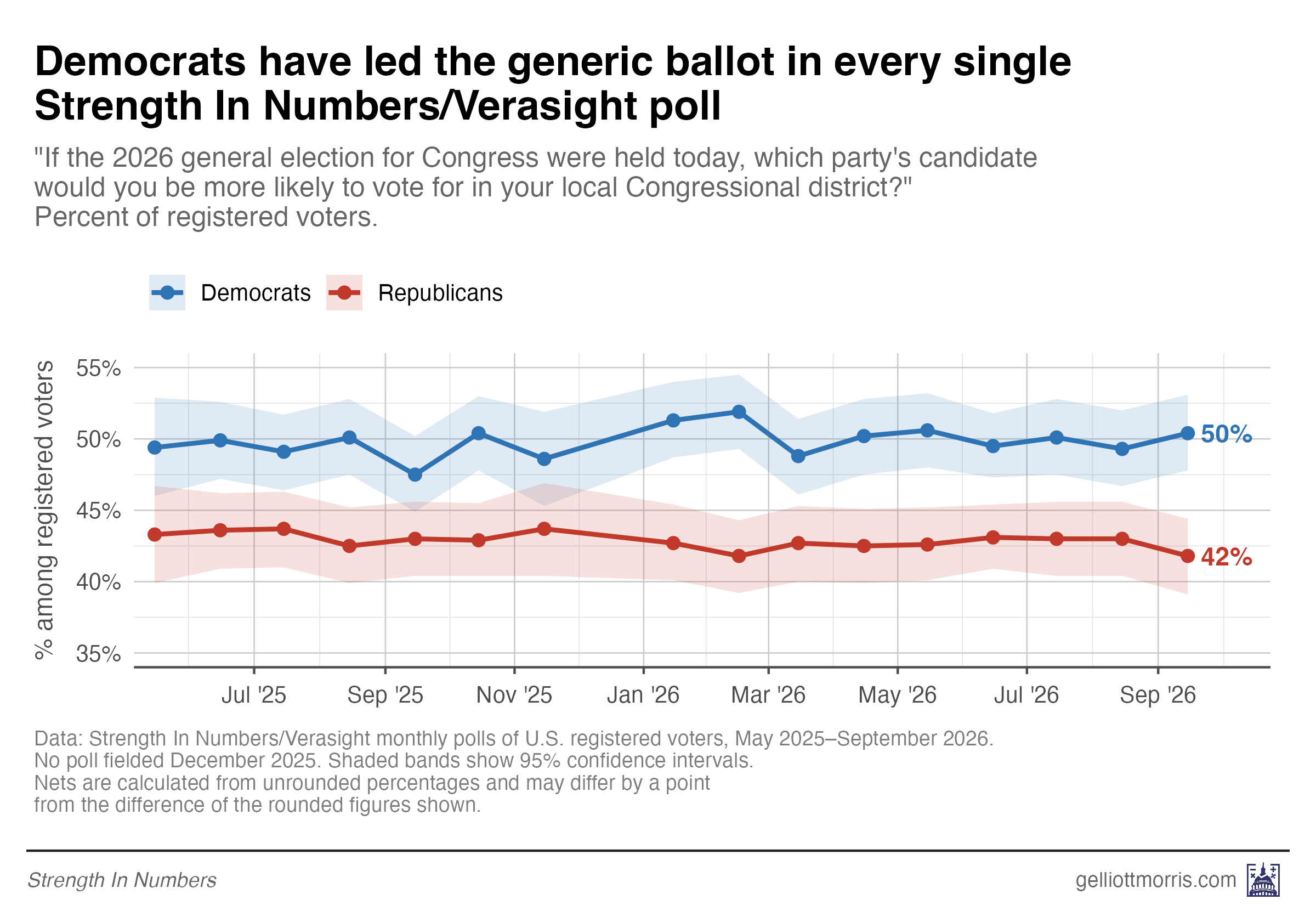
Generic ballot: Democrats lead 50–42 among registered voters (D+9 unrounded), 52–42 among likely voters (D+10), and 55–42 (D+12) among registered voters who say they will definitely vote. Democrats have led in all 16 of our polls since May 2025.
Party trust: Democrats lead on 10 of 13 issues, set series highs on five, and pull ahead of Republicans on trust to handle immigration (D+1) for the first time. They lead by 11 on handling of each voter’s own most important problem (45–35).
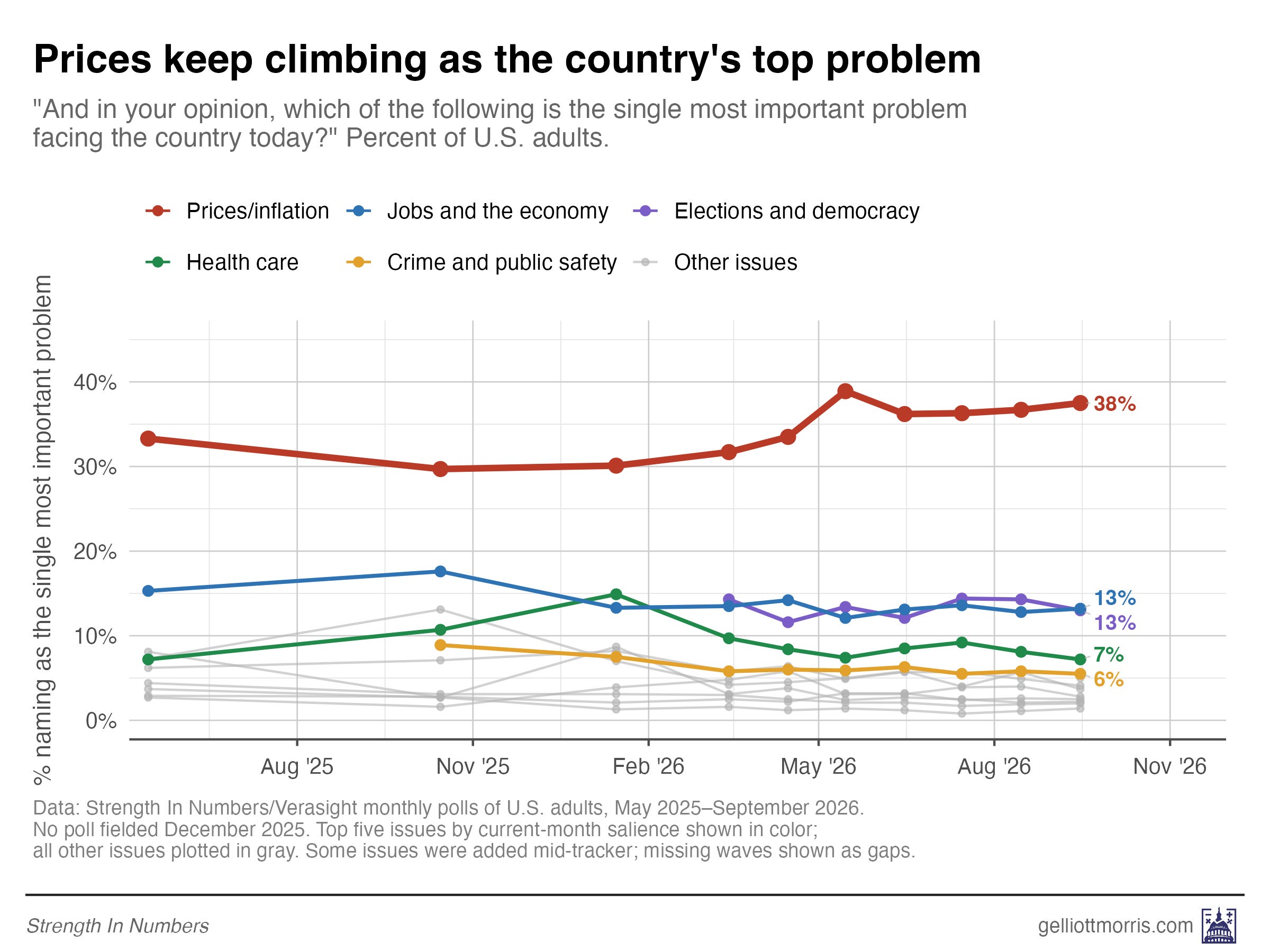
Top problem: 38% name prices/inflation the single most important problem facing the country; 59% put it in their top three.
Better off than you were four years ago? 26% say they are, versus 45% who say they’re doing worse. 24% of adults say the country is better off, 58% worse.
Direction of the country: 54% say things are going poorly and major, disruptive changes are needed; just 7% say things are going well.
Strength In Numbers conducts a monthly poll with Verasight asking a mix of political tracking questions and questions sent to us by readers. Subscribe to Strength In Numbers to get future poll results in your inbox, and to be able to submit questions we may use in future polls.
Trump’s approval hits a new low, thanks to Republican defection
In our poll, 33% of adults approve, and 63% disapprove of the job Trump is doing as president, a net of −30 (using unrounded figures), down from −24 in August. That is a new low on all three measures: the first wave under 35% approval, the first over 62% disapproval, and the worst net since our poll began last year.
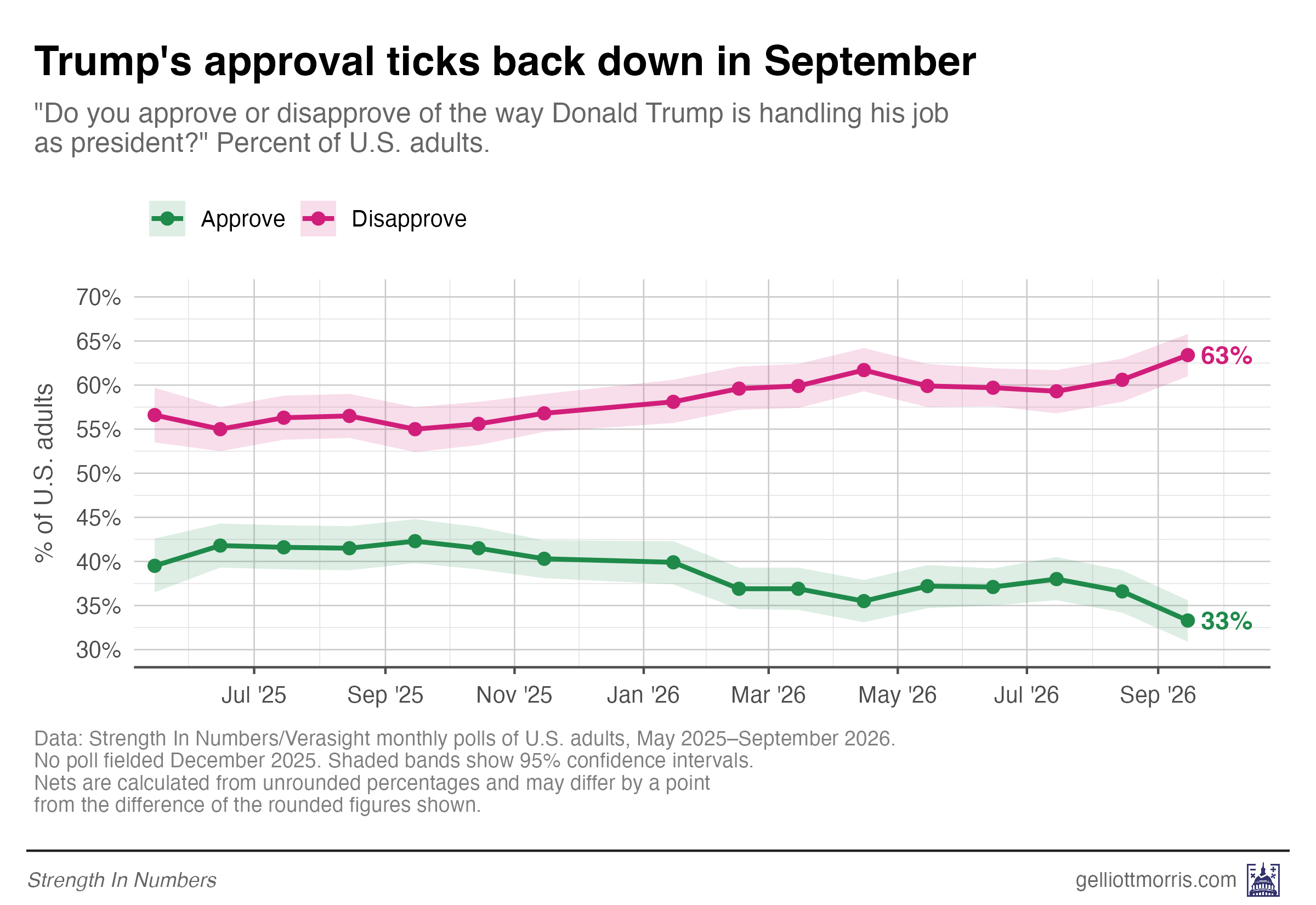
The month-to-month move on the topline is outside our margin of error, as are several important differences by subgroup. Among Republicans and Republican leaners, net approval of the president fell from +54 to +43 (71% approve, 27% disapprove), an 11-point drop outside the confidence interval in movement across previous months in the tracker. Trump’s prior approval among Republicans was +51 in April. Democrats went from −89 to −90 and independents from −48 to −49.
Updating a chart we made for the first time last month, we see there is an increasingly large gap between the share of American adults who strongly approve and disapprove of the president’s job performance. About half of Americans strongly disapprove, a sign of major discontent among the American public.
Trump hits yet another record low on prices
Trump’s net approval on prices and inflation fell to −54 (21% approve, 75% disapprove), the worst number we have recorded for any issue, from −48 in August, which had been the previous record. Five of the 12 issues we have tracked all year are at series lows: prices, health care (−33), jobs and the economy (−28), trade (−27) and deportations (−15).
The one cluster that improved is immigration. Border security went from −5 to −3, immigration from −14 to −11, and crime from −13 to −10, all within the margin of error. Our survey was out of the field before the latest shooting by Immigration and Customs Enforcement in Austin, Texas, this past weekend.
This month is the first time we have asked about approval for Turmp on artificial intelligence. The president starts with a −27 (30% approve, 56% disapprove) approval rating on the issue, with 14% unsure.
Democrats lead the generic ballot for a 16th straight poll, and by 10 among likely voters
Democrats lead the generic congressional ballot 50–42 among registered voters (D+9 unrounded) and 49–41 among all adults in our September poll, up from 49–43 in August and the second-widest lead in the series behind February’s D+10 among registered voters. Across 16 polls since May 2025, Democrats have never trailed the Republicans on the generic ballot. The GOP’s 42% in this month’s survey is a series low.
When registered voters are weighted by their probability of turning out to vote in November, Democrats lead Republicans 52 to 42 (D+10.4), up from D+7.5 in August and the highest since February. The likely-voter screen has added between a quarter of a point and two points to the Democratic margin in every wave since we began asking the turnout question a year ago.
The tightest screen tells the same story. Among registered voters who say they will definitely vote in November, about 73% of registered voters, Democrats lead 55–42, a 12-point margin (D+12.3 before rounding), up from the 9-point lead the same group gave them in August. Just 3% of these voters are undecided.
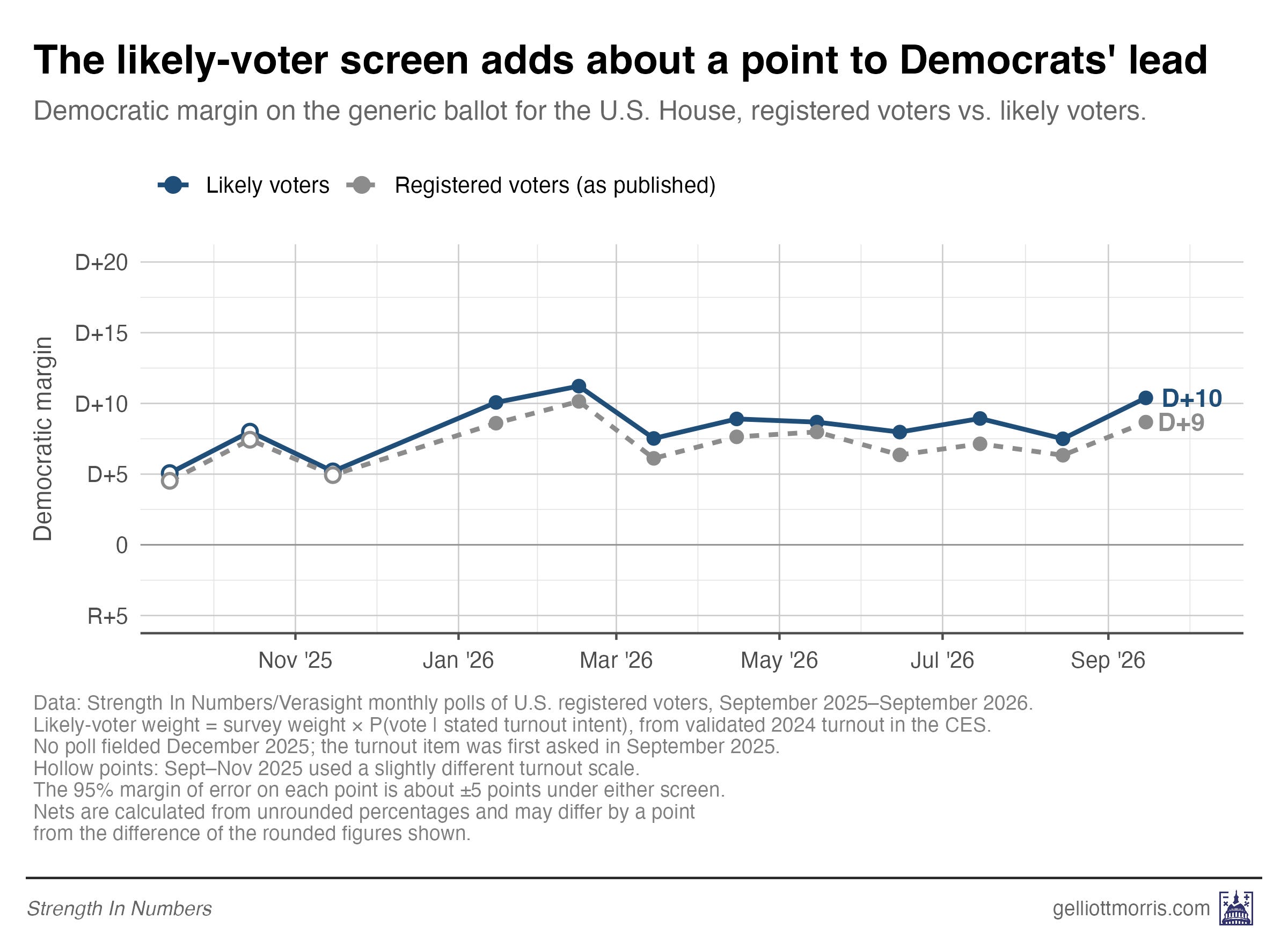
Our LV model translates a respondent’s stated vote intention to a probability of turnout based on the responses and behavior of validated voters in the 2024 Cooperative Election Study.
Democrats lead on 10 of 13 issues and pull even on immigration for the first time
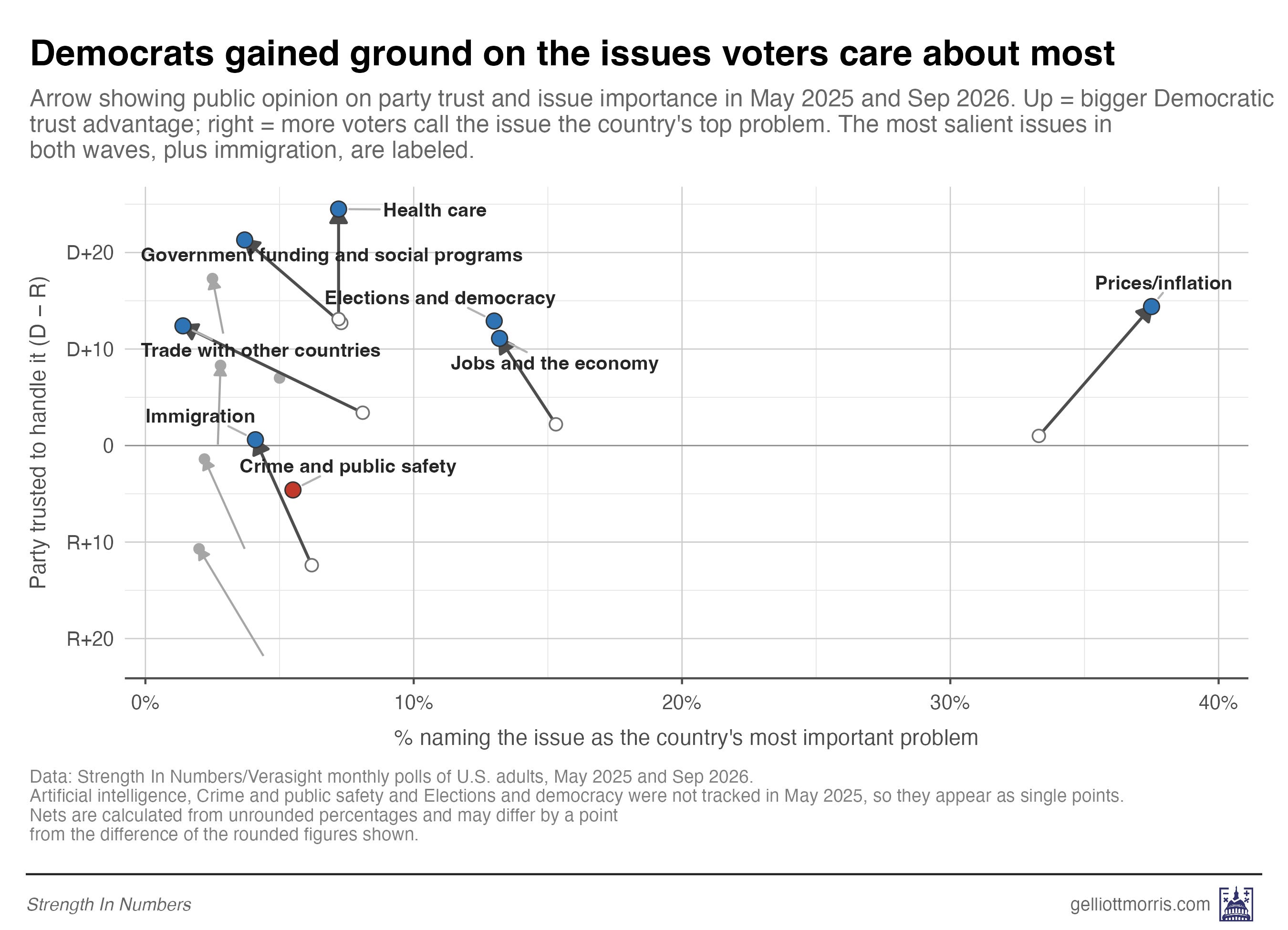
Our new poll also reveals Democrats are trusted more to handle most issues Americans rate as their most important problems.
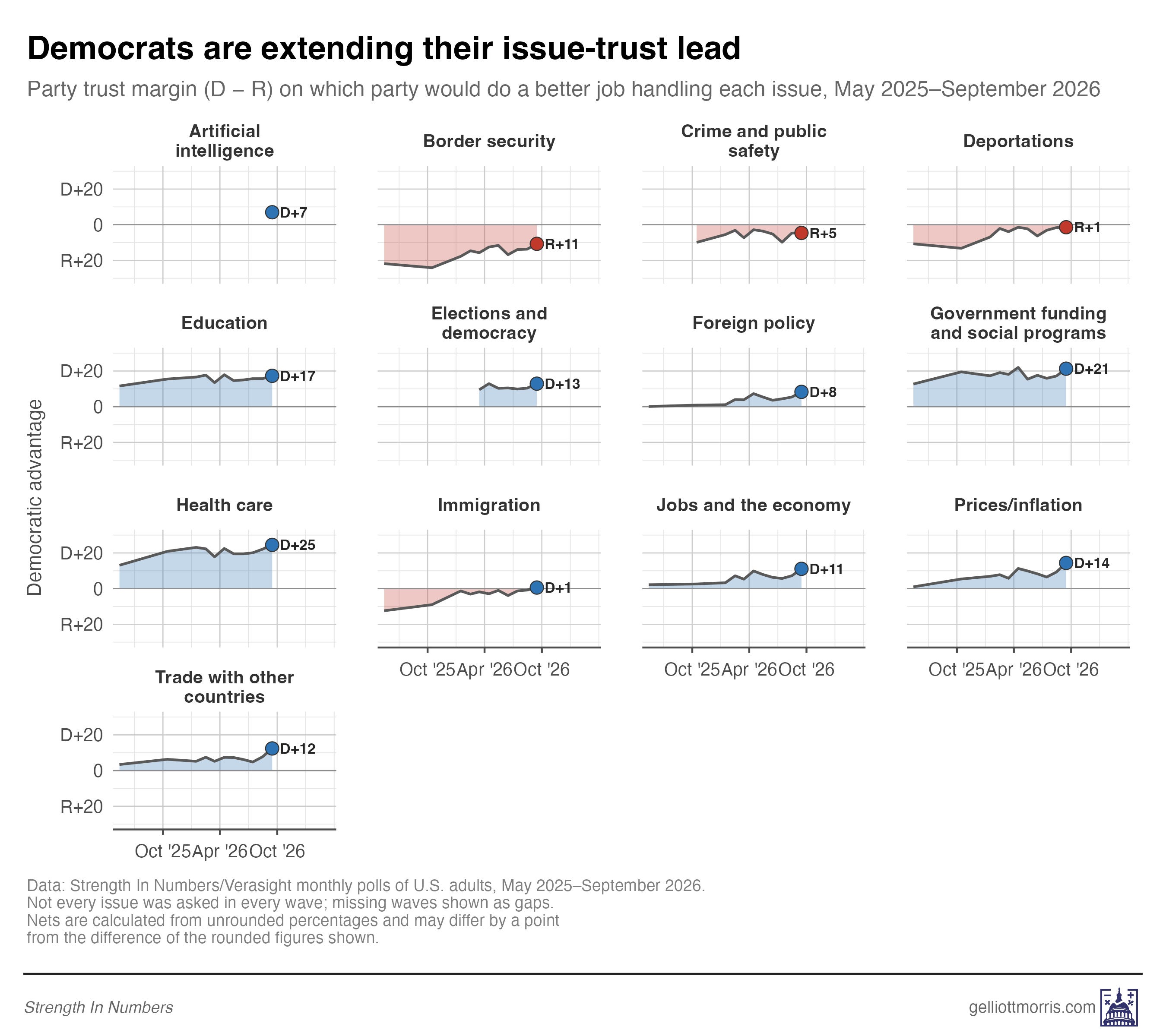
The party is trusted more than Republicans to handle health care by 25 points (a series high), government funding and social programs by 21, education by 17, prices by 14 (a high; the gap was one point in May 2025), elections and democracy by 13, trade by 12 (high), jobs by 11 (high), and foreign policy by 8 (high).
In our first survey including artificial intelligence in the issue battery, Americans trust Democrats over Republicans on the issue by 7 points.
On immigration, Democrats are at D+1 (42–41), the first reading in the tracker that isn’t a Republican advantage; it was R+12 in May 2025. Republicans lead only on deportations (R+1), crime (R+5) and border security (R+11).
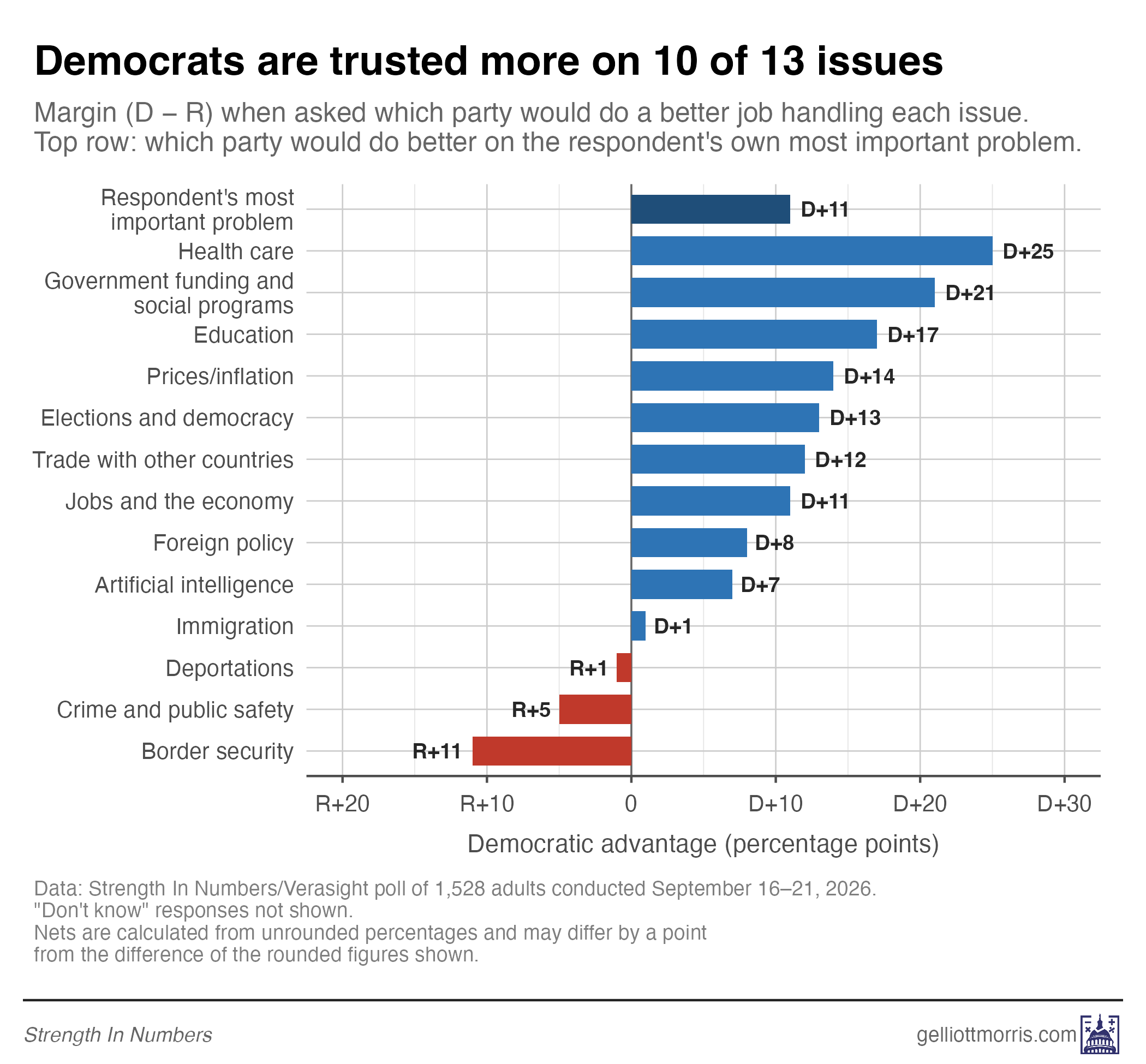
On whichever issue each respondent named as the country’s most important problem, Democrats lead 45–35, an 11-point edge; that lead has run between 9 and 13 points all year.
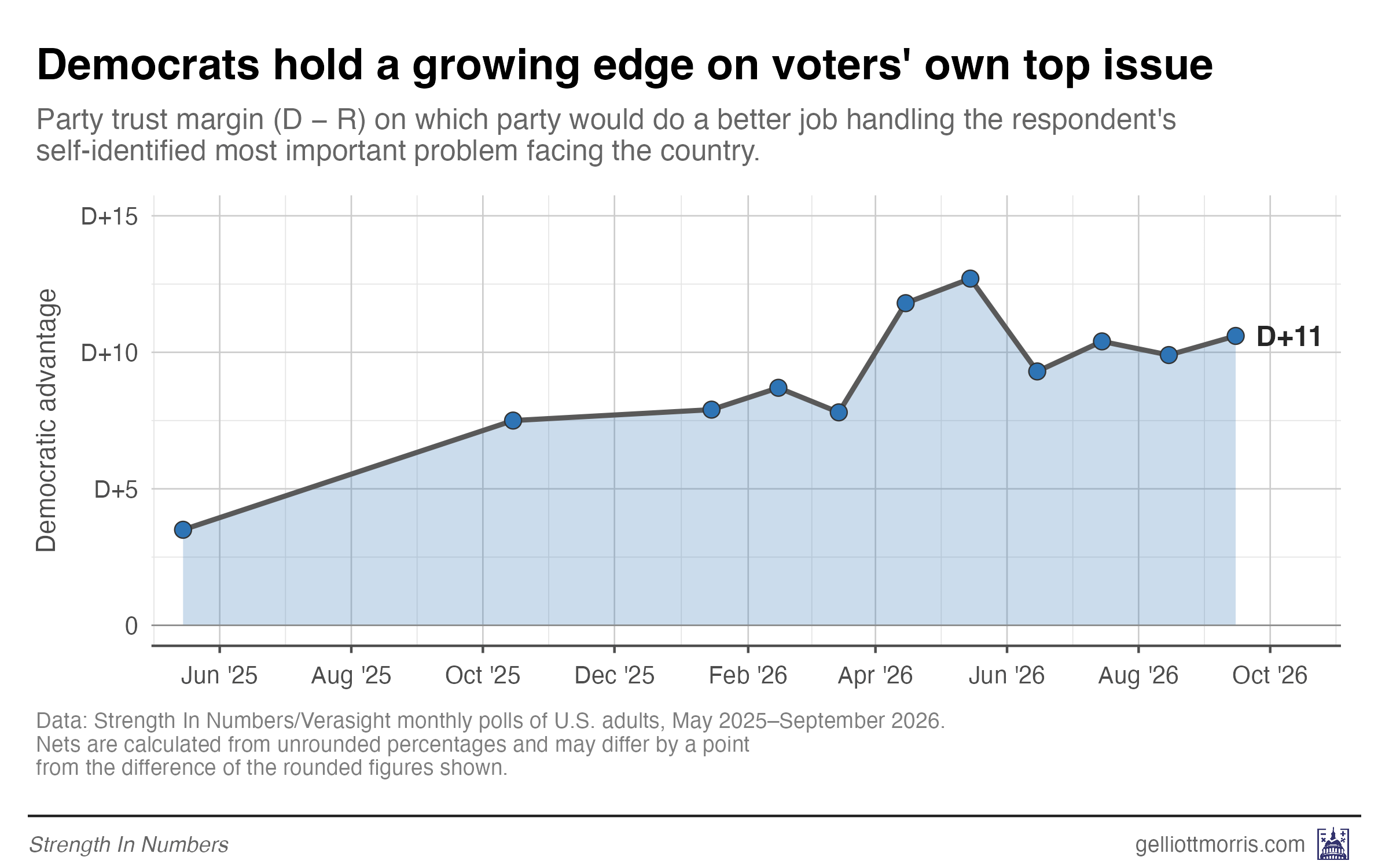
Democrats have gained ground on almost every issue, but especially high-salience issues, since last May. Prices, the country’s top problem by a wide margin, went from a one-point Democratic edge to D+14; jobs and the economy from D+2 to D+11; health care from D+13 to D+25. Immigration, R+12 when we started asking in May 2025, is now even.
If you prefer a time-series chart for just one variable, the graph below shows the party trust numbers for each of the 13 issues we track going back to September 2025.
Prices are still the top problem for most Americans — making Democrats’ continued lead on the consequential in the upcoming midterms.
Overall, 38% of U.S. adults name prices and inflation the single most important problem facing the country, up a point from August and a point shy of May’s record. Jobs and the economy and elections and democracy are tied for second at 13%, then health care at 7% and crime at 6%. Artificial intelligence, asked for the first time, is named by 5%, and 16% put it in their top three, roughly level with crime and a point behind immigration.
Most say they are worse off than four years ago
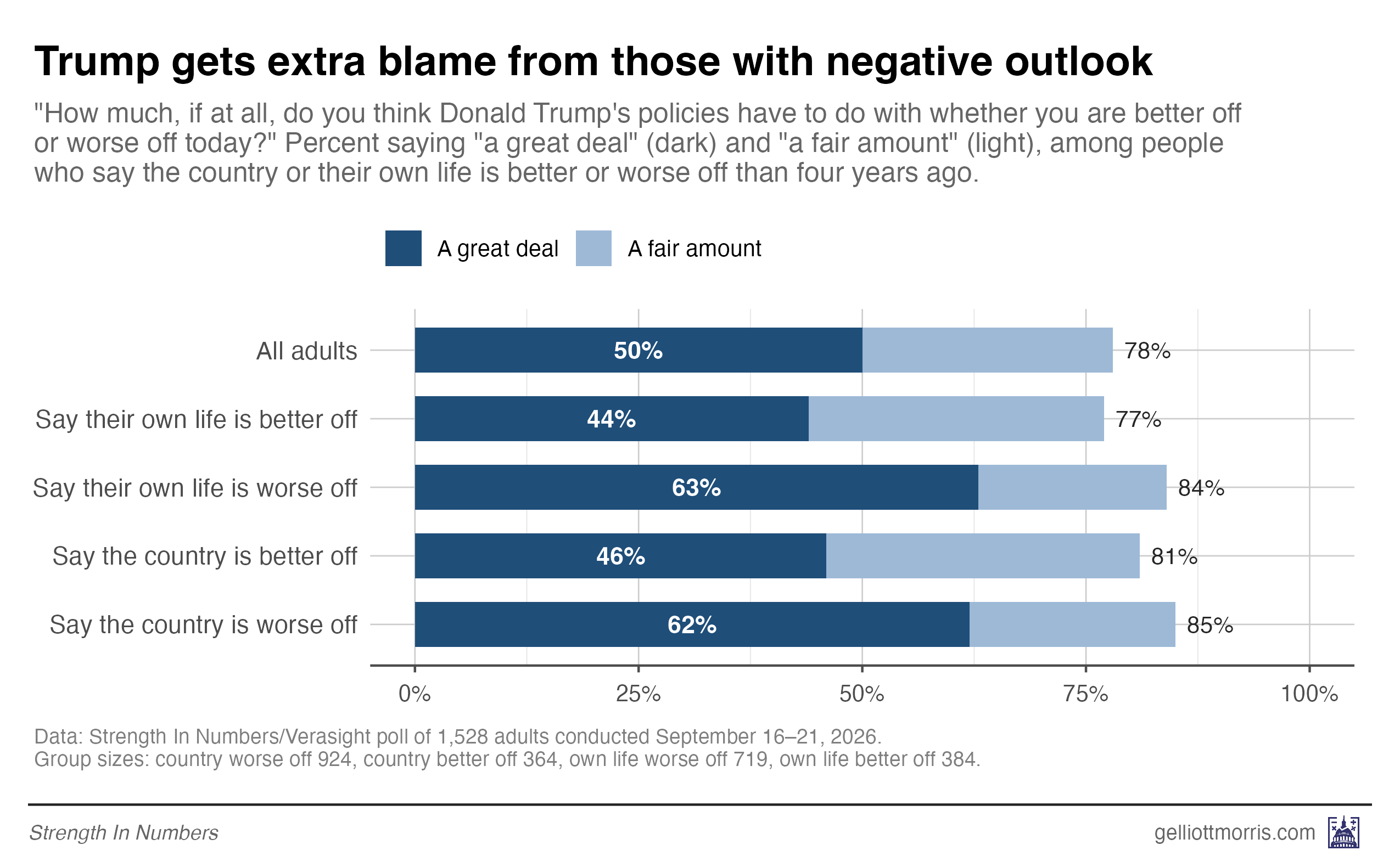
Our new poll also finds 45% of Americans say they are worse off than they were four years ago, compared to 26% who say they are better off. Assessments of the country as a whole are even more negative: 58% say the country is worse off and 24% say it is better off. Most Americans connect these changes to the president, with 78% saying Trump’s policies have a great deal or a fair amount to do with them. Among those who say they are worse off, 63% say President Trump’s policies have had “a great deal” to do with it.
Americans are somewhat more optimistic about the year ahead: 34% expect their own lives to get better and 23% expect them to get worse.
There is also significant demand for changes to the political system. 54% of Americans say things are going poorly and major, disruptive changes are needed, up from 52% in August and 49% in July, and just one point below the high we recorded in April. Another 36% say things could be going better, while just 7% say things are going well. Here, too, we see Republicans becoming less satisfied: the share who say things are going well has fallen from 21% in January to 13% this month.
Reader-suggested questions
Each month, paying subscribers to Strength In Numbers can suggest questions for us to pick from and include in a designated community question block. I usually field at least a few questions from readers. This month we asked three:
Which party cares more about people like you? Democrats 38%, Republicans 26%, both 7%, neither 22%, statistically unchanged since May.
What motivated your 2024 vote? Among 2024 voters, 31% say agreement with their side’s priorities, 25% keeping the other side out of power, and 37% both equally. More results on this question, breaking down by crosstabs, next week.
Who should pay for AI data centers? 63% of adults say the technology companies building AI data centers should pay for the power plants and grid upgrades necessary to run them, unchanged from July’s 64%. Agreement is bipartisan, with 69% of Democrats agreeing, along with 66% of Republicans.
I’m holding two blocks from this wave for later in the week. On Friday, results from an experiment we ran on Trump’s $5,000-check promise, and what they say about the convention it came from. And next Tuesday, a Deep Dive on what Americans think of federal troops and ICE agents at polling places, and whether either side would accept losing in November. Make sure you’re signed up to get those in your inbox!
And if this type of work is useful to you or you believe in supporting it for the public good, consider becoming a paid member of this Substack. Paying subscribers to Strength In Numbers make it possible for me to spend time on this original, independent, data-driven political journalism that’s not beholden to any corporation or billionaire donor. Support my work and get access to articles like this one for $10/month or $90/year.
Methods statement: Verasight collected the data for this survey from Sept. 16–21, 2026. The sample consists of 1,528 United States adults ages 18 and above. The data are weighted to match the August 2026 Current Population Survey on age, race/ethnicity, sex, income, education, region, and metropolitan status, as well as to a running three-year average of partisanship distributions from the Pew Research Center NPORS benchmarking surveys and population benchmarks of 2024 vote. The margin of sampling error is ±2.6%.
While Strength In Numbers has input on question wording, all other methodological decisions were made and carried out by Verasight to ensure independence of the data-generating process behind these results. Verasight reviewed the questionnaire for typos and completeness.
You can download a full topline file, key crosstabs, and full methodology statement at the Strength In Numbers/Verasight polling portal. The paywalled section containing full crosstabs and more interactive graphics is updated as of publication.
If you have any questions about this poll or the release, please email polling[AT]gelliottmorris.com.
Have a suggestion for next month’s poll? Leave it in the comments below!


All time low!
With a Republican Senator now calling for an investigation of Don Junior’s wedding grift, the time seems right to gauge (or update) voter sentiment about corruption at the highest levels of the government. And your readers might be interested in insight into levels of support to impeach Hegseth.