


It’s election season. Here’s my pitch to you to support this work with a paid subscription.
The next four weeks are like an extended Super Bowl for election analysts. It’s when our work to root your understanding of politics in the hard data matters most. There will be a flood of polls, narratives, and hot takes between now and Election Day that draw attention and take our eyes off the ball. My goal is to help you separate the real signals from the noise with independent, data-driven analysis.
If you support that mission, consider becoming a paying subscriber to Strength In Numbers. You’ll get access to our private community on Discord and get additional premium analysis at least once weekly. Paying members of this community keep Strength In Numbers running by supporting the time and data collection it takes to do analyses like this one.
Because election season is also when press and search-engine referral traffic to independent sites like SIN is the highest, Oct-Nov is also our best chance to recruit new members to this community. If you find value in this work, a paid subscription makes it sustainable over the long term.
Paid subscriptions are what fund our surveys, data analysis, and simply the time it takes for me to do this work carefully. If you’ve been thinking about joining, now is a particularly good time.
Here’s a headline from our September poll that got overlooked:
For the first time in our monthly polling here at Strength In Numbers, a majority of Republicans and Republican-leaning independents disapprove of Donald Trump’s handling of prices.
Today I want to share two charts. Well, actually four charts, but the piece is mostly about the chart below. It shows, on the top, the retail price of diesel since Donald Trump became president; and, on the bottom, Donald Trump’s approval rating on prices among people in our monthly Strength In Numbers/Verasight poll who self-identify as Republicans.
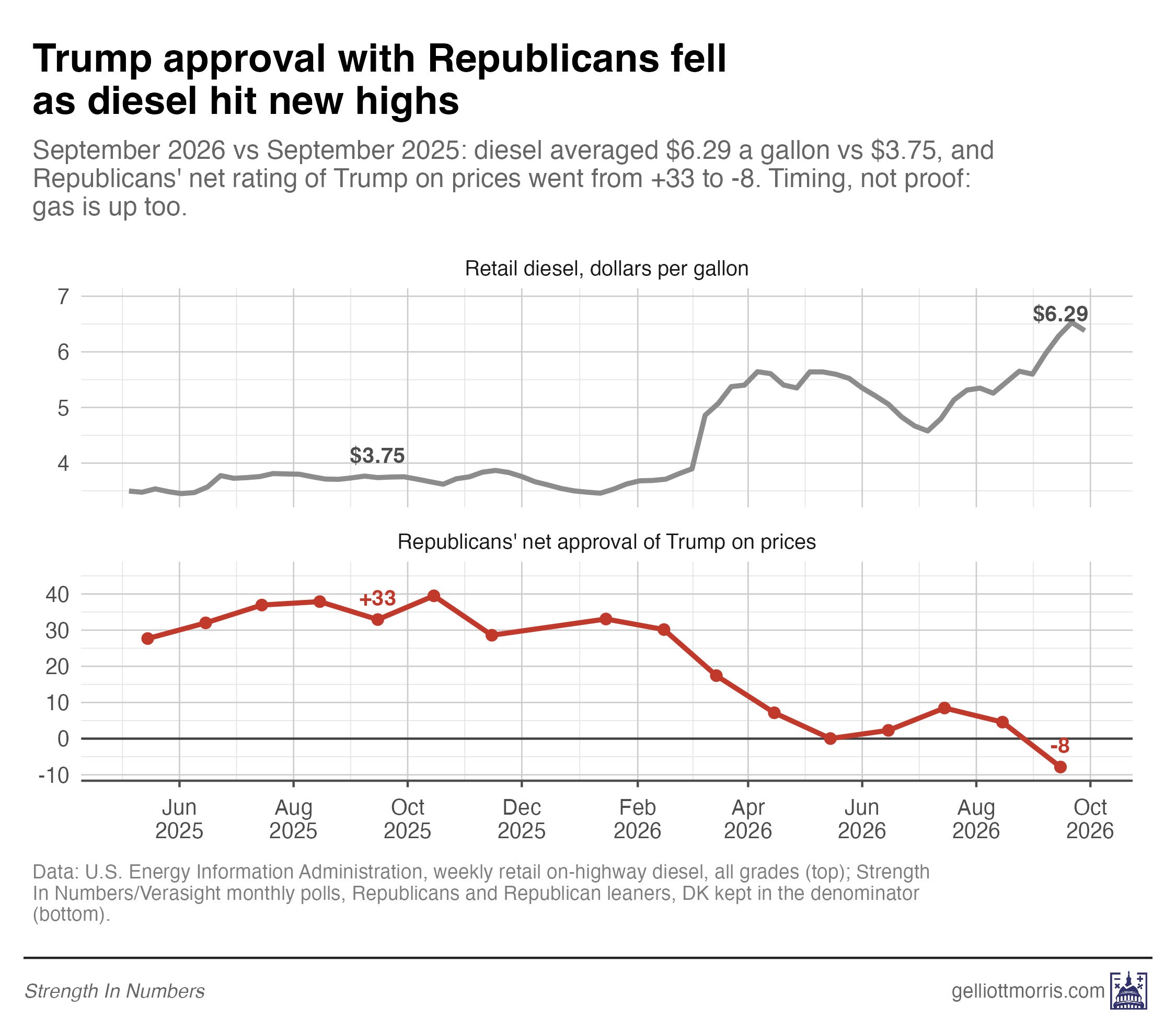
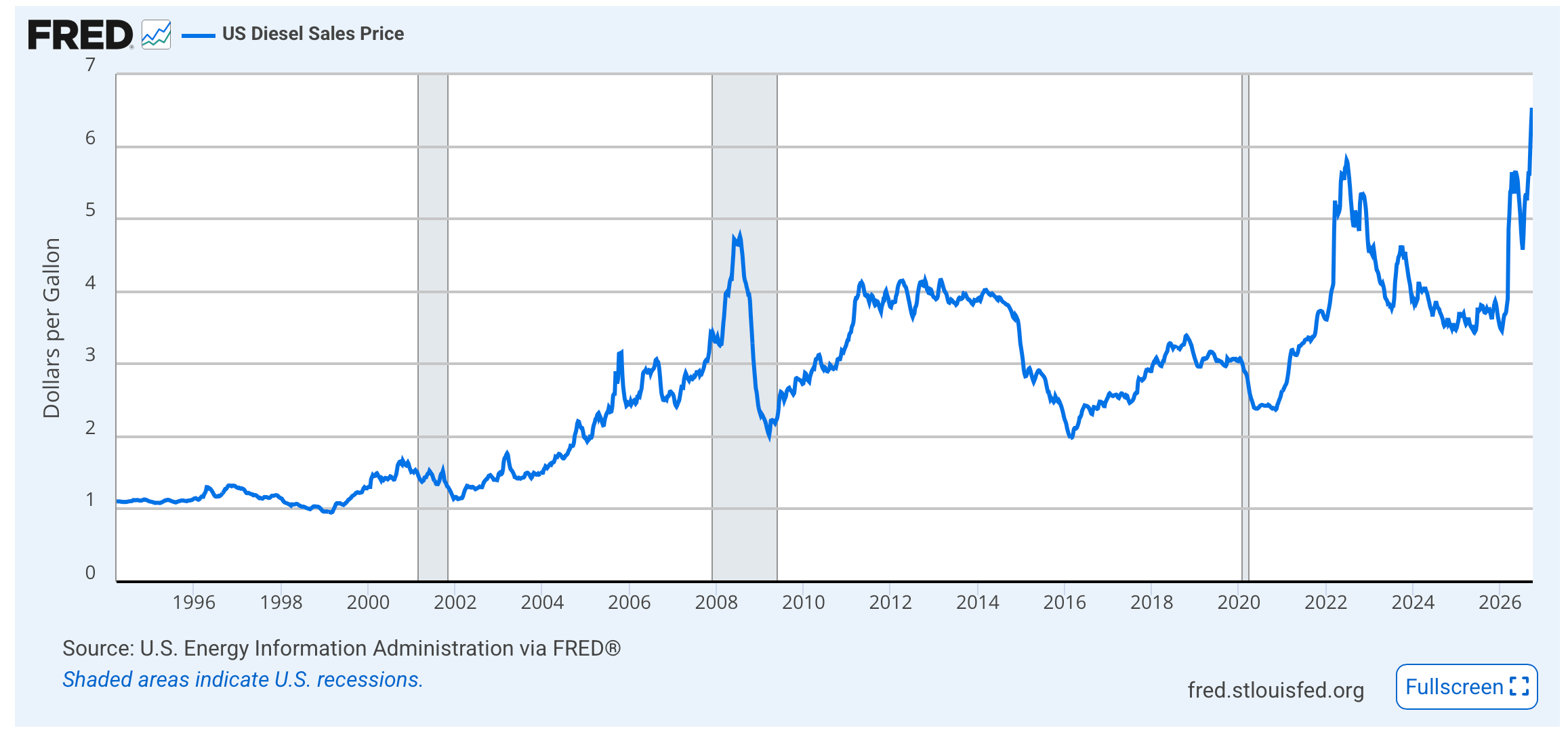
Since May 2025, the price of diesel fuel has risen from an average of $3.50 across the whole country to $6.29 as of September 28, 2026 (the next weekly update from the U.S. Energy Information Administration comes out October 6).
In September 2026, the price of a gallon of diesel hit an all-time high.
As I wrote in my write-up of our September poll, an overall 6-point net drop in Trump’s approval from August was driven almost entirely by Republicans. Among Republicans and Republican-leaning independents, net approval of Trump fell from +54 in August to +43 in September. That’s an 11-point drop in a month, to the lowest level in 16 waves of our monthly poll. A year ago, Republicans were at +68!
Last month, Donald Trump’s approval rating for handling prices and inflation also hit a new low among self-identified Republicans. The chart above shows his rating at −8.
You know who uses a lot of diesel? Farmers and truckers. You know which occupations have a large share of Republican voters? Farmers and truckers!
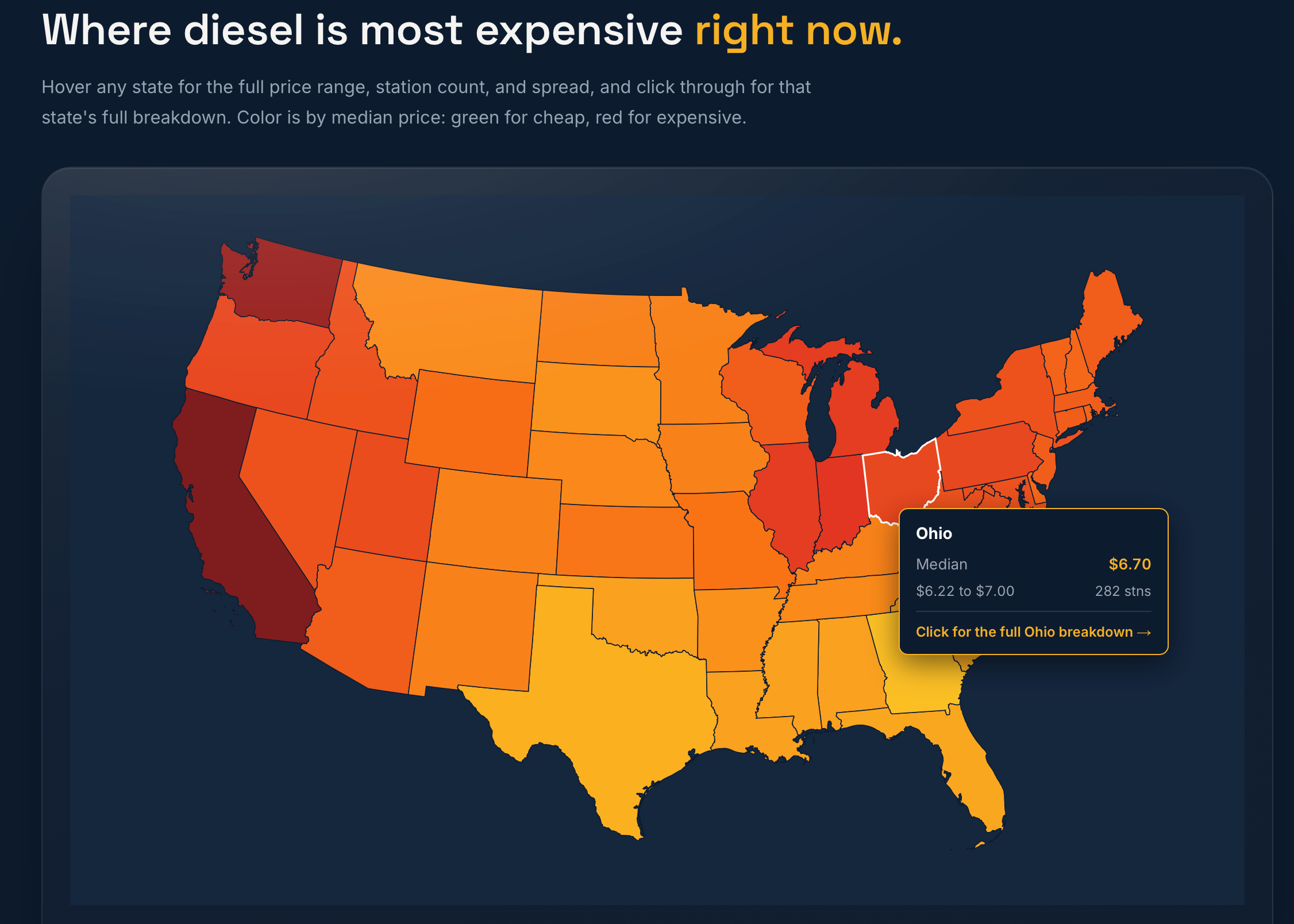
This map, which I found via Google at https://valverideflow.com/diesel-prices, shows diesel is particularly expensive in several states holding Senate elections this fall, particularly Ohio, Iowa, and Michigan. Kansas and Nebraska too, though to a lesser extent. (Diesel is also expensive on the West Coast, but so is everything else.)
My case in this week’s Friday column is that prices are a unique vulnerability for Trump and Republicans with their base. In fact, prices are the only issue Republicans rate Trump net-negative on.
Republicans rate Trump net-negative on prices
This graph shows Trump’s net approval rating — the percent approving of him minus the percent disapproving — in August and September 2026 among Republicans on 12 different issues. From August to September, the largest decline in Trump’s ratings was on prices, going from +5 to −8. That move is outside the surveys’ respective margins of error (about 5 points on net approval).
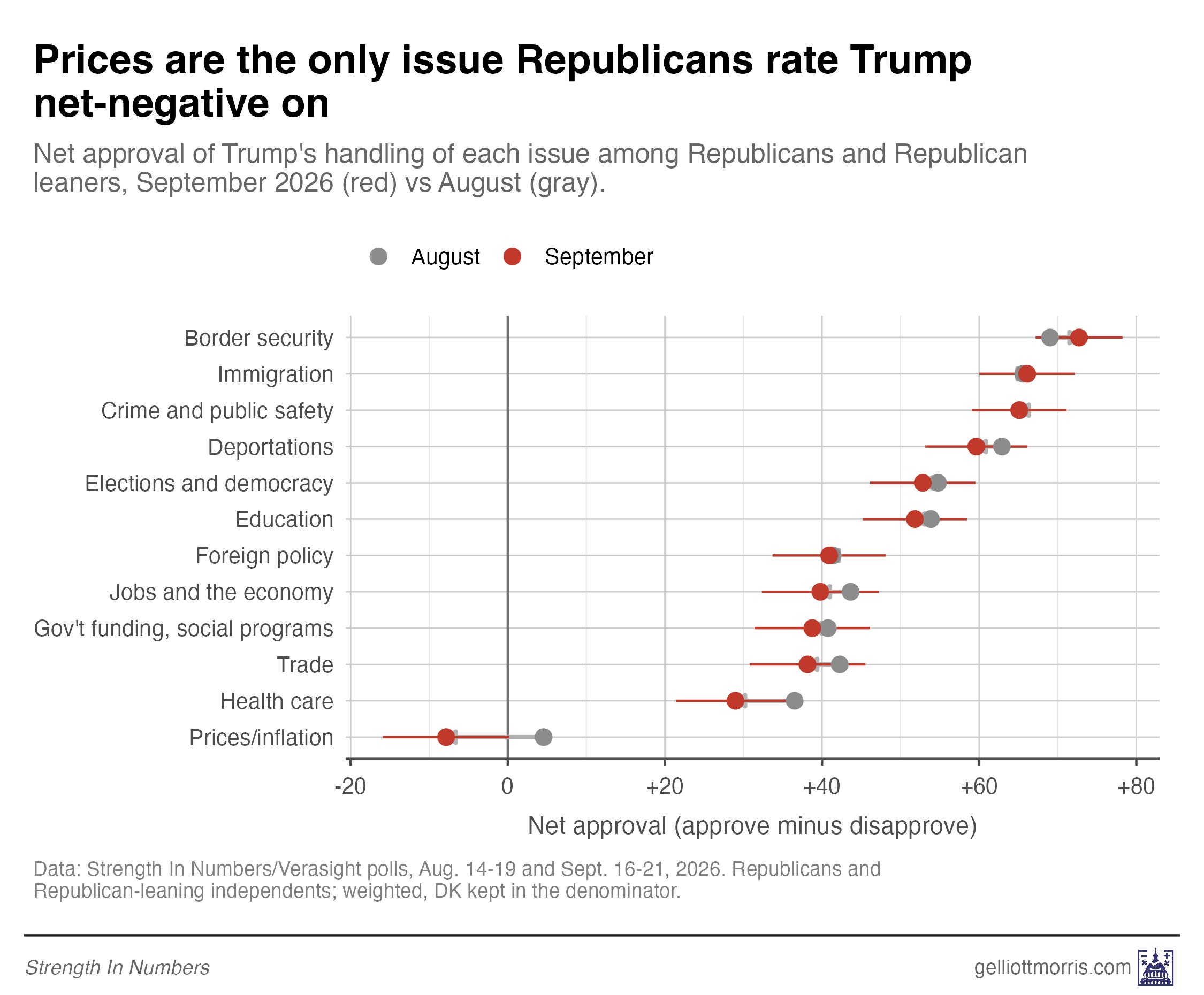
This chart suggests Trump and Republicans are uniquely vulnerable on prices. The diesel price hikes make inflation even more salient for everyday Americans.
But the president’s weakness extends beyond his ratings on prices. My state-level model also estimates that Trump’s overall job approval is underwater in many states he won comfortably.
My MRP model has Trump net-negative in some of the most deep-red states in the country. From May 2025 to September 2026, Trump’s approval rating has fallen the most in...
Wyoming (+22 in May 2025 to −3 in September 2026)
Utah (0 to −23).
Kentucky (+17 to −5).
Mississippi (+2 to −20)
West Virginia (+31 to +9)
Alabama (+15 to −6)
Arkansas (+17 to −4)
Idaho (+19 to −1)
North Dakota (+19 to −2)
Tennessee (+16 to −3)
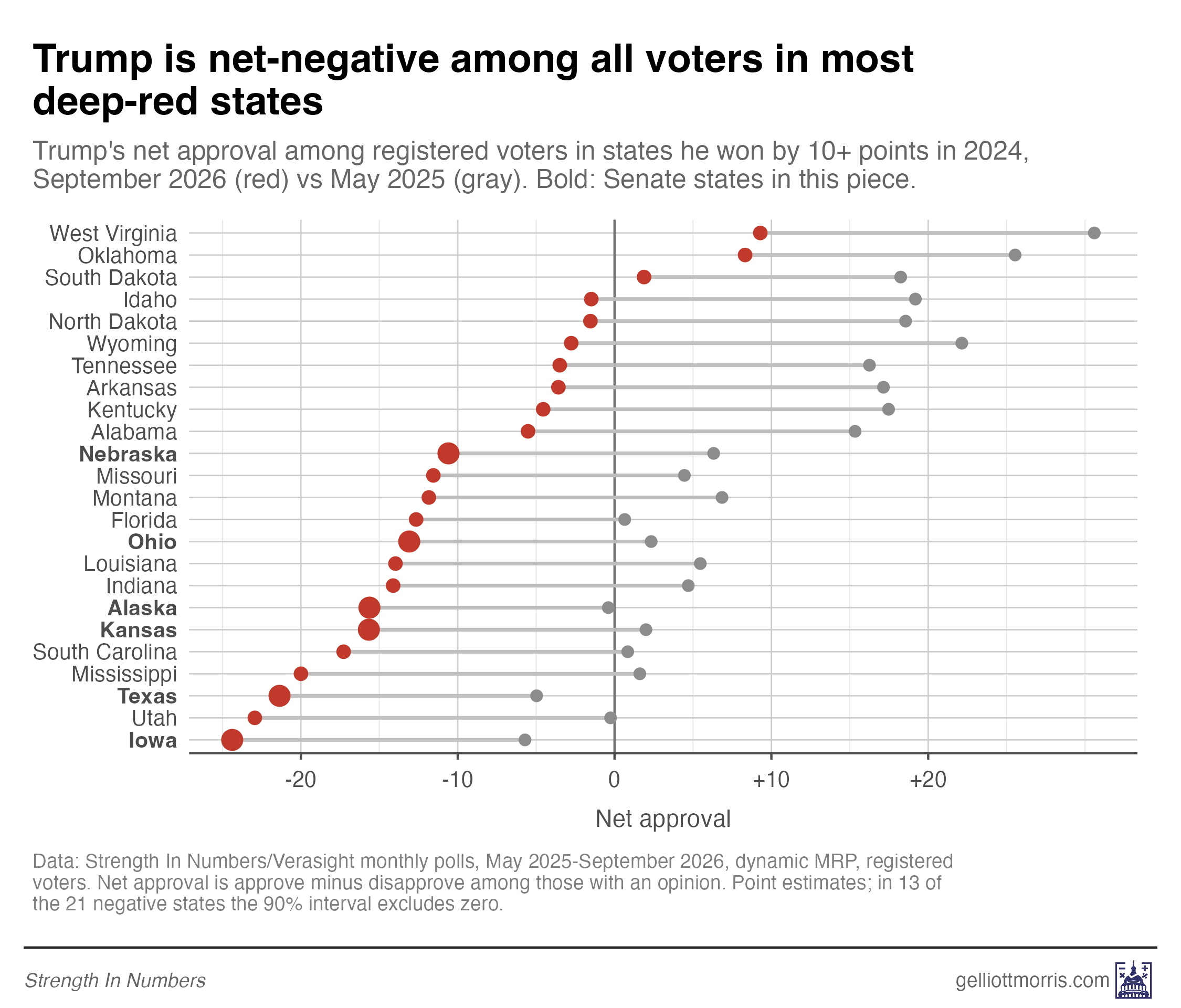
Here’s the data from the graph above if you are just looking at states with Senate races, sorted by Trump’s approval rating among his own 2024 voters:
Iowa (+42 among Trump’s 2024 voters; −24 among all voters; open seat)
Mississippi (+47; −20; Hyde-Smith)
Wyoming (+50; −3; open)
South Carolina (+51; −17; appointed, Darline Graham)
Texas (+51; −21; open, Paxton nominee)
Louisiana (+52; −14; open)
Kentucky (+54; −5; open)
Kansas (+55; −16; Marshall)
North Carolina (+56; −21; open)
Montana (+56; −12; open)
Note the placement of Iowa and Texas here.
It is unlikely that anxiety about prices, and backlash against Trump’s handling of the issue, would only impact the president. This all may be hurting Republican nominees for the Senate.
In the chart above, I’ve bolded states that have competitive Senate races this year. Many of these are the states on that map above showing average diesel prices, especially Ohio and Iowa.
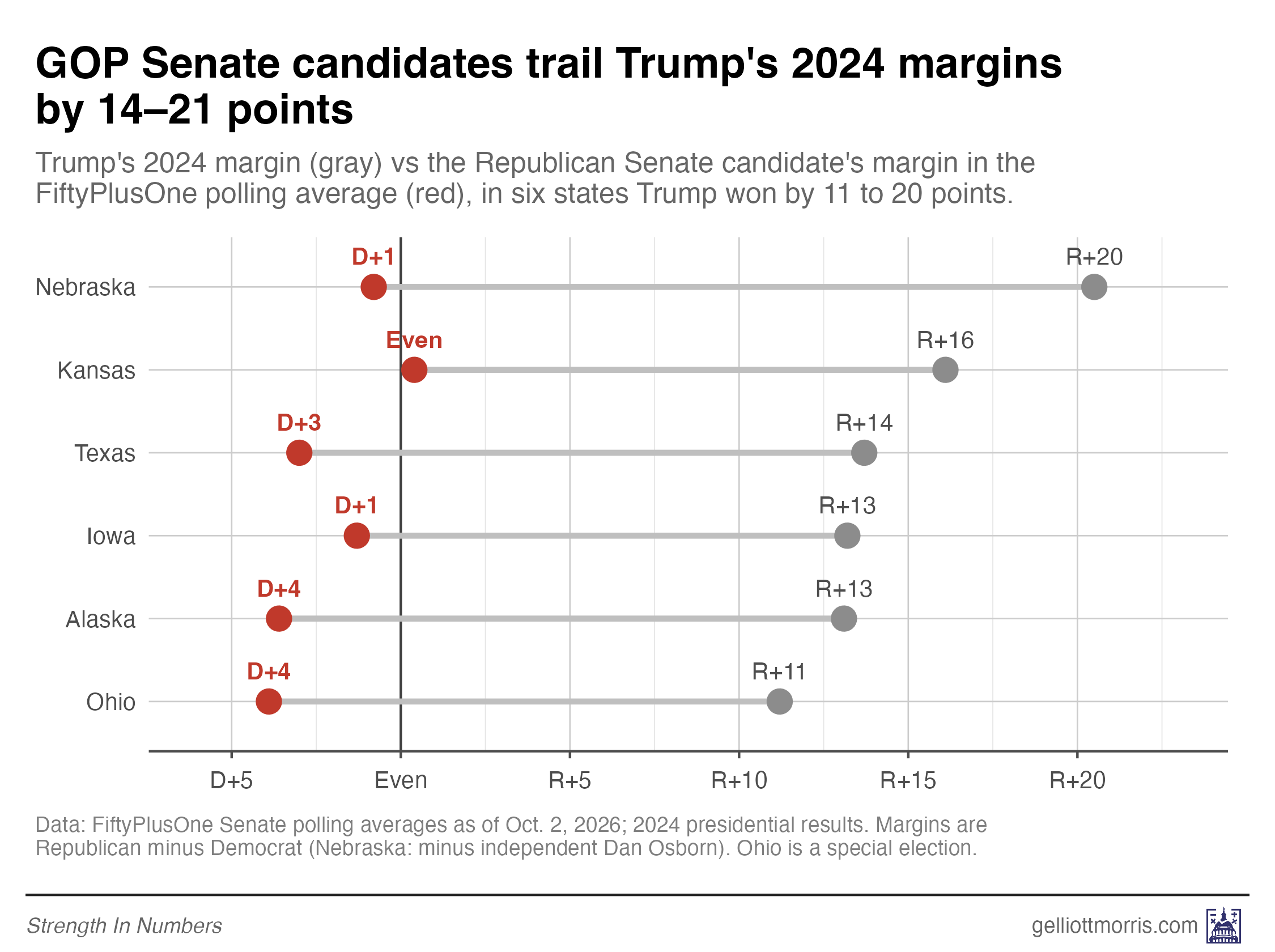
Trump won every one of those six states by double digits in 2024. Yet the Republican Senate candidates are now tied or trailing in the polling averages.
Trump won every one of those six states by double digits in 2024. Yet the Republican Senate candidates are now tied or trailing in the polling averages.
These elections are not over. And issues other than diesel matter. But it is notable that a majority of Republicans and Republican-leaning independents now disapprove of the president’s handling of prices.
That has the potential to turn soft partisans into Democratic voters, and to turn off strong partisans from voting.
Republican candidates can hope that voters care more about other policies, where Trump scores better ratings. But on the cost of living, the number-one issue among voters of all parties, the president and his party have something more basic to do: They have to win back their own voters.
With charts like the above showing all-time highs for diesel prices across the country, that’s going to be hard. And with only 32 days before Election Day, time is running out.
This post was free for everyone. But paying subscribers pay our bills and make work like this possible. If you find this kind of data-driven analysis valuable, consider supporting the work with a paid subscription.


Here in Iowa there is a huge local issue that doesn't get much national media attention: fertilizer runoff. Minnesota has made Big Ag clean up its act. Iowa has not. Environmentalists have been trying to get the public to care about fertilizer runoff for many years, to little avail, but the past two summers have been a breaking point: one out of five Iowa households had lawn-watering bans because the nitrate-removal capacity of water treatment plants was not sufficient to keep up with rising nitrate levels in rivers.
And at the same as these watering bans, there were many news articles saying Iowa's cancer rates are higher than most of the USA, possibly due to agricultural pollution.
MAHA parents face a choice between culture wars and their kids.
California diesel prices are particularly important for Republicans because so many long haul truckers from all over the country have to fill up there. Sometimes it’s over $1,000 for a fill up and they are angry.