In this Deep Dive episode of the Strength In Numbers podcast, Elliott sits down with Lee Drutman, senior fellow at the New America Foundation and author of Breaking the Two-Party Doom Loop: The Case for Multiparty Representation in America, to talk about whether the way out of America’s escalating gerrymandering war isn’t legislation for fairer maps or redistricting commissions, but maybe doing away with districts altogether. Lee is one of the country’s leading advocates for proportional representation, and has a vision for a better democracy that is worth paying attention to!
We cover the history of how the U.S. wound up with single-member districts in the first place, why proportional representation would render gerrymandering irrelevant and make multiple parties possible, what PR would actually look like from the voters’ perspective, and how Congress could move to a multi-party system without amending the Constitution.
Here are the big takeaways:
Single-member districts are the problem, not how we draw them. Drutman argues that no “fair map” standard can resolve the underlying contradictions of the single-winner district, which force an impossible trade-off between partisan proportionality, competitiveness, compactness, communities of interest, and minority representation.
Proportional representation would make every vote count and give voters real choices. Under an open-list PR system, states divide voters into multi-member districts where parties win seats roughly in proportion to their vote share, making third and fourth parties viable and every district competitive. Lee that PR systems also produce more diverse representation, not less, because party leaders want to put forward lists that appeal to broad constituencies.
It could happen with one act of Congress — and the moment may be closer than people think. PR for House elections doesn’t require a constitutional amendment; Congress can amend the 1967 Uniform Congressional District Act under its Article I, Section 4 powers, and pair it with fusion voting (already legal in New York and Connecticut) for inherently single-winner offices like the presidency. Drutman thinks 2029 could open a window for a broader “democracy reconstruction” with PR as one piece.
Thanks again to Lee for joining me for this special Deep Dive episode of the show.
If you value this work and want to help keep it going, please consider becoming a premium subscriber to Strength In Numbers. Paid subscriptions support the podcast, the newsletter, and the time it takes to do this kind of analysis well. Paying subscribers also gain the ability to send in questions during our live streams, so you can directly shape the conversations we’re having on the podcast.

A reminder: Elliott and David Nir record the usual Strength In Numbers podcast live every Thursday at 2:00 PM Eastern. We always discuss a few pre-planned topics and then answer questions submitted live by viewers.
You can also subscribe to us on your favorite podcast app to listen on your own time. And if you do listen via one of those apps, please drop us a five-star rating and review if you feel we’ve earned it — it really helps people discover the show!
A reminder that paid subscribers to Strength In Numbers get to participate in our live Q&A!
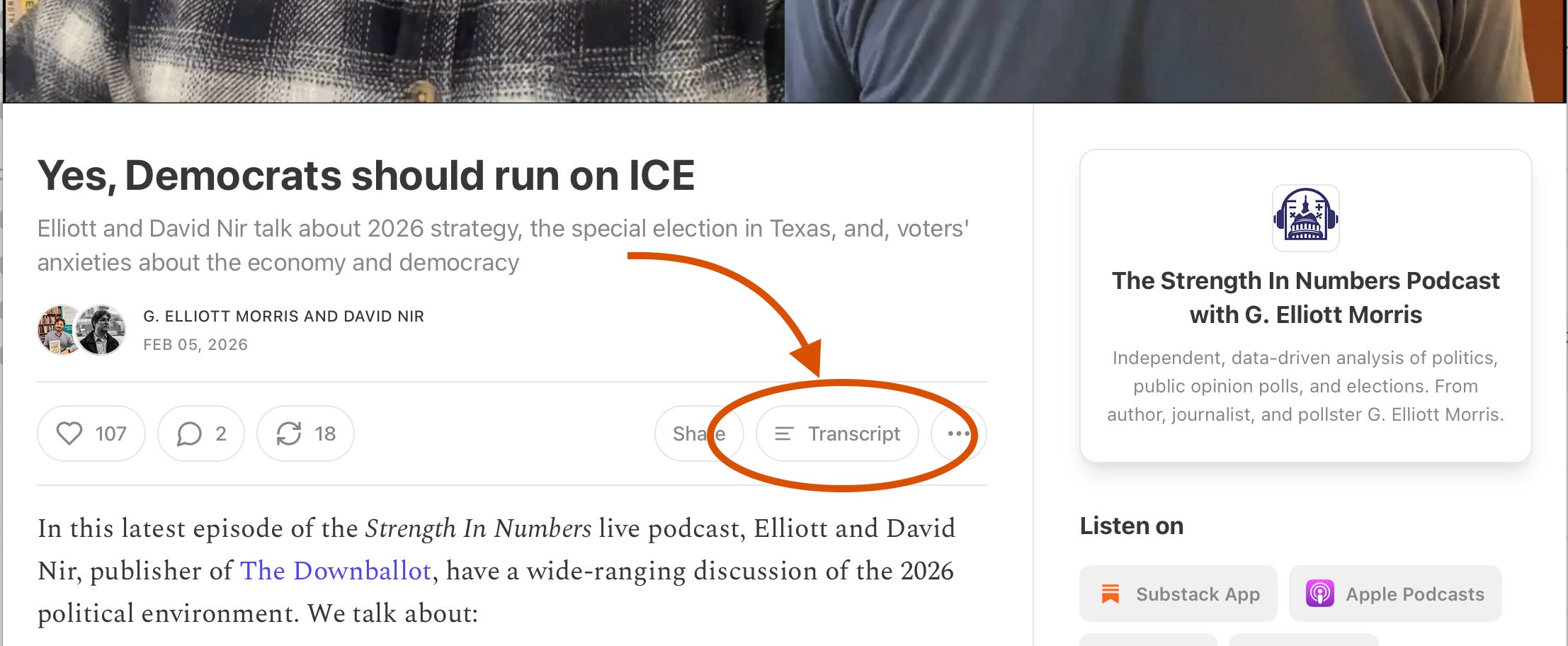
You can also read the transcript of our conversation by clicking the headline of this article to take you to the web version of the podcast, then clicking the button just below the byline that looks either like a piece of paper or is labeled “Transcript,” like so: