

How low could Trump's approval realistically go?
43% of Republicans say he isn't keeping his promises on the economy

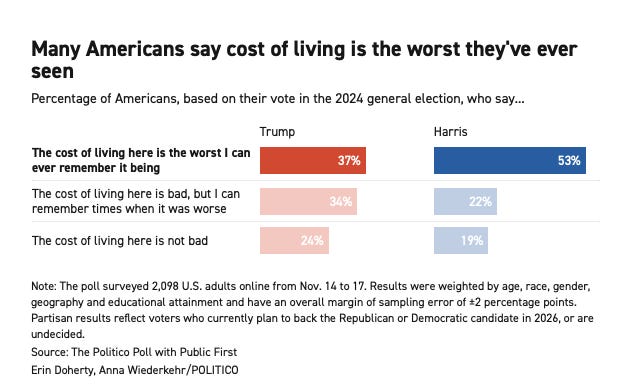
I came across a new poll from POLITICO on Thursday that shares more data on Trump’s ever-declining numbers on the economy. POLITICO reports:
Almost half — 46 percent — say the cost of living in the U.S. is the worst they can ever remember it being, a view held by 37 percent of 2024 Trump voters. Americans also say that the affordability crisis is Trump’s responsibility, with 46 percent saying it is his economy now and his administration is responsible for the costs they struggle with.
And the piece includes this graphic:
Déjà vu, right?
In another piece out Thursday, Natalie Jackson, a pollster and columnist at the National Journal, writes that “some of the [Republican] party faithful are starting to defect—and it’s because of the economy.”
It may feel like people are over-covering the economy recently, but remember, this is worth paying attention to since it’s the number-one issue for anywhere between a clear plurality and a slight majority of voters (the precise number depends on how you ask the question). Affordability is also the number one issue in congressional communications today — on both sides of the aisle.
Economic malaise is a serious problem for Trump. He won in 2024 because economic anxiety conditioned lots of voters to pull the lever against the incumbent. But now, he is the target of their ire. Losing economy-focused swing voters would cause a bloodbath for Republicans in the 2026 midterms. The 2025 statewide elections and special election in Tennessee’s Seventh District on Tuesday confirm the party is in trouble.
But, in quantitative terms, how bad is this problem for Trump, really? Are we talking about Bush 2008 levels of disapproval? Worse than Trump’s first-term ratings after Jan. 6, 2021? Today’s Chart of the Week: How low could Trump’s approval go?
To stay up to date with all the data on the 2026 midterm elections, and get updates about my plans for more polling and forecasting, be sure to sign up to get Strength In Numbers in your inbox:
And consider a paid subscription to get premium analysis weekly and support all the data work I’m doing here on Substack.
Trump’s approval could fall 3 points with greater disaffection from economy-focused Republicans
The core question we are interested in is the following: What would Donald Trump’s approval rating be if current supporters abandoned him because of economic anxiety?
To start with, here are Trump’s job approval and disapproval ratings from my average for SIN sister site FiftyPlusOne. Today, we estimate that 39.7% of adults approve of the job Trump is doing as president, while 56.1% disapprove of his job.
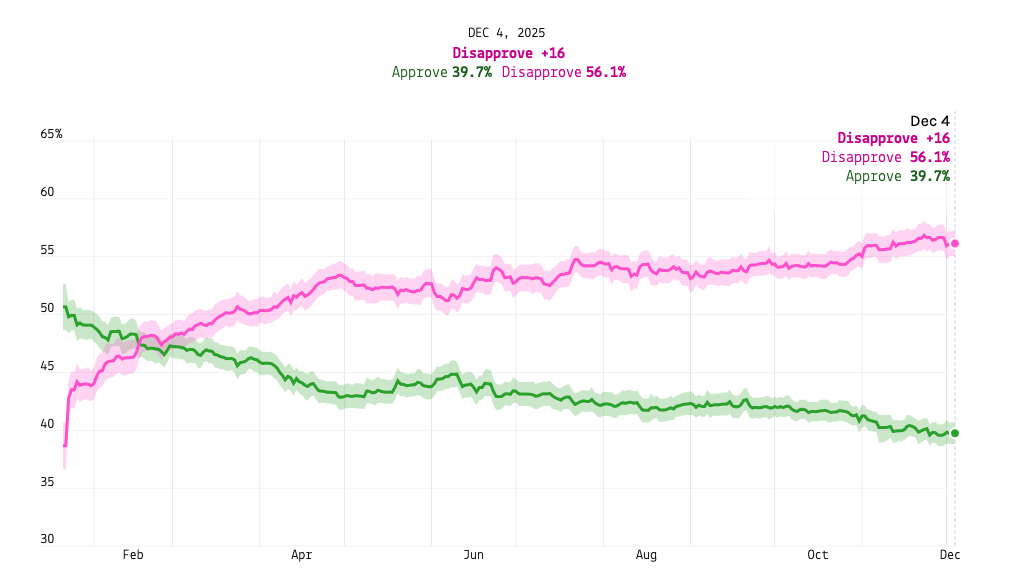
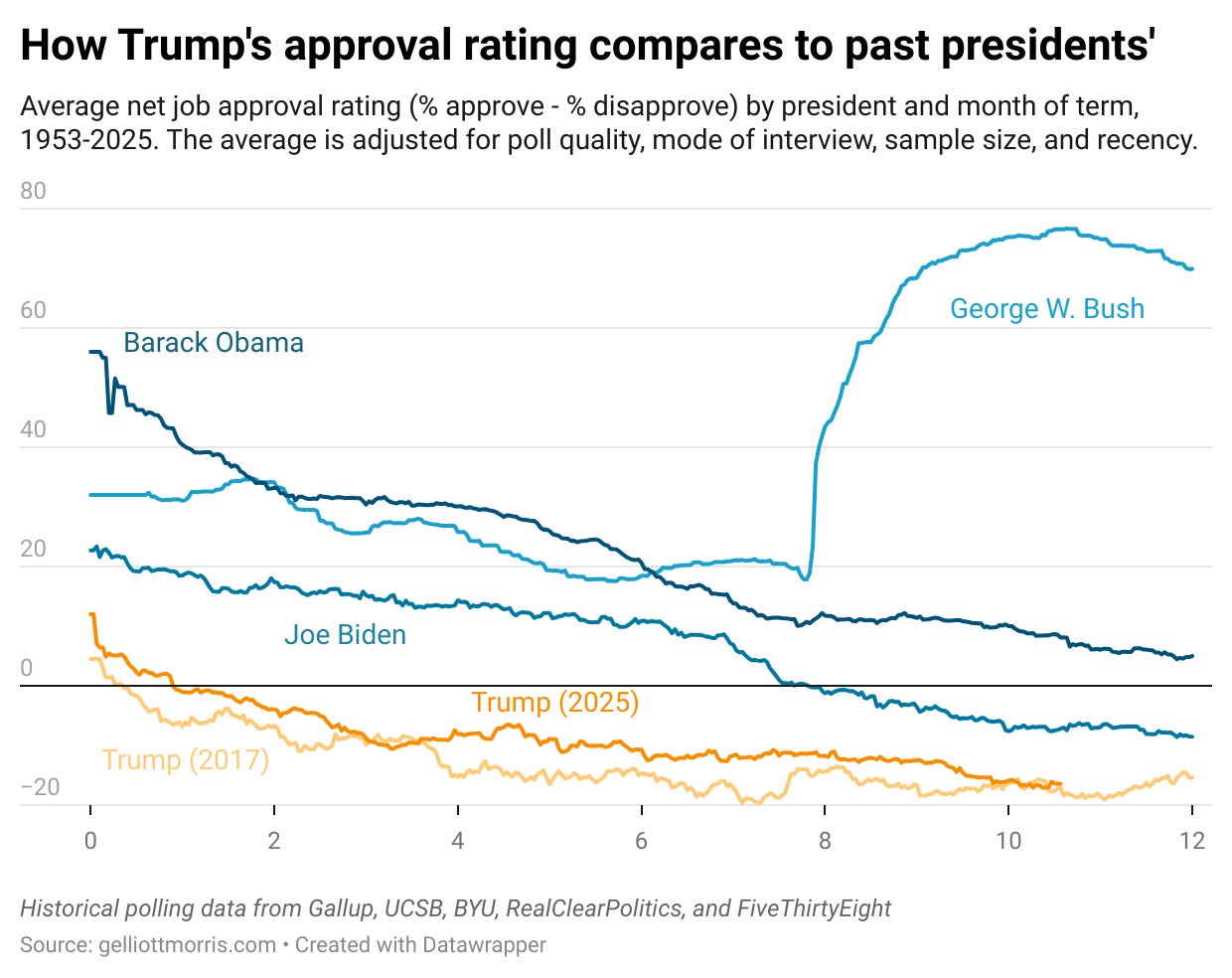
For context, this is a pretty bad number. With a -16 net rating, Trump is as unpopular as he was at this point in his first term, and more unpopular at this point than any president who came before him. (The following chart is from the SIN data portal.)
So Trump is starting in a pretty bad place. But even at a 39% approval rating, things could be worse. That’s because his approval rating is currently being shored up by Republicans who do not think he is doing a good job on the economy. Let me unpack this.
First, consider this crosstab from our November Strength In Numbers/Verasight poll. The screenshot below shows that 47% of self-described Republicans agree with the statement “Donald Trump has achieved his goals on the economy,” while 43% say he has not. If I’m Trump or a Republican running for office in 2026, I’d be pretty worried about these numbers. This level of defection from your own party cannot be good!
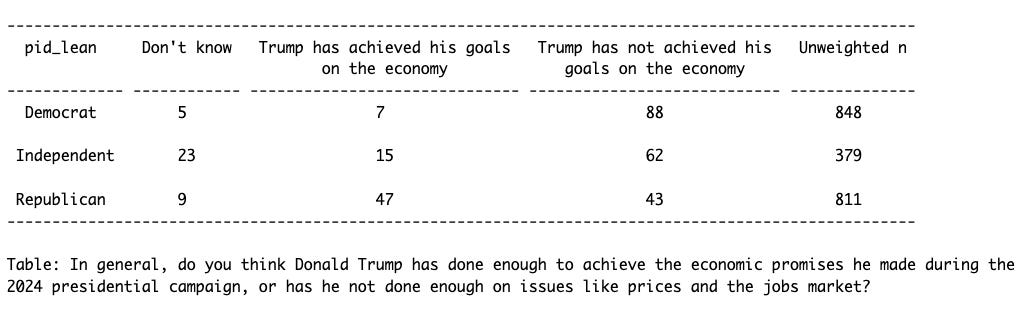
But now, let’s see how these voters in each group feel about the job Trump is doing as president. The table below shows Trump’s job approval rating among voters in each of our six groups (for each of the three parties, voters saying Trump has vs has not achieved his economic goals):
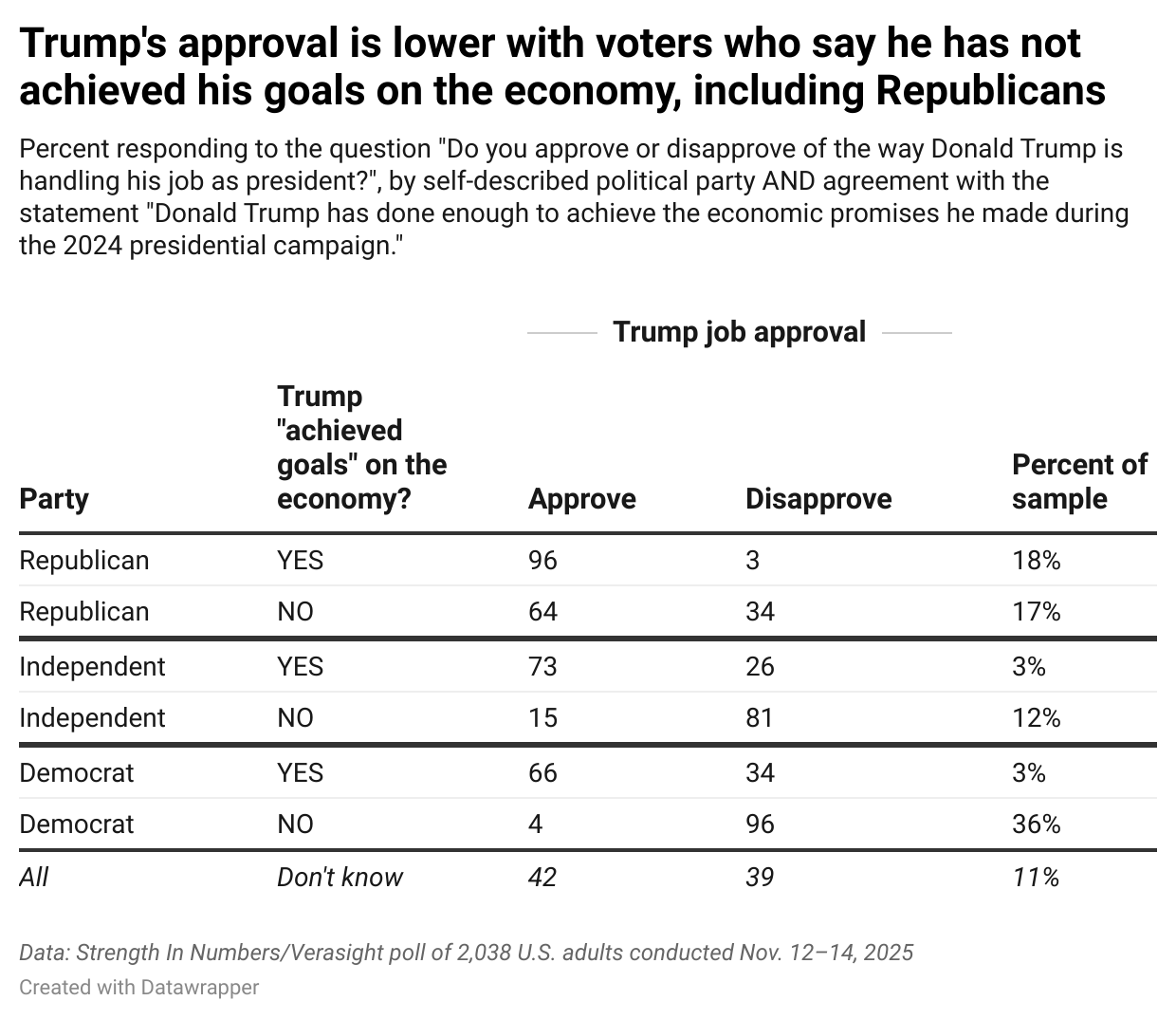
How to read this table: Among Republicans, for example, 96% of people who say Trump has achieved his goals on the economy also approve of his job as president. That number falls to 64% among Republicans who say he has not achieved his goals on the economy. Another example is that 73% of independents who say Trump has achieved his economic goals approve of the president — but this makes up a small portion of our sample, at just 3% of all respondents to the poll. Independents are much more likely (per the screenshot!) to say Trump has not achieved his goals, at a rate of 4:1 (62% vs 15%).
(I have included respondents who say they “don’t know” if Trump has achieved his goals at the bottom of the table. This row includes respondents from all parties.)
This table should not be surprising to you, since responses to the two questions are expected to be highly correlated. Voters who say Trump hasn’t kept his promises also disapprove of his job as president at a higher rate than those who say he has kept his promises? Shocker!
But what the table gives us is a way to recalculate Trump’s approval rating, if we make new assumptions about how voters feel about his performance on the economy.
Here’s how this works: If you multiply the `Percent of sample` column by the `Approve` column and sum up those numbers, you will get the overall job approval for the president that we reported in our poll: 40% approve. Do the same with the `Disapprove` column, and you’ll get 57% overall disapproval for Trump. For proof this works, here’s a spreadsheet of math, and here’s our original poll release.1
Now it’s hypothetical time. To estimate what Trump’s approval would be if more Republicans disapproved of his job on the economy, we reduce the `Percent of sample` percentage for the first row of the table above and increase the percentage in the second row. What should that number be? Right now, slightly more Republicans say Trump has “achieved his goals” vs not achieved them (47 vs 43%, per the first table screenshot in this section). But if we change these numbers to, say, 40% and 60%, then Trump’s recalculated overall approval drops by 1.3 points to 39% in our poll.
Assuming a disaster scenario for the economy that pushed 80% of Republicans to say they think Trump hasn’t kept his promises on the economy, his overall approval would fall to 36.7%, per our spreadsheet.
To me, this illustrates two things:
Trump’s approval could take a small-to-medium hit from more Republicans rating him negatively on the economy (between 1 and 4 points, depending on the size of the economic shock you’re gaming out).
The real hit for Trump would come from broader disaffection among Republicans, regardless of how they feel on the economy.
For a final simulation, we can reduce Trump’s approval rating among all Republicans by 10 percentage points. Per YouGov, that is roughly the same decline in support the president has seen since taking office (so it’s not an unreasonable simulation).
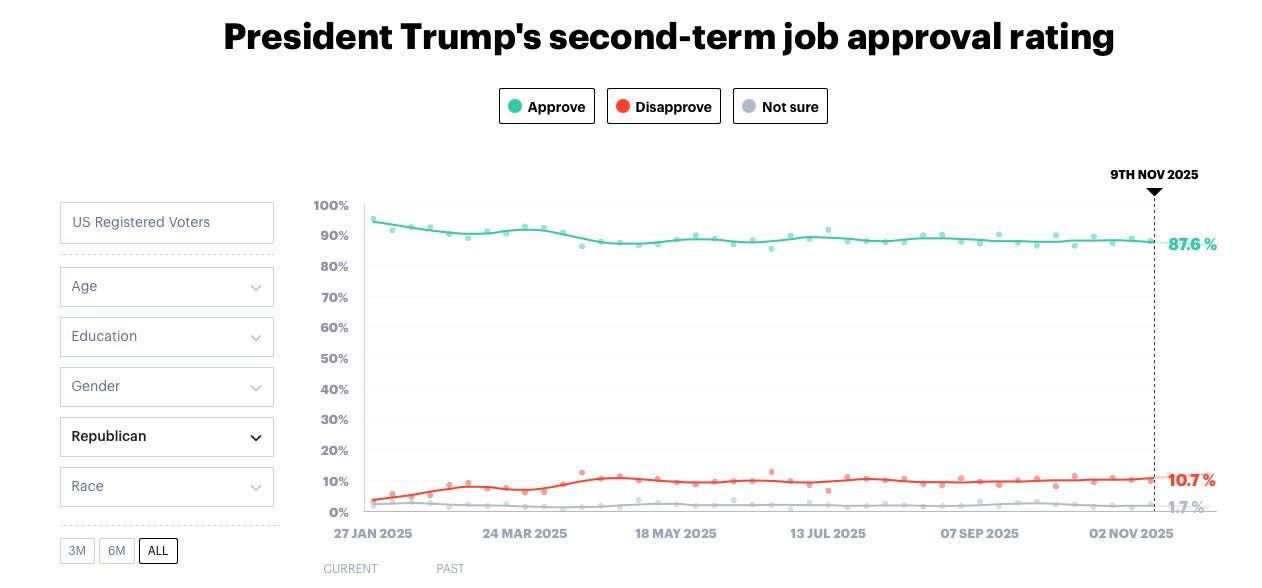
Dropping Trump’s approval rating by another 10 points among Republicans puts him at a 33% approval overall. Of course, in that scenario, political independents might also move against the president. Decrease their approval of Trump (from an already terrible 27%), and he ends up at 31.7% overall.
That would be almost as bad as his approval rating after the Jan. 6 riot at the U.S. Capitol (29%, according to the Pew Research Center).
The title of this article is “How low could Trump’s approval realistically go?” I think I have answered it with the above data, which gives two answers:
First, further incompetence in managing the U.S. economy would turn more Republicans against the president on his handling of the issue, in turn decreasing his approval by between 1 and 4 points.
But a larger drop in Trump’s approval (to the mid-30s) would require broader political problems, or a sustained decrease in his rating among Republicans — regardless of how they feel about the president’s performance on the economy. Another 10-point drop in Trump’s approval with GOP voters would put him at a 33% rating — near his all-time low.
The implications of this piece for Democratic strategy are two-fold. First, considering campaigning on affordability and Trump’s economic mismanagement is a high-leverage way to reach hesitant Trump approvers inside the Republican Party. Remember, there are a lot of self-described Republicans who do not have particularly right-leaning beliefs. Here is the big graphic from my piece “The Hidden Axis” published last month:
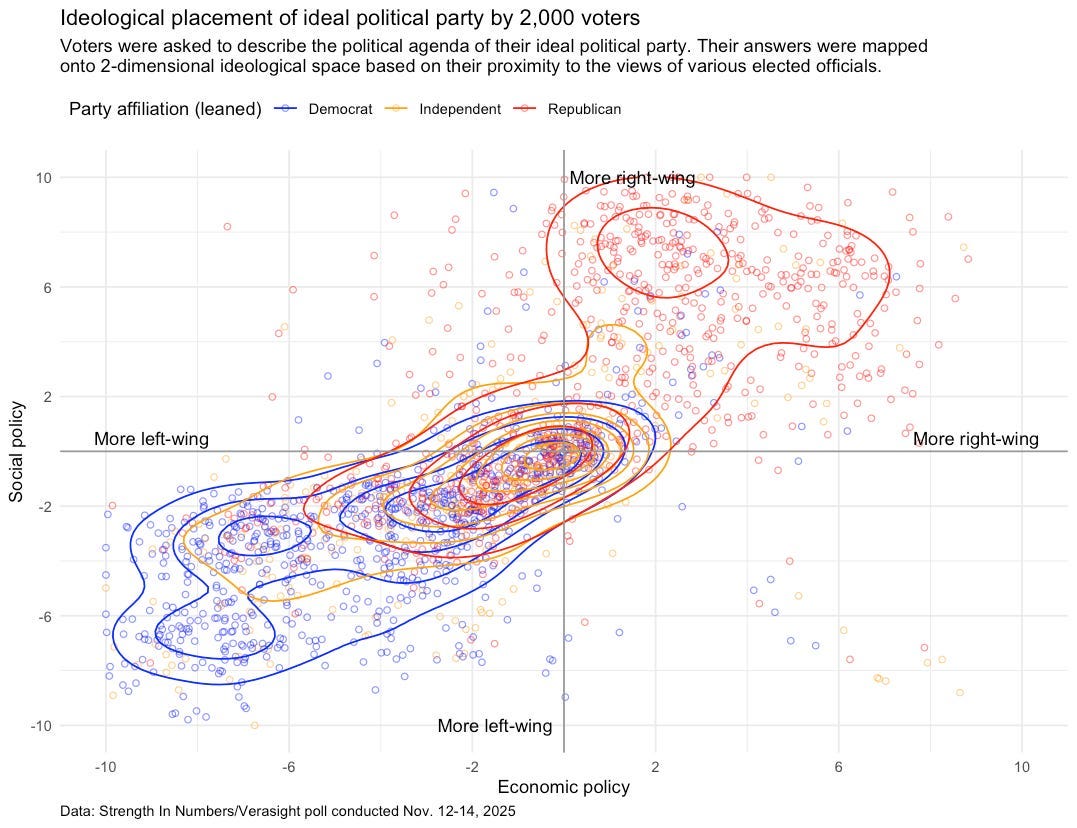
And most of those voters in the middle aren’t very ideological; they just want a party that delivers pragmatic government and economic prosperity for them. The “hidden axis” is the non-ideological spectrum:

But second, campaigning on affordability won’t be enough in isolation to drive Trump’s approval down to its previous lows. That will require sustained opposition to the president’s policies in general. And on that subject, there are plenty of unpopular policies to point to.
Trump began his presidency with talk of a broad mandate for change and popular will at his back. But over the last year, we have gotten a lot of data about how small his core constituency truly is. If economic anxiety keeps rising, it’s going to get even smaller.
If you want to play around with the data in my table and see how different levels of loyalty and anxiety impact Trump approval, make a copy of this spreadsheet and give things a whirl.
For clarity, the original poll release says 41% approve, but that’s due to rounding in the intensity column of the report. Math using the collapsed approve/disapprove ratings at an individual level yields 40.3% approval, rounding down to 40%, and 56.6% disapprove, rounding up to 57%.
It seems to me that many of the people who say that Trump is keeping his promises on the economy must be thinking mainly about their taxes, which have been cut in various ways. (The rest of those expressing that view I would think are mostly hyper-partisan.)
Do you agree with my assumption about the salience of tax issues on the "is Trump keeping his promises" question?
Do any polls ask respondents specifically about their tax burden rather than about the more general topic "cost of living"?
You are so good at doing this creative work and presenting it clearly.