


On this week's Strength In Numbers podcast, G. Elliott Morris and David Nir unpack the Supreme Court's decision in Louisiana v. Callais and explain what it means for the midterms and beyond. Then we push back on a trendy take: Because Democrat' "only" have an 8-point lead on the generic congressional ballot — despite Trump's -22 net approval rating — that’s somehow proof that the party is fundamentally misaligned with voters on cultural issues. Here are the big takeaways:
Republicans could redraw a dozen House seats because of the Callais decision. Plaintiffs in VRA cases now have to prove intentional discrimination, which is nearly impossible because states can just say they drew maps for partisan reasons. Eight Southern states are home to at least a dozen VRA-protected districts that Republicans can now dismantle, with Louisiana already racing to redraw its map before 2026.
The U.S. is increasingly governed by minority rule, and Callais is the latest symptom. Democrats have won the effective popular vote for the Senate in every cycle but one since 1992. Nonetheless, two presidents who lost the popular vote in their first elections went on to stack the Supreme Court with justices confirmed by that minority-elected Senate. That court just trashed legislation 67% of voters say is still needed — and 65% of voters now support term limits for the justices.
The “Democrats should be up 20 points” narrative is built on a misunderstanding of the data, and the claimed cause—crime and social issues—is wrong. Our investigation of the Trump disapprovers in Strength In Numbers polling finds that most disapprovers who have not committed to voting Democratic on the generic ballot are in fact “closet partisans” — voters who say they identify as Republicans and are strong conservatives. Accounting for that, the realistic ceiling for Democrats is around D+13, not D+20; treating every Trump disapprover as a winnable Democratic vote is a misread of the data. Additionally, only 3% of persuadable Trump-disapprovers name crime as their top issue, while 66% cite the economy, prices, or healthcare — and most say they don’t even know which party to trust on those issues.

If you missed our video livestream, you can watch it by clicking play on the web version of this post at gelliottmorris.com. We record the podcast live every Thursday at 2:00 PM Eastern. We always discuss a few pre-planned topics and then answer questions submitted live by viewers.
You can also subscribe to us on your favorite podcast app to listen on your own time. And if you do listen via one of those apps, please drop us a five-star rating and review if you feel we’ve earned it — it really helps people discover the show!
A reminder that paid subscribers to Strength In Numbers get to participate in our live Q&A!
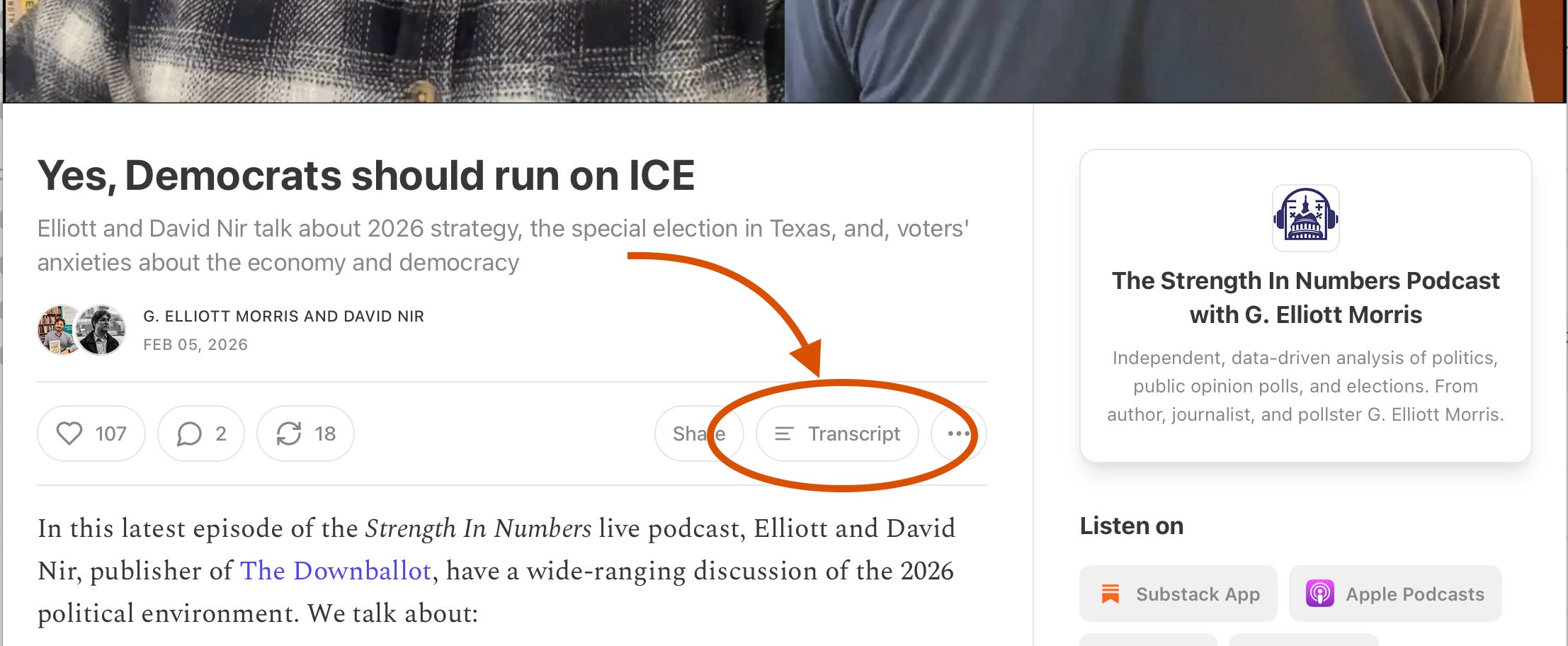
You can also read the transcript of our conversation by clicking the headline of this article to take you to the web version of the podcast, then clicking the button just below the byline that looks either like a piece of paper or is labeled “Transcript,” like so:
If you’re a reader of Strength in Numbers and haven’t yet subscribed to David’s newsletter, head to the-downballot.com.
And if you’re coming from David’s site, subscribe here to get the numbers behind the news.


