

The mystery variable that explains stubbornly low consumer sentiment
Plus, more on moderation and AI “polls.” Your weekly political data roundup for April 12, 2026.

This is my weekly Sunday roundup of new political data published over the last seven days. It is free to read, but if you want to support independent data-driven political journalism, become a paying subscriber and get additional data products and premium analysis at least once weekly.
Edit: I am not in the habit of linking criticism of my work here, but here is one post bashing me for having my head in the sand about economic anxiety and only just now “figuring out” that people were upset when this data came out. The post is snarky but raises the possibility this article was not framed clearly enough/that it could turn off people who are unfamiliar with my past work on this subject, so here’s a short note:
I have been talking about high nominal prices dragging economic sentiment measures down since mid-2024. I wrote about this at FiveThirtyEight before Disney shut us down, and here is an interview I did with Paul Krugman about this last September:

Krugman and I talked about this partly within the context that other smart people have been putting together various statistical models to predict economic sentiment with objective economic indicators, and have concluded that sentiment is lower than the data justifies. With a limited model, you cannot understand why sentiment is so much lower than “predicted,” and are left to either (a) accept the gap as an interesting data point in and of itself and thoughtfully explore possible explanations for it based on other economic data and interviews with real people, or (b) ascribe causality for the gap based on your own pet theories of how voter psychology works.
On (b), the most prominent theory — pushed mostly by really left-leaning loud online commentators, not economists — is that the news media and social media are sources of negative information for people, which drags down consumer sentiment. This camp argues that people are actually broadly doing fine right now, they’re just being misled about the state of the economy by TV news hosts and clips of people filling up their F-150s at the gas pump.
The data presented in this article, however, fills a gap in the predictive models scholars are running by asking people directly if they are currently anxious about prices. This is close to what I talked with Krugman about, which is accounting for cumulative medium-run inflation in things most people spend a lot of their income on (e.g., housing, food at home, and car payments). Government economic statistics — namely, annual inflation — do not account for the cumulative strain put on households by step increases in the price paid for a gallon of milk (not dissimilar these days to the price of a gallon of gas). But the polling data here does.
So, why is there a disconnect between official measures of (broadly speaking) how the economy is doing and how people say they are doing, personally? Maybe because everyone is being hoodwinked by the news media and their social media algorithms, and the economy is actually going gangbusters right now! Real wages are going up by 0.6% annually, hooray! Or maybe the surveys are right, and things really are stressful for most people in America right now, but analysts are looking at the wrong data to properly explain how they feel.
So that’s the context for this piece. Also, in case it’s not obvious, “mystery variable” in the title is supposed to sarcastic; I think it’s obvious that people care about prices!
Back to the article:
Leading off: Consumer sentiment just hit the lowest level ever recorded by the University of Michigan — lower than during the financial crisis, peak COVID, stagflation, and Biden’s presidency. I write about what that means for 2026, and about an under-covered variable in explanations of low consumer sentiment.
On deck this week: As I mentioned Friday, I’ll have a Tuesday Deep Dive on the relationship behind economic news sentiment, prices, and consumer sentiment, and what this means for voter psychology and the midterms. Friday’s Chart of the Week is TBD.
Thank you for reading Strength In Numbers for another week! On with the data.
1. One measure of how consumers feel about the economy just hit its lowest level ever recorded
The University of Michigan has been measuring consumer sentiment since 1952. On Thursday, economist Justin Wolfers flagged that the April reading came in at 47.6 — the lowest in the survey’s 74-year history. That index value is lower than for the depths of the 2008 financial crisis, the worst of the post-COVID inflation surge, the 2022-23 inflation spike, and any point during the stagflation of the early 1980s.
Charles Franklin at Polls & Votes put together a useful comparison of consumer sentiment in Trump’s first term vs his second. In the first 23 months of term one, the Michigan index averaged 97.5. In term two so far, it’s averaged 55.5 — and now sits at 47.6. That’s a 50-point swing from the first-term average to today’s reading.
Two things stood out to me about this new data release. First, here’s the thing about the first term that’s easy to forget: the economy was basically the only thing Trump had going for him politically. His approval ratings were otherwise underwater on pretty much every policy domain. His signature legislative achievement — the 2017 tax bill — was unpopular, as were his immigration policies. And his general vibe as head of state was divisive (less so than now but still a serious drawback).
Yet consumer confidence was sky-high from 2017 through early 2020, the stock market was booming, and unemployment was low. Republicans still lost 40 House seats in 2018.
So what’s going to happen when Trump’s policies are underwater across almost every issue, AND economic sentiment is literally worse than it’s ever been, according to this rating? We’ll have to wait to see exactly what, but signs are pointing to a solid rout.
In short, it matters not just that Trump is more unpopular than he was at this point in 2018, but how he’s more unpopular.
It’s both “vibes” and prices
There’s a theory popular in certain corners of the very online left that consumer sentiment is inexplicably low right now because of the way the news media is covering the economy. The theory points out that in most of 2024 and 2025 the labor market was doing fine by historical standards, but people still rated the economy poorly. The sentiment numbers, per this view, are a product of news and social media amplifying bad economic stories and data and dragging down the national mood.
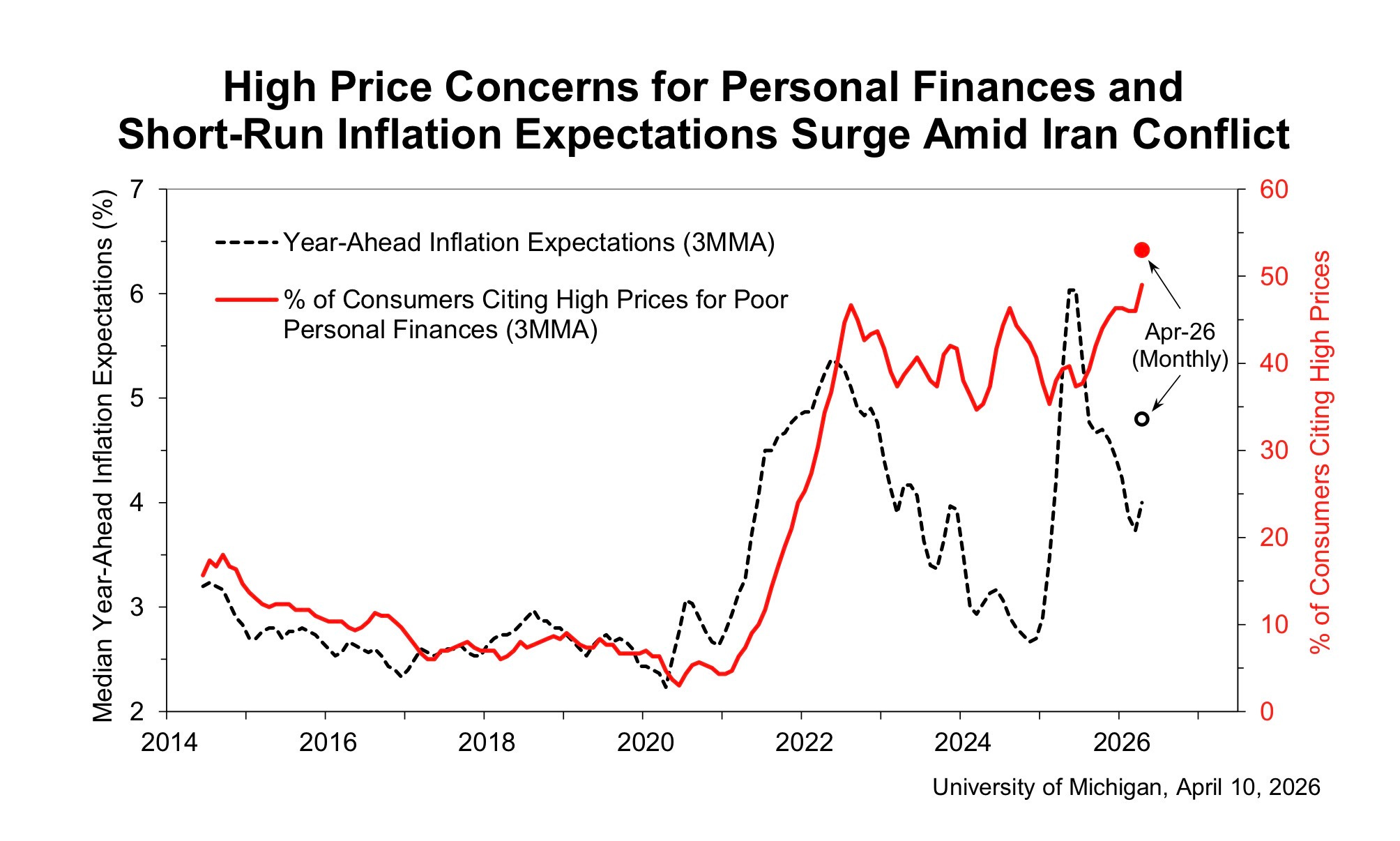
I’ve got some data I’m going to dig into next week that speaks to this more directly. But for now, look at the following chart from the Michigan survey itself. It tracks the share of consumers who cite high prices as the reason they are personally struggling financially.
And here is the complete time series:
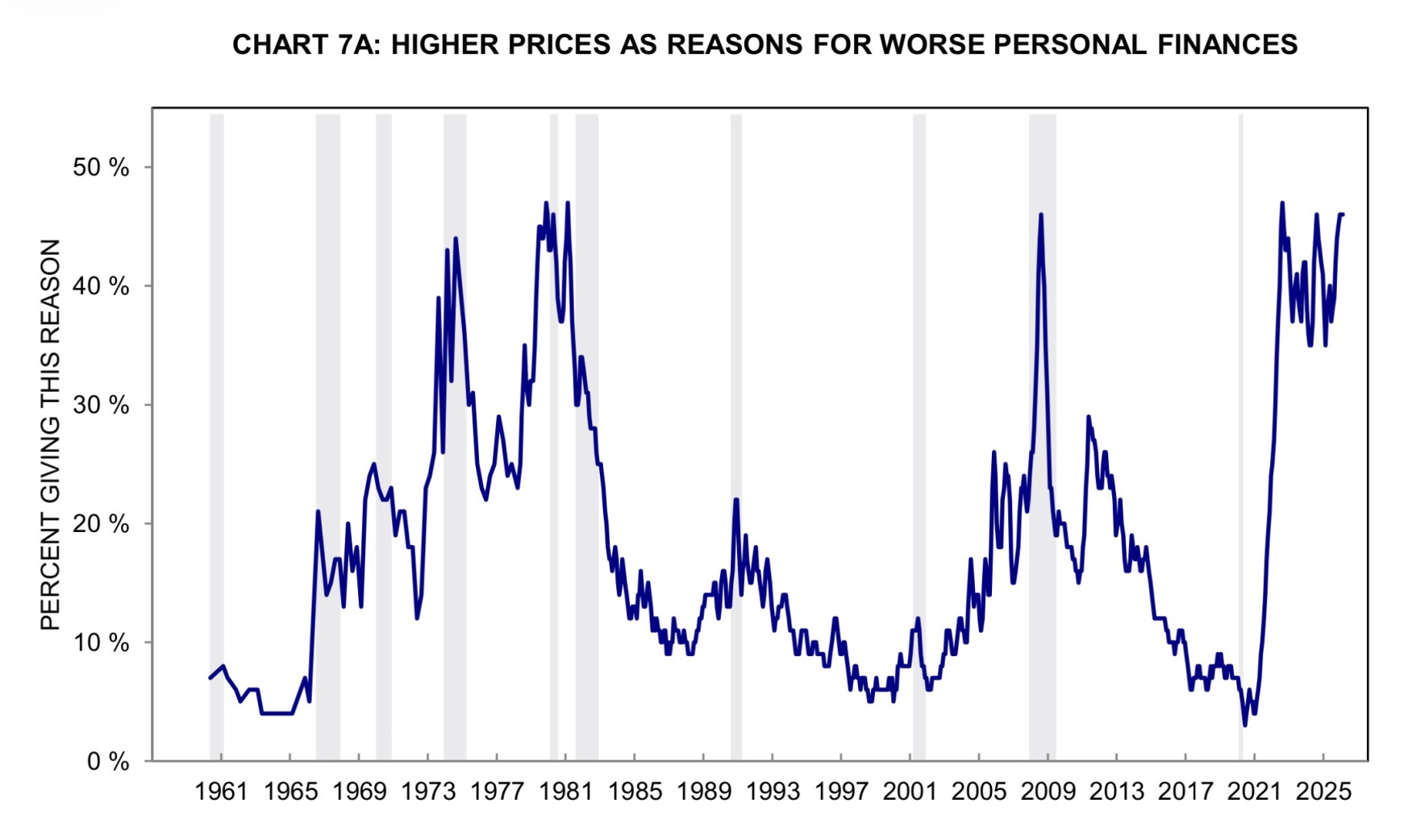
Before 2021, this number hovered near zero percent. Empirically speaking prices were a non-factor in how people viewed the state of the economy.
Then, everything changed. The share of adults citing high prices asa sources of anxiety went exponential during the 2021-22 inflation spike and never came back down. It’s now above 50%, likely because of the gas prices spike from the war in Iran.
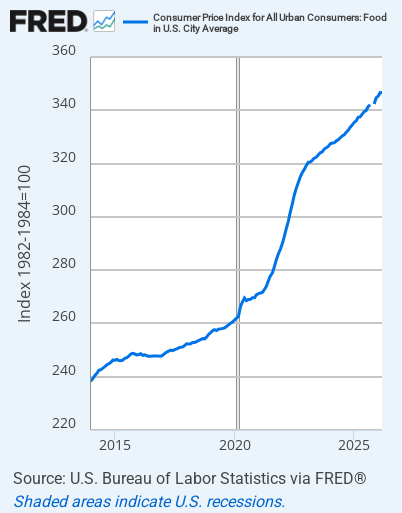
This trend actually looks similar to a chart of cumulative change in food prices since 2014:
And the price of shelter:
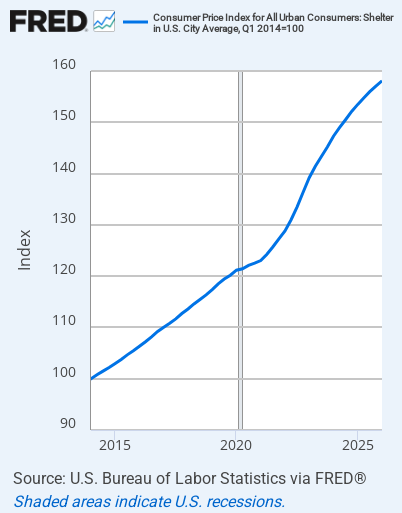
While inflation dropping from 8% to 3% reflects a “cooling off” of the economy, but evidently, people still mostly just see high prices for things and get upset about that. And fair enough!
My theory is that price levels account for much to most of the “puzzle” of why consumer sentiment is lower than you would predict based on the historical relationship between CPI, unemployment, the cost of money and etc. I will test the models and see if that’s true in reality too. The theory here is simple: prices didn’t used to dominate how people thought about their personal finances. But now they do, and that’s a source and level of anxiety that doesn’t show up in historical data on inflation, unemployment, etc.
Maybe that is unsatisfying as a grand political theory. But I think it’s workable descriptively and helps resolve some of the puzzle of voter psychology here. In terms of causality, there is still some work to be done.
2. What Strength In Numbers published last week
This week’s first-ever monthly deep dive podcast episode on Monday featured focus group insights on what voters really want from their representatives right now:

The Deep Dive column on Tuesday covered new research that shows why ideological moderation is an incomplete and potentially suboptimal strategy for parties to win back defectors in non-competitive states:

Democrats posted some of their biggest election swings of the 2026 cycle so far in Wisconsin and Georgia on Tuesday night — more evidence of the shifting blue midterm environment:

Trump is underwater in every competitive House and Senate seat, according to my latest state and district level MRP estimates:

The normal weekly podcast explained how that MRP modeling works, and covers other newsy topics like the Iran ceasefire and Tuesday’s elections.

And Friday’s Chart of the Week looked at the relationship between gas prices and presidential approval — timely, given the Iran-driven spike:

If you’re a frequent reader of Strength In Numbers, I’m confident you will get a lot of value out of a paid subscription. You’ll get access to all of my Tuesday Deep Dives, monthly polling data, and more.
3. Even more numbers!
Nothing really aside from the consumer sentiment data above.
I did think this piece on AI “polls” from Eli at Nate Silver’s blog was good, and it links to lots of interesting research (including mine!) on the capabilities of what industry folks are calling “synthetic sampling” or “digital twins.”
My point on this, starting back in 2024, has been that you shouldn’t think of these tools as polls, but as predictions. They use large language models and other systems to predict how “people” with certain demographic traits would respond to survey questions had they been asked them. This is similar in principle to how something like MRP works, except for the key factor that the information the model has about the beliefs held by certain types of people comes from the LLM, not underlying survey data.
That’s not polling, but maybe it could be a decent predictive model if you don’t have any other information about how people in a certain geography are feeling.
And that’s it for this week. I spent most of the weekend hiking instead of reading the internet, so section 3 is shorter than usual. Back to normal programming tomorrow. Here’s a picture of a gopher I saw waddling around in the woods:

Strength In Numbers will be back in your inbox Tuesday with a deeper look at the consumer price data.
Got more for next week? Email your links or add to the comments below.
Elliott
"The theory here is simple: prices didn’t used to dominate how people thought about their personal finances. But now they do, and that’s a source and level of anxiety that doesn’t show up in historical data on inflation, unemployment etc."
I have a theory.
I think people used to feel optimistic that tough times would get better, because we lived in a wealthy, powerful, stable democracy, so we could change up our reps and expect better policies in the future.
Trump has upended ALL of that. And though he's not responsible for Citizens United, the destabilizing effect of Big Money donors owning our government reps and ensuring that tax cuts for the uber-rich are the be-all and end-all of government legislation has revealed just how entrenched income inequality has become. There's no reason to hope that healthcare, housing, or higher education will become more affordable. We know that climate change is going to drive costs up, not down.
For MAGA folks, the initial thrill of owning the libs is fading as kitchen-table issues become more and more pressing every day, and the Trump administration is constantly setting fires to make things worse.
There is no sense of a future that can be bright for our children and grandchildren. Our entire paradigm of America is on the ropes. No wonder we are all in a sour mood. Malaise.
The average price of a new car has hit $50K, not so much because of inflation but because car companies are prioritizing affluent buyers. Accordingly, automakers are producing more high-end vehicles. Anyway, I wonder how much the consumer sentiment index is a function of a sense that middle- and lower-income people are being shut out of parts the economy altogether.