


Strength In Numbers is independent and reader-funded. Paying subscribers get premium posts like weekly Deep Dive article, can access our community Discord server, and support the data collection and analysis work that powers this independent, data-driven journalism.
If you want political analysis that’s honest and data-driven, not beholden to publishers’ ideological agendas or donations from corporate PACs, upgrade to a paid subscription.
The “SAVE America” Act, a bill in Congress championed by Donald Trump that would require U.S. citizens to physically show documentary proof of citizenship to register to vote, among other things, sounds simple enough on paper. What’s so hard about showing your passport or birth certificate to a county clerk when you register to vote?
Turns out, a lot of things. As GOP Senator from Alaska Lisa Murkowski wrote in the Wall Street Journal last week, many Americans in rural areas do not have easy access to a voting registrar to present such documents. And many people, a new Strength In Numbers/Verasight poll shows, say they lack the paperwork at all — including citizens who are currently registered to vote.
Plus, our survey finds the people who are most in favor of Trump’s new election law are the ones who have heard the least about it.
In this week’s Chart of the Week I report on two questions about Trump’s SAVE Act that other pollsters are missing.
Who could prove their citizenship?
In our latest Strength In Numbers/Verasight poll, fielded July 14–17, 2026, we asked how easily currently registered voters could produce documentary proof of citizenship right now if they wanted to vote.
At first glance, the answer is reassuring; 90% would clear the bar without much trouble — 74% said “very easily,” 16% “with some effort.” Only 6% of registered voters said they would manage to prove their citizenship “with a lot of difficulty,” while 2% said they could not produce one at all, and about 3% weren’t sure.
But 7% of registered voters is still millions of people. Who are these people who would be effectively disenfranchised by Trump’s new law?
The chart below shows how hard a time registered voters from various demographics say they’d have proving their citizenship status:
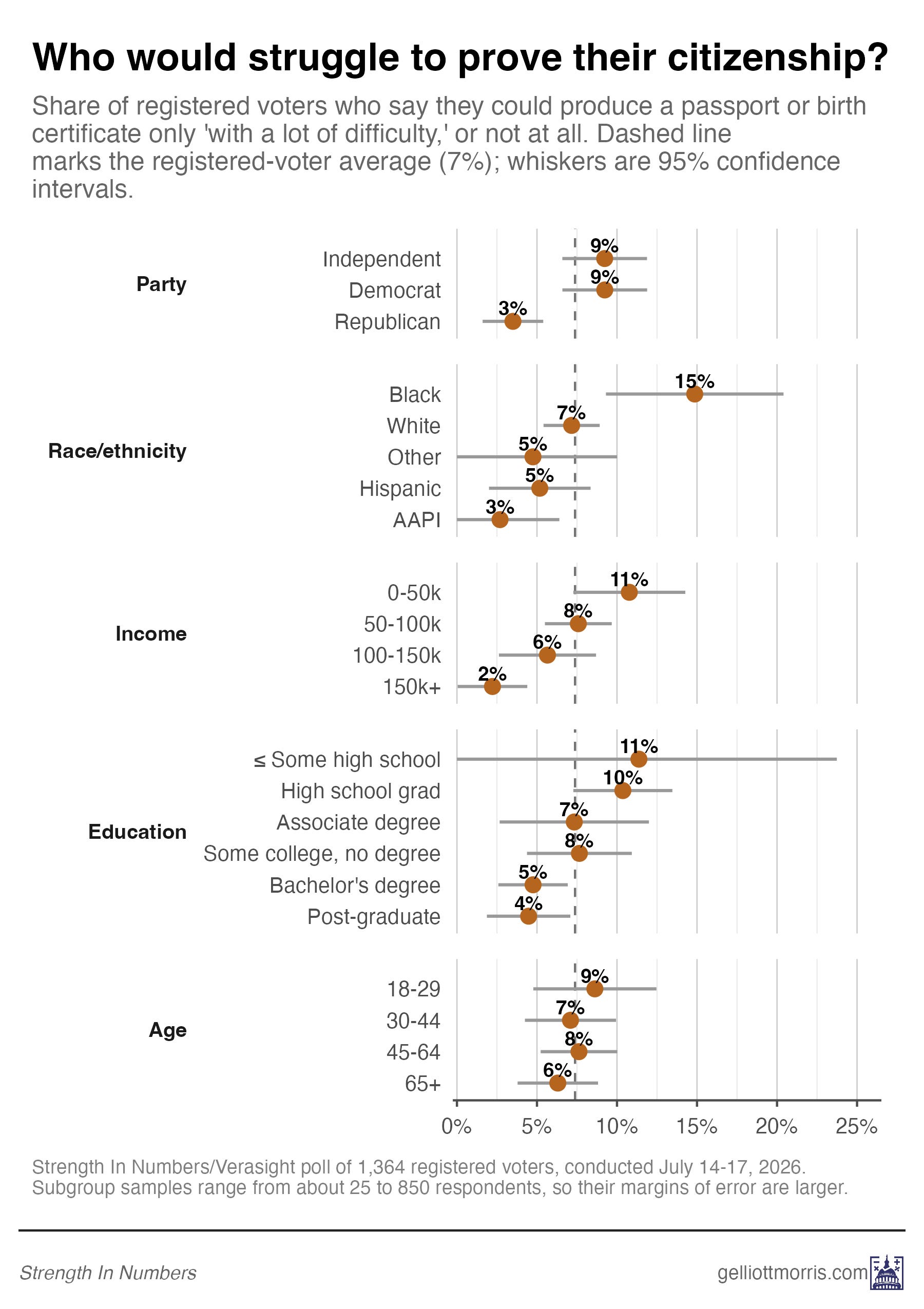
Some groups stand out. First, lower income voters. The share who’d struggle runs from 11% among registered voters earning under $50,000 to just 2% among those making more than $150,000 — a 9-point gap disenfranchising the poor the most.
Younger voters also say they’d be more likely to have a hard time proving their citizenship.
But the group most likely to say the SAVE Act would effectively disenfranchise them is Black voters: 15% say they’d struggle to prove their citizenship, vs 7% for white voters and 5% for Hispanics.
These two findings suggest Trump’s voter ID law would produce a meaningfully more Republican electorate. Nine percent of currently Democratic voters say they’d struggle to prove their citizenship vs 3% of Republicans.
Hearing more about the SAVE Act decreases support
Another question about the SAVE Act is whether the people who actually understand it still support the bill. Support actually peaks among registered voters who’ve heard just a little about it — 58% back a documentary citizens requirement, vs 35% oppose it.
Among those who’ve heard a lot, on the other hand, it’s nearly a coin flip: 53% support to 45% oppose, a net of just +8. People who say they are not sure what they have heard about the law are the most supportive of it, 43% to 8%.
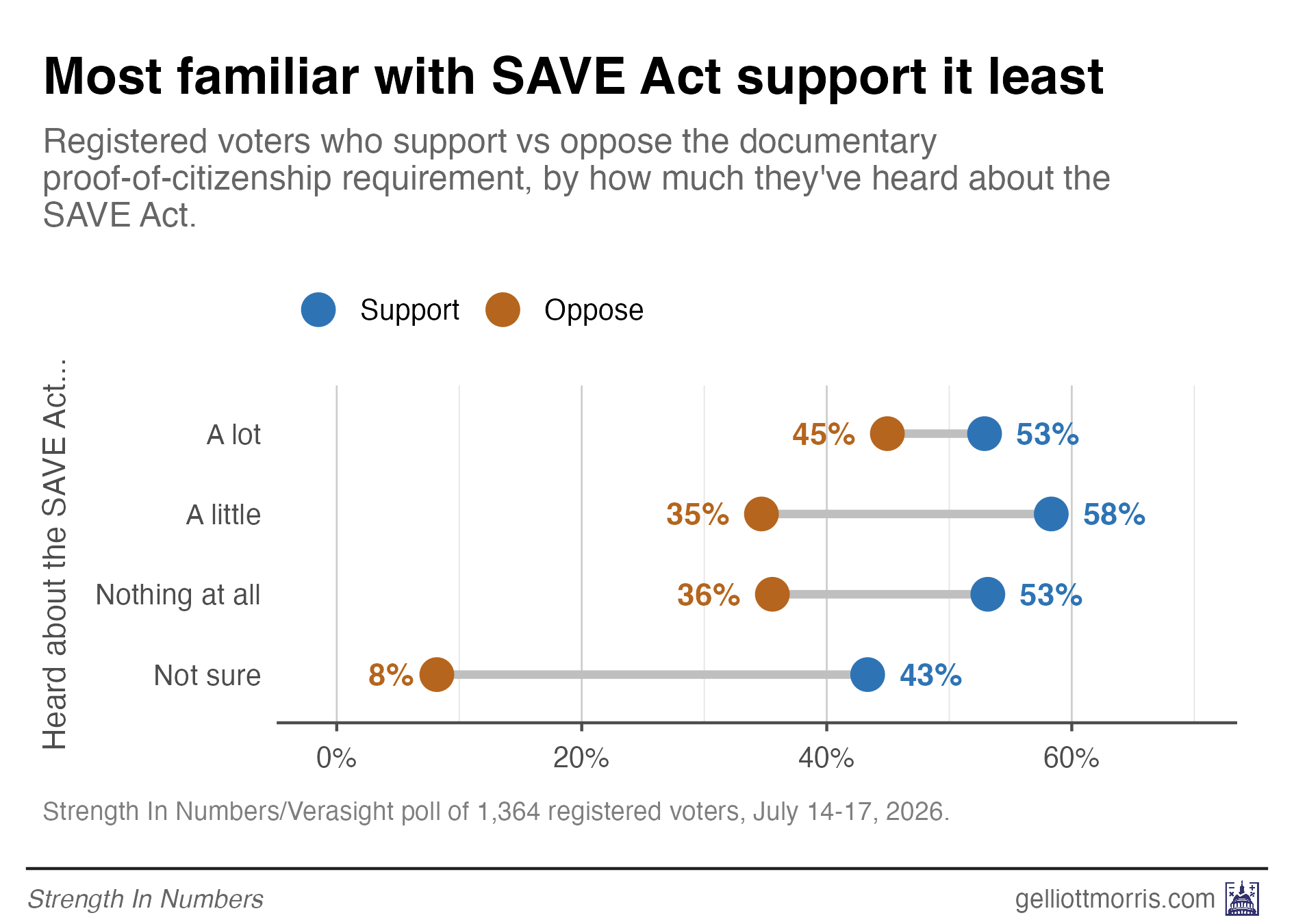
It is usually a bad sign when the people paying the closest attention to your bill aren’t its most supportive, but the largest detractors.
This would not be the first time in the last year when voters turned against something they thought they wanted. That is, in several ways, the story of Donald Trump’s presidency so far
The July 2026 Strength In Numbers/Verasight poll surveyed 1,514 U.S. adults online from July 14–17, 2026. Responses are weighted to Census (CPS) benchmarks for demographic variables, a three-year running average of Pew’s NPORS party-identification benchmark, and to the results of the 2024 election by recalled vote. The margin of error for the group of 1,364 respondents who said they are registered to vote is ±2.7 points. You can find the full methodology statement, toplines, and crosstabs at the Strength In Numbers/Verasight polling portal.


I'm sorry. white single native born female here. People are over-estimating how easily they can provide proof of citizenship.
I ran into problems when I had to replace a lost driver's license. AL required a birth certificate. oops! what I & my family believed was my birth certificate was not considered one by the state. Because it was issued by the hospital & didn't have the state seal. no problem, said the clerk. Just go to the health department, pay $5 & you can get an official one. Except I wasn't born in AL. I was born in MI. I could order one from MI relatively inexpensively but it would take 8 weeks. Or I could order online, answer Lexus-Nexus questions, pay $80 & get it in a week or so. I took the 2nd route. And I ordered 2, so I'd have a backup.
Do you think I could find either when I went to apply for a Star ID a decade or so later? No. So I ordered again from MI. And I had several options on the kind, so let's hope I picked right. (I did)
& the number of documents I had to produce for my Star ID! First was proof of identity NOT proof of citizenship. I'd have had more options if I were a naturalized citizen than a native-born American.
& here's the kicker, which Republicans with their "you need a driver's license to order at Alive Garden" nonsense deliberately omit: "If the applicant’s name has changed from the name displayed on the document presented to verify identity and date of birth, certified documents verifying this change are also required (ex. marriage certificate, adoption, court order)." Married white native born females over 65 in red states are going to have problems like I had.
Thanks for generating this data. Numbers I had seen from other sources were incomplete and contradictory as to which party would be more disadvantaged. Nice to have something definitive to refer to.