


In this week’s Friday column, I want to bring out from behind the paywall one of the premium charts from Wednesday’s article on “Trumpapalooza” to share it with the full audience. It’s an important chart I want everyone to see.
In that piece, I dive into the actual polling data on low-turnout midterm voters and find that the Republicans Donald Trump and his electoral strategists are trying to activate with their first-ever midterm convention this week actually disapprove of how Trump has handled the presidency, especially on prices.
Here’s the full story:

And here’s the graph I want to share with the full newsletter audience today. It shows approval of Trump overall and on various issues for people who call themselves Republicans, by those respondents’ stated likelihood of voting in November:

For some added context, here is the same chart among all voters, not just Republicans.
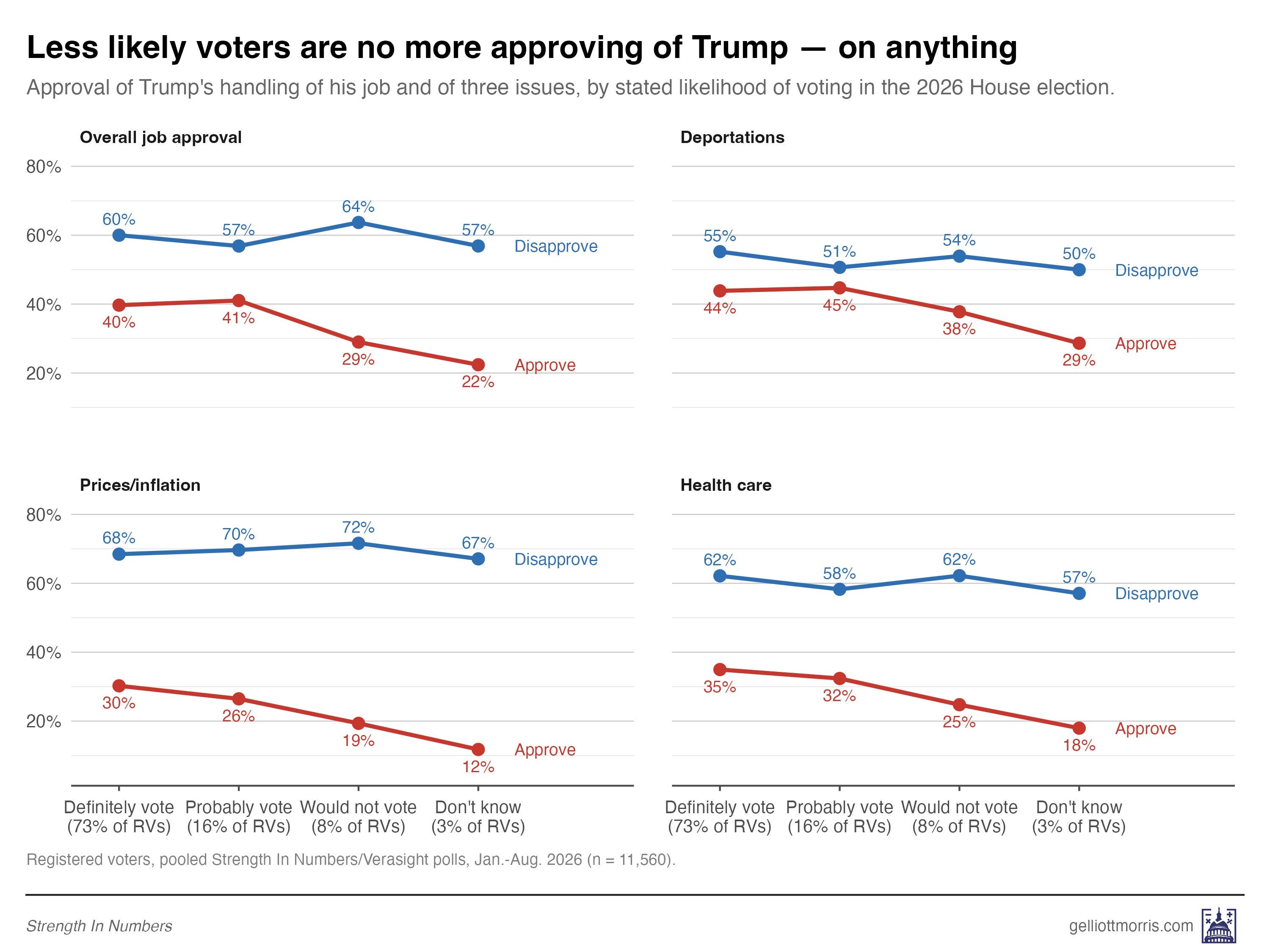
This chart is remarkable (as in the literal sense: you should remark about this, with your friends and peers!) for the story it tells about Trump’s own 2024 voters. First, it shows that the president’s past supporters actually get less supportive of him as they get more politically disengaged. The Republicans who say they are definitely going to vote in November say they approve of Trump at 87%, versus 13% who disapprove. But among 2024 Trump voters who say they won’t vote in November, POTUS’s approval is just 55%, vs 40% who disapprove.
As discussed in the Deep Dive article linked above, the story is much the same on voters’ priorities; low-turnout Republicans care significantly more about inflation and the economy (and less about immigration) than do high-turnout Republicans.
Substack is how I pay my bills. If you want to support independent, data-driven political journalism and get premium posts sent to your inbox up to 3x a week, become a paying subscriber to Strength In Numbers today. Members also get early access to data products, a private community on Discord for our political data nerds, and an ad-free newsletter experience.
Increasing turnout among low-engagement voters could hurt the GOP in November, not help it.
This is the type of analysis you can conduct when you do the hard work of running an independent politics poll every month. The individual-level data we have captured about Americans this year is very rich and enables us to understand voters better than the pundits — or, in this case, those Republican strategists cheering on Trump’s convention.
The second reason that chart above is remarkable is for what it tells us about low-engagement voters more broadly. See there is a conventional wisdom in Washington that, since low-engagement voters favored Trump in 2024, they must be conservatives/MAGA/whatever. The narrative I hear often from strategists and partisan consultants is that these low-turnout voters who put Trump in the White House in 2024 are durably pro-Trump and trust Republicans more than Democrats to handle big policy issues.
This is, simply, not true. And it hasn’t been for a while; as early as last summer (2025) I was writing about how non-voters had already shifted hard against Republicans because Trump was mismanaging inflation and tariffs. In February I looked again at how “normie” voters were feeling, and it was not good. Yet consultants refuse to update their beliefs about low-engagement voters.
Well, let this chart, and Trump’s palooza, force the updating of the conventional wisdom.
Many in the media are still living in early 2025, when Trump’s approval rating was 45% and the president’s victory had left journalists entranced by the right’s supposed enduring cultural dominance. Then, the popular — and wrong — view was that Trump won because voters supported his policies. Especially among low-turnout voters.
But that was wrong then, and it’s wrong now. Trump won in 2024 because inflation was high under Democrats, so voters — especially low-engagement voters — punished the Democrats. That does not make them conservative as much as it makes them anti-status-quo. Add this to the list of things I wrote about months ago here at Strength In Numbers that people are finally catching on to.
This doesn't just matter for 2026, though. In 2027-28 a lot of Democratic groups are going to spend a lot of money hiring pollsters and consultants that adopt the same flawed beliefs about low-engagement voters as Trump does. Many firms engage exclusively in left-vs-right ideological thinking, leaving no room in their mental models of voter behavior for things like status-quo bias and anti-incumbent or anti-system sentiment — components of political belief systems that are largely if not mostly responsible for Trump’s victories in 2016 and 2024.
It’s far past time for pundits to update the conventional wisdom about low-engagement voters. No, they are not MAGA!


You are truly a gem, Mr. Morris. May all of your thoroughly dissected data and prognostications come true!
We are all on tenterhooks as we hope and pray that the elections result in Democratic control of the House and Senate. It's the minimum thrust we need to turn the ship of state back toward truth and hope and a better future for all.
Of course, we all know that Republicans are doing everything they can to cheat: lying about the economy, stealing seats through gerrymanders, bullying legislators and voters with bogus mail-in ballot "rules", promising $5K bribes.
I think it's tough to be optimistic, even in the face of good polling news, because we all got kicked in the face so hard two years ago.
a. Maybe you said this and I missed it - they may be "disengaged" *because* they disapprove.
b. As you have pointed out, disapproving of Trump does not mean voting for Dems in the midterm.