


This is my weekly Sunday roundup of new political data published over the last seven days. It is free to read, but if you want to support independent data-driven political journalism, become a paying subscriber and get additional data products and premium analysis at least once weekly.
1. If Democrats win, one reason will be great recruitment
A new YouGov poll sponsored by CBS News out today has Democrats up 8 percentage points on the U.S. House generic ballot among likely voters. That would be enough for them to win the House majority, and likely enough for the Senate if states fall the right way.
But hold on... What’s this? Another YouGov poll, sponsored by The Economist, had the Democrats up 11 points for the House on Tuesday.
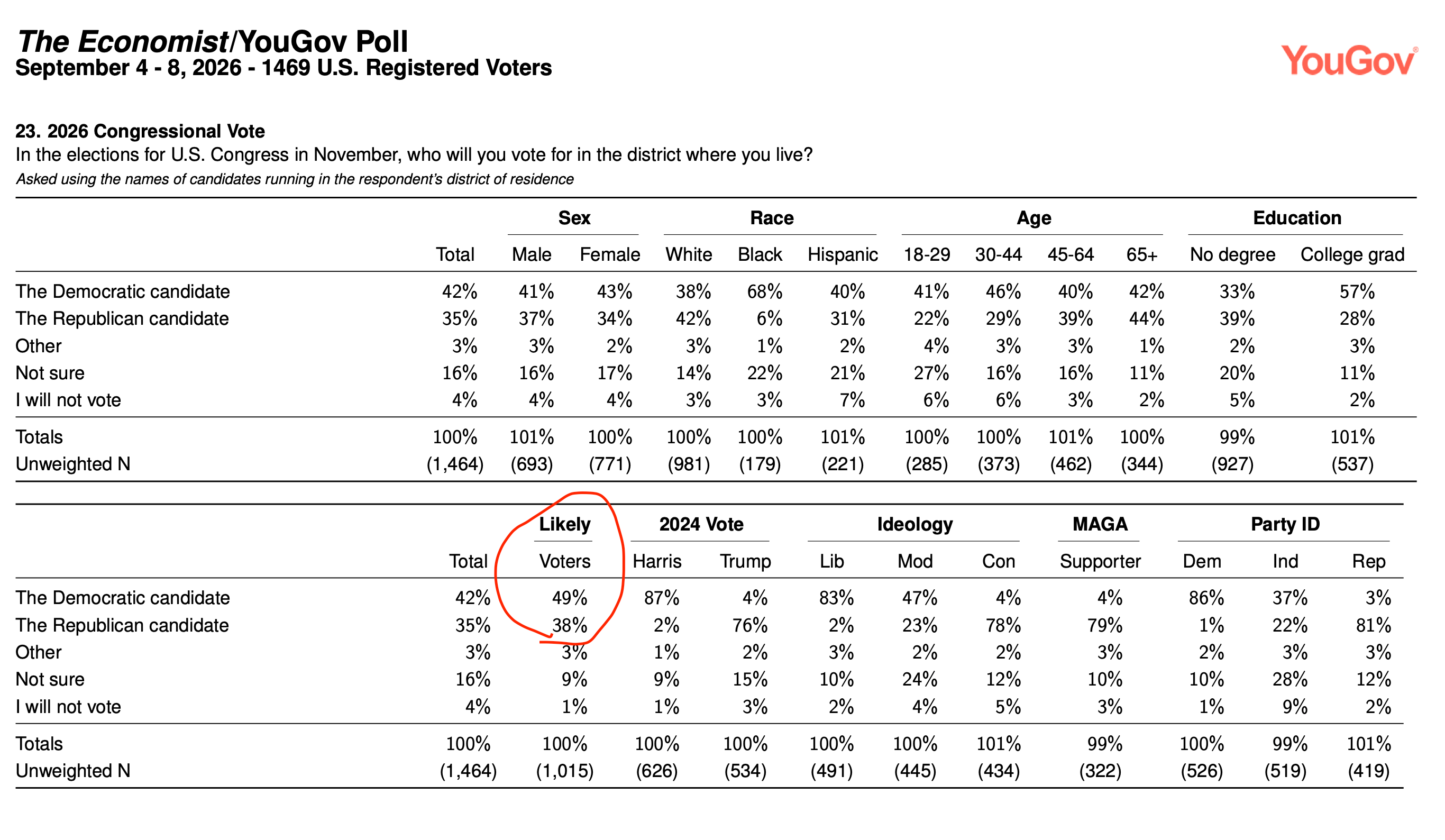
Both samples are among “likely voters,” who YouGov identifies as people who say they “definitely will vote” in November. So who’s right? Are Democrats up 8 or 11? Is this just normal sampling noise across polls?
Well, the difference between these polls certainly could be due to noise. But it may be driven by differences in how YouGov asks about vote intention for House elections. See, for CBS, YouGov asked who voters would pick in the “generic congressional ballot” — a poll question that asks who voters would vote for “in the district where you live?”
But for The Economist, YouGov this week asked who voters would pick “using the names of candidates running in the respondent’s district of residence.” In the CBS poll, people don’t see the names of people running in their districts — in the Economist poll, they do. The latter approach, while rare in media polling, is common in academia; this is how the Cooperative Election Study run out of Harvard (and fielded by YouGov) has asked the question for decades. And it correlates very well with district-level election outcomes in 2022 and 2024.
In both of those years, Democratic House candidates outran their party’s presidential nominees across the board, but especially in competitive seats. I know this because when I ran my analysis of the GOP’s 2026 gerrymanders, I trained a model to forecast races in 2024 using the historical presidential results in each seat. Without adjusting for the pattern of House candidates beating the baseline across the map, this model would have badly underestimated Democratic seats.
This year, we may be looking at the same thing. Democrats have done a great job around the country recruiting candidates who are good fits for the districts they are running in, especially in competitive seats. The YouGov polls suggest this may earn them a couple points on vote margin — reasonable per the historical boosts candidates get when they run against suboptimal opponents.
In the Senate, candidates like James Talarico and Sherrod Brown also fit this pattern of good recruitment. And especially in Texas, where Talarico is running against one of the most flawed Republicans of all time — and is currently favored to win that election.
If Democrats do win the House and Senate this year, it might be because they again have a sizable recruitment advantage over the Republicans.
2. What Strength In Numbers published last week
Last Sunday I wrote four short essays about how this newsletter works and how I actually make a living as an independent journalist and pollster. Includes some thoughts on largely quitting algorithms and social media, which continues to be one of the best decisions I ever made.

Then on Wednesday I wrote about why you should think of all polls as models now. The old probability-vs-opt-in distinction is largely meaningless for accuracy. Response rates have collapsed so far that every pollster is modeling now, whether they admit it or not. What a pollster does to their data matters more than how they got it:

And on Wednesday night, in my coverage of the Republican Party’s midterm “convention,” I discussed why the strategic logic behind “Trumpapalooza” is so misguided.

David Nir and I discussed a little more about that in our podcast on Thursday, and also talked through a guide on how to know when polls are worth paying attention to. See above: Not all polls are created equal.

And Friday’s free Chart of the Week explains that low-turnout voters aren’t MAGA diehards. They’re anti-status-quo, and went for Trump in 2024 because of prices — which leaves many of them opposed to Trump today.

If you’re a frequent reader of Strength In Numbers, I’m confident you will get a lot of value out of a paid subscription to the site. You’ll get the Tuesday Deep Dive every week, access to a private community for paying members, and first access to our monthly Strength In Numbers/Verasight poll. More than that though, you’ll be supporting original, data-driven journalism about American politics.
3. Even more numbers!
The latest Quinnipiac University poll has Democrats up 49-38 for control of the House. That’s an 11-point lead, which nudged our FiftyPlusOne average up to about D+7 late last week. What’s interesting is that Democrats are losing ground over time mostly to the “don’t know” bucket; Since QPac’s July poll, Democrats picked up a point, Republicans shed three, and “no opinion” climbed to 13%. Voters Favor Dems Over GOP By 11 Points For Control Of U.S. House
It’s really not hard to understand why Democrats are doing so well. In QPac’s poll, Trump is at a 32%-65% approval rating on the economy, 29-65 on Iran, 28-62 on Canada trade, and 28-61 on Ukraine, with voters against him 33% to 59% overall. He’s even underwater on immigration by 18 points. Quinnipiac crosstabs, September 10
I have really been enjoying Scott Clement’s new newsletter on polls at WaPo. This week he has a lot of great tips about how to read polls. Seven simple tips to understand midterm election polls
Cook and TelevisaUnivision find that the GOP’s 2024 gains with Texas Hispanic voters have evaporated. Their new poll has Talarico up 63-30 in the Senate race with Latinos, 60-33 for governor, and Trump’s approval with Hispanics down to 33%. Exclusive new poll of Hispanic Texas voters shows collapse of GOP’s 2024 gains
More Senate polls! CNN/SSRS has Maine at 48-45 and Michigan at 47-44 (conducted August 31 to September 6), in states where roughly two-thirds of voters disapprove of Trump. CNN polls: Maine and Michigan Senate races
Data for Progress has Trump 16 points underwater on his handling of corruption, but doesn’t trust either party to fix the issue, rating Democrats at -6, and Republicans at -12. Voters Don’t Trust Trump — or Either Party — to Address Corruption
New reporting by NPR finds Trump administration officials want to pull race questions out of the census and leave millions of people out of the 2030 count. Trump officials propose census changes. Quoting here: “The administration’s proposal, which was released online Wednesday, calls for an unprecedented exclusion of non-U.S. citizens without a green card from a key set of 2030 census results that the 14th Amendment says must include the “whole number of persons in each state.”“
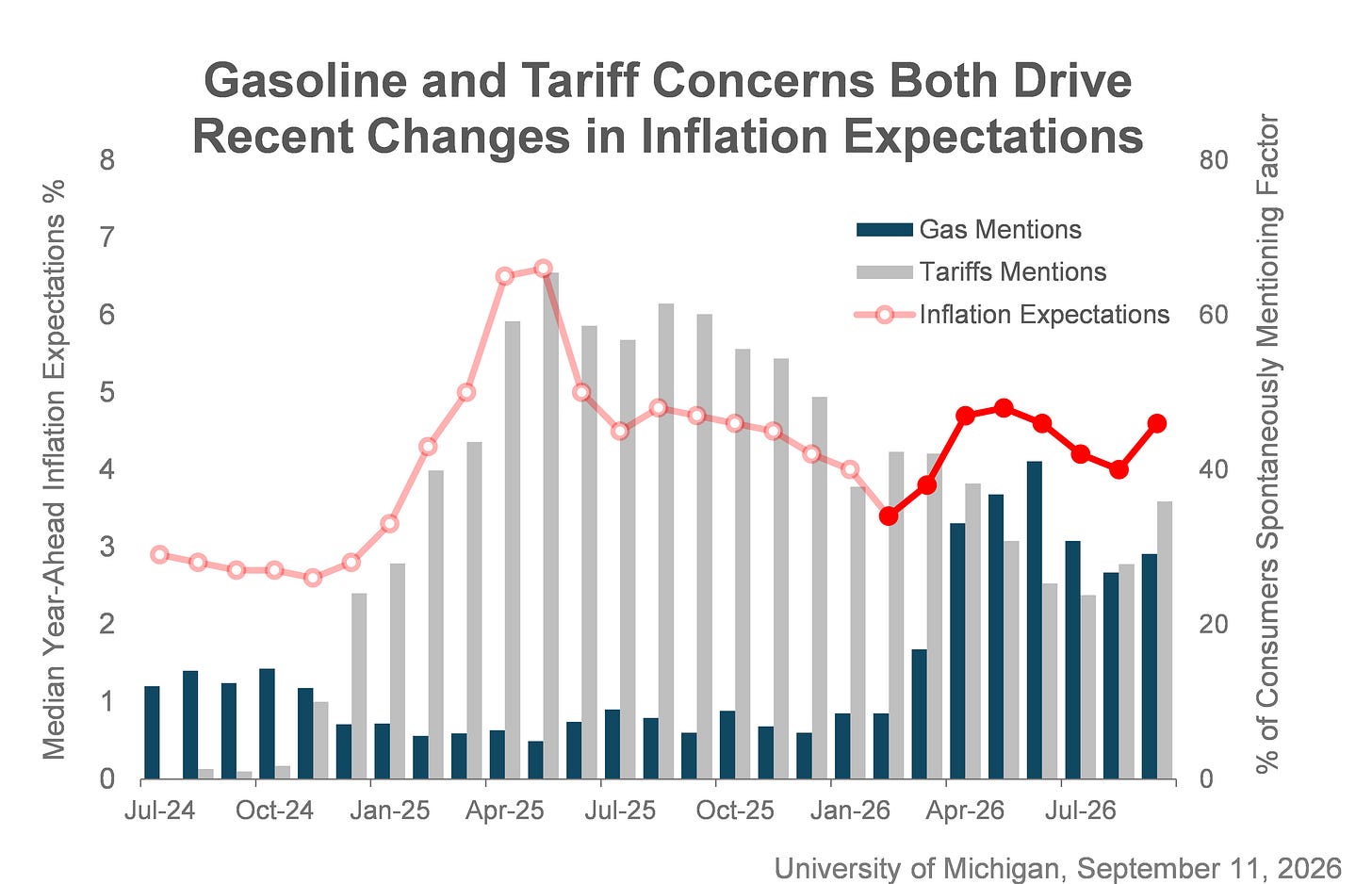
Consumer sentiment is down a second straight month at Michigan, to 47.8 from 51.7, with Joanne Hsu pointing at fuel prices and trade. New Surveys of Consumers
And this new paper shows primary voters are badly unlike the electorates they’re picking candidates for. Good discussion of how to “make primaries more democratic.” A good read even if don’t agree that that should be the long term goal for primaries. The Problem With Primary Voters
And that’s it for this week! Thanks for reading. Strength In Numbers will be back in your inbox on Tuesday.
Got more for next week? Email your links or add to the comments below!